

CCSD code G5100: Bypass of duodenum billing guide
CCSD code G5100 bills a bypass that leaves the duodenum in place CCSD code G5100...

Last Updated: Oct 16, 2026
32551 is the CPT code for tube thoracostomy, includes connection to drainage system (eg, water seal), when performed, open (separate procedure). It reports an open chest tube insertion through an incision into the pleural space, with a 0-day global period.
The code has no image-guided counterpart. Thoracentesis is reported with 32554 or 32555, and percutaneous catheter drainage with 32556 or 32557. A tunneled pleural catheter is 32550, and the choice between them turns on technique and the device left in place.
Let Pabau's smart automation suggest the right codes, reduce claim denials, and keep your practice compliant—effortlessly.
Automate repetitive tasks and focus on what matters most—your patients.
Reduce coding errors and ensure compliance with the latest regulations.
Clean claims, fewer denials, and faster reimbursements.
Powerful insights and reporting to help your practice thrive.
HIPAA compliant SOC 2 certified GDPR-compliant Trusted by 4,000+ clinics worldwide

CPT code 32551 reports an open tube thoracostomy, including connection to a drainage system such as a water seal when performed.
32551 has no image-guided twin. Thoracentesis is 32554 or 32555, and percutaneous catheter drainage is 32556 or 32557.
A tunneled indwelling pleural catheter with cuff is a different device, reported with 32550.
Most 32551 denials trace to the wrong code family, a nonspecific ICD-10 code, same-side bundling, or a note that never states open technique.
In Pabau, the practice software we build, required note fields hold the technique and laterality, and the codes your staff enter carry onto the claim.
The American Medical Association defines CPT code 32551 as: Tube thoracostomy, includes connection to drainage system (eg, water seal), when performed, open (separate procedure). It sits with the introduction and removal procedures on the lungs and pleura (32550-32557). The code covers opening the chest wall, placing a drainage tube in the pleural space, and securing it. Connection to a drainage system is included when performed.
32551 replaced the retired code 32020, whose wording listed water seal and examples such as empyema and hemothorax. That older wording still circulates in chargemasters and coding references. Replace it with the current descriptor wherever it appears in your systems.
Key facts about the code at a glance:
In an open tube thoracostomy, the physician makes a small incision between the ribs and uses blunt dissection to enter the pleural cavity. A chest tube is then advanced along the inner chest wall to the target position. The tube is then connected to a drainage collection system and secured to the skin with sutures and occlusive dressing.
The clinical steps that the billing code encompasses, in sequence:
All steps through tube securing are included in the 32551 global service. The post-placement chest X-ray is a distinct diagnostic service, so it is billed separately, often as 71045 for a single view.
The current 32551 descriptor names no diagnoses. Any condition that needs sustained pleural drainage through an open chest tube can support it, provided the documentation shows medical necessity.
Accepted clinical indications:
Medical necessity documentation must match the chosen ICD-10 code. Submitting 32551 against an unspecified pleural code when a more specific code is available is a common audit flag.
CPT 32551 has no image-guided counterpart. Look-alike codes describe different procedures: thoracentesis (32554, 32555), a tunneled pleural catheter (32550), and percutaneous drainage (32556, 32557).
An incision with blunt dissection into the pleural space is 32551. A needle or catheter removed at the end of the session is thoracentesis: 32554 without imaging, 32555 with it.
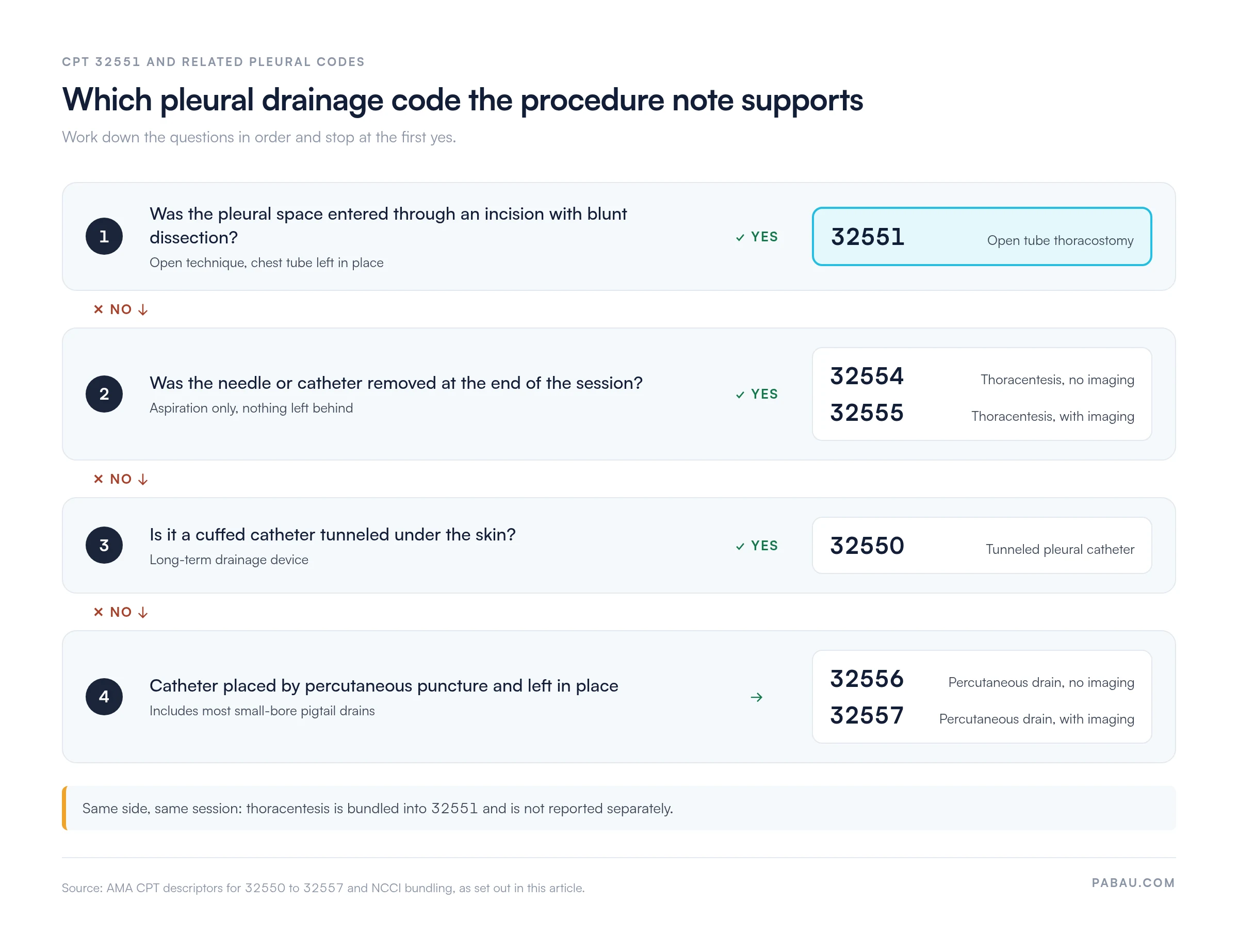
Small-bore pigtail drains cause the most mix-ups. Orders call them chest tubes, but they are percutaneous catheter drainage, not open tube thoracostomy.
When a thoracentesis and a chest tube are done on the same side in one session, NCCI bundles the aspiration into 32551. A distinct-service modifier fits only for separate procedures, such as opposite sides, each documented.
The same bundling runs the other way during a lung resection. A chest tube placed in that operative session is included in the global surgical package for 32663, the VATS lobectomy code. That package runs 90 days, so routine post-op care is not billed again, unlike the 0-day period on 32551.
The global service bundled into CPT code 32551 covers each step needed to place the tube and start drainage. Billing any of these components separately is a bundling violation under NCCI policy.
Bundled (not separately billable):
Separately billable when independently documented:
Document the tube size (French gauge), the open technique, and the drainage system in the procedure note. Those three details separate an open tube thoracostomy from percutaneous catheter drainage when a payer requests records.
The National Correct Coding Initiative (NCCI) tables govern which codes cannot be billed together with CPT code 32551. Reporting a column-one/column-two pair without an appropriate modifier results in automatic denial. Build these pairs into the pre-submission check so the edit is caught before the claim leaves.
Key NCCI bundling relationships for 32551:
Modifier selection for CPT code 32551 follows standard surgical modifier rules. A common mistake is using -50 (bilateral) when the second tube was placed during a separate visit. Another is omitting laterality modifiers that a payer contract requires.
Payers run automated crosswalks between 32551 and the ICD-10-CM codes that support it. A mismatch triggers a medical-necessity denial before a human reviewer sees the claim. Superbill documentation should capture the specific diagnosis code at the time of service, not a catch-all unspecified code.
Medicare reimburses CPT code 32551 through the CMS Physician Fee Schedule. Payment rates vary by calendar year and by geographic practice cost index. The values below are the 2026 national unadjusted rates, calculated at the CY2026 conversion factor of $33.4009.
For 32551, the facility and non-facility practice expense RVUs are both 0.77. Medicare therefore pays the same national rate whether the tube goes in at a hospital, an emergency department, or an office. Your local payment still shifts with the geographic practice cost index for your area.
Most payers do not require prior authorization for emergent chest tube placement. The procedure treats an acute, life-threatening condition, where waiting for approval would be clinically inappropriate. Medicare and most commercial plans treat emergent pleural drainage as a covered benefit without advance approval. For elective thoracic procedures, check eligibility and authorization rules before the case is scheduled.
Where authorization requirements do apply:
The safest practice is to document the clinical urgency clearly in the procedure note. Phrasing such as “emergent tube thoracostomy performed without delay for patient safety given impending respiratory compromise” gives you a documented basis. It supports a retrospective authorization request if a payer questions the missing pre-authorization. Ensuring medical billing compliance standards are met in the procedure note reduces retrospective denial risk significantly.
The denial patterns below recur on 32551 claims. Each has a fix that addresses the cause before the claim is sent. A systematic denial management workflow catches most of these before submission.
Ensuring clean claim submission for 32551 requires pre-scrubbing for these six patterns before the claim reaches the clearinghouse.
A complete procedure note for tube thoracostomy must include all of the following elements to withstand payer audit. Missing any one of them gives a payer grounds for a documentation denial or a records request. Either one delays payment, even when the procedure was appropriate.
Many billing teams rebuild a chest tube claim from a free-text note, then chase the physician when technique or laterality is missing. Each round trip delays payment and raises the risk of a wrong-family code.
Pabau’s practice software lets you build a chest tube procedure note template with required fields for laterality, technique, tube size, and drainage system. Once your staff enter the diagnosis and procedure codes, its claims management software carries them onto the claim for submission and tracking through Claim.MD.
For US practices, Claim.MD is the clearinghouse that routes claims to thousands of payers and returns electronic remittance advice. Your team submits and tracks 32551 claims without logging in to each payer portal.

Pabau’s procedure note templates and claims management keep the technique, laterality and diagnosis on every chest tube claim. Claims go out through Claim.MD, with status and remittance tracked in one place.

Code 32551 only when the note shows an open tube thoracostomy. A drain placed through a needle puncture belongs with the thoracentesis or percutaneous drainage codes, whatever the order called it.
Settle that decision in the procedure note template, and the technique and bundling denials stop before a claim is built. The ICD-10 code then needs to match the confirmed diagnosis, not the working one.
Book a demo to see how Pabau keeps procedure notes and claims aligned for pleural procedures.

Need to understand the clearinghouse that processes your 32551 claims? Medical claims clearinghouse guide explains how claims are routed, validated, and returned to billers.
Want to reduce revenue lost to billing errors across all procedure codes? Revenue cycle management guide covers the end-to-end workflow from patient encounter to collected payment.
Looking for the Claim.MD pricing breakdown before committing? Claim.MD pricing guide details per-claim fees, monthly plans, and how costs compare at different claim volumes.
CPT code 32551 is the procedure code for open tube thoracostomy, the surgical placement of a chest tube into the pleural space through an incision. It includes connection to a drainage system such as a water seal when performed. Common indications are empyema, hemothorax, hydrothorax, and pneumothorax.
CPT code 32551 bundles local anesthesia, blunt dissection, tube insertion, drainage-system connection, tube securing, and initial drainage management. Separately billable services include the post-procedure chest radiograph, chest tube management on later days, and pleural fluid laboratory analysis. A same-day evaluation and management service for a distinct problem is also billable with modifier -25.
Yes. CPT 32551 and CPT 31622 (diagnostic bronchoscopy) can be billed together when both are performed in the same session for distinct indications and fully documented. Check the current NCCI tables for an edit pair before submitting. Payers may still request records confirming that the two procedures served separate purposes.
Common ICD-10-CM pairings for CPT 32551 are J86.9 (pyothorax without fistula) and J86.0 (pyothorax with fistula) for empyema, and J94.2 for hemothorax. Pneumothorax codes include J93.0, J93.11, and J93.12, and J91.8 covers pleural effusion in other conditions. Using an unspecified pleural code when the documentation supports a more specific one is a frequent audit flag.



