ICD-10 code Y83.0: Surgical operation with whole organ transplant
ICD-10 code Y83.0 names the transplant as the cause, not the problem ICD-10 code...

Last Updated: Nov 19, 2026
ICD-10 Code J90 is the billable ICD-10-CM code for pleural effusion, not elsewhere classified. It covers fluid in the pleural space that the physician has diagnosed without tying it to a cause that has its own code. CMS’s FY2026 MS-DRG Definitions Manual lists J90 under that title as a principal diagnosis for the pleural effusion DRGs.
When the effusion is a manifestation of another coded condition, J91.8 applies instead. A confirmed malignant effusion takes J91.0 or C78.2, and tuberculous or chylous fluid has its own code too. J90 is what remains once those are ruled out.

J90 covers pleural effusion not elsewhere classified, meaning pleural fluid with no more specific ICD-10-CM code available.
Use J91.8 when the effusion is a manifestation of a separately coded condition, such as heart failure (I50) or liver cirrhosis (K74.6).
A confirmed malignant effusion is coded J91.0 or C78.2, never J90, because J90’s Excludes1 note bars malignant pleural effusion.
As a principal inpatient diagnosis, J90 groups to MS-DRG 186, 187 or 188, depending on the CC and MCC codes on the claim.
Pabau’s claims management software sends J90 claims through the Claim.MD clearinghouse, with eligibility checks before submission.
ICD-10 Code J90 describes pleural effusion, not elsewhere classified. That is excess fluid in the pleural cavity that the physician documents without attributing it to a condition with its own pleural effusion code.
The code sits in ICD-10-CM Chapter 10 (Diseases of the respiratory system, J00-J99), within the J90-J94 subsection “Other diseases of pleura.” It has been valid since the US moved to ICD-10-CM and is unchanged in the current fiscal year update.
The “not elsewhere classified” (NEC) designation is the operative phrase. It signals that ICD-10-CM offers no more precise code for this presentation, which is a different statement from “the cause is unknown.” When a more specific code exists, such as for malignant, chylous or tuberculous effusion, that code is used in place of J90.
The ICD-10-CM tabular list attaches two types of instructional notes to J90, inclusion terms and an Excludes1 note. Reading both before assigning the code prevents the most costly audit errors.
The Excludes1 list holds hard exclusions. Reporting J90 and J91.0 (malignant pleural effusion) on the same claim violates the tabular instruction, and payer claim edits flag the pair. J90 carries no Excludes2 note, so the tabular list names no condition to report alongside it. Confirm the physician documentation before assigning J90.
J90 applies when the pleural effusion is the primary or unspecified finding. J91 applies when the effusion is a manifestation of another condition that is separately coded on the same claim.
The decision point is whether the physician has documented a causal condition. Heart failure (I50) causing pleural fluid moves the code to J91.8 (pleural effusion in other conditions classified elsewhere).
Malignant disease of the pleura moves it to J91.0. J90 stays correct when no causal condition is documented, or when the effusion is explicitly noted as idiopathic or unspecified.
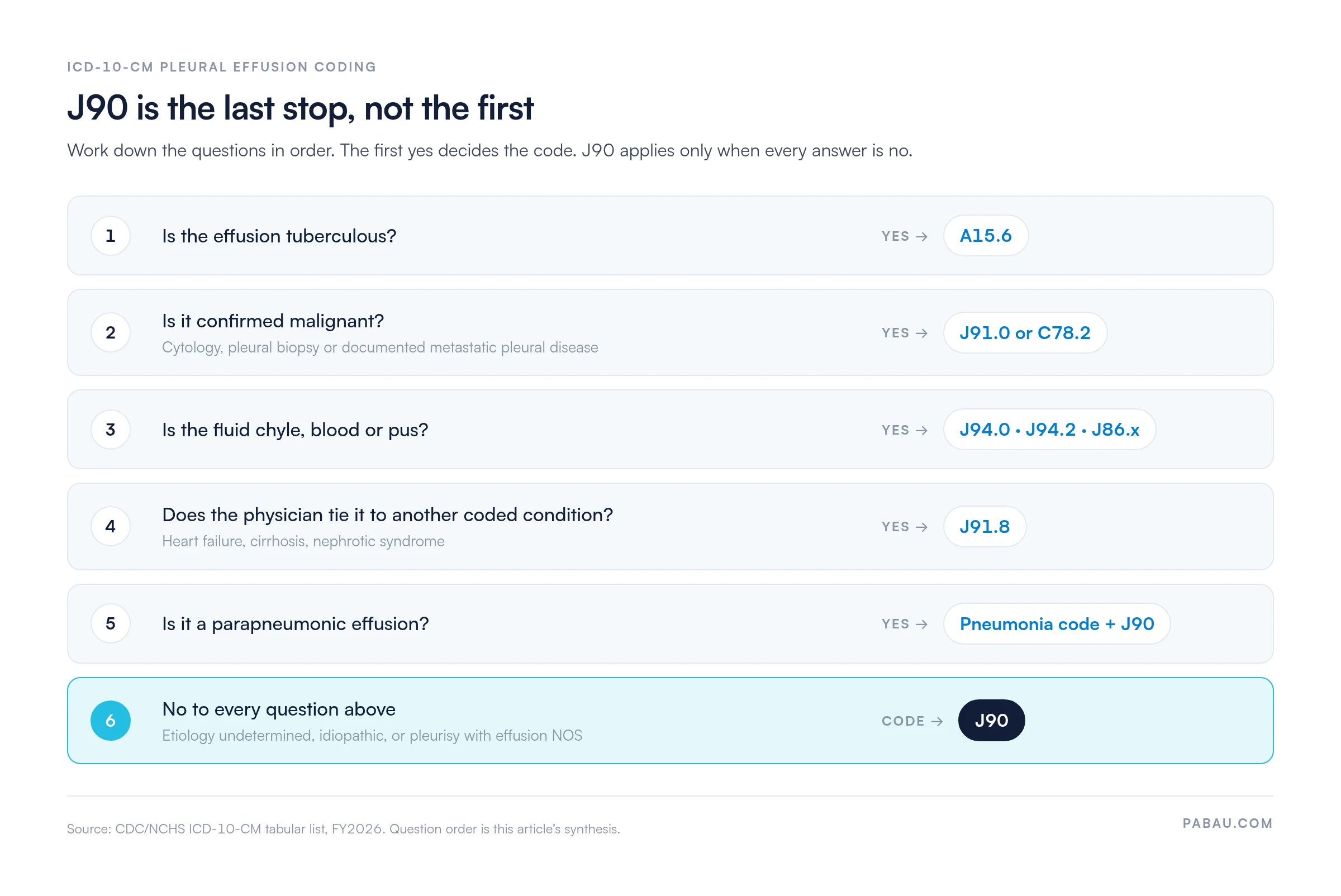
A practical test: If removing the underlying condition code from the claim would leave the pleural effusion clinically unexplained, J90 is likely correct. If the effusion is a known direct consequence of the other condition, J91 applies. The ladder below puts every alternative in the order a coder should rule it out.
No. ICD-10-CM J90 does not differentiate between transudative and exudative pleural effusion. Both types map to J90 when no causal condition is separately coded.
Light’s criteria are the standard clinical test for classifying pleural fluid. They shape documentation quality and the physician’s workup, but they do not decide between J90 and J91 on their own. What matters for coding is whether the physician has named a causal condition. A transudative effusion caused by documented heart failure still goes to J91.8, and an exudative effusion with no documented cause still goes to J90.
No. J90 carries no laterality axis in ICD-10-CM. Unilateral and bilateral pleural effusion both map to J90, and the same code applies whichever side is affected.
Official ICD-10-CM guidelines do not require reporting J90 twice for bilateral effusion, because a single J90 on the claim captures both sides. The note should still state bilateral effusion explicitly to support medical necessity for bilateral procedures.
For a bilateral thoracentesis, the CPT code is reported once with modifier -50, or on two lines with RT and LT, depending on payer preference. The diagnosis code remains J90 on each line.
The table below sets out the pleural codes coders confuse most often, with the key differentiator for each.
Codes outside this subsection, such as C78.2 and A15.6, are indexed in our diagnostic codes library.
A malignant pleural effusion is never coded J90. When cytology, pleural biopsy, or documented metastatic disease of the pleura confirms malignancy, C78.2 (secondary malignant neoplasm of pleura) is the correct code.
The Excludes1 note at J90 makes this a hard rule, so J90 and malignant pleural effusion cannot appear on the same claim. Report the primary malignancy code first, then C78.2 for the secondary pleural involvement.
J91.0 (malignant pleural effusion) is a valid alternative when the physician documents it that way without specifying the pleural neoplasm. Never assign J90 when the documentation confirms malignancy.
Parapneumonic effusion is fluid that develops in the context of pneumonia, and it needs two codes under ICD-10-CM guidelines. The pneumonia code is sequenced as the principal diagnosis. J90 is added as a secondary code to capture the effusion.
Thoracentesis is the most common procedure performed alongside a J90 diagnosis. Two CPT codes cover the service, and the distinction between them matters for reimbursement and NCCI compliance.
J90 serves as the supporting diagnosis on claims for both 32554 and 32555. Payers expect to see it paired with the CPT code as evidence of medical necessity. Check the current NCCI manual for modifier requirements and bundling edits, because they update quarterly.
Under Medicare’s inpatient prospective payment system, J90 affects MS-DRG grouping differently as a principal or a secondary diagnosis.
As a principal diagnosis, J90 groups to MS-DRG 186 (pleural effusion with MCC), 187 (pleural effusion with CC), or 188 (pleural effusion without CC/MCC). The split depends on the complication or comorbidity codes on the claim.
As a secondary diagnosis, J90 carries CC status under most MS-DRG versions, which can move the case into a higher-weighted DRG. Confirm the mapping in the FY2026 Definitions Manual, as weights and grouper logic update annually.
Run your J90 claims through the current CMS MS-DRG grouper before billing inpatient encounters. A secondary J90 acting as a CC can shift the DRG weight materially. Leaving it off underpays the stay, and adding it without documentation support creates audit exposure.
Medicare and most commercial payers require specific clinical evidence in the record before accepting J90 on a claim. Local Coverage Determinations (LCDs) from Medicare Administrative Contractors (MACs) set the standard, and requirements vary by region. Always check your MAC’s current LCD rather than treating the list below as universal.
Payers generally expect four elements in the record:
Documentation is what separates a paid J90 claim from an audited one. The medical record must contain each of the following for the code to withstand payer scrutiny.
A clean claim starts with a note the coder can read the diagnosis from directly. For the full path from coding to payment, see our medical billing guide.
J90 claims deny for a small set of predictable reasons. The table below identifies the top denial triggers and the specific documentation fix for each.
Tracking J90 denials by payer and reason code catches recurring errors before they compound. Our guide to denial management in healthcare sets out how to run that log.
Most of the denials above start between the note and the claim form. The physician documents heart failure, but the coder works from a summary and picks J90 by default. Or the effusion appears on the imaging report and never in the physician’s own statement. The imaging claim follows the same rule, so a four-view chest X-ray billed as code 71048 needs the diagnosis the physician documented.
Pabau, the practice management platform we build, keeps the clinical note and the claim in one patient record. The coder reads the diagnosis straight from the physician’s documentation, so a documented cause steers the claim to J91.8 and away from J90.
Pabau’s claims management software then sends the claim through the Claim.MD clearinghouse, with an eligibility check before submission.
Claim status updates and electronic remittances come back against the same record. Your billing team sees a rejected thoracentesis claim the day it returns and can fix the documentation while the encounter is still fresh.

Pabau links ICD-10 diagnosis codes to the clinical note and sends claims through the Claim.MD clearinghouse. Run eligibility checks, submit claims and track denials from one patient record.

J90 is the code left standing once every specific cause is ruled out. Before assigning it, check for tuberculous, malignant, chylous and secondary effusions, in that order. If the physician has named a cause, the claim belongs to a different code.
The fix sits upstream of the coder. A physician statement that names the effusion and says whether a cause is known settles the code, the DRG and the medical necessity case together. Book a demo to see how Pabau keeps that statement and the J90 claim in one record.

Submitting claims through a clearinghouse for the first time? Medical claims clearinghouse guide explains how clearinghouses validate and route HIPAA-compliant claims before they reach payers.
Want to understand how the 837P maps to a completed claim? 837 EDI file overview breaks down the transaction set structure used to submit professional claims electronically.
ICD-10 Code J90 is the billable diagnosis code for pleural effusion, not elsewhere classified. It means excess fluid in the pleural space that cannot be assigned to a more specific ICD-10-CM code. It covers unspecified, idiopathic and serous effusions, plus encysted pleurisy and pleurisy with effusion NOS, when no causal condition is coded separately on the claim.
J90 covers pleural effusion when the effusion is the primary or unspecified finding. J91 covers pleural effusion that is a manifestation of another condition already coded on the claim. For example, heart failure (I50) leads to J91.8, and malignant disease leads to J91.0. If a causal condition is documented, J91 applies. If no cause is coded, J90 is correct.
Yes. J90 carries no laterality distinction in ICD-10-CM. Both unilateral and bilateral pleural effusion map to J90, and official guidelines do not require reporting the code twice. A single J90 on the claim covers both sides. The documentation should still note bilateral effusion to support medical necessity for bilateral procedures.
Use C78.2 (secondary malignant neoplasm of pleura) once the physician confirms the effusion is malignant. Confirmation comes from cytology, pleural biopsy, or documented metastatic pleural involvement. J90 has an Excludes1 note for malignant pleural effusion, so the two codes cannot appear on the same claim. Report the primary malignancy code first, then C78.2 as the secondary code for pleural involvement.
CPT 32554 covers thoracentesis without imaging guidance. CPT 32555 covers thoracentesis with imaging guidance, with the imaging component bundled. J90 serves as the supporting diagnosis on both. Do not separately bill imaging guidance codes (76942, 77002) alongside CPT 32555, because bundling violations are a leading denial reason on thoracentesis claims. Always check the current NCCI manual for updated edits.
Yes. J90 can be sequenced as the principal diagnosis on inpatient and outpatient claims when pleural effusion is the main condition treated or evaluated. As a principal inpatient diagnosis, J90 groups to MS-DRG 186, 187 or 188, depending on complications or comorbidities. As a secondary diagnosis, it carries CC status and can affect DRG weighting.