

HCPCS code J2690: Procainamide units and billing guide
What HCPCS code J2690 covers, and what it does not HCPCS code J2690 reports R...

Last Updated: Oct 30, 2026
32557 is the CPT code for pleural drainage, percutaneous, with insertion of indwelling catheter; with imaging guidance. It covers a small-bore catheter placed through the chest wall and left in the pleural space, with ultrasound or fluoroscopy guiding placement.
Because 32557 describes catheter drainage, it never substitutes for the thoracentesis (aspiration) codes 32554 and 32555. Imaging guidance is part of its descriptor, and confusing the two code families is a common cause of denials.
Let Pabau's smart automation suggest the right codes, reduce claim denials, and keep your practice compliant—effortlessly.
Automate repetitive tasks and focus on what matters most—your patients.
Reduce coding errors and ensure compliance with the latest regulations.
Clean claims, fewer denials, and faster reimbursements.
Powerful insights and reporting to help your practice thrive.
HIPAA compliant SOC 2 certified GDPR-compliant Trusted by 4,000+ clinics worldwide

CPT code 32557 is a drainage code, so it requires an indwelling catheter, and imaging guidance is always part of its descriptor.
Codes 32554 and 32555 are thoracentesis (aspiration) codes, while 32556 and 32557 are drainage codes, so choose by procedure type before imaging.
ICD-10 codes J90, J91.0 and J86.9 are the most common diagnoses paired with 32557 to establish medical necessity.
Imaging guidance codes 76942 and 77002 are not billed with 32557, because the guidance is already included in the code.
A procedure note that confirms real-time imaging and a catheter left in place is the best defense against a downcode to 32556.
CPT code 32557 is the American Medical Association’s designated code for “Pleural drainage, percutaneous, with insertion of indwelling catheter; with imaging guidance.” That puts it in the drainage category of thoracic procedures. A catheter is inserted, fluid drains over time, and real-time ultrasound or fluoroscopy guides the needle and catheter into place.
The clinical context is straightforward. A patient presents with a pleural effusion or empyema that is too large, too loculated, or too complex for a single-pass thoracentesis. The physician places a small-bore drainage catheter under image guidance. The catheter may stay in place for hours to days, depending on fluid volume and clinical response.
Three elements define whether 32557 is the right code. First, the intervention must be percutaneous. Second, it must involve insertion of an indwelling catheter (not just a needle pass for aspiration). Third, imaging guidance must be used and documented. All three must be present. Missing any one of them points to a different code in the 325xx family.
The 325xx series divides along two axes: Procedure type (aspiration vs drainage) and imaging guidance (with vs without). Choosing on the wrong axis is a common source of thoracic coding errors.
The most important distinction is between aspiration and drainage. With 32554 and 32555, the physician removes fluid with a needle and the needle comes out. With 32556 and 32557, an indwelling catheter stays in the pleural space. If the operative note says “catheter placed and left to bulb suction” or similar, only 32556 or 32557 applies. The imaging qualifier then decides between them, as the grid below shows.
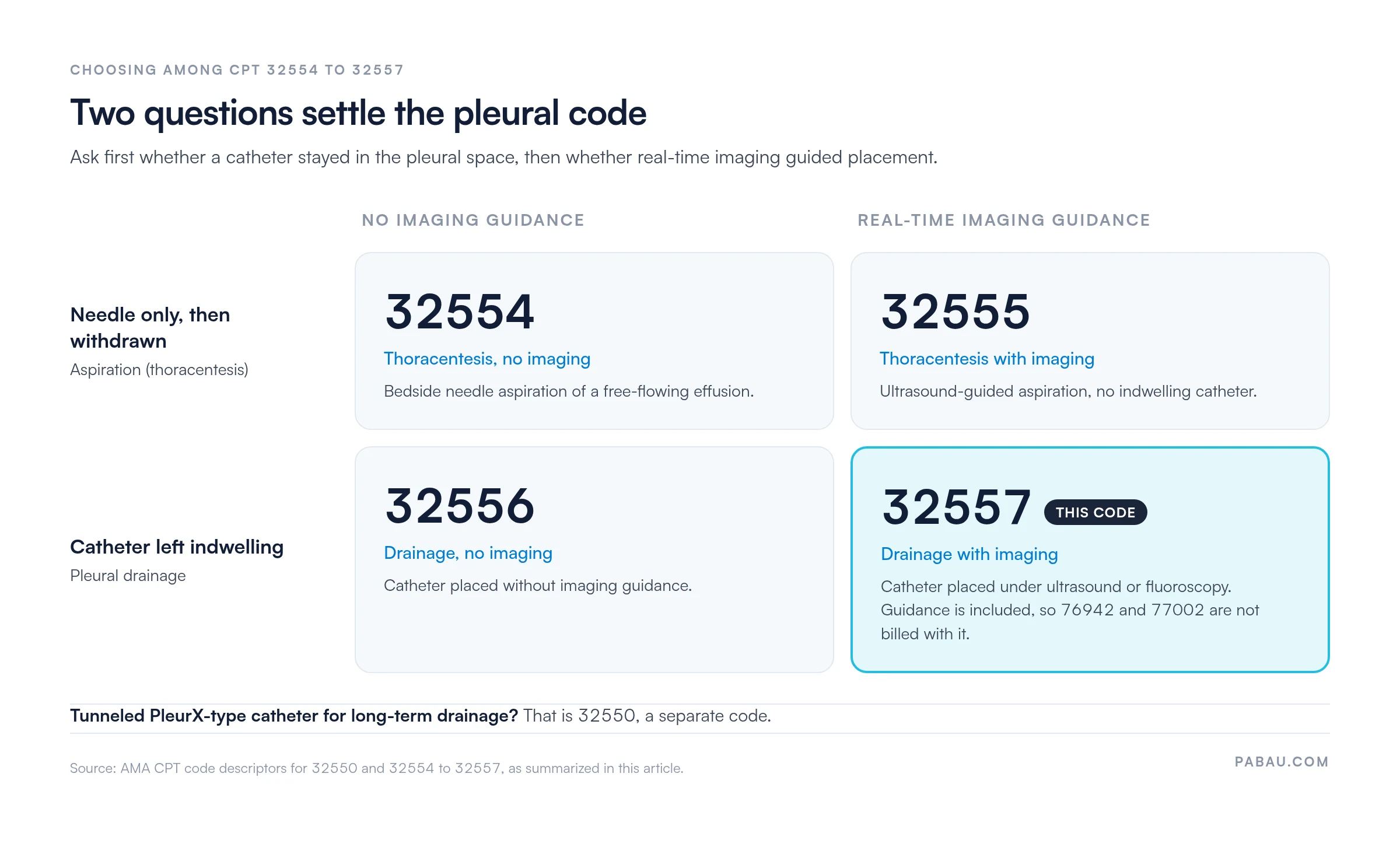
CPT code 32550 covers insertion of a tunneled indwelling pleural catheter (PleurX-type) for long-term outpatient drainage. It is a separate code. Don’t confuse it with 32557, which describes acute percutaneous drainage with imaging guidance.
Imaging guidance is included in the descriptor of CPT code 32557, so it is never a separately reportable service. Adding an imaging guidance line to the claim bills the same guidance twice.
CPT 76942 covers ultrasonic guidance for needle placement, including radiological supervision and interpretation. National Correct Coding Initiative (NCCI) edits apply when it is paired with 32557. The NCCI Policy Manual for Medicare Services is updated quarterly, so check the current edit table when a claim is rejected.
The documentation must state the imaging modality, confirm that guidance was real-time during the procedure, and note a permanent record of the image. Without it, the note no longer supports the imaging element of 32557.
Pairing CPT code 32557 with the correct ICD-10-CM diagnosis code is essential for establishing medical necessity. Payers use diagnosis-procedure pairings to decide whether the intervention was clinically appropriate for the documented condition.
A diagnosis of J90 alone can support CPT code 32557 when the effusion volume, symptoms, or imaging findings meet payer criteria for catheter drainage. For malignant effusions (J91.0), document the primary malignancy as a secondary diagnosis. For empyema (J86.9), a note describing infected or purulent fluid makes the medical necessity case almost by itself.
Always verify ICD-10 medical necessity pairings against the applicable Medicare Administrative Contractor (MAC) Local Coverage Determination (LCD) for thoracic drainage procedures. LCDs specify which diagnosis codes meet coverage criteria for your jurisdiction and are updated separately from the national NCCI edits.
Modifier use on CPT code 32557 is a consistent audit target, particularly modifier 59. Apply modifiers only when the documentation clearly supports them.
Medicare reimburses CPT code 32557 under the Physician Fee Schedule (PFS), at rates that vary by geographic practice cost index (GPCI) and care setting. Check current rates for your locality and year in the CMS Physician Fee Schedule lookup tool. The figures below are national values and change with each annual update.
The FastRVU lookup tool shows current wRVU values, total RVUs, and Medicare payment estimates adjusted for your locality. The 0-day global period means no post-procedure care is bundled into the 32557 payment. A same-day E/M visit still needs a significant, separately identifiable reason and modifier 25, while later visits bill normally.
The operative or procedure note for CPT code 32557 must contain specific elements to pass payer medical necessity review and audits. A note that only says “chest tube placement,” with no imaging guidance detail, invites a denial.
Thorough documentation also protects against Recovery Audit Contractor (RAC) and MAC pre-payment review. Structured medical billing compliance workflows reduce audit exposure by making sure procedure notes are complete before submission. The superbill created at the point of care is the first document that links diagnosis to procedure. If it omits imaging guidance, the claim can go out as 32556 even when the operative note is complete.
CPT code 32557 has a predictable denial profile. Most denials fall into six categories, and most of them can be prevented with complete documentation.
Submit appeals with the procedure note, the imaging documentation, and a letter of medical necessity that addresses the specific denial reason. For downcoded claims (32557 denied, 32556 paid), attach the imaging record and the note language confirming real-time guidance. Most payers allow 60 to 180 days from the denial date for a first-level appeal.
Structured denial management workflows track denial reasons by code and payer. That makes systemic problems easier to spot, such as one payer routinely downcoding 32557 to 32556. You can then escalate to provider relations instead of appealing claim by claim. Our guide to denial codes in medical billing explains the CARC codes on each remittance. Billing staff can then name the exact rejection reason in the appeal.
Run a monthly query on 32557 claims showing denial rate by payer and denial reason code. If one payer’s denial rate exceeds 10%, request a peer-to-peer clinical review. Radiologists and interventional physicians are typically the most effective advocates for overturning imaging guidance documentation denials.
Many 32557 denials trace back to a procedure note and a claim that were built in different places. The coder reads a dictated note and types the codes into a billing system. A missing imaging attestation only surfaces when the payer downcodes to 32556.
Pabau, the practice management and billing platform we build, keeps the procedure note, the diagnosis and the CPT code on one patient record. Its claims management software builds the claim from that record. Your coder can confirm the catheter and real-time imaging details before the claim reaches the clearinghouse, and remove any stray 76942 line.
Claims go out electronically, and remittances come back against the same record. A downcoded 32557 then shows up next to the note that should have supported it, so the appeal starts from the right documents.

Pabau keeps procedure notes, ICD-10 pairings and CPT codes in one workflow, so your billing team catches 32557 errors before a payer does.

Code 32557 only when the note proves a percutaneous approach, a catheter left indwelling, and real-time imaging guidance. If one of the three is missing, the claim belongs to 32554, 32555 or 32556, and a payer will say so for you.
The quickest fix sits in the procedure note template. Add a real-time imaging attestation and a catheter line, and stop sending 76942 or 77002 with 32557. Those two changes head off the downcodes and bundling denials described above.
The trade-off is a few extra seconds of documentation at the bedside in exchange for fewer appeals later. Want that check built into how your team handles medical billing? Book a demo to see how Pabau turns a complete procedure note into a clean 32557 claim.

Need to understand how clearinghouse claims processing works? Our Claim.MD clearinghouse guide explains how electronic claims flow from submission to ERA remittance.
Want a framework for reducing billing denials across your practice? The clean claim guide covers the elements every CPT claim needs to pass payer edits on first submission.
Looking for guidance on insurance eligibility verification before procedures? Insurance eligibility verification walks through how to confirm coverage and avoid post-procedure billing surprises.
CPT code 32557 is the procedure code for percutaneous pleural drainage with insertion of an indwelling catheter and imaging guidance. It covers catheter drainage of a pleural effusion or empyema under real-time ultrasound or fluoroscopy. That separates it from the aspiration codes (32554/32555) and from drainage without imaging (32556).
CPT 32554 is a thoracentesis (aspiration) code performed without imaging guidance. The physician removes fluid with a needle, and the needle is withdrawn. CPT code 32557 is a drainage code that requires an indwelling catheter placed with real-time imaging guidance. If no catheter is left in place, 32554 or 32555 applies, not 32557.
Yes. Imaging guidance is part of the official AMA descriptor for CPT code 32557, so it is inherent to the code. CPT 76942 (ultrasonic guidance) and 77002 (fluoroscopic guidance) are not separately billable with 32557.
The most common ICD-10 pairings are J90 (pleural effusion, not elsewhere classified), J91.0 (malignant pleural effusion), and J86.9 (pyothorax without fistula / empyema). J91.8 is used when the effusion is a manifestation of another condition classified elsewhere. Always verify the applicable MAC LCD for your jurisdiction to confirm coverage criteria.
Medicare reimbursement for CPT code 32557 varies by geographic locality and is updated annually. The work RVU is approximately 3.04. Use the CMS Physician Fee Schedule lookup tool at cms.gov to find current facility and non-facility payment amounts for your MAC jurisdiction.
The most common reason is imaging guidance not documented as real-time, which leads to a downcode to 32556. Other causes are billing 32554 or 32555 when a catheter was placed, an ICD-10 mismatch against the payer’s LCD, and missing prior authorization. Billing 76942 or 77002 alongside 32557 also triggers denials.


