

CCSD code G5100: Bypass of duodenum billing guide
CCSD code G5100 bills a bypass that leaves the duodenum in place CCSD code G5100...

Last Updated: Oct 16, 2026
32663 is the CPT code for thoracoscopy, surgical; with lobectomy (single lobe). It covers a VATS lobectomy, the anatomic removal of one whole lung lobe through thoracoscopic ports with no rib spreading.
Coders confuse it most often with CPT 32666, a VATS wedge resection that needs far less dissection and pays differently. The operative report settles it. 32663 needs documented anatomic lobe removal with hilar dissection and stapled transection, and 32666 does not. Claims for 32663 usually need prior authorization and are subject to NCCI bundling edits, so documentation and modifier selection must be right at submission.
Let Pabau's smart automation suggest the right codes, reduce claim denials, and keep your practice compliant—effortlessly.
Automate repetitive tasks and focus on what matters most—your patients.
Reduce coding errors and ensure compliance with the latest regulations.
Clean claims, fewer denials, and faster reimbursements.
Powerful insights and reporting to help your practice thrive.
HIPAA compliant SOC 2 certified GDPR-compliant Trusted by 4,000+ clinics worldwide

CPT code 32663 describes a VATS lobectomy, the anatomic removal of one lung lobe through thoracoscopy, not a wedge or partial resection.
A frequent coding error is billing 32663 when the op report supports only a wedge resection (CPT 32666), which creates a downcode risk at audit.
Most commercial payers and Medicare Advantage plans require prior authorization, and emergent cases go through retroactive review.
Pabau’s claims management software lets you submit, track and record payment on 32663 claims from one dashboard, sending US claims electronically via Claim.MD.
CPT code 32663 is the code for a VATS lobectomy, the thoracoscopic removal of one whole lung lobe. The American Medical Association lists it in the Surgery / Respiratory System section of the CPT manual. It sits within the 30000-32999 Respiratory System range (surgical thoracoscopy, 32650-32674).
The official descriptor reads: Thoracoscopy, surgical; with lobectomy (single lobe). The descriptor stem “Thoracoscopy, surgical” confirms a thoracoscopic approach. Open thoracotomy routes to a different code family.
Key facts coders need to lock in before reviewing an operative report:
Knowing the surgical steps lets coders confirm that the operative report documents an anatomic lobectomy. A lesser resection billed as 32663 fails that check.
In a standard VATS lobectomy, the surgeon creates 2-4 small port incisions in the chest wall. A thoracoscope (camera) is inserted to visualize the thoracic cavity without spreading the ribs.
The surgeon then identifies the target lobe and dissects the hilar structures, meaning the pulmonary artery branches, pulmonary vein and lobar bronchus. Each one is divided individually with a surgical stapler or ligating clips, and the intact lobe is excised. Lymph node sampling or dissection typically follows. A chest tube is placed before port closure.
What the op report must document to support 32663:
This code pair is a frequent source of coding errors in VATS thoracic coding. Both codes describe thoracoscopic lung resections, but their scope differs entirely.
If the op report describes a wedge resection without hilar dissection, 32663 cannot be supported even if the surgeon charted “lobectomy” in the dictation header. Coders should read the body of the operative note, not the procedure title field.
CPT 32480 describes open lobectomy, the removal of a single lung lobe via thoracotomy (a full chest-wall incision with rib spreading). The clinical outcome may be identical to 32663, but the approach determines the code.
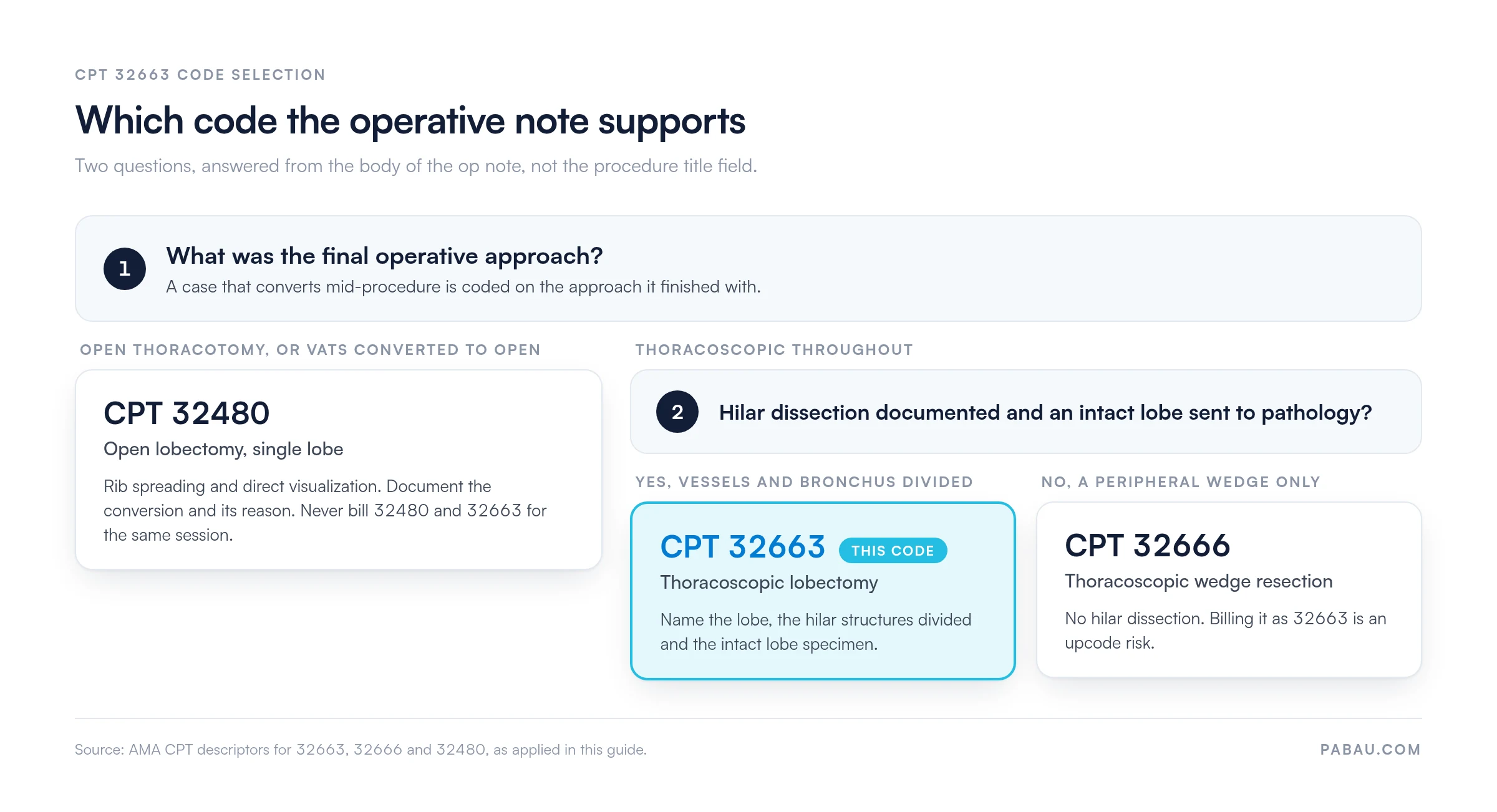
When a VATS case converts to open thoracotomy, the final operative approach governs code selection. Bill 32480, not 32663, and ensure the operative note documents the conversion and the reason (adhesions, bleeding, anatomic difficulty). Never bill both codes for the same session. The diagram below puts both checks in the order a coder should run them.
The global surgical package for 32663 bundles several services that cannot be billed separately under NCCI edits. A chest tube placed during the same session would otherwise carry CPT code 32551, which is not separately reportable alongside 32663.
Included in 32663:
Not included (separately billable when documented as distinct):
Check the current NCCI Procedure-to-Procedure (PTP) edit table before billing any code alongside 32663. NCCI edits are updated quarterly, and the bundling status of adjacent codes can change between updates. Bronchoscopy codes are the ones to watch. CMS publishes the tables at cms.gov at no cost.
Medical necessity for VATS lobectomy rests on the diagnosis supporting the resection. These are the ICD-10-CM codes most frequently submitted with 32663 claims. Pairing the right code is also a prior authorization requirement for most commercial payers.
Always use the most specific ICD-10-CM code available. Generic codes like C34.90 (unspecified part of unspecified bronchus or lung) create unnecessary medical necessity friction. Payers expect lobe-specific and laterality-specific codes when the operative note identifies them.
Modifier selection for 32663 affects both claim acceptance and payment integrity. A wrong or missing modifier is a common denial trigger for this code.
Verify laterality modifier requirements with each payer. Medicare does not require -LT/-RT for 32663 as a condition of payment, but many commercial plans will return a claim without them. Understanding medical billing fundamentals helps coders make consistent modifier decisions across payer types.
Payment for 32663 is driven by its Relative Value Unit (RVU) assignment under the CMS Physician Fee Schedule. Values are updated each calendar year and should always be verified against the CMS Physician Fee Schedule lookup tool for the current year’s conversion factor.
Use FastRVU’s RVU lookup tool to pull current wRVU values and calculate Medicare allowable amounts by geographic locality. Commercial payers typically multiply RVUs by their own contracted conversion factor, which varies significantly from the Medicare rate.
Prior authorization is required for VATS lobectomy by most commercial payers and Medicare Advantage plans. Traditional fee-for-service Medicare does not require prior authorization for 32663, but all other plan types generally do. Verify with each payer individually, because policies change and vary by plan.
Running every 32663 request through the same prior authorization process keeps a scheduled lobectomy from stalling on a missing document. Payers typically require the following documentation:
For emergent cases where prior authorization cannot be obtained before surgery, most payers allow retroactive review within 24-72 hours post-procedure. Document the emergent nature clearly in the operative note and notify the payer’s utilization management team as soon as the patient is stable. Confirm this process with insurance eligibility verification workflows before the case reaches billing.
The operative report is the only document that can defend a 32663 claim at audit. A pathology report confirming lobectomy is corroborating evidence, not a substitute for a complete op note.
Checklist of elements that must appear in the operative report:
Auditors downcoding 32663 to 32666 almost always cite one of two deficiencies: Missing hilar dissection detail or absence of a statement confirming intact lobe removal. A complete operative report submitted as a clean claim from the first submission reduces the chance of a medical records request that delays payment.
Flag operative reports that use template language (‘standard VATS lobectomy performed’) without procedure-specific detail. Generic templates are a frequent documentation audit failure for 32663. Train surgical dictation to include hilar vessel names, stapler firing count, and lobe specimen confirmation as non-negotiable elements.
32663 denials cluster around five root causes. Catching them at the coding stage, before the claim goes out, prevents most of the rework.
Structured denial management workflows help thoracic surgery practices categorize 32663 denials by root cause and track appeal outcomes over time. Referencing medical billing denial codes alongside the CARC reason codes returned on the remittance advice makes appeal letters faster to prepare and better targeted.
Many thoracic surgery billing teams track 32663 claims across a clearinghouse portal, a spreadsheet and several payer websites. Every status check means another login, so a stalled claim is easy to miss.
Pabau’s claims management software lets you submit, track and record payment on 32663 claims from one dashboard. Each claim moves through clear stages, from pending and submitted to processing, paid or error. Validation checks run before every submission, so a missing authorization code is caught before the payer sees it.
US practices send claims electronically through Claim.MD, Pabau’s US clearinghouse partner. It handles professional CMS-1500 claims across thousands of US payers, with real-time eligibility checks. Your team can confirm coverage before surgery and see where each lobectomy claim stands without switching systems.
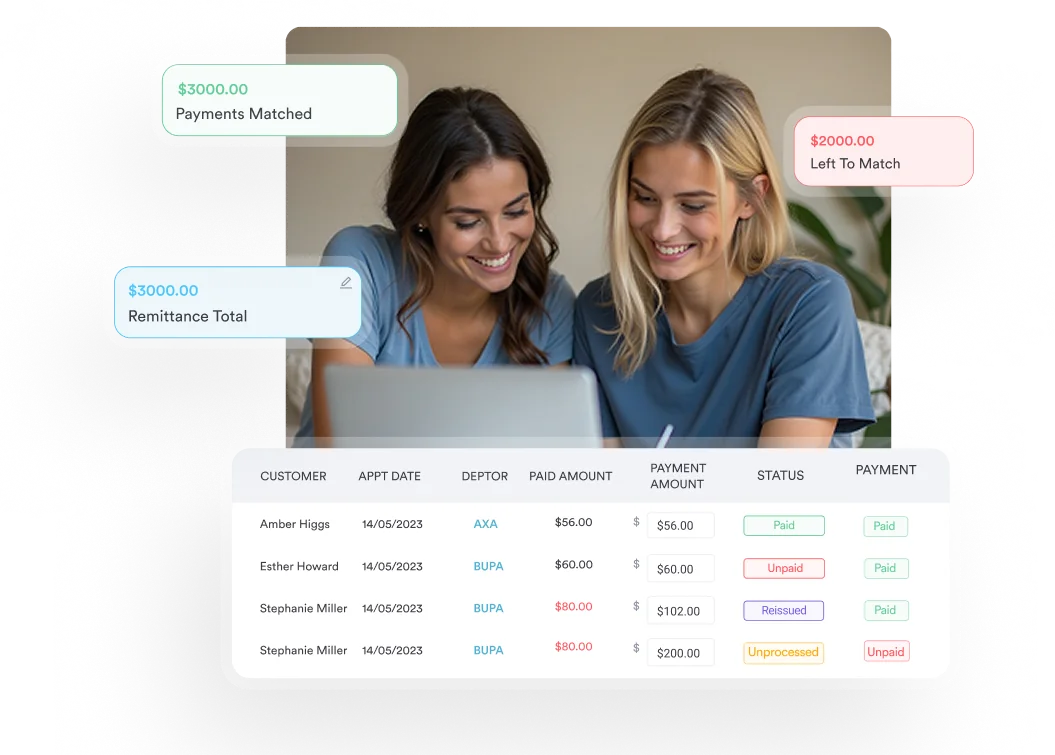

Submit, track and record payment on 32663 claims from one Pabau dashboard. US claims go electronically through Claim.MD to thousands of payers.

CPT 32663 pays for an anatomic lobectomy, and the operative note has to prove one. Before a claim leaves your practice, check that the note names the lobe, describes the hilar structures divided and confirms the intact specimen.
If one of those is missing, query the surgeon before submission instead of waiting for a downcode to 32666. A dictation fix takes minutes, while a records request after an audit holds up payment far longer.
Documentation is the first step of revenue cycle management, and a clean 32663 claim starts in the operating room. Book a demo to see how Pabau helps your thoracic surgery practice submit and track 32663 claims from one dashboard.

Need to understand how clearinghouse submission works for complex surgical codes? Medical claims clearinghouse guide explains how electronic claims flow from practice to payer and where 32663 claims are most often held for review.
Want to reduce the time between surgery and payment for thoracic procedures? 837 EDI file submission guide covers the electronic transaction format used to submit CPT surgical claims, including required data elements for 32663.
Looking for best practices on appeal letters for denied surgical claims? Medical billing compliance guide covers documentation standards and appeal strategies that apply directly to high-value CPT codes like 32663.
CPT code 32663 is used to bill thoracoscopic lobectomy, the surgical removal of a single lung lobe performed via video-assisted thoracoscopic surgery (VATS). It applies when the surgeon completes an anatomic lobe resection through small port incisions without open thoracotomy. It is most commonly associated with non-small cell lung cancer resections.
CPT 32663 is lobectomy, the anatomic removal of an entire lung lobe with hilar dissection. CPT 32666 is wedge resection, the non-anatomic removal of a peripheral lung wedge without hilar dissection. The operative report decides which applies. Documented hilar dissection supports 32663, while a stapler passed around a nodule supports only 32666.
Medicare reimbursement for CPT code 32663 is calculated using the code’s RVU value multiplied by the current CMS conversion factor and geographic adjustment. RVU values and conversion factors are updated annually. Use the CMS Physician Fee Schedule lookup tool at cms.gov or FastRVU to obtain current year-specific figures for your locality.
Yes, prior authorization is required for CPT 32663 by most commercial payers and Medicare Advantage plans. Traditional Medicare fee-for-service does not require it, but commercial plans almost universally do. Required documentation typically includes CT imaging, biopsy results, pulmonary function tests, and a surgeon’s letter of medical necessity.
The most common modifiers for CPT 32663 are -LT or -RT for laterality, which many commercial payers require. Modifier -62 applies when two co-surgeons each perform distinct portions. Use -80 when another physician assists at surgery, and -AS when a PA, NP or clinical nurse specialist assists. Modifier -59 marks a separately billable distinct procedure documented alongside 32663.
The work RVU for CPT code 32663 is updated annually by CMS as part of the Physician Fee Schedule. The value changes each calendar year and is subject to geographic adjustment. Verify the current figure with the CMS MPFS lookup tool at cms.gov, or with the FastRVU calculator using your practice’s locality code.
Intraoperative bronchoscopy performed as an integral part of VATS lobectomy is generally bundled into 32663 under NCCI edits and cannot be billed separately. Bronchoscopy performed as a distinct diagnostic procedure at a separate encounter may be separately billable. Check the current NCCI Procedure-to-Procedure edit table, as bundling status is updated quarterly.



