



CCSD code G5100: Bypass of duodenum billing guide
CCSD code G5100 bills a bypass that leaves the duodenum in place CCSD code G5100...

Last Updated: Oct 16, 2026

CPT code 29824 is arthroscopy, shoulder, surgical; distal claviculectomy including distal articular surface, known as the Mumford procedure.
The descriptor contains no acromioplasty, so any source that adds acromioplasty language to 29824 is quoting a code that does not exist.
CPT 29826 is an add-on code, so report it alongside 29824 as a primary and add-on pair. Modifier 59 and modifier XU do not belong on that claim.
NCCI includes limited debridement (29822) in 29824 outright, and allows extensive debridement (29823) only in a different area of the same shoulder.
Practice management software like Pabau keeps CPT and ICD-10 lookup libraries in the billing screen and checks required fields before a claim goes out.
CPT code 29824 covers arthroscopic distal claviculectomy, the shoulder procedure surgeons know as the Mumford. Medicare values it at roughly $639, and it carries a 90-day global period.
One fact settles most of the coding questions around it. CPT 29826 is an add-on code, so it is reported alongside 29824 rather than unbundled from it. Modifier 59 and modifier XU have no place on that claim.
What follows is the descriptor, the modifier set, the NCCI rules, and the diagnosis codes that carry medical necessity.
CPT code 29824 is the billing code for arthroscopy, shoulder, surgical; distal claviculectomy including distal articular surface.
Surgeons call it the arthroscopic Mumford procedure. It treats acromioclavicular (AC) joint pathology by resecting the distal end of the clavicle and its articular surface. That relieves impingement and pain at the AC joint.
The code sits in the musculoskeletal arthroscopy section of the AMA CPT code set, alongside siblings 29805 through 29828. It is a surgical arthroscopy code, so the diagnostic shoulder arthroscopy (29805) that precedes it is bundled in and never billed separately.
Full descriptor: Arthroscopy, shoulder, surgical; distal claviculectomy including distal articular surface (Mumford procedure).
What it includes: resection of the distal clavicle and the articular surface at its end. That is the whole descriptor. Acromioplasty is absent from it. CMS quotes the descriptor in full in Chapter 4 of the NCCI Policy Manual, and the phrase “including any acromioplasty” appears nowhere in it. That misquote drives most of the bad advice about this code.
What it excludes: subacromial decompression. That work belongs to a separate code, +29826. Its descriptor reads: decompression of subacromial space with partial acromioplasty, with coracoacromial ligament (ie, arch) release, when performed. A surgeon who decompresses the subacromial space and resects the distal clavicle in one session has performed two reportable services.
Payers want medical necessity documented before they approve 29824. The operative report has to link the procedure to a diagnosis that justifies arthroscopic distal claviculectomy.
These are the indications carriers accept most consistently:
Conservative treatment failure belongs in the record before surgery. Most MAC Local Coverage Determinations for shoulder arthroscopy require evidence that non-surgical treatment was tried and did not work.
Leave that out and the claim comes back on medical necessity grounds.
Medical necessity gets the claim considered. Modifier selection settles how much of it survives. 29824 describes a unilateral procedure, so laterality modifiers are required. The code’s fee schedule indicators control which payment modifiers are available to you.
The table below covers the modifiers orthopedic billing teams reach for most often on this code.
The bilateral billing trap: billing 29824 with modifier 50 when only one shoulder was treated is a frequent audit finding. Some facilities apply modifier 50 because the surgical consent covered both shoulders. Both shoulders have to be operated on, on the same date, for modifier 50 to hold. Using RT or LT incorrectly, or leaving them off, causes rejections at the clearinghouse before the claim reaches the payer.
Medicare pays 29824 under the Resource-Based Relative Value Scale. The work, practice expense, and malpractice RVUs are each adjusted by the geographic practice cost index, then multiplied by the conversion factor.
CMS finalized two conversion factors for 2026: $33.5675 for qualifying APM participants and $33.4009 for everyone else.
One line on the fee schedule surprises practices. 29824 carries an “NA” indicator in the non-facility column, which means CMS calculates no office-based rate for it. There is a single physician payment, and it is the facility rate.
When the case runs in a hospital outpatient department or an ASC, that facility bills separately for the room, the staff, and the supplies.
Drug lines on that facility claim are itemized separately too. HCPCS code J1630 carries revenue code 0636 on the UB-04, while the surgeon’s CMS-1500 carries no revenue code at all.
Those are national figures before any geographic adjustment, taken from the July 2026 release of the CMS Physician Fee Schedule.
GPCI moves them by several percentage points in either direction depending on locality. Verify against the live CMS tool before you use any rate for contract analysis or fee schedule negotiation.
+29826 changes the math whenever the decompression was performed and documented. It adds 4.42 RVUs, or roughly $147.63 at the nonqualifying APM conversion factor.
Add-on codes carry multiple procedure indicator 0, so that amount escapes the multiple procedure reduction. Treat 29826 as unbillable with 29824 and you leave about $148 behind in every one of those cases.
Rebuild your 29824 fee schedule twice in 2026, not once. CMS now publishes two conversion factors, and they differ by about $3 per case on this code. Check which factor applies to your group before you load rates into the practice management system. Re-check after each quarterly RVU release.
29824 carries a 090-day global period, which makes it major surgery in Medicare’s terms. The payment covers the day before surgery, the procedure itself, and 90 days of routine post-operative care.
CMS splits the code’s work into 0.10 pre-operative, 0.69 intra-operative, and 0.21 post-operative. Those fractions are what the split-care modifiers pay against.
Routine follow-up inside those 90 days is not separately billable. Charging an office visit for a standard six-week check after 29824 is a common overpayment finding.
An auditor spots it in seconds, because the date sits inside the global window. Save modifier 24 for visits that genuinely address a different problem.
NCCI policy for 29824 turns on two questions. Which companion codes are always included, and which can be reported next to it?
Chapter 4 of the NCCI Policy Manual sets rules for shoulder arthroscopy specifically. They run stricter than the general arthroscopy guidance most coders learn first.
NCCI adds a modifier restriction on top of that edit table. An edit pair of two shoulder arthroscopy codes cannot be bypassed with a modifier when both procedures are on the same shoulder.
Modifier 59 or XU works only across opposite shoulders, or inside the 29823 exception above. Appending 59 to force an ipsilateral pair through is the behavior that draws a post-payment audit.
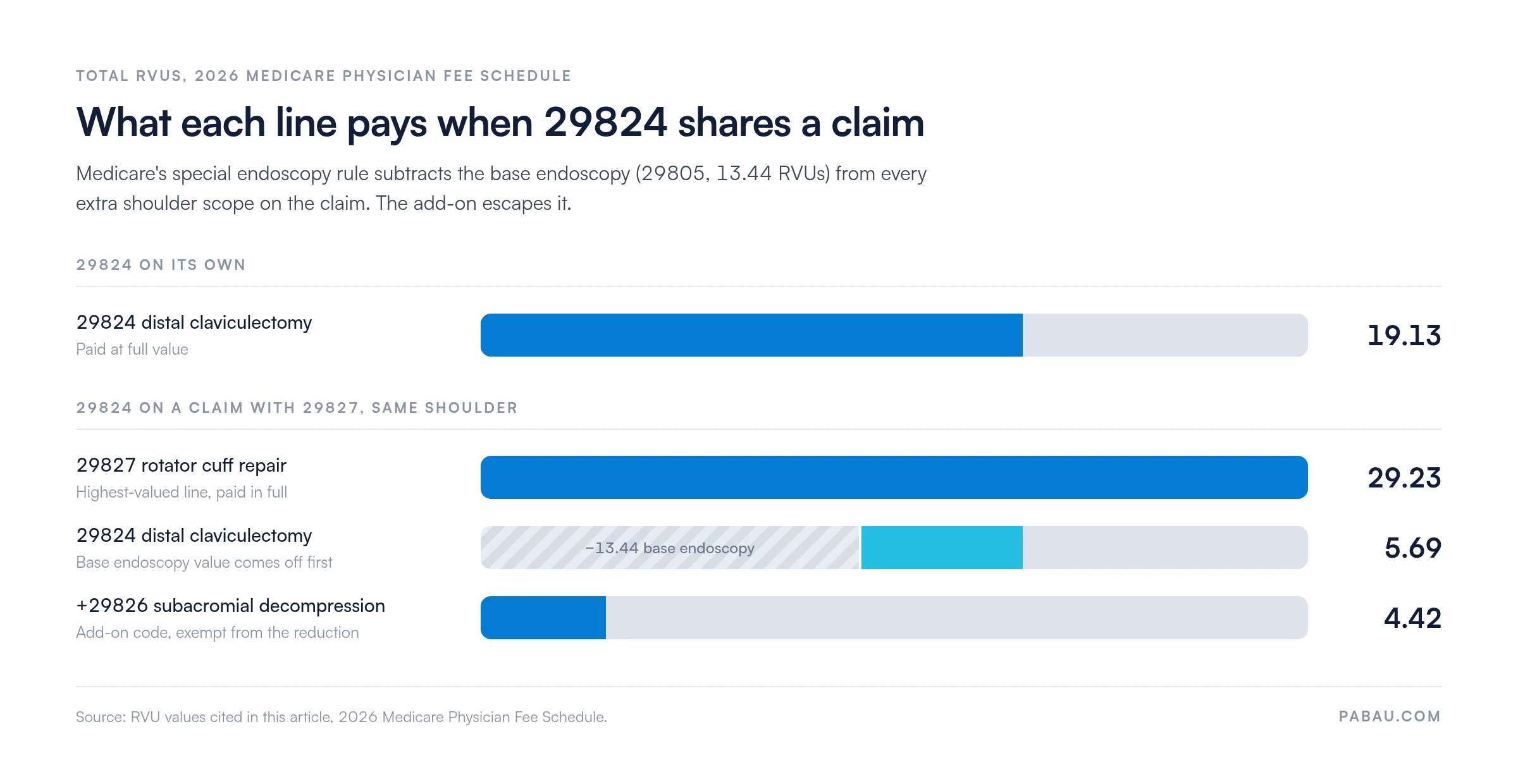
Payment for a multi-code shoulder case follows a second rule. 29824 carries multiple procedure indicator 3, so Medicare applies its special endoscopy policy whenever another code from the 29805 family is on the claim.
The highest-valued procedure pays in full. Each additional one pays at its own value minus the value of the base endoscopy.
Take a case where the surgeon repairs the cuff and resects the distal clavicle. 29827 is the higher-valued line at 29.23 RVUs, so it pays in full. 29824 pays 19.13 minus the 13.44 base endoscopy value, which comes to 5.69 RVUs.
If the subacromial decompression was performed too, +29826 adds its full 4.42 RVUs, untouched by the reduction.
NCCI edit pairs are revised quarterly, so confirm the current table before billing an unusual combination. The AMA’s CPT coding resources cover modifier use for bundled codes. Your MAC’s LCD for shoulder arthroscopy shows any payer-specific reading of the same policy.
Every 29824 claim needs at least one ICD-10 code that establishes medical necessity. Payers check the pairing during automated adjudication, so an unspecified diagnosis raises the denial risk immediately.
When a chart describes pathology the list below misses, work back from the ICD-10-CM code library rather than settling for an unspecified code.
Osteolysis is the one to watch. It is coded in the M89.5 series, not M89.2. A claim built on the wrong series fails a medical necessity review even when the clinical story is right.
Laterality is the other. Payers match the ICD-10 laterality to the modifier on the CPT line. A right-shoulder diagnosis with an LT modifier triggers an automated mismatch denial. Verify crosswalks against the CDC/NCHS ICD-10-CM web tool before you finalize charge capture.
Thin documentation is the second most common reason 29824 claims fail, after medical necessity. The operative report is the document payers adjudicate surgical claims against.
It has to show that the service was needed and that it was performed as described. It should include:
Pre-authorization paperwork has to match that report. If the authorization named an AC joint procedure and the note describes a different primary procedure, payers deny on the mismatch.
29824 claims are denied more often than most orthopedic codes. Three sources of payer scrutiny land on the same procedure: surgical necessity thresholds, bundling policy, and laterality matching.
Knowing the patterns lets a billing team write a faster, more targeted appeal. Strong denial management habits before submission still beat appealing after the fact.
29806 sits at the start of that range and covers arthroscopic shoulder capsulorrhaphy, including Bankart-type labral repair. Its guide sets out what the operative report and payer authorization need to show.
The appeal itself should open with a cover letter citing the exact LCD criteria the claim meets, with page-referenced documentation behind it.
AAPC coding resources and AAOS appeal templates give specialty-specific guidance for the harder cases. Most MACs allow 120 days from the remittance advice date, though the window varies by contractor.
Run a quarterly audit of your 29824 denial rate by payer. If one payer denies at more than double your average for this code, pull the operative notes from those cases. Read them against that payer’s LCD. The documentation standard often differs from CMS, and one targeted change to the pre-op note template can clear the whole pattern.
29824 belongs to a family of shoulder arthroscopy codes that coders meet together on one operative note.
Knowing how each differs, and whether it can be billed alongside 29824, is what keeps charge capture accurate on a multi-procedure case.
Among those siblings, 29825 is the frozen shoulder code. Its descriptor covers lysis and resection of adhesions, with or without manipulation, and the indication is adhesive capsulitis rather than AC joint disease.
29827 and 29828 turn up in the same session as 29824 often, because rotator cuff and biceps pathology travel with significant AC joint disease.
Both are billable alongside it, and neither needs modifier 51 on a Medicare claim. The special endoscopy rule already determines what the second line pays.
The open version of the same procedure sits outside this arthroscopy family. An open resection of the distal clavicle is reported with 23120, so the operative note has to state the approach.
Orthopedic and sports medicine practices billing 29824 hit the same operational problems. Charge entry happens away from the note, so laterality gets keyed by hand. Authorization numbers live in a separate inbox, and denial patterns only surface when someone builds a report.
Practice management software like Pabau closes those distances. Pabau pre-fills the claim from the patient record. The diagnosis, the laterality, and the date of service carry across from the visit instead of being retyped.
CPT and ICD-10 lookup libraries sit in the billing screen, so a coder picks M89.511 from a list instead of from memory. Required-field checks hold back a claim that is missing an authorization number or a place of service.
Pabau’s software for orthopedic billing then routes the claim electronically, through clearinghouse connections in the US, the UK, and Australia. In the US that is Claim.MD, which handles CMS-1500 and 837P submission to thousands of US payers, plus eligibility checks and electronic remittance advice.
The bigger win is watching denial patterns across 29824 claims over time rather than working each denial alone. A payer that keeps denying this code on medical necessity is telling you about your documentation protocol, not about one case. Software that surfaces the pattern lets a billing manager fix the cause.

Pabau pre-fills the claim from the patient record, keeps CPT and ICD-10 lookup libraries in the billing screen, and checks required fields before submission. Claims then route to payers through clearinghouse connections in the US, the UK, and Australia.

Two boundaries decide whether a 29824 claim pays. The first is the add-on relationship with 29826, which is a pairing to report rather than an edit to unbundle. The second is NCCI’s debridement policy, which shuts out 29822 completely and allows 29823 only in a different area of the same shoulder.
Both are documentation problems before they are coding problems. The note that names the area debrided, quantifies the bone removed, and describes the decompression separately is the note that survives review. Rewrite the operative template once and the denial pattern on this code changes for good.
If the retyping between the note and the claim is where your 29824 lines go wrong, that is the part worth fixing first. Book a demo to see how Pabau pre-fills a surgical claim and checks it before submission.

Billing the decompression on the same claim? CPT code 29826 covers the add-on’s own rules, from primary-code pairing to the modifier 51 exemption.
Repairing the cuff in the same session? CPT code 29827 explains how the higher-valued line pays and what the operative note has to show.
Working through a stack of denials? Denial codes in medical billing maps the 20 CARC codes that show up most and the fix for each.
Want the claim right the first time? Clean claim requirements lists the elements a surgical claim needs to pass automated edits without rejection.
Checking coverage before the surgery date? Insurance eligibility verification covers how to confirm benefits and authorization windows before the procedure.
That depends on the payer, not on CPT. Most commercial plans require prior authorization for shoulder arthroscopy, and the authorization has to name the procedure that was performed. If the surgeon adds a decompression during the case, check whether the authorization still covers it before the claim goes out.
Not with 29824. That code is specific to the arthroscopic approach, so an open resection of the distal clavicle is reported with 23120, claviculectomy; partial. The operative note has to state the approach, because that is what separates the two code families.
Yes, with modifier 57. 29824 carries a 090-day global period, which makes it major surgery. The evaluation and management visit where the decision for surgery was made stays separately payable. Append modifier 57 to the E/M code, not modifier 25.
The facility does, on its own claim. CMS assigns 29824 a facility-only physician payment, so the surgeon’s line covers the professional work only. The ASC or hospital outpatient department bills separately for the room, the staff, and the supplies used.



