CPT code 96158: Individual health behavior intervention billing
CPT code 96158: official descriptor and clinical scope CPT code 96158 describes ...

Last Updated: Oct 15, 2026
29806 is the CPT code for arthroscopy, shoulder, surgical; capsulorrhaphy. It covers arthroscopic tightening or repair of the shoulder joint capsule, including Bankart-type labral repair and the suture anchors that hold it.
Coders confuse it with CPT 29807, which covers SLAP repair, and that mix-up drives a large share of denied or downcoded shoulder claims. A 90-day global period, CCI bundling edits with 29826, and commercial prior authorization add three more places where a 29806 claim fails.
Let Pabau's smart automation suggest the right codes, reduce claim denials, and keep your practice compliant—effortlessly.
Automate repetitive tasks and focus on what matters most—your patients.
Reduce coding errors and ensure compliance with the latest regulations.
Clean claims, fewer denials, and faster reimbursements.
Powerful insights and reporting to help your practice thrive.
HIPAA compliant SOC 2 certified GDPR-compliant Trusted by 4,000+ clinics worldwide

CPT code 29806 covers arthroscopic shoulder capsulorrhaphy, including Bankart and anterior-to-posterior labral repair. SLAP repair belongs to 29807.
When 29806 and 29807 are both performed on the same date of service, 29806 is billed as the primary procedure.
CPT 29826 (acromioplasty) is subject to CCI bundling edits with 29806. Append modifier 59 or XS when a distinct acromioplasty is separately documented.
At the 2026 conversion factors, the national facility payment for 29806 is $972.97, or $977.82 for a qualifying APM participant.
Practice management software like Pabau validates 29806 claims against built-in CPT and ICD-10 catalogues before they reach the payer.
CPT code 29806 describes arthroscopy, shoulder, surgical; capsulorrhaphy.
The American Medical Association’s CPT code set places 29806 in the musculoskeletal arthroscopy section, alongside the other shoulder surgical codes. Capsulorrhaphy here means tightening or repairing the joint capsule. Surgeons most often do it to correct instability after a Bankart lesion, an anterior dislocation, or multidirectional shoulder instability.
The procedure bundles several surgical elements under one code. Coders do not report suture anchor placement, labral repair, or capsular plication separately when each forms part of the same capsulorrhaphy.
The split between 29806 and 29807 is the most frequently audited coding decision in shoulder arthroscopy. CPT 29806 covers capsulorrhaphy and Bankart-type labral repair. CPT 29807 covers repair of the superior labrum anterior to posterior, the SLAP tear. Anatomical location and repair type decide the code, whatever terminology the surgeon prefers.
Where a surgeon performs both a capsulorrhaphy and a SLAP repair in one session, 29806 is the primary procedure. 29807 is secondary, with modifier 51. Document both repairs in the operative note with clear anatomical landmarks.
Capsulorrhaphy tightens a lax capsule, so a stiff shoulder points to a different code. Arthroscopic lysis and resection of adhesions, with or without manipulation, is reported under CPT 29825.
Several shoulder arthroscopy codes turn up on the same claim as 29806. Whether each one is separately billable depends on CCI edits and payer policy, and bundling mistakes here are a leading source of orthopedic claim rejections.
CMS updates CCI edits quarterly. Check the current NCCI table for 29806 and 29826 before submitting, because bundle status can shift between fiscal years.
Modifier selection is a top denial driver on these claims. The wrong modifier, or a missing required one, either bounces the claim or pays it at the wrong rate.
The diagnosis code on a 29806 claim must match the surgical findings in the operative report. A pre-operative impression does not suffice, because the final diagnosis should reflect what the surgeon confirmed arthroscopically. The codes below come from the ICD-10-CM code set and are the ones payers most often accept for this procedure.
Most commercial payers and Medicare Advantage plans require prior authorization for shoulder arthroscopy, 29806 included. Traditional Medicare Parts A and B do not, though Medicare Advantage plans frequently do. Medicaid rules vary by state. Confirming eligibility and authorization before surgery is the first defense against a post-service denial.
Payers commonly apply these clinical criteria when approving a 29806 authorization:
Check the payer’s local coverage determination and prior authorization policy for the plan year every time. Approval criteria are not identical across plans.
Medicare payment for 29806 comes from the 2026 Medicare Physician Fee Schedule. Two numbers drive it: the code’s total relative value units and the conversion factor. For 2026 there are two conversion factors rather than one, so the same code pays two different national amounts.
The split conversion factor is new for 2026, and it is worth seeing the arithmetic laid out before you quote a figure to a surgeon.
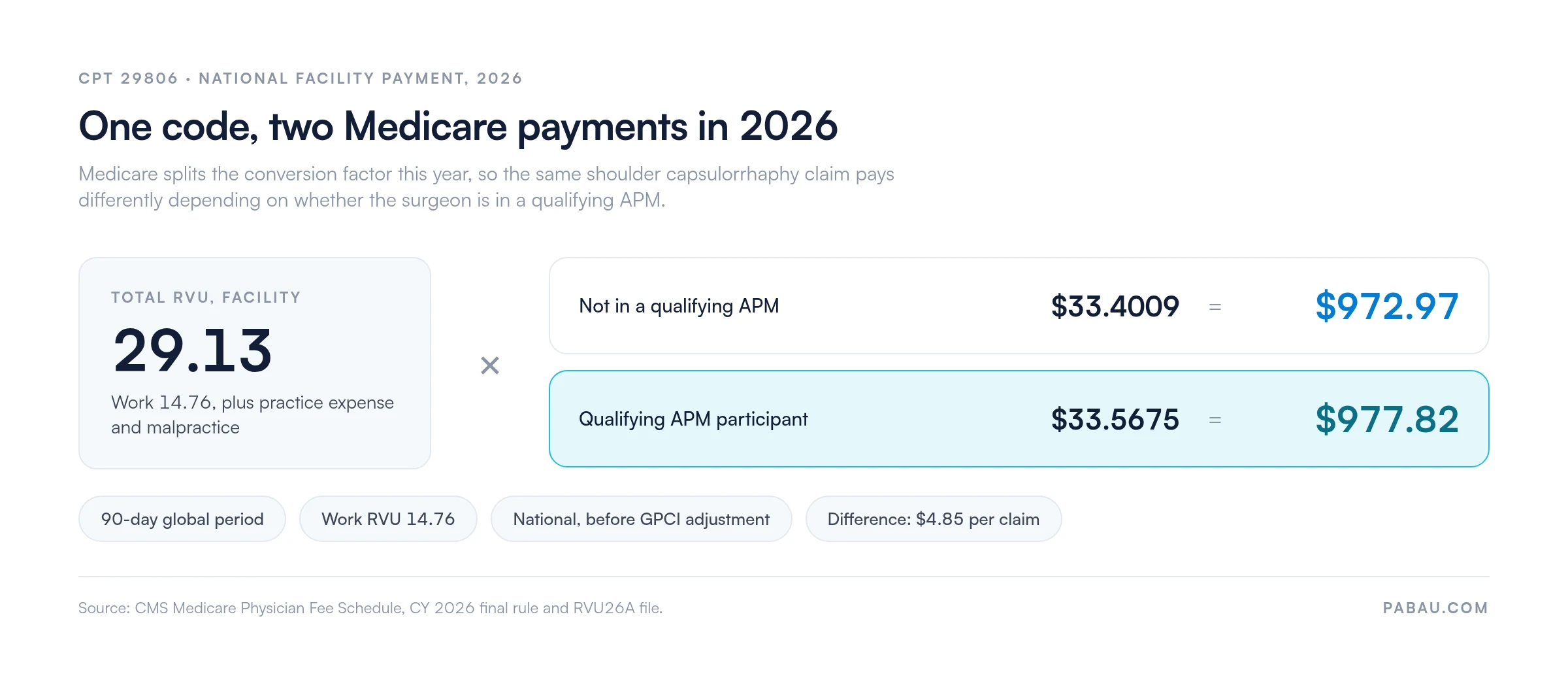
Both figures are national and unadjusted. Your locality rate will differ once Geographic Practice Cost Indices are applied, so confirm it with the CMS MPFS lookup tool. Commercial payers typically pay a multiplier above the Medicare allowable, which your payer contracts will set.
The 90-day global surgery period applies to 29806 under Medicare. Routine wound checks, suture removal, and standard follow-up inside that window fall within the global package. None of them are separately billable without a modifier, such as modifier 24 for an unrelated E/M service.
Denial patterns on this code are predictable. Four root causes account for most of them: the wrong code, a thin operative note, missing prior authorization, and bundling errors. Naming the root cause is the first step toward an appeal that works, which is where denial management strategies earn their keep.
The claim adjustment reason code on the remittance tells the billing team which appeal path to take. CARC 4 means the procedure code is inconsistent with the modifier used, or that a required modifier is missing. CARC 197 means precertification or authorization was absent. CARC 97 means the service is bundled into another payment, and CARC 50 means the payer did not consider it medically necessary.
Run a pre-submission audit on every 29806 claim. Confirm the laterality modifier, RT or LT, and verify the prior auth number is on the claim. Check that the ICD-10 code matches the surgical findings in the op note. Then confirm 29826 carries modifier 59 if it is billed alongside. Catching those four errors before submission eliminates most 29806 denials.
A well-documented operative report is the foundation of a defensible 29806 claim. Payers running a retrospective audit pull the op note first, so every element below should be confirmed before the claim goes out.
In most orthopedic billing teams these checks happen by hand. Someone reads the operative note, matches the ICD-10 code, confirms the laterality modifier, then looks up the authorization number in a payer portal. Every one of those steps is a place where a 29806 claim goes out wrong.
Pabau, practice management software for busy practices, moves those checks into the claim itself. Built-in CPT and ICD-10 catalogues validate the pairing as the claim is built. Submission then runs through the Claim.MD clearinghouse, so real-time payer edits are applied before adjudication rather than after a denial.
Remittance advice comes back electronically against the original claim, so the team can see which 29806 claims paid short and why. That is the job orthopedic claims software should be doing: less rework after the fact, and a shorter path from surgery to payment.

Pabau validates CPT 29806 claims against built-in CPT and ICD-10 catalogues, then submits them through the Claim.MD clearinghouse. Orthopedic practices see fewer denials and less rework inside the 90-day global period.

What decides a 29806 claim happens before it is submitted, not after it is denied. Read the operative note for the anatomy, choose between 29806 and 29807 on that basis, then confirm laterality, authorization, and the 29826 modifier. Those four checks settle most of the risk on this code.
A denied 29806 costs the practice twice, because the 90-day global period means the follow-up care is already committed. Book a demo to see how Pabau validates shoulder arthroscopy claims before they reach the payer.

List Item #1
List Item #2
CPT code 29806 covers arthroscopic shoulder surgery with capsulorrhaphy. That includes anterior and posterior capsular repair, labral reattachment (Bankart repair), and suture anchor placement, all performed through an arthroscopic approach. An open capsulorrhaphy with labral repair is coded to CPT 23455 instead.
Use 29806 when the repair involves the anterior or posterior capsule and a Bankart-type labral tear. Use 29807 when the repair addresses a SLAP lesion, the superior labrum from anterior to posterior. When both are performed in one session, 29806 is primary and 29807 is secondary with modifier 51.
Yes, but only when a distinct and separately documented acromioplasty is performed, rather than one that forms a routine part of the capsulorrhaphy. CCI edits may bundle 29826 with 29806, and modifier 59 or XS is required to unbundle. Verify the current NCCI table before submitting, because bundle status is updated quarterly.
Laterality modifiers RT or LT are required by most payers. Modifier 51 applies to any secondary procedure performed in the same session. Modifier 59 or XS is needed to unbundle 29826 when it is separately performed. Modifier 22 may be appended for unusual complexity, but only where the operative note documents what increased operative time.
The operative report must confirm the arthroscopic approach and name each structure repaired. It also documents suture anchor count and type, states laterality explicitly, and carries a surgeon attestation. The ICD-10 code on the claim must reflect intraoperative findings, and prior authorization documentation must be on file for the payers that require it.
Posterior labral repair is generally coded to 29806 when performed as part of a capsulorrhaphy, though guidance for isolated posterior labral repair varies. Check your payer’s LCD and AMA CPT Assistant guidance for the scenario in front of you. Some payers ask for extra documentation to confirm 29806 rather than another code.