

CCSD code G5100: Bypass of duodenum billing guide
CCSD code G5100 bills a bypass that leaves the duodenum in place CCSD code G5100...

Last Updated: Oct 16, 2026
J1630 is the HCPCS Level II code for injection, haloperidol, up to 5 mg.
Haloperidol lactate is cheap, so the money at stake on any single claim is small. Repeat the error across a busy psychiatric service and it stops being small.
Let Pabau's smart automation suggest the right codes, reduce claim denials, and keep your practice compliant—effortlessly.
Automate repetitive tasks and focus on what matters most—your patients.
Reduce coding errors and ensure compliance with the latest regulations.
Clean claims, fewer denials, and faster reimbursements.
Powerful insights and reporting to help your practice thrive.
HIPAA compliant SOC 2 certified GDPR-compliant Trusted by 4,000+ clinics worldwide

HCPCS code J1630 covers an injection of haloperidol lactate, and one billing unit means one 5 mg increment.
A 10 mg dose bills as 2 units, so reporting 5 units for 5 mg overstates the claim five times over.
Medicare Part B pays J1630 at ASP plus 6% in the office, and CMS refreshes that price every quarter.
Medicare and Medicaid claims need the 11-digit NDC off the vial, plus modifier JW or JZ on every line.
J1631 is the decanoate code and counts per 50 mg, which is where the costly 10x unit mix-up starts.
HCPCS code J1630 is maintained by the Centers for Medicare and Medicaid Services (CMS) as part of the HCPCS Level II code set.
The official long descriptor reads: Injection, haloperidol, up to 5 mg. CMS added J1630 effective January 1, 1986, and the code stays active for 2026 with no termination date.
One detail decides the code: J1630 applies to the lactate formulation only. Haloperidol decanoate is coded separately as J1631.
Practices that stock both formulations are the ones that get audited on this. The two vials sit on the same shelf, and the charge template rarely tells them apart.
Haloperidol (brand name Haldol, Janssen) is a first-generation antipsychotic in the butyrophenone class. It blocks dopamine D2 receptors in the mesolimbic pathway, which brings down positive psychotic symptoms.
Emergency departments and inpatient psychiatric units keep it stocked because it works fast by the intramuscular route and sits on almost every formulary.
FDA-approved indications for injectable haloperidol include the clinical scenarios where J1630 usually applies:
Off-label use is common in practice, particularly for delirium in the ICU and for chemotherapy-induced nausea. When you bill an off-label administration, make sure the linked ICD-10 code reflects a medically necessary indication.
The note also has to spell out the clinical reasoning. Payers look harder at off-label drug claims than at any other line in this family.
Every J1630 claim needs an ICD-10-CM diagnosis code that establishes medical necessity. Payers reject injectable antipsychotic claims most often when the diagnosis on the line does not support the drug that was given.
The table below lists the codes paired with J1630 most frequently on Medicare and commercial claims.
R45.1 is the pragmatic choice in an emergency department when no psychiatric diagnosis is confirmed yet. Once the workup lands on something definitive, use that code on the follow-up billing instead.
Payers can ask for documentation showing the diagnosis was recorded alongside the administration rather than added afterwards. Each code in that table carries its own documentation quirks, which our ICD-10-CM code guides cover one by one.
Under Medicare Part B, physician-administered drugs like J1630 are paid on the Average Sales Price (ASP) methodology. The formula is ASP plus 6%, where the 6% is meant to cover acquisition, storage, and handling.
CMS republishes ASP pricing files quarterly, so the allowed amount for J1630 changes four times a year. Check current rates in the CMS Physician Fee Schedule lookup tool before you submit the first claims of a new quarter.
Payment also moves with the place of service. Hospital outpatient departments fall under the Outpatient Prospective Payment System (OPPS), which pays on a different basis than the physician office.
The same 5 mg injection can therefore land at two different allowed amounts depending on where the patient received it.
Haloperidol lactate is a low-cost generic, so ASP plus 6% on J1630 is a modest number. Practices running high volumes of psychiatric injections should compare acquisition cost against ASP payment each quarter. That is the only way to know whether buy-and-bill still washes its face for this drug.
Verify J1630 rates before the start of each CMS quarter. ASP updates take effect January 1, April 1, July 1, and October 1. Pull the new ASP pricing file and update your fee schedule before the first claims of the quarter go out. Otherwise you are underpaid for three months.
Buy-and-bill means the practice purchases haloperidol lactate from a wholesaler, administers it, then bills J1630 to the payer. Medicare pays ASP plus 6%. The difference between acquisition cost and that payment is the practice’s return on the drug.
Covered entities under the 340B Drug Pricing Program, administered by HRSA, buy haloperidol lactate at reduced 340B ceiling prices. They still bill J1630 at the standard rate, which widens the margin.
Since January 1, 2025, 340B covered entities report modifier TB on the drug line, replacing the retired JG modifier. The compliance conditions that come with the discount are strict:
Practices outside the program bill J1630 from wholesale acquisition cost or contract pricing and receive ASP plus 6%.
Because haloperidol lactate’s ASP is low, the 340B benefit on this particular drug is thin while the compliance burden is identical to a high-cost biologic. Only entities that have confirmed covered entity status with HRSA should apply 340B pricing to J1630.
CMS requires an NDC (National Drug Code) on the claim line alongside HCPCS code J1630 for Medicare and Medicaid. The NDC names the exact product and package given, which is how CMS ties the claim back to drug pricing.
Missing or wrong NDCs are the leading reason J1630 claims reject at submission. Capture the number at the point of administration, not later at charge entry.
Several companies manufacture haloperidol lactate, and the NDC changes with the manufacturer and the package size. Products from Hikma Pharmaceuticals, Pfizer, and Fresenius Kabi all turn up as 5 mg/mL vials.
Because repackaging and supplier changes move these numbers, read the NDC off the vial that was used. Billing from memory or from a saved template is how the wrong number gets on the claim.
Billing J1630 takes more than dropping the code onto a charge line. The claim has to carry the dose in units and the right place of service. It also needs the NDC off the vial and a diagnosis that supports the drug. Work down this list before the batch leaves.
Units cause more J1630 rejections than any other field on that list, and the reason is easier to see side by side with J1631.
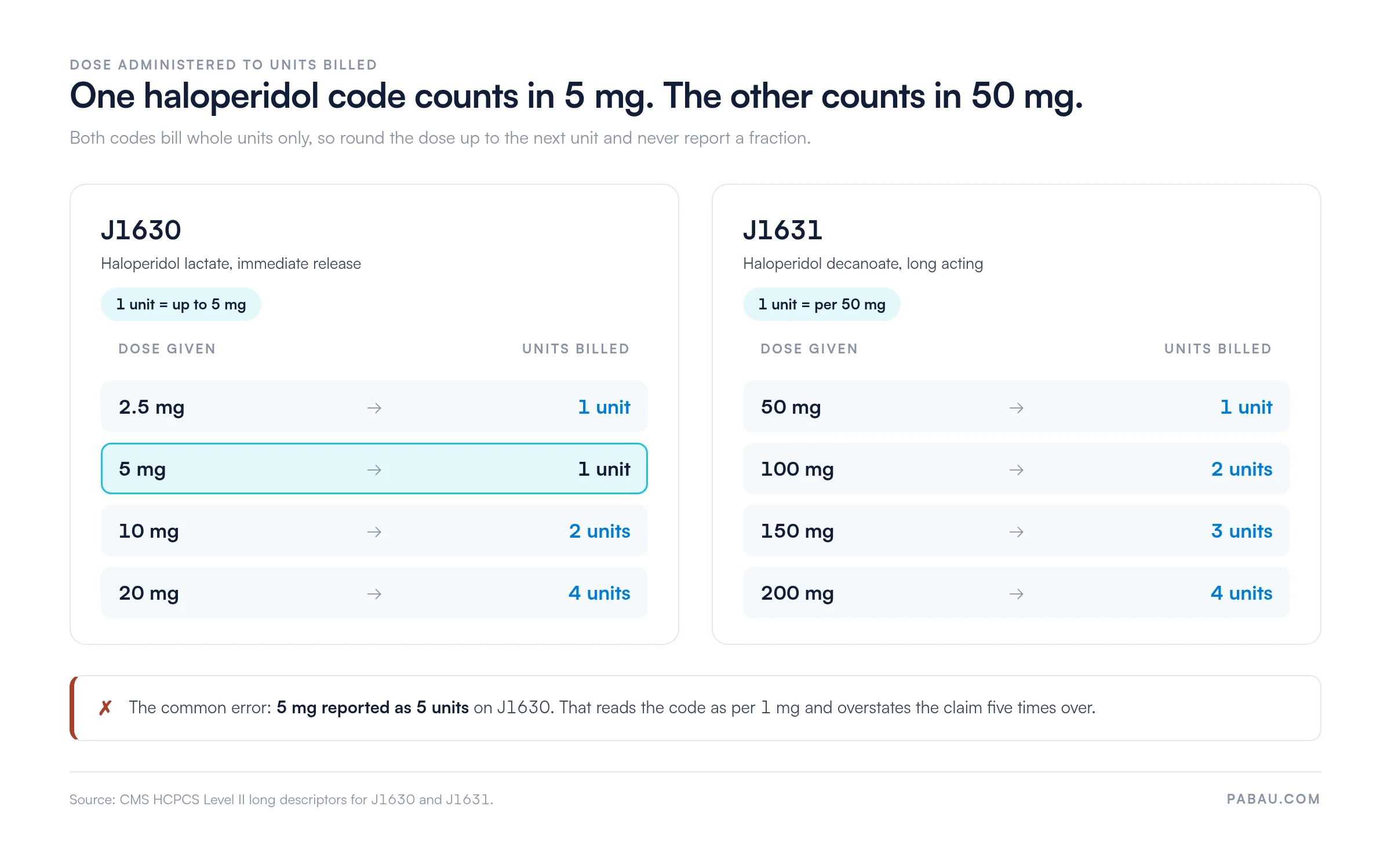
J1630 denials cluster around five mistakes. Each one is visible on the claim before it goes out, which makes them cheap to catch and expensive to leave alone.
Here is what a clean J1630 line looks like in practice. A patient in the emergency department receives 10 mg of haloperidol lactate IM for acute agitation. The claim goes out carrying:
Every field on that line traces back to something the clinician recorded at the bedside. When one of them has to be reconstructed from memory at charge entry, that is the field that ends up wrong.
Audit J1630 quarterly against your administration records. Pull every claim billed with the code, compare billed units to the documented dose, and check that each one carries an NDC. Unit errors are almost always systematic, so one fix to the charge template corrects every claim that follows.
The most common code confusion in haloperidol billing sits between J1630 and J1631. Both cover haloperidol, but they describe different formulations with different clinical jobs, dosing units, and payment profiles.
J1631 counts per 50 mg while J1630 counts per 5 mg, so a mix-up moves the billed units by a factor of ten.
The clinical rule is simple. If the drug is calming an episode happening right now, use J1630. If the patient is getting a scheduled depot injection for long-term maintenance, use J1631.
Practices that stock both and do not separate them in the medication administration record end up making this error on a schedule.
Psychiatric and emergency billing runs into the wider antipsychotic J-code family often, and several of these codes are routinely mixed up with each other.
Brand names are the usual culprit, because one molecule can carry a short-acting code and a long-acting code that look nothing alike. The AAPC HCPCS code lookup is a useful crosscheck alongside this table.
Formulation decides the code in this family, not the drug name. Aripiprazole alone occupies two codes with a fourfold difference in unit size.
Check the vial against the descriptor whenever a new drug goes into the charge template, and again whenever a supplier changes.
Plenty of practices still rebuild the J1630 line by hand. Someone opens the administration record, types the code, works out the units, then copies the NDC off the vial label into the claim. Each of those steps is a chance to transpose a digit.
Practice management software like Pabau shortens that journey. Our claims management software pre-fills the claim form from the client record. The code attached to the service lands on the charge line, and the recorded diagnosis seeds the ICD-10 slot.
Full ICD-10-CM and HCPCS lookup libraries sit behind a search icon, so a coder can check J1630 against J1631 without leaving the claim. Pabau also confirms that required claim fields are complete before the send button unlocks. US claims route through Claim.MD, so eligibility checks and remittance posting sit alongside the record.
Your team still decides the units, the modifier, and the NDC on the line. Pabau does not choose those for you, and no software should. What it removes is the retyping between the treatment note and the claim. That handoff is where transcription errors get in.
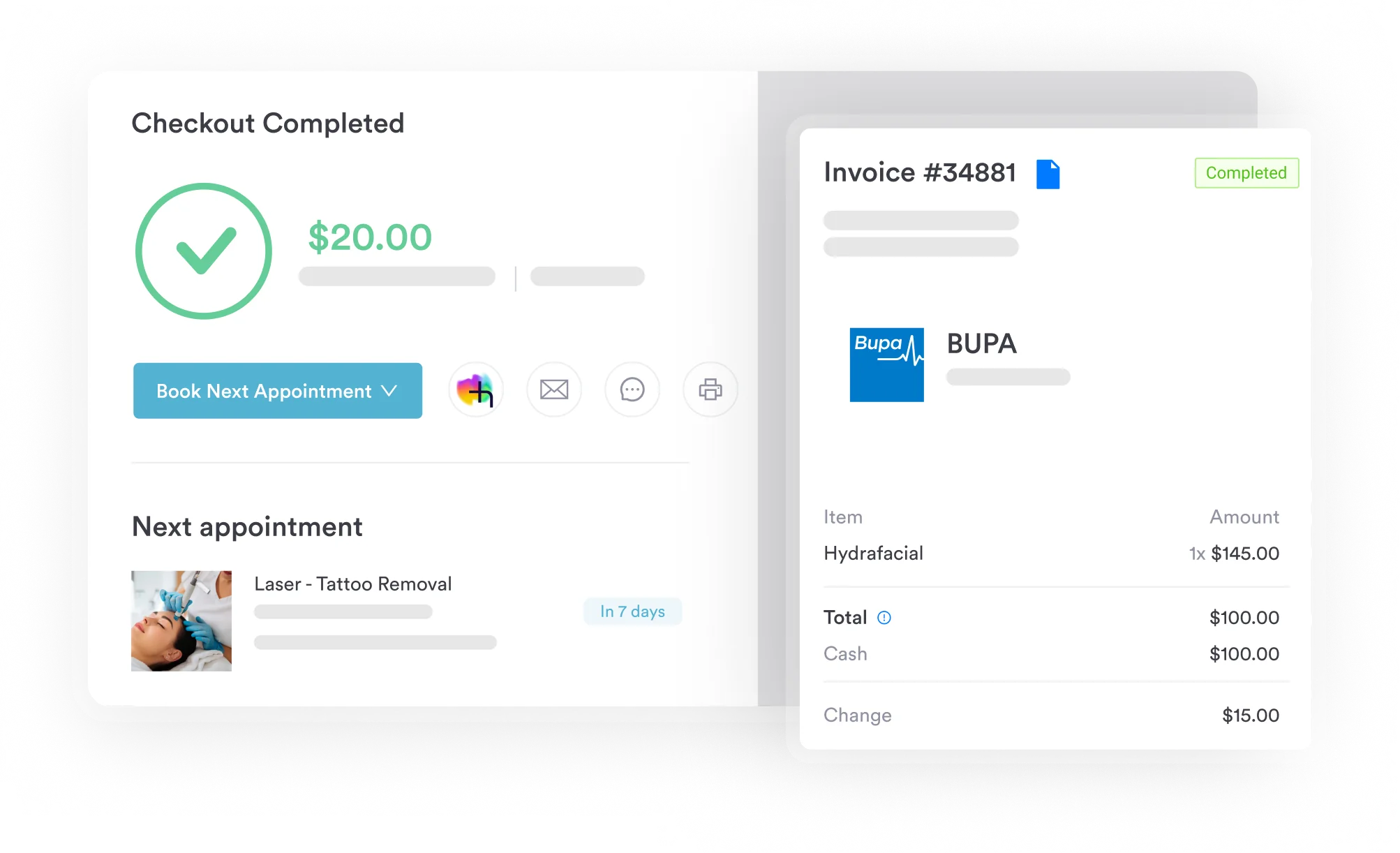

Pabau pre-fills the claim from the clinical record and checks that required fields are complete before you submit. Your billing team keeps control of the units, the modifier, and the NDC.

J1630 is a small code with an outsized error rate, and the fix nearly always sits upstream of the claim. Set the charge template to count in 5 mg increments once and the unit errors stop repeating. Capture the NDC at the bedside rather than at charge entry and the rejections stop with them.
The trade-off worth remembering is that haloperidol lactate is cheap. Chasing a corrected J1630 claim costs more staff time than the claim is worth. The money is in getting the line right the first time, on a drug nobody thinks twice about.
Book a demo to see how Pabau carries the drug, dose, and diagnosis from the treatment note onto the claim form.

Want to see why your J-code claims keep bouncing? Denial management in healthcare walks through the rejection patterns that repeat and how to close them off.
Not sure what a drug administration superbill should capture? Superbill documentation best practices sets out the fields that keep a charge line defensible.
Chasing a higher first-pass acceptance rate? What makes a clean claim breaks down the elements a payer checks before a claim is adjudicated.
Billing high-scrutiny injectable drugs regularly? Medical billing compliance covers the documentation standards auditors apply to injectable claims.
In an office setting, yes. J1630 pays for the drug only. The administration is reported with CPT code 96372 for a therapeutic intramuscular injection. Hospital outpatient and emergency claims often package the administration into the facility payment, so check the payer’s policy first.
Part B. A clinician administers the injection, which puts it in the Part B drug benefit. Part D covers drugs the patient takes themselves, and an intramuscular haloperidol injection does not qualify. Bill J1630 to Part B.
Facility claims on the UB-04 report drug charges under revenue code 0636, which covers drugs requiring detailed coding. The HCPCS code and the units still sit on that same line. Physician office claims go out on the CMS-1500 and carry no revenue code at all.
CMS publishes medically unlikely edit (MUE) values for drug codes and revises them quarterly. Pull the current practitioner services MUE file before you hard-code a unit cap into your billing rules, because the published value can move between quarters.
In an office setting, yes. The physician must have seen the patient, established the plan of care, and be providing direct supervision during the visit. Emergency departments and hospital outpatient settings follow facility billing rules instead of incident-to rules.



