



CCSD code G5100: Bypass of duodenum billing guide
CCSD code G5100 bills a bypass that leaves the duodenum in place CCSD code G5100...

Last Updated: Oct 16, 2026

CPT Code 29827 covers arthroscopy, shoulder, surgical; with rotator cuff repair, the most common arthroscopic shoulder procedure billed in orthopedic practices.
Medicare prices 29827 the same in facility and non-facility settings, so the site of service does not change the physician payment.
Modifier LT or RT is required on every claim to show laterality, and it must match the ICD-10 laterality.
CPT 29826 for acromioplasty is an add-on code, so it is reported with 29827 and never billed on its own.
Practice management software like Pabau submits 29827 claims electronically through Claim.MD, then tracks claim status and posts ERA remittances.
CPT Code 29827 is the billable code for arthroscopy, shoulder, surgical; with rotator cuff repair. It covers camera-guided repair of torn rotator cuff tendons through small portals rather than an open incision. It is the most frequently reported surgical shoulder arthroscopy code, and it draws a heavy share of denials.
The American Medical Association (AMA) maintains the code and its descriptor. It sits in the musculoskeletal surgery section (20000-29999) of the CPT code set and applies only to the arthroscopic approach. Open rotator cuff repair is reported with separate codes, such as 23410 or 23412.
This reference covers Medicare reimbursement, RVUs, modifiers, ICD-10 pairings, bundling rules, documentation requirements, and the denial reasons that show up most often.
CPT 29827 is appropriate when a patient presents with a confirmed rotator cuff tear that has not responded to conservative treatment. Payers require medical necessity documentation demonstrating that non-surgical options were attempted before surgery.
Clinical criteria commonly required by Medicare and commercial payers include:
Documenting each of these criteria in the pre-operative note and operative report directly supports the claim. Missing any one of them is a common trigger for medical necessity denials. Both documents should be filed against the same encounter so billing staff can find them without chasing the surgeon.
Every CPT 29827 claim requires at least one ICD-10-CM diagnosis code that supports medical necessity. Coders should select the most specific code available, including laterality where the code set allows it. For a full-thickness tear of the right shoulder that is M75.121, the pairing that carries the clearest medical necessity for 29827.
Always verify ICD-10-CM codes against the CDC/NCHS ICD-10-CM web tool for the applicable date of service. Codes can be revised or retired between fiscal years.
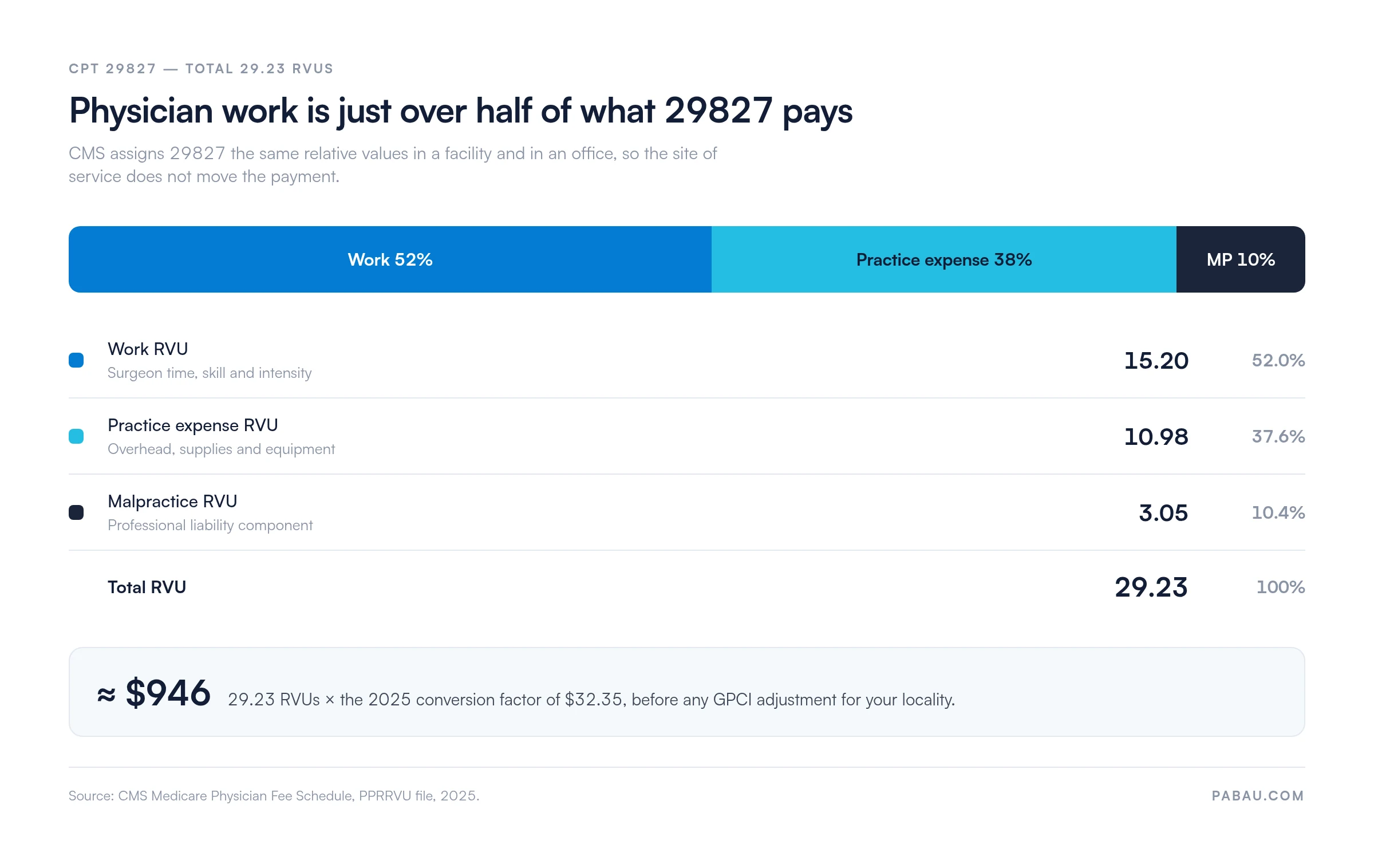
Medicare pays about the same for CPT 29827 wherever it is performed. CMS assigns the code identical facility and non-facility RVUs, so the site of service does not shift the physician payment. The figures below reflect 2025 Medicare national averages from the CMS Physician Fee Schedule lookup. Geographic Practice Cost Index (GPCI) adjustments still apply, so check the rate for your own locality.
Commercial contracted rates vary widely. Before appealing an underpayment, check the allowed amount for 29827 against your own payer contract rather than the Medicare national average. A clearinghouse submission also gives you real-time claim status and electronic remittance advice (ERA) on a high-value surgical code.
Verify CPT 29827 rates for your specific MAC (Medicare Administrative Contractor) jurisdiction using the CMS Physician Fee Schedule search tool. National averages can differ from your local rate by 10-20% depending on your GPCI values for work, practice expense, and malpractice.
Relative Value Units (RVUs) determine how Medicare calculates payment for CPT 29827. The total is the sum of three components. Each one is adjusted by the GPCI values for the practice’s location, then multiplied by the Medicare conversion factor (CF). The 2025 CF is roughly $32.35 per RVU, and CMS republishes it every year.
The figures above come from the CMS PPRRVU file, which CMS releases with each annual fee schedule. Confirm the values for the current year before using them in reimbursement projections or contract negotiations.
Modifier errors are one of the most common reasons a 29827 claim is denied or flagged for audit. The table below covers the modifiers most frequently required with this code.
Modifier 59 carries the highest audit risk of any modifier used with CPT 29827. Apply it only when the operative report documents a separately identifiable procedure on a distinct anatomical area or at a distinct session. Routine unbundling without clinical justification is a compliance violation under the CMS NCCI Policy Manual.
CPT 29827 sits in a family of shoulder arthroscopy codes. Knowing which one applies, and when two can be reported together, prevents both undercoding and improper unbundling. The table below crosswalks the codes most often encountered alongside it, per the AMA CPT code set.
A frozen shoulder released in the same session raises a separate coding question. Arthroscopic lysis of adhesions carries CPT 29825, which is separately reportable alongside 29827 only where the note documents two distinct pathologies.
The National Correct Coding Initiative (NCCI) edits govern what can be billed alongside CPT 29827. CMS updates them quarterly, so check the current edit pairs rather than a saved copy from last year.
Getting the pairs right protects the practice from both underpayment and compliance exposure. A clearinghouse will catch most edit conflicts before the claim reaches the payer, provided the code pairs leave your system correctly.
Key bundling principles for CPT 29827:
Insufficient documentation is the single most preventable cause of CPT 29827 denials. The operative report has to stand on its own as proof that the procedure the code describes took place. Checking that before submission costs far less than working an appeal afterwards.
Every CPT 29827 claim should be supported by documentation covering these elements:
Tear size and repair technique deserve particular care in the note. Payers use them to tell a straightforward repair from a complex multi-tendon repair, and the second one justifies the code without argument. Attach the operative note and the pre-operative imaging report at initial submission rather than waiting for a records request.
Denials on CPT 29827 cluster into four categories: modifier errors, bundling violations, missing prior authorization, and incomplete documentation. Building each one into a pre-claim checklist is the fastest way to cut rework. A repeat denial usually points at the workflow rather than at one coder.
For persistent bundling denials, start with the current quarter’s NCCI edit table. Our reference on medical billing denial codes covers the CARC reason codes and the right response to each. Track denial patterns by CPT code rather than by individual claim, so you can tell a documentation problem from a payer policy change.
Laterality checks are not specific to shoulder claims. Blepharoptosis repair, reported under CPT 67904, draws denials when the H02 diagnosis contradicts the eyelid named in the operative note.
Medicare does not require prior authorization for CPT 29827 in most circumstances. Commercial payers are a different story. Most major plans require prior authorization for elective shoulder arthroscopy with rotator cuff repair, including UnitedHealthcare, Aetna, Cigna, and many Blue Cross Blue Shield plans.
The same payer split shows up on drug lines. HCPCS code J1931 needs prior authorization from Medicare Advantage and most commercial plans before the first infusion, but traditional Medicare does not.
Requirements change often, so check the payer’s current policy before the case is scheduled. Catching an authorization requirement at booking costs far less than catching it after surgery.
Clinical information typically required for prior authorization includes:
When prior authorization is denied, the American Academy of Orthopaedic Surgeons (AAOS) provides appeal resources and coding guidance for shoulder arthroscopy procedures. A peer-to-peer review is often the faster route. The surgeon speaks directly with the payer’s medical director, which resolves a good share of first-pass authorization denials.
On a high-value surgical code like CPT 29827, the paperwork usually lives in three places. The operative report sits in the chart, the authorization confirmation in someone’s inbox, and the claim in a separate billing system. Every handoff is a chance to lose a document the payer wanted.
Practice management software like Pabau keeps them together. Its claims management software reads from the clinical record. Billing staff can check the required fields before the claim goes out, not after a denial.
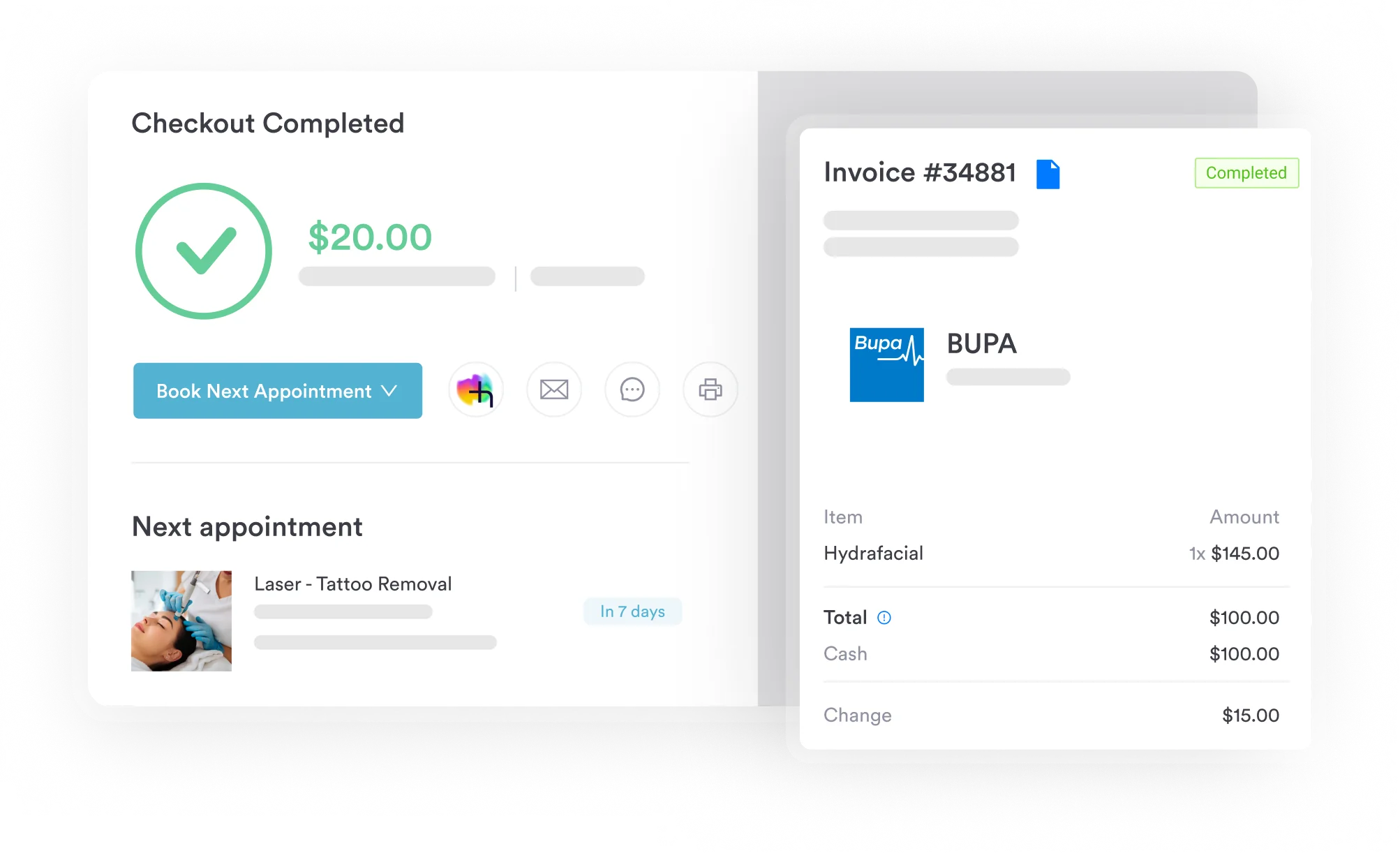
Pabau integrates with Claim.MD for electronic claim submission to thousands of US payers, covering CMS-1500 and 837P formats. ERA responses feed back automatically, so you can see which 29827 claims paid, which were denied, and under which CARC reason code.
That reporting is what makes denial patterns visible while you can still act on them. A run of the same CARC code on 29827 claims shows up before the month closes, not in a year-end write-off.

Pabau connects the operative note to electronic claim submission. Your billing team can check documentation and modifiers on a 29827 claim before it goes out.

Four things have to line up on the same 29827 claim. Those are the laterality modifier, a supporting ICD-10 diagnosis, an operative report that proves the repair, and any authorization the payer required.
Handled across disconnected systems, each one is a separate chance to lose the payment. Practices that keep their denial rate low on this code check all four before submission, not after the remittance arrives.
If your 29827 denials keep coming back for the same reason, the fix sits upstream of the billing team. Book a demo to see how Pabau links the operative note to the claim before it leaves the practice.

Need to understand how clearinghouse billing works? Medical claims clearinghouse overview explains how electronic claim routing reduces denials for surgical codes.
Tracking denials across your orthopedic practice? Getting credentialed with insurance companies covers the credentialing steps that affect claim acceptance rates for surgical providers.
Want to understand ERA and remittance responses? Electronic remittance advice guide breaks down how to read ERA files and apply payment posting for surgical claims.
Wondering what makes a claim pass first time? What is a clean claim in medical billing sets out the fields a payer checks before it pays.
Billing a surgical episode to a self-pay patient? What is a superbill shows which charges belong on the form and how patients claim them back.
CPT Code 29827 is the procedure code for arthroscopy, shoulder, surgical; with rotator cuff repair. It reports camera-guided surgical repair of torn rotator cuff tendons through small portals. It is distinct from open rotator cuff repair (23410, 23412) and from diagnostic shoulder arthroscopy (29805). The code is maintained by the American Medical Association and applies only to US billing under the CPT code set.
Yes, but not as two independent codes. CPT 29826 for acromioplasty has been an add-on code since 2012. It is only reportable in addition to a primary shoulder arthroscopy code such as 29827. Report 29827 first, then 29826 on the same claim when the subacromial decompression is performed and documented. Modifier 59 has no role here, and modifier 51 does not apply to add-on codes. Some payers still deny the pair, so check the plan’s policy first.
Medicare generally does not require prior authorization for CPT 29827. Most commercial payers do require it for elective shoulder arthroscopy with rotator cuff repair, including UnitedHealthcare, Aetna, Cigna, and many BCBS plans. Authorization requirements vary by payer and change frequently. Check the specific plan’s policy before scheduling any elective case.
CPT 29827 covers suture repair of torn rotator cuff tendons. CPT 29826 covers decompression of the subacromial space with partial acromioplasty. The bigger difference is structural. Since 2012, 29826 has been an add-on code, so it cannot stand alone on a claim. CPT 29827 is a standalone primary procedure code, and 29826 never substitutes for it when a formal cuff repair was performed.



