

HCPCS code E0198: Water pressure pad billing guide
HCPCS code E0198 is a water pad for a standard mattress HCPCS code E0198 is the ...

Last Updated: Oct 13, 2026
23120 is the CPT code for claviculectomy; partial. It covers open removal of part of the collarbone, usually the distal end at the acromioclavicular (AC) joint, as in the open Mumford procedure.
The approach decides the code. Total removal is 23125, and an arthroscopic distal clavicle resection is 29824. The operative report has to show an incision and the length of bone removed, or the claim stalls in review. Diagnosis pairing, modifier order and the 90-day global are where most 23120 claims go wrong.
Let Pabau's smart automation suggest the right codes, reduce claim denials, and keep your practice compliant—effortlessly.
Automate repetitive tasks and focus on what matters most—your patients.
Reduce coding errors and ensure compliance with the latest regulations.
Clean claims, fewer denials, and faster reimbursements.
Powerful insights and reporting to help your practice thrive.
HIPAA compliant SOC 2 certified GDPR-compliant Trusted by 4,000+ clinics worldwide

CPT code 23120 covers open partial claviculectomy only. Total removal is 23125, and the arthroscopic version is 29824.
CMS gives 23120 a 90-day global period, so routine post-op visits in that window are bundled into the surgical payment.
The 2026 national Medicare payment is about $565 in both facility and office settings, because the total RVU is 16.91 either way.
When 23120 shares a session with 29827, list 29827 first and add modifier 51 to 23120 only if the payer asks for it.
Pabau’s claims management software sends claims electronically through Claim.MD and returns eligibility checks and ERAs to the practice.
CPT code 23120 describes the open surgical removal of part of the clavicle, most often the distal end at the acromioclavicular (AC) joint.
The American Medical Association, which maintains the CPT code set, publishes the descriptor as Claviculectomy; partial. Removal of the whole bone is a different code, 23125.
Clinically, the procedure removes enough distal clavicle to stop bone-on-bone contact at the AC joint. The open Mumford procedure is the classic example. The surgeon makes a direct incision, excises 1 to 2 centimeters of the distal clavicle, and closes the wound. The arthroscopic Mumford uses portals instead and is coded as 29824.
Payers want the operative record to establish medical necessity. Common indications that support a 23120 claim include:
Each indication has to appear in both the clinical notes and the operative report. When the pre-operative diagnosis and the operative findings disagree, auditors notice, and orthopedic claims draw extra review.
Knowing the code’s scope prevents two opposite errors. One is unbundling services already included. The other is leaving legitimately distinct work unbilled.
The National Correct Coding Initiative (NCCI) publishes quarterly edit tables that define which procedure pairs bundle. Check the current version before billing 23120 alongside any arthroscopic shoulder code. A pair that was separately reportable in Q1 may bundle by Q3.
The surgical approach controls which code applies. Mixing up 23120 with 29824, the arthroscopic distal claviculectomy, is a common error on AC joint claims. Code 29826 sometimes gets pulled into the same decision, but it is an add-on for subacromial decompression, not a clavicle code.
Sometimes a surgeon starts arthroscopically and converts to open in the same session. Document the conversion in the operative note and report only the open code, 23120. Never bill both codes for one converted case.
Here’s the whole decision on one screen:
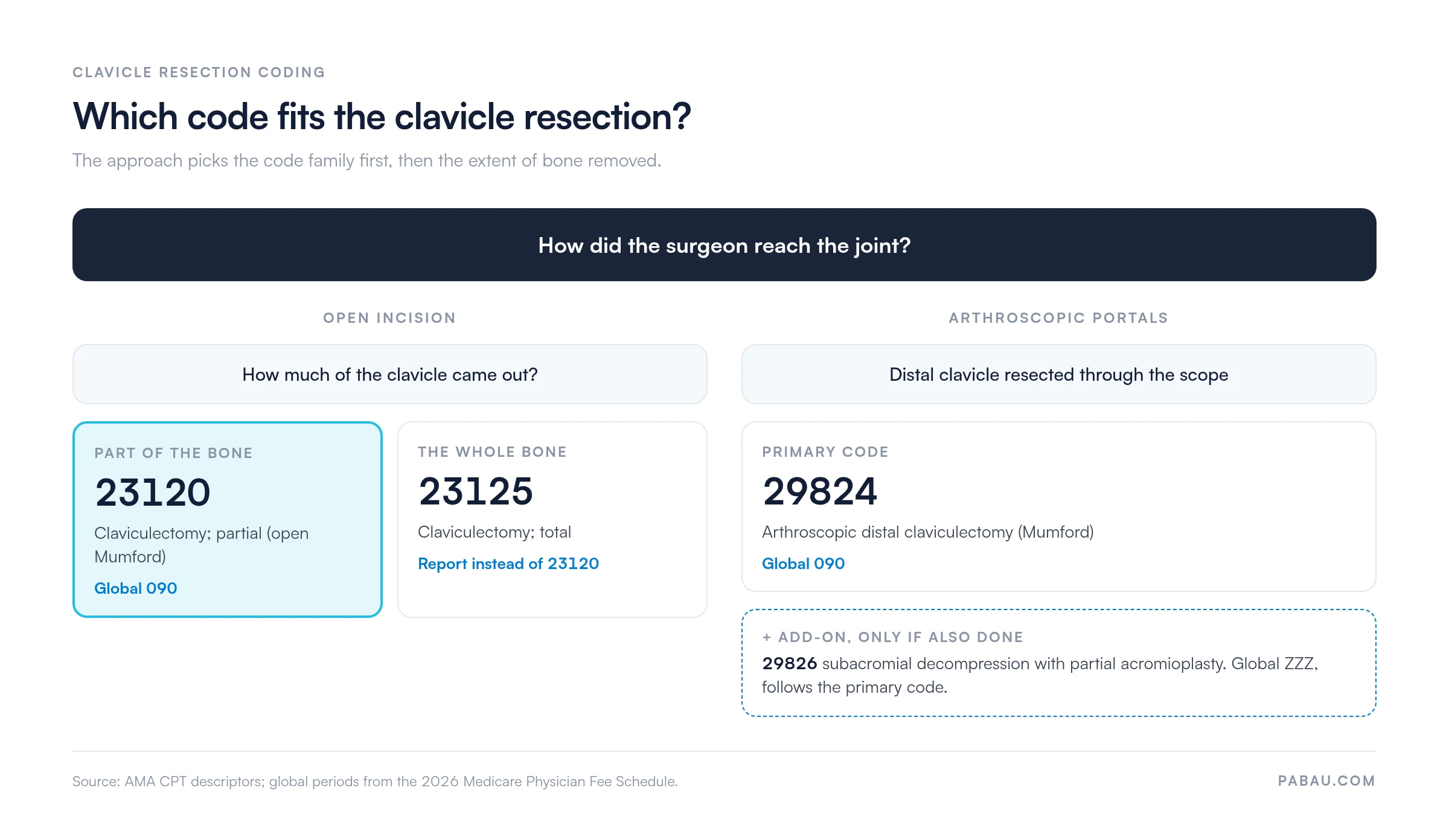
The ICD-10-CM code establishes medical necessity and decides whether the claim meets the Local Coverage Determination (LCD). Each Medicare Administrative Contractor (MAC) may publish its own list of covered shoulder diagnoses.
The codes below are commonly accepted, but check the applicable LCD before you submit.
Laterality is mandatory. Submitting M19.01 without the sixth character for right (1) or left (2) returns an invalid-code rejection before anyone reviews the claim. Specify the operative side in every field.
Medicare reimbursement for CPT code 23120 comes from the annual CMS Physician Fee Schedule. The 2026 national figure is about $565, using the $33.4009 conversion factor. Facility and office payments match because the total RVU is 16.91 in both settings.
Use the FastRVU RVU lookup or the CMS search tool to pull the work, practice expense, and malpractice RVUs for your locality. Geographic practice cost indices (GPCIs) then adjust the national figure up or down, so rural and high-cost urban practices see different payments.
CPT code 23120 carries a 90-day global surgical period under CMS. During that window, the operating surgeon can’t separately bill these services:
Some services inside the window stay billable. Unrelated E&M visits take modifier 24, new conditions needing distinct treatment take modifier 79, and staged procedures take modifier 58. Spell out the clinical distinction in the encounter note.
Run a global period tracker in your billing software from the date of service, not the date of surgery scheduling. CMS counts the global period from the day of surgery; the pre-operative day is included. Billing a routine post-op E&M without modifier 24 during an active 90-day global is one of the most audited errors in orthopedic practices.
Modifier choice for CPT code 23120 turns on two questions. Did the surgeon perform other procedures in the same session, and what does the payer’s NCCI edit require? A wrong or missing modifier is a frequent denial trigger.
The AAPC Codify CPT lookup shows modifier guidance and NCCI edit status for 23120. NCCI edits update quarterly, so check the edit table in effect on the date of service, not today’s.
Most commercial payers and Medicare Advantage plans require prior authorization for elective shoulder surgery, claviculectomy included. Requirements vary by payer, but most requests ask for the same core documents:
Good medical billing compliance means confirming authorization before the surgery date, not at claim submission. A claim that reaches adjudication without an approved auth comes back as a CO-197 denial, which is hard to fix after the fact.
Thin operative documentation is a leading reason 23120 claims get denied or downcoded after audit. The report should contain each of these elements before the claim goes out.
A clean claim submission starts with documentation that is complete before the claim leaves the practice. Operative reports amended after a denial get extra scrutiny from commercial payers and Medicare RAC auditors.
Once the report is signed, the claim follows a predictable path. Each step is a place it can stall.
23120 claims sit where medical necessity, NCCI bundling, and authorization meet, so several things can go wrong. Each denial reason below maps to one prevention step.
Effective denial management workflows add a pre-claim scrub that checks authorization, NCCI edits, and diagnosis-to-procedure linkage. Reading the medical billing denial codes on each ERA lets billers appeal with the right documents the first time.
Shoulder surgery claims rarely carry a single code. Knowing the neighboring codes protects revenue from separately reportable work and avoids denials for improper unbundling.
When rotator cuff repair (29827) and open claviculectomy happen in the same session, list 29827 first. It carries the higher RVU, so 23120 becomes the secondary procedure and takes modifier 51 where the payer requires it.
Medicare contractors apply the multiple-procedure payment reduction automatically, and many commercial payers do the same. In medical billing, that sequence decides which line is paid at 100% and which is reduced.
Many orthopedic practices still key surgical claims into a clearinghouse portal by hand. Then they phone payers to check eligibility and wait days to learn a claim was denied. Every handoff adds a chance to drop a laterality modifier or miss an auth number.
Pabau’s claims management software sends claims electronically through its Claim.MD integration. Eligibility checks run before the surgery date. ERAs post back against the patient record, so a CO-97 or CO-197 shows up the day it lands.
Coding decisions stay with your coders. Pabau doesn’t pick modifiers or apply NCCI edits, but it cuts the retyping and chasing between the op note and the payment.

Pabau submits claims electronically through Claim.MD and posts eligibility and ERA responses back to the patient record. Your team sees a denied 23120 claim the day it lands.

For 23120, the operative note does most of the coding work. If it states an incision and a partial resection length, the code holds up. If it doesn’t, no modifier will rescue the claim.
So make the op note your first check, then confirm the authorization and NCCI edits before release. The trade-off is a few extra minutes per claim against a 90-day global window you can’t rebill once a denial lands.
Book a demo to see how Pabau gets your shoulder surgery claims to payers faster and flags denials as soon as they post.

Coding the arthroscopic version instead? CPT code 29824 covers distal claviculectomy through the scope, with its own documentation rules.
Adding a subacromial decompression? CPT code 29826 explains how the add-on rides on a primary arthroscopic shoulder code.
Need help managing surgical claim denials systematically? Denial management in healthcare covers the full workflow for tracking, appealing, and preventing claim denials across procedure types.
Want to understand how clearinghouse submission works? Medical claims clearinghouse explains how electronic claims move from the practice to the payer and where errors are caught.
Looking for a compliance framework for orthopedic billing? Medical billing compliance outlines the documentation and audit readiness requirements that protect practices during post-payment review.
It depends on the approach. An open Mumford procedure, done through an incision over the AC joint, is 23120. The arthroscopic Mumford, done through portals, is 29824.
Report 23125 when the surgeon removes the entire clavicle. Code 23120 is limited to partial removal, so the operative report’s resection length decides between the two.
No. 29826 is an add-on code with a ZZZ global, reported only with a primary arthroscopic shoulder code such as 29824 or 29827. An open 23120 can’t carry it.
CO-97 means the payer treats the service as already paid inside another service or the global package. For a post-op visit, add modifier 24 or 79 when the visit is unrelated or a new problem.
Most commercial and Medicare Advantage plans require it for elective shoulder surgery. Send imaging, at least six weeks of failed conservative care, and the planned open approach with the request.



