28290 is a deleted CPT code for correction of hallux valgus (bunion), with or without sesamoidectomy, by simple exostectomy (eg, Silver type procedure). The AMA removed it on January 1, 2017, so any claim that still carries it comes back as an invalid code.
The surgery itself is still billable under newer codes. A simple exostectomy is now usually reported with 28292, while corrections that add an osteotomy or a fusion move to 28295 through 28299. Getting that swap right decides whether a legacy claim, an appeal or an old superbill template gets paid. The sections that follow map each technique to its code, walk a corrected claim through submission and list the mistakes that trigger denials.
Related Information
Section
10004-69990 Surgery
Subsection
20100-29999 Musculoskeletal system
Code range
28001-28899 Foot and toes
Billable
No
Code also known as
bunionectomy, Silver procedure, bunion shaving, hallux valgus correction, Silver type bunionectomy
Save time. Improve accuracy. Get paid faster.
Automate coding with Pabau
Let Pabau's smart automation suggest the right codes, reduce claim denials, and keep your practice compliant—effortlessly.
Automate repetitive tasks and focus on what matters most—your patients.
Improve accuracy
Reduce coding errors and ensure compliance with the latest regulations.
Get paid faster
Clean claims, fewer denials, and faster reimbursements.
Grow with confidence
Powerful insights and reporting to help your practice thrive.
HIPAA compliant•SOC 2 certified•GDPR-compliant•Trusted by 4,000+ clinics worldwide
Key takeaways
CPT code 28290 was deleted on January 1, 2017, so a claim that carries it is rejected as an invalid code.
A simple exostectomy, the old Silver procedure, is now usually reported with 28292, which involves no metatarsal osteotomy.
Corrections with an osteotomy or a fusion move to 28295 through 28299, chosen by where the surgeon cut or fused.
For a legacy or reopened claim, void the 28290 line and submit a corrected claim with the successor code rather than appealing.
Pabau, practice software with built-in claims management, pre-fills CPT and ICD-10 codes from the patient record and checks required claim fields before submission.
CPT code 28290 is deleted, so bill its successor instead
CPT code 28290 described a hallux valgus correction by simple exostectomy, and it hasn’t been billable since January 1, 2017. AAPC’s deleted-code record lists 28290 as a deleted code from that date. The American Medical Association (AMA), which maintains the CPT code set, retired it in a rewrite of the bunion correction codes.
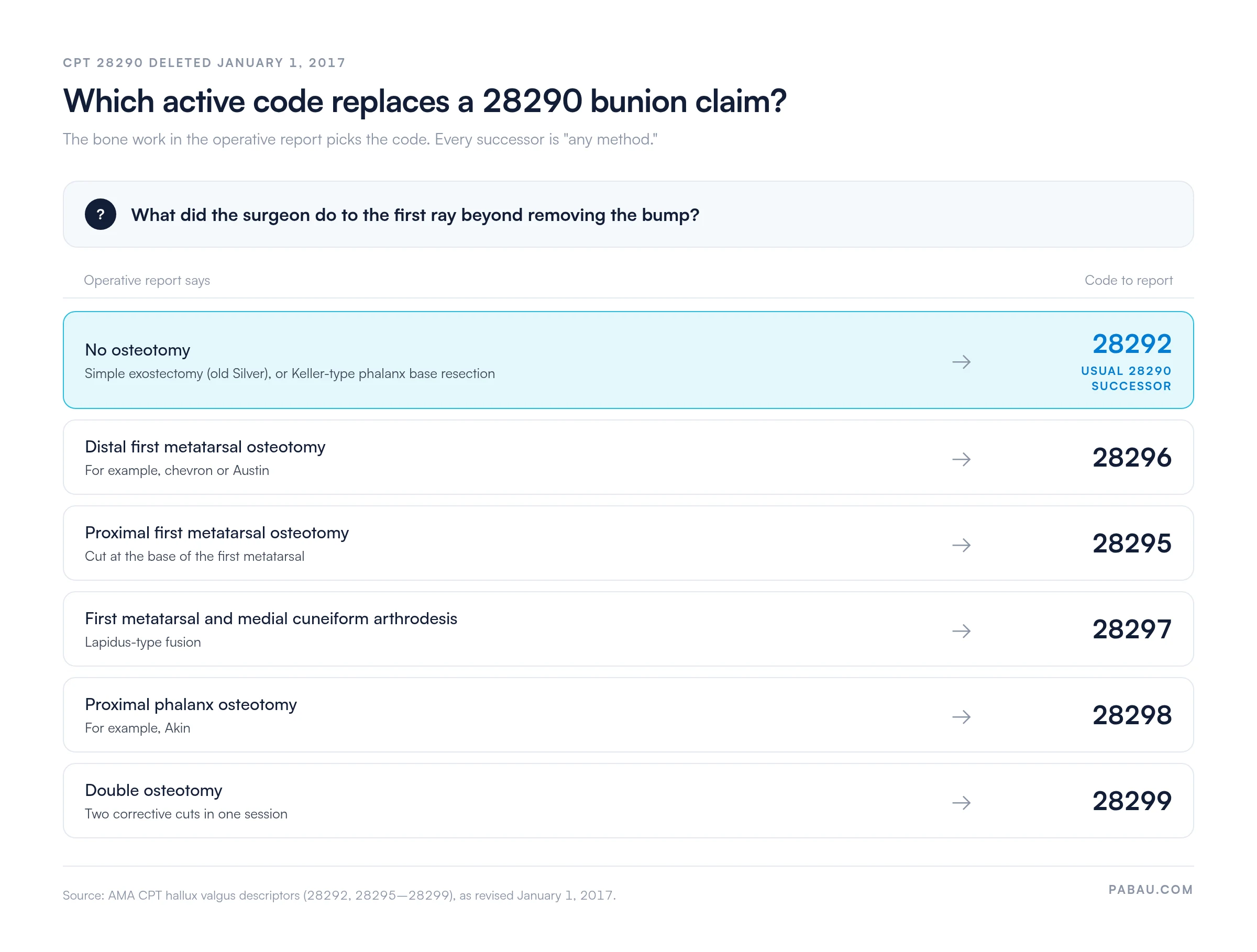
That rewrite sorted bunion surgery by technique. A bump removal with no bone cut now usually goes to 28292. Corrections that add an osteotomy or a fusion go to 28295 through 28299.
Field
Detail
Code number
28290
Official descriptor
Correction, hallux valgus (bunion), with or without sesamoidectomy; simple exostectomy (eg, Silver type procedure)
Code status
Deleted (effective January 1, 2017)
Specialty
Podiatry, orthopedic surgery, general surgery
Code family
Musculoskeletal system, foot and toes (28001-28899)
Replacement codes
28292 (bunionectomy without osteotomy, Keller-type resection included), plus 28295, 28296, 28297, 28298 and 28299 (osteotomy and arthrodesis variants)
28290 covered a bump removal and nothing more
While it was active, 28290 had a narrow scope. The surgeon removed the medial eminence of the first metatarsal head, the bony prominence of a bunion, without cutting or realigning the metatarsal. The Silver procedure is the technique the descriptor named.
What the procedure included
Medial eminence resection: Removal of the bony bump on the inside of the first metatarsal head with a saw or osteotome.
Capsular repair: Tightening of the medial capsule to stabilize the first metatarsophalangeal (MTP) joint after the bump came off.
Optional sesamoidectomy: Removal of one or both sesamoid bones when they were involved. The “with or without” wording bundled it into 28290, so it was never billed separately.
No osteotomy: A cut that changed the metatarsal’s angle took the case outside 28290. It moved into the osteotomy codes (28295, 28296 and related 282xx codes).
The operative report had to rule out a bone cut
Documentation had to show the procedure stopped at the exostectomy. An operative report describing a chevron cut, a Scarf osteotomy or any angular correction ruled out 28290. The missing osteotomy step was the deciding detail, and it still is for the successor codes.
Pick the replacement code from the bone work, not the bunion
With 28290 gone, the operative report picks the hallux valgus correction CPT code. The table maps each active code, plus two that often get confused with them, to the feature that separates it.
CPT code
Descriptor (summary)
Key distinguishing feature
Status
28290
Simple exostectomy (Silver type), with or without sesamoidectomy
Medial eminence removal only; no osteotomy
Deleted 2017
28292
Bunionectomy with sesamoidectomy when performed; with proximal phalanx base resection when performed, any method
No metatarsal osteotomy. This is the usual successor for a simple exostectomy.
Active
28296
Bunionectomy with distal metatarsal osteotomy, any method
Lesser metatarsal osteotomy; not for first-ray hallux valgus
Active
28285
Correction of hammertoe (eg, interphalangeal fusion, partial or total phalangectomy)
Lesser toe deformity correction; unrelated to first-ray hallux valgus
Active
The guide below turns that table into one question about the operative report, with one answer per technique.
Most old 28290 cases land on 28292, because a simple exostectomy involves no bone cut. Codes follow the AMA’s 2017 hallux valgus descriptors.
The selection rule, technique by technique
No osteotomy: A simple exostectomy or a Keller-type resection is reported with 28292.
Distal first metatarsal osteotomy: A chevron or Austin cut is reported with 28296.
Proximal first metatarsal osteotomy: A cut at the base of the metatarsal is reported with 28295.
Lapidus fusion: Arthrodesis of the first metatarsal and medial cuneiform joint is reported with 28297.
Phalanx osteotomy: A proximal phalanx cut, such as an Akin, is reported with 28298.
Double osteotomy: Two corrective cuts in the same session are reported with 28299.
How a legacy 28290 claim moves from chart to payment
Most 28290 claims you meet today are reopenings, audit requests or rejections caused by an outdated template. Each one follows the same path.
Find where the code lives. Old superbills, EHR templates, prior authorization forms and remittance advice can still carry 28290. Take it off any template still in use.
Check the date of service. Before January 1, 2017, 28290 was valid. An audit of that claim judges it against the code set in force at the time.
Read the operative report. Map the documented technique to its successor with the selection rule above.
Rebuild the claim line. Add the successor code, RT or LT, and an M20.1- diagnosis that matches the treated foot.
Confirm the authorization. An approval issued against 28290 may not cover the new code, so check it before you resubmit.
Submit a corrected claim. Void the 28290 line rather than appealing it, and keep the AMA’s 2017 code change summary on file.
Read the remittance. A CO-181 or CO-4 on the corrected claim means a deleted or invalid code is still on it somewhere.
Pair the successor code with an M20.1- diagnosis
Medical necessity for a bunion correction needs a supporting ICD-10-CM code, whether the claim was billed under 28290 or a current code. The CMS ICD-10-CM code list and the applicable MAC LCD set out which diagnoses qualify. The M20.1- family covers acquired hallux valgus.
ICD-10-CM code
Description
Use when
M20.10
Hallux valgus (acquired), unspecified foot
Laterality not documented; prefer a laterality-specific code when available
M20.11
Hallux valgus (acquired), right foot
Right-foot procedure; pair with modifier RT on the CPT line
M20.12
Hallux valgus (acquired), left foot
Left-foot procedure; pair with modifier LT on the CPT line
M79.671
Pain in right foot
Secondary code when pain drives the surgery; list M20.11 as the principal diagnosis
M79.672
Pain in left foot
Secondary code for left-foot pain; supplementary to the deformity code
Laterality has to agree across the claim. A left-foot bunionectomy pairs M20.12 with modifier LT, and a mismatch between the two is an easy denial. Some LCDs also keep an explicit list of covered diagnoses. A code outside that list gets denied even when it’s clinically accurate.
Pro Tip
Run an ICD-10-to-CPT crosswalk before submission to confirm your diagnosis code is on the payer’s LCD-approved list for the specific procedure code. The AAPC Codify crosswalk tool and the CMS LCD database both provide diagnosis-to-procedure mapping for active foot surgery codes.
Modifiers still decide whether the successor claim pays
The modifier rules that applied to 28290 carry straight over to its successors. Laterality and bundling cause most of the trouble.
Modifier
When it applies
Payer notes
RT / LT
Use RT or LT to show which foot was treated when the procedure is unilateral.
Medicare and most commercial payers require RT/LT for laterality. Omitting them triggers a missing-modifier denial.
50
Bilateral procedure performed in the same session on both feet
Medicare pays 150% of the single-unit rate for bilateral surgical codes. Some commercial payers want two lines with RT and LT instead, so check payer policy first.
22
Increased procedural complexity beyond the standard descriptor scope
Needs an operative note explaining what made the case substantially harder. Overuse is an audit flag, so apply it only when documentation clearly supports it.
59
Distinct procedural service performed at a separate site or during a distinct encounter
Do not use 59 to unbundle sesamoidectomy, since it is included in the descriptor. Reserve 59 for a truly distinct procedure at a separate site.
Pro Tip
Check the bilateral surgery indicator for each active successor code (28292, 28296) in the Medicare Physician Fee Schedule before submitting. Some codes carry Indicator 1 (bilateral pays 150%), others carry Indicator 0 or 9. Applying modifier 50 to a code with Indicator 9 will not increase payment and may trigger an edit.
Documentation that holds up for any bunionectomy code
Appeals on old 28290 claims turn on the same records the successor codes need. A clean claim for any bunionectomy rests on four pieces of evidence.
Failed conservative treatment: Chart evidence that orthotics, padding, anti-inflammatory medication or shoe changes were tried, with dates and duration. The minimum duration varies by payer, so check the MAC’s LCD rather than assuming a number of weeks.
Radiographic evidence: Weight-bearing foot X-rays confirming the deformity. Record the hallux abductus angle (HAA) and first intermetatarsal angle (IMA), since many LCDs set minimum angles for coverage.
A specific operative report: “Bunion repair performed” isn’t enough. State the technique, the instruments, the extent of resection and whether a sesamoidectomy or osteotomy was done.
A post-operative plan: Care instructions, follow-up and the expected recovery timeline round out medical necessity.
From a payer’s point of view, an undocumented step didn’t happen. Thin operative notes are a frequent cause of medical necessity denials on elective foot surgery.
Prior authorization depends on who pays
Authorization rules for bunion surgery vary by payer class and plan. Traditional Medicare doesn’t require prior authorization for most elective foot surgery, but Medicare Advantage plans often do. Confirm the requirement when you verify coverage at scheduling.
Medicare (traditional FFS): Generally no prior authorization for the exostectomy or its successor codes. Medical necessity documentation must still be in the chart and available on request.
Medicare Advantage: Treat it like a commercial plan. Most require authorization for elective foot surgery, with evidence of failed conservative treatment.
Commercial insurers: Many require authorization for any 282xx procedure. Send the conservative treatment note, the radiology report with angles and the proposed code.
Medicaid: Coverage varies by state. Some programs exclude elective bunion surgery, while others cover it under set criteria, so check the state provider manual first.
Medicare has no rate for 28290, so price the successor
Because 28290 is deleted, it carries no active Medicare Physician Fee Schedule (MPFS) rate. An RVU lookup returns nothing or a pre-2017 figure that no longer applies. For current planning, query the successor code in the CMS Physician Fee Schedule lookup tool.
How RVU-based reimbursement works for podiatric surgery codes
Medicare pays surgical foot codes through the Resource-Based Relative Value Scale (RBRVS). The FastRVU lookup tool shows the work, practice expense and malpractice RVUs by code, with geographic adjustments by locality.
RVU component
What it covers
Where to verify
Work RVU (wRVU)
Physician time, skill and mental effort
CMS PFS lookup or FastRVU for the active code
Practice expense RVU
Staff time, supplies and equipment overhead
Varies by facility vs. non-facility setting
Malpractice RVU
Malpractice insurance cost allocation
CMS PFS lookup for the active code
Geographic adjustment (GPCI)
Cost-of-living and wage variation by Medicare locality
CMS locality fee schedule by MAC jurisdiction
Commercial payers negotiate separately. Many pay a percentage of the Medicare allowable, and others set custom contracted rates. Check the contracted amount in the provider agreement rather than assuming Medicare rates apply.
Before you submit: A quick checklist for successor claims
Run through these six checks before a corrected bunion claim leaves the practice.
No 28290 anywhere. Search the claim, the superbill and the charge template, not just the line you edited.
Code matches the bone work. No osteotomy means 28292. Any cut or fusion means a code from 28295 to 28299.
Laterality agrees. RT pairs with M20.11, and LT pairs with M20.12.
Sesamoidectomy isn’t on its own line. It’s included in the successor descriptors.
Authorization covers this code. The approval should name the successor, not 28290.
The evidence is attached or on file. That means the conservative treatment notes, the X-ray angles and a specific operative report.
Denials on 28290 claims follow a predictable pattern
Denials on 28290 claims fell into a handful of categories, and the same ones hit the successor codes. Each remark code points to a specific fix. For the full list, see our guide to medical billing denial codes.
Denial reason
Typical remark code
Recommended action
Invalid or deleted code
CO-181 (procedure code invalid on date of service) / CO-4
Void and rebill with the correct successor code from the selection rule. Don’t appeal a deleted code; correct it and resubmit.
Missing conservative treatment documentation
CO-50 / N115
Appeal with chart notes showing conservative treatment, dates and outcomes. Request a clinical review if the first denial was automated.
Missing or incorrect laterality modifier
CO-4
Correct the RT or LT modifier and resubmit. Most payers accept a corrected claim rather than a formal appeal for modifier edits.
Unbundling: sesamoidectomy billed separately
CO-97
Sesamoidectomy is included in the descriptor. Void the separate line and rebill without it unless a valid NCCI edit exception applies.
No radiographic evidence in the record
CO-50 / N115
Appeal with the radiology report documenting the hallux valgus angles, plus the clinical note that references them.
Prior authorization required but not obtained
CO-15
Retrospective authorization is rarely granted, so verify requirements at scheduling. Some plans allow retro-auth for emergency or urgent cases only.
Common mistakes that turn a bunion claim into a denial
Resubmitting 28290 with a new date. The code is invalid on every date of service after 2016, so the claim bounces again.
Reading 28292 as the old Keller code. Since 2017 it covers a bunionectomy without osteotomy, with sesamoidectomy and phalanx base resection when performed.
Calling an exostectomy an osteotomy. Shaving the bump isn’t a bone cut. Reporting 28296 for it overcodes the case.
Billing modifier 59 on a sesamoidectomy. It’s bundled into the descriptor, so the extra line invites a CO-97.
Leaving old templates live. One superbill that still lists 28290 keeps producing the same rejection.
How Pabau keeps bunionectomy claims complete before they go out
Without a connected system, a podiatry team builds each bunion claim by hand from the operative note, the diagnosis and a payer portal. Every handoff is a chance for an old code or a blank field to slip through.
Pabau pre-fills the CPT and ICD-10 codes from the patient record, and its ICD-10-CM and CPT lookup libraries help you pick the successor. Before submission, it checks that the required claim fields are complete. Its podiatry claims management runs through Claim.MD for real-time eligibility checks, ERA posting and claim-status tracking.
Your billing team then spends its time on the coding decision itself, which is where a 28290 claim is won or lost.
Build complete podiatry claims from the chart
Pabau pre-fills CPT and ICD-10 codes from the patient record and checks required claim fields before submission. Eligibility checks, ERA posting and claim-status tracking run through Claim.MD.
Whenever 28290 turns up, on a template, a denial or an audit request, the fix starts in the operative report. The code itself can’t be saved, but the procedure behind it can still be billed correctly.
If the surgeon removed the bump and cut no bone, 28292 is almost always the answer. Any osteotomy or fusion moves the claim into the 28295 to 28299 range, and the note has to show which one.
A corrected claim takes longer than a quick resubmission, but a rebilled 28290 line only comes back again. Book a demo to see how Pabau pre-fills codes from the record and checks each claim before it leaves your practice.
Continue your research
Need a systematic approach to reducing claim rejections?Denial management in healthcare covers the full workflow from root-cause analysis through appeal submission.
Submitting claims through a clearinghouse for the first time?Medical claims clearinghouse explains how clearinghouses validate, route, and report on claims across payers.
Want to understand the 837P file your clearinghouse transmits?837 file breaks down the EDI transaction format used for professional claims.
Coding a tailor’s bunion on the fifth toe instead?CPT code 28110 covers partial excision of the fifth metatarsal head for a bunionette.
Frequently asked questions
Which CPT codes replaced 28290?
No single code replaced it. A simple exostectomy usually maps to 28292, a bunionectomy with sesamoidectomy when performed, with proximal phalanx base resection when performed. Osteotomy corrections use 28295 (proximal metatarsal), 28296 (distal metatarsal osteotomy), 28297 (Lapidus fusion), 28298 (phalanx) or 28299 (double osteotomy).
What is the CPT code for a Silver bunionectomy?
Since 2017, a Silver bunionectomy, which removes the medial eminence without a bone cut, is reported with 28292. The Silver name no longer appears in any active CPT descriptor.
Can you still bill 28290 for a date of service before 2017?
In principle, yes, because the code was valid on that date. In practice, Medicare’s one-year filing limit means those claims closed long ago. You’ll mostly meet 28290 in audits, reopenings and old records.
What denial code does a deleted CPT code get?
Expect CARC CO-181, procedure code invalid on the date of service, or CO-4. Neither is worth appealing. Void the line and submit a corrected claim with the successor code.
Which CPT code covers hallux rigidus instead of hallux valgus?
Hallux rigidus has its own codes. 28289 covers cheilectomy, debridement and capsular release of the big toe joint without an implant, and 28291 covers the same work with an implant.
Is 28290 the same as a bunionette procedure?
No. A bunionette, or tailor’s bunion, sits on the fifth metatarsal. It has its own codes, such as 28110 for partial excision of the fifth metatarsal head. 28290 only covered the big toe.