

CCSD code G5100: Bypass of duodenum billing guide
CCSD code G5100 bills a bypass that leaves the duodenum in place CCSD code G5100...

Last Updated: Oct 16, 2026
26600 is the CPT code for closed treatment of a single metacarpal fracture without manipulation, reported once for each bone treated.
It is one of four closely related closed-treatment codes (26600, 26605, 26607, 26608). Picking the wrong one is a frequent source of payer denials in hand billing. Coders often confuse 26600 with 26605 when the note is unclear about whether reduction was attempted.
Let Pabau's smart automation suggest the right codes, reduce claim denials, and keep your practice compliant—effortlessly.
Automate repetitive tasks and focus on what matters most—your patients.
Reduce coding errors and ensure compliance with the latest regulations.
Clean claims, fewer denials, and faster reimbursements.
Powerful insights and reporting to help your practice thrive.
HIPAA compliant SOC 2 certified GDPR-compliant Trusted by 4,000+ clinics worldwide

CPT 26600 covers closed treatment of a single metacarpal fracture without manipulation, so the bone fragments are not reduced or realigned.
The code carries a 90-day global period that bundles related follow-up visits. Only the initial splint or cast application is included, so replacement casts and splints are reported separately.
Splint application codes 29130 and 29131 cannot be billed with CPT 26600 on the same date, because NCCI bundles them into the fracture care.
Pabau, the practice management platform we build, submits claims electronically through Claim.MD and tracks their status.
CPT code 26600 reports closed treatment of one metacarpal fracture when the physician immobilizes the hand without manipulating the bone. The official AMA descriptor reads: “Closed treatment of metacarpal fracture, single; without manipulation, each bone.” The phrase “each bone” means you report 26600 separately for each metacarpal treated on the same date of service.
The code sits in the Surgery section of the AMA CPT code set, under the Musculoskeletal System subsection for the hand and fingers. It opens the fracture and dislocation range 26600 to 26785, alongside the other CPT codes for hand procedures.
Imaging is not part of the 26600 work. A three-view hand X-ray taken at the visit goes on the claim as its own line, usually as 73130.
Closed treatment means no incision is made to reach the fracture. “Without manipulation” narrows it further, because the physician does not move or realign the bone fragments. The fracture is stable, or its angulation is clinically acceptable, so immobilization alone is the right treatment.
The clinical sequence that justifies billing 26600 typically follows these steps:
The note must make the absence of manipulation explicit. A note that reads “fracture treated and splint applied” leaves the code selection open to question. Payers often deny or downcode that claim until the documentation is clarified.
Four codes cover closed or percutaneous care of a metacarpal fracture: 26600, 26605, 26607 and 26608, which reports percutaneous skeletal fixation. Percutaneous pinning of a proximal or middle phalanx is coded 26727 instead of 26608. The table compares the three closed-treatment options. Selecting the right one depends on whether manipulation was performed and whether external fixation was applied.
Key distinction: a splint applied with no attempt to reposition the fracture is 26600. If the physician applies traction, uses a finger trap, or manually adjusts the metacarpal before splinting, the claim moves to 26605 at minimum. Billing 26605 when the note documents no manipulation is upcoding. Billing 26600 after a documented reduction is undercoding, and the practice absorbs the lower payment.
Open reduction takes the claim out of this family altogether. 26615 covers open treatment of a single metacarpal fracture, including internal fixation when performed. The decision tree below maps the note’s answers to each closed-treatment code.
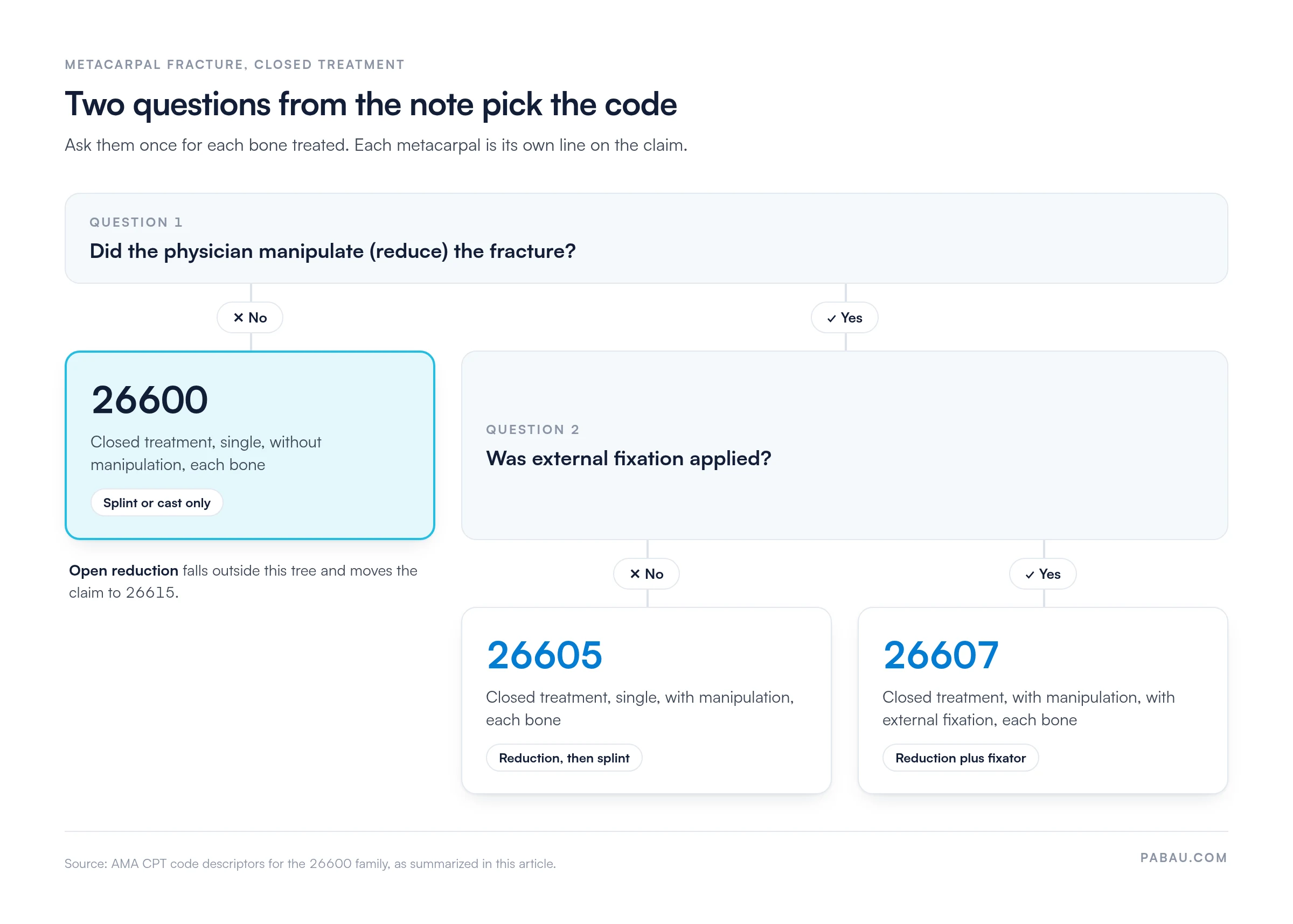
Before submitting a claim, verify the clinical note explicitly states whether manipulation was or was not performed. A note that says ‘fracture reduced and splinted’ justifies 26605. A note that says ‘fracture in acceptable alignment, splint applied’ justifies 26600. When in doubt, query the treating physician before coding – not after a denial lands.
Every CPT 26600 claim needs a supporting ICD-10-CM diagnosis from the metacarpal fracture categories. The range is S62.2x–S62.4x. S62.2- covers the first metacarpal, S62.3- the second through fifth, and S62.4- multiple metacarpal fractures.
Laterality sits in the 6th character. The 7th character carries only the encounter type, such as A (initial encounter for closed fracture), D (subsequent encounter with routine healing) or S (sequela). The encounter type must match the date of service. An initial encounter suffix (A) on a follow-up visit is a common pairing error in fracture care.
The full S62 subcategory set covers all five metacarpals with distinct codes for each bone and side. Verify the specific code against the CDC/NCHS ICD-10-CM web tool for the current fiscal year. The CDC updates code descriptions and valid character extensions annually.
The clinical note must support every element of the code selection. For submitting a clean claim on 26600, the encounter documentation needs to contain all five of the following elements.
A note that covers all five points answers the questions a payer would otherwise raise before downcoding 26600.
CPT 26600 carries a 90-day global period under the CMS global surgical package. The original payment bundles related follow-up services within 90 days of the procedure date, so you cannot bill them separately. A standard E/M visit for a fracture recheck in this window will deny, or payers will recoup it on audit.
Services bundled in the 90-day global period:
Services you can bill separately during the global period, with the correct modifier:
A related follow-up E/M billed in the window denies as bundled. Modifier -24 is only for unrelated services, so it cannot turn a fracture recheck into a billable visit.
The National Correct Coding Initiative (NCCI) bundles certain codes with 26600, so you cannot bill them separately on the same date of service. Splint codes such as 29130 are the usual conflict, because the splint is part of the fracture care. These are the edits to check on every 26600 claim:
CMS updates NCCI edits quarterly. Verify current edit pairs in the CMS Physician Fee Schedule or the NCCI policy manual before assuming a modifier can unbundle a pair.
CMS calculates Medicare reimbursement for CPT 26600 using the Resource-Based Relative Value Scale (RBRVS). CMS publishes the work, practice expense, and malpractice RVU components annually in the Medicare Physician Fee Schedule. For current national rates, use the FastRVU 2026 RVU lookup tool or the CMS MPFS search directly. Dollar amounts change with each year’s conversion factor and vary by geographic practice cost index (GPCI).
Medicaid rates for 26600 vary substantially by state, as each state administers its own fee schedule. When reading electronic remittance advice on 26600 claims, check that the allowed amount matches your contracted rate. Underpayments on fracture care codes often surface only when you review the ERA systematically.
Commercial rates are set by individual contracts. Negotiate and verify them against the practice’s fee schedule agreement rather than assuming them from Medicare benchmarks.
Most CPT 26600 denials trace back to one of six root causes. Structured denial management workflows can catch and resolve these before they become write-offs.
The AMA descriptor for CPT 26600 includes the phrase “each bone.” The code may therefore be reported more than once on the same date when more than one metacarpal is treated without manipulation. That matters for hand trauma patients with two or three metacarpal fractures from a single incident.
How to bill multiple metacarpal fractures: report CPT 26600 once per bone. That holds whenever two or more metacarpals on the same hand are treated the same day without manipulation. Append modifier -59 (distinct procedural service) or XS (separate structure) to each additional unit. This tells the payer the services were performed on separate anatomical structures, not submitted twice.
Example: a patient presents with closed fractures of the right 3rd and 4th metacarpals, both in acceptable alignment and both splinted with no manipulation. The correct claim is 26600 for the right 3rd metacarpal, plus 26600-59 or 26600-XS for the right 4th. Document each metacarpal separately in the note, so the payer’s review matches the claim line by line.
Verify this approach against the AAPC Codify CPT lookup and the current AMA CPT codebook before submitting. Modifier guidance can change with annual code revisions.
Audit your 26600 claims monthly for global period and splint unbundling errors. Pull a 90-day rolling report of E/M visits after each 26600 encounter. Related rechecks should not be billed at all, and only a visit unrelated to the fracture should carry modifier -24.
The denials above start in the note or at claim entry. A missing manipulation statement, a stale encounter suffix, or a recheck billed inside the global window each sends a 26600 claim back to the practice.
Pabau, the practice management platform we build, keeps the treatment note, the diagnosis and the invoice on one patient record. Its claims management software submits claims electronically through Claim.MD and tracks their status. Your billing team can follow each 26600 claim from submission to payment.
Code selection stays with your coder and physician. What Pabau takes off their plate is the re-keying, the status chasing, and the remittance matching once the payer responds.
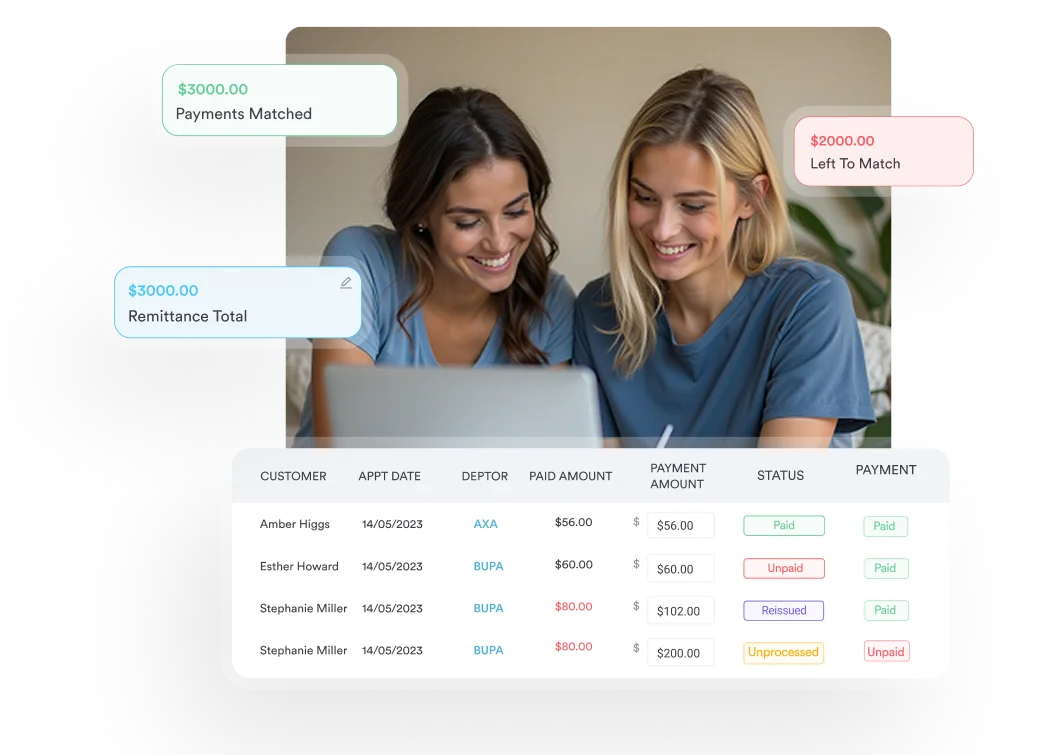

Pabau submits your fracture care claims electronically through Claim.MD and tracks their status, so your billing team spends less time chasing rework.

Code 26600 from the note, not from memory of the visit. If the record states acceptable alignment and no reduction, the claim is defensible. If it doesn’t, query the physician before you submit, because a downcode is harder to reverse than a question is to ask.
Treat the 90-day window with the same care. The original payment already covers related rechecks, while you bill replacement casts and genuinely unrelated visits on their own terms.
Book a demo to see how Pabau submits and tracks your fracture care claims through Claim.MD.

Need a structured approach to claim denials? Denial management in healthcare covers the root-cause analysis frameworks billing teams use to reduce rework.
Submitting fracture claims electronically? Claim.MD clearinghouse guide explains how electronic submission and claim status tracking work.
Want to understand your remittance data better? Revenue cycle management explained walks through the full claim lifecycle from encounter to payment posting.
Immobilizing the forearm as well as the hand? CPT code 29125 covers billing for a static short arm splint.
CPT code 26600 covers closed treatment of a single metacarpal fracture without manipulation. The physician confirms acceptable alignment and applies a splint or cast without reducing the bone fragments. It applies to any of the five metacarpals and is reported once per bone treated on the same date.
CPT 26600 carries a 90-day global period. Related follow-up visits and X-ray interpretation for the fracture are bundled into the original payment for those 90 days. Only the initial splint or cast application is included, so replacement casts and splints are reported separately. An unrelated E/M visit in this window can be billed with modifier -24.
A common cause is splint code 29130 or 29131 billed with 26600 on the same date, which breaks NCCI bundling. Others are a wrong ICD-10 encounter suffix on a follow-up visit and a same-day E/M without modifier -25 for a distinct service. Missing X-ray documentation and notes that never state the absence of manipulation also draw medical necessity review.
CPT 26600 pairs with metacarpal fracture codes from S62.2x–S62.4x in ICD-10-CM. S62.2- covers the first metacarpal, S62.3- the second through fifth, and S62.4- multiple metacarpal fractures. Laterality sits in the 6th character. The 7th character carries only the encounter type, such as A for initial or D for subsequent with routine healing. An initial encounter suffix on a follow-up visit is a common audit trigger.



