CPT code 21011: Excision of soft tissue tumor of the face
CPT code 21011: Official descriptor and procedure overview CPT code 21011, as pu...

Last Updated: Oct 8, 2026

CPT code 29125 covers application of a short arm splint, forearm to hand, held in a static position.
A dynamic or functional splint is CPT 29126 instead, and mixing the two is the leading audit trigger for this code family.
Medicare’s 2026 national non-facility rate for 29125 works out at roughly $79, before geographic and MAC adjustment.
NCCI edits bundle 29125 into same-encounter fracture management codes 25600 to 25652. Separate billing needs a documented distinct service and modifier -59.
The splint device itself is a HCPCS L-code, and most Medicare claims cannot bill it alongside 29125.
CPT code 29125 is the billable code for applying a short arm splint, from the forearm to the hand, in a static position.
It pays for the professional work of applying the splint, whether the device is prefabricated or custom-fabricated. Medicare’s national non-facility rate for it comes to roughly $79, before geographic adjustment.
Four checks decide whether the claim gets paid, and each one carries its own denial reason. The device has to be static, and the splint must not be bundled into same-day fracture management. The modifier has to fit the situation, and any supply line needs the payer’s approval.
Orthopedic surgeons, emergency physicians, urgent care providers and hand surgeons bill 29125 most often, for wrist and hand injuries that need immobilization.
The American Medical Association’s CPT code set defines 29125 as applying a short arm splint in a static, non-dynamic position. The splint runs from the forearm to the hand.
The code covers prefabricated and custom-fabricated devices alike, as long as the splint immobilizes the wrist and hand. A device that allows active or passive joint movement falls outside it.
The code sits in the CPT 29xxx casting and strapping family, which runs from finger splints to long arm casts. Knowing where 29125 stops matters as much as knowing what it covers, because the boundaries with 29126 and 29105 are easy to cross.
Billing 29126 when a static splint was applied is upcoding. Billing 29125 when a dynamic device was used is undercoding. Both carry compliance exposure, and the medical record is what settles which one happened.
The distinction rests on the device that was applied and documented, not on which code reimburses more. A note that says only “splint applied” supports neither code cleanly.
Modifier choice for 29125 depends on the context of the encounter. The right modifier in the wrong situation still triggers a denial, so check each payer’s guidelines before you submit.
Modifier -59 draws the most scrutiny. CMS and most commercial payers want documentation that clearly separates the splint application from any other same-day procedure before they accept it. Payer rules differ, so confirm the requirement before the claim goes out.
Before submitting 29125 with modifier -59, confirm the medical record contains a separate note entry or distinct procedure description for the splint application. A combined note that blends two services into one paragraph will not satisfy most payer audit requirements.
Drug lines in the same encounter take modifiers that describe the vial, not the service. HCPCS code J2783 ships in single-dose vials, so each claim carries JW for discarded drug or JZ attesting that none was discarded.
Medical necessity for 29125 rests on an appropriate ICD-10-CM diagnosis code. Payers match the diagnosis to the procedure, so a splint billed against an unrelated or vague diagnosis is a common denial.
Use the most specific code the record supports. For fractures that means laterality, the episode of care (initial A, subsequent D, sequela S), and the fracture type wherever it is documented. Unspecified codes are acceptable when the detail is genuinely unknown, but they invite closer review before payment.
Scaphoid fractures are where the specificity rules bite hardest, because the distal pole carries its own codes by side and displacement. A displaced right-side distal pole fracture is S62.011A, and the left-side equivalent is S62.012A. Nondisplaced fractures take S62.015A and S62.016A instead.
Medicare payment for 29125 varies by MAC jurisdiction and by setting. Non-facility rates, which cover the office and urgent care, run higher because the practice expense component reflects overhead the provider carries directly.
Facility rates for hospital outpatient and ED settings run lower, since CMS assumes the facility recovers those costs separately.
The current national non-facility rate works out at roughly $79. That figure comes from a total RVU of 2.37 multiplied by the 2026 conversion factor of $33.40, before any geographic or MAC adjustment. The CMS Physician Fee Schedule Look-Up Tool gives the exact amount for your own jurisdiction.
Fee schedule amounts change every year, so treat any published figure as a baseline and verify it before you quote a patient.
After submission, payment arrives by electronic remittance advice, the ERA or 835 file, which itemizes the allowed amount, any adjustments and the patient responsibility. Reconciling those files against the expected fee schedule rate is how practices catch 29125 lines paid below the allowed amount.
CPT 29125 pays for applying the splint. It does not cover the device material. Whether you can bill a separate HCPCS L-code for the splint itself depends on the payer and the clinical setting.
Check the payer’s Local Coverage Determination (LCD) or National Coverage Determination (NCD) for splint supplies before you bill an L-code. Submitting one without that check produces a denial that takes several appeals to unwind.
The National Correct Coding Initiative (NCCI) restricts billing 29125 alongside certain fracture management codes in the same encounter. When a provider reduces a fracture and splints it as part of that procedure, the splint application counts as integral to the fracture management service.
Fracture management codes in the CPT 25600 to 25652 range cover distal forearm and wrist fractures, and they bundle the splint or cast application. Billing 29125 on the same claim without a documented separate service triggers the edit, and the 29125 line is denied or reversed.
Thin documentation is a common reason 29125 claims fail a post-payment audit. The clinical note has to support every element of the service, from who provided it through to what was applied and where.
A charge capture step that prompts the clinician to confirm splint type, laterality and the necessity narrative keeps the note and the claim in step. Adding it at the point of care costs seconds. Rebuilding the record months later for an auditor costs considerably more.
Five denial patterns account for most 29125 rejections. Each one is preventable with a check run before the claim leaves the practice.
Run the four checks below in order and each of those five patterns gets caught before submission rather than after payment.
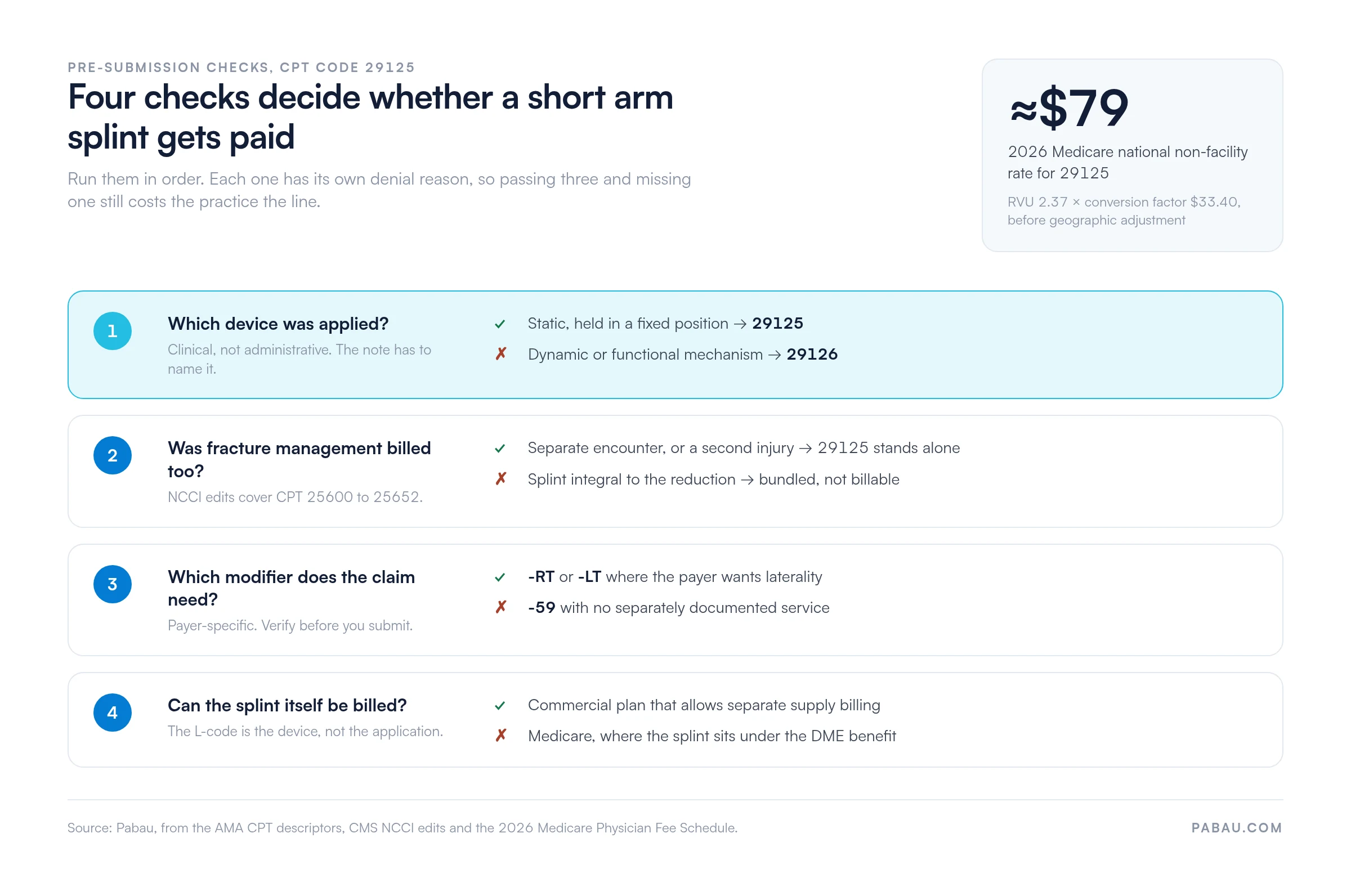
Tracking denials by root cause is the fastest way to see which of the five is recurring. Once you can name the pattern, updating the charge capture workflow stops it repeating on every later claim.
Run a monthly audit on your 29125 claims. Filter by denial reason code, then group the denials by type: bundling, modifier, or ICD-10 mismatch. Any single type above 20% of rejections points at the workflow rather than at one coder.
29125 is one of several codes in the 29xxx casting, strapping and splinting family. Knowing the full range prevents miscoding when the clinical picture sits near a boundary between two codes.
Our CPT code library covers the rest of the 29xxx family alongside the fracture management codes that sit next to it. The AAPC Codify CPT lookup carries the full descriptors and crosswalk data.
The decisions that make or break a 29125 claim happen at two moments. One is when the clinician finishes the note. The other is when billing staff prepare the charge. Miss either and the practice loses the reimbursement.
Practice management software like Pabau closes both moments in one system. Configurable clinical note templates prompt the provider to confirm splint type, laterality and the necessity wording before the note is finalized. The record already says “static short arm splint” by the time a coder opens it.
Pabau’s error-catching claims management handles the billing side. Automated modifier rules attach the right modifier for the codes billed in the same encounter, and flag NCCI conflicts before the claim goes out.
Built-in ICD-10 catalogs surface the diagnosis codes usually paired with the procedure, so a high-volume code like 29125 does not rest on one coder’s memory.
For practices submitting to US payers, the Claim.MD integration routes finished claims through a clearinghouse that validates CPT and ICD-10 pairing before transmission. Errors come back as a correction to make, not as a denial to appeal weeks later.

Pabau brings coding, documentation and clearinghouse submission into one system. Attach modifiers, run ICD-10 crosswalks and track claim status without switching between tools.

29125 is a small line on a claim, and it can fail for four separate reasons. That is why it denies more often than its size suggests. The device type, the bundling check, the modifier and the supply line all have to be right on the same claim.
The practical move is to push all four checks upstream, into the note and the charge, where each one costs a few seconds. Left downstream they cost an appeal, and an appeal costs more staff time than the $79 line is worth.
Documentation discipline is what makes that work, and software is what makes the discipline repeatable. Book a demo to see how Pabau keeps splint claims clean before they ever reach the payer.

Need a complete medical billing compliance framework? Medical billing compliance requirements covers HIPAA documentation rules, audit readiness, and payer-specific obligations for US practices.
Want to know how denials are categorized and resolved? Denial codes in medical billing provides a full CARC and RARC reference, so billing staff can act on a rejection notice immediately.
Ready to streamline clearinghouse submission? Claim.MD clearinghouse overview explains how electronic claim routing, eligibility verification, and ERA processing work together to speed up reimbursement.
CPT code 29125 is the AMA procedure code for applying a short arm splint in a static, non-dynamic position. The splint runs from the forearm to the hand. It applies to both prefabricated and custom-fabricated devices. Orthopedic surgeons, emergency physicians, urgent care providers and hand surgeons bill it for wrist and hand injuries needing immobilization.
CPT 29125 is the static version, where the splint holds the wrist and hand in a fixed, non-moving position. CPT 29126 is the dynamic version, where the device allows controlled, assisted joint movement. The dynamic code is typically used in post-operative or rehabilitative settings. The distinction rests on the device actually applied, not on provider preference.
The three most common are -59, -RT or -LT, and -GA. Use -59 when 29125 is subject to an NCCI edit and the services are separately documented. Use -RT or -LT to identify right or left laterality. Use -GA when an ABN is on file and Medicare medical necessity is uncertain. Modifier rules are payer-specific, so verify each policy before billing.
Generally no. NCCI edits bundle splint application into fracture management codes 25600 to 25652 when both services occur in the same encounter. That applies wherever the splint is integral to the fracture procedure. Separate billing requires a genuinely distinct service with full supporting documentation, and modifier -59 can override the edit once that standard is met. Check the current CMS quarterly edit files before you submit.
Yes. CPT code 29125 is commonly billed in urgent care and emergency department settings for acute wrist and hand injuries. The same documentation requirements apply. The record has to confirm the static splint type, the injury diagnosis with an appropriate ICD-10-CM code, the laterality, and the provider’s credentials. Urgent care facilities should also check whether their MAC requires additional facility-level modifiers.
CPT code 29125 is the primary code for a static wrist splint, short arm, forearm to hand. If the device extends above the elbow, CPT 29105 applies instead. If the wrist splint has a dynamic mechanism, CPT 29126 is correct. The phrase wrist splint CPT code most often refers to 29125 in clinical coding practice.