HCPCS Code G0163: Skilled nursing observation and assessment
What is HCPCS Code G0163? HCPCS Code G0163 is a deleted Level II code for skille...

Last Updated: Oct 15, 2026

CPT Code 73130 covers a hand X-ray with a minimum of 3 views, while 73120 covers a 2-view study.
Common clinical indications include hand fractures, arthritis, soft tissue injuries, and pre-surgical or post-surgical evaluation.
Modifiers -26, -TC, -RT, and -LT all apply to 73130, and incorrect modifier use is a leading cause of denial.
Medicare’s 2026 national average for the global code is about $38 in a non-facility setting.
Practice management software like Pabau tracks code entry, modifiers, and ICD-10 documentation to reduce radiology billing errors.
CPT Code 73130 is the code for a radiologic examination of the hand with a minimum of 3 views.
It applies when the radiology report documents three or more views, most often posteroanterior, lateral, and oblique. A hand study with only two views bills under 73120 instead.
This reference covers the official description, the clinical indications, and the ICD-10 codes that establish medical necessity. It also covers modifiers, 2026 Medicare reimbursement, documentation requirements, and the errors that trigger denials.
Official AMA short descriptor: Radiologic examination, hand; minimum of 3 views.
The code sits within the musculoskeletal radiology family alongside codes for the wrist (73100, 73110), fingers (73140), elbow (73070, 73080), and shoulder (73030). Shoulder arthrography carries its own code, 73040, which is a contrast study rather than a view-count code. According to the AMA’s CPT code set overview, codes in this family are defined by anatomical site and the number of views acquired. That distinction decides which code you bill.
CPT Code 73130 applies when a minimum of three radiographic views of the hand are medically necessary. Three views, typically posteroanterior (PA), lateral, and oblique, give the imaging depth needed to assess complex anatomy or several structures at once. A two-view study that clearly answers the clinical question bills under 73120 instead.
Common clinical scenarios that justify a 3-view hand X-ray include:
The ordering provider’s documentation must establish medical necessity for each view. Payer local coverage determinations (LCDs) vary, so verify the covered diagnosis list against the relevant payer’s policy before submitting.
The ICD-10 diagnosis code on the claim must support the medical necessity of a 3-view hand X-ray. The table below lists frequently paired codes. It is illustrative rather than exhaustive, so verify coverage against the applicable payer LCD and the patient’s clinical documentation. Pick each diagnosis code from the documented clinical findings, not from a generic list.
Use the most specific laterality code available, whether that is right versus left or an individual digit. CMS and most commercial payers require laterality precision. Reaching for an “unspecified” code when the laterality is documented is a common audit trigger. An open wound of the hand with a retained foreign body also has its own S61 codes, which are more specific than M79.5.
Both 73120 and 73130 cover hand radiographs. The billing distinction rests on how many views the radiologist or technologist acquired, not on how many were ordered.
The radiology report must state the number of views obtained. If the report says “two views” but 73130 appears on the claim, the claim will be denied on audit. Overcoding and undercoding both create compliance risk.
Modifiers clarify billing circumstances and prevent improper denials. On CPT Code 73130, the most frequently applied modifiers relate to component billing and laterality. Verify modifier applicability with the specific payer before submitting, because policies differ between Medicare, Medicaid, and commercial plans.
Split billing between -26 and -TC is standard in hospital outpatient and IDTF settings. Never append both -26 and -TC to the same line from the same provider. When the physician owns the equipment and performs the interpretation, bill the global code with no modifier.
Medicare reimburses CPT Code 73130 under the Medicare Physician Fee Schedule (MPFS), updated annually by CMS. The figures below are 2026 national averages for the global code. Rates vary by geographic practice cost index (GPCI), so confirm your own locality in the CMS Physician Fee Schedule lookup tool.
Non-facility rates apply when imaging is performed in a physician’s office or an independent diagnostic testing facility (IDTF). Facility rates apply in hospital outpatient departments and ambulatory surgical centers. The difference matters for practices deciding where to perform and bill imaging.
The professional and technical components are priced separately in the CMS RVU file, so look up 73130-26 and 73130-TC for your own locality. Practice expense accounts for 0.95 of the code’s 1.14 total RVUs, and that expense sits with the technical component. Splitting the global rate down the middle therefore understates the technical side and overstates the professional read.
Commercial payer rates vary widely. Many payers reimburse at a percentage of Medicare rates, often 110% to 140%, while others use proprietary fee schedules. Verify contracted rates before quoting patients.
Insufficient documentation is one of the most common reasons radiology claims are denied on post-payment audit. An auditor reads the medical record, not the claim form, when deciding whether the service was justified. Consistent documentation habits separate a clean claim from a recoupment demand months later.
Required documentation for CPT Code 73130:
Fast access to radiology documentation matters as much as storing it securely. One HIPAA-compliant system can hold the clinical notes, the imaging records, and the billing together. That makes missing documentation far less likely when a payer audits the claim.
Run a quarterly audit on your 73130 claims. Pull the last 30 submissions, check each radiology report for explicit view-count language, and confirm the ICD-10 code matches the clinical note. Those two checks cover the documentation failures an auditor looks for first. Catching them in-house is faster and cheaper than answering a payer audit.
Most denials on 73130 claims are preventable at the point of coding. The errors below are the ones worth checking before a batch of claims goes out.
Before submitting a batch of 73130 claims, run a modifier consistency check. Filter your billing queue by CPT 73130 and confirm every split-bill claim carries either -26 or -TC, never both from the same provider. Then confirm each claim carries a laterality modifier that matches the radiology report. This check takes five minutes and catches both modifier errors before the batch leaves.
On a code that pays about $38, an appeal can cost more staff time than the claim is worth. Submitting a clean claim the first time is what protects the revenue. Practices that build pre-submission checks into their billing workflow catch these errors before they reach the payer.
CPT Code 73130 sits within the upper extremity radiology family. Knowing the adjacent codes prevents undercoding and reduces the risk of picking the wrong code when clinical circumstances shift. The table below covers the codes cross-referenced most often. Practices with broader radiology billing needs can work through Pabau’s CPT code library for the rest of the imaging family.
When imaging crosses anatomical boundaries, each anatomical area gets its own CPT code. A study that also included wrist views needs the appropriate wrist code reported alongside 73130, provided the documentation supports each. Check NCCI edits before reporting multiple codes from one session. The grid below shows how anatomic site and view count combine across the family.
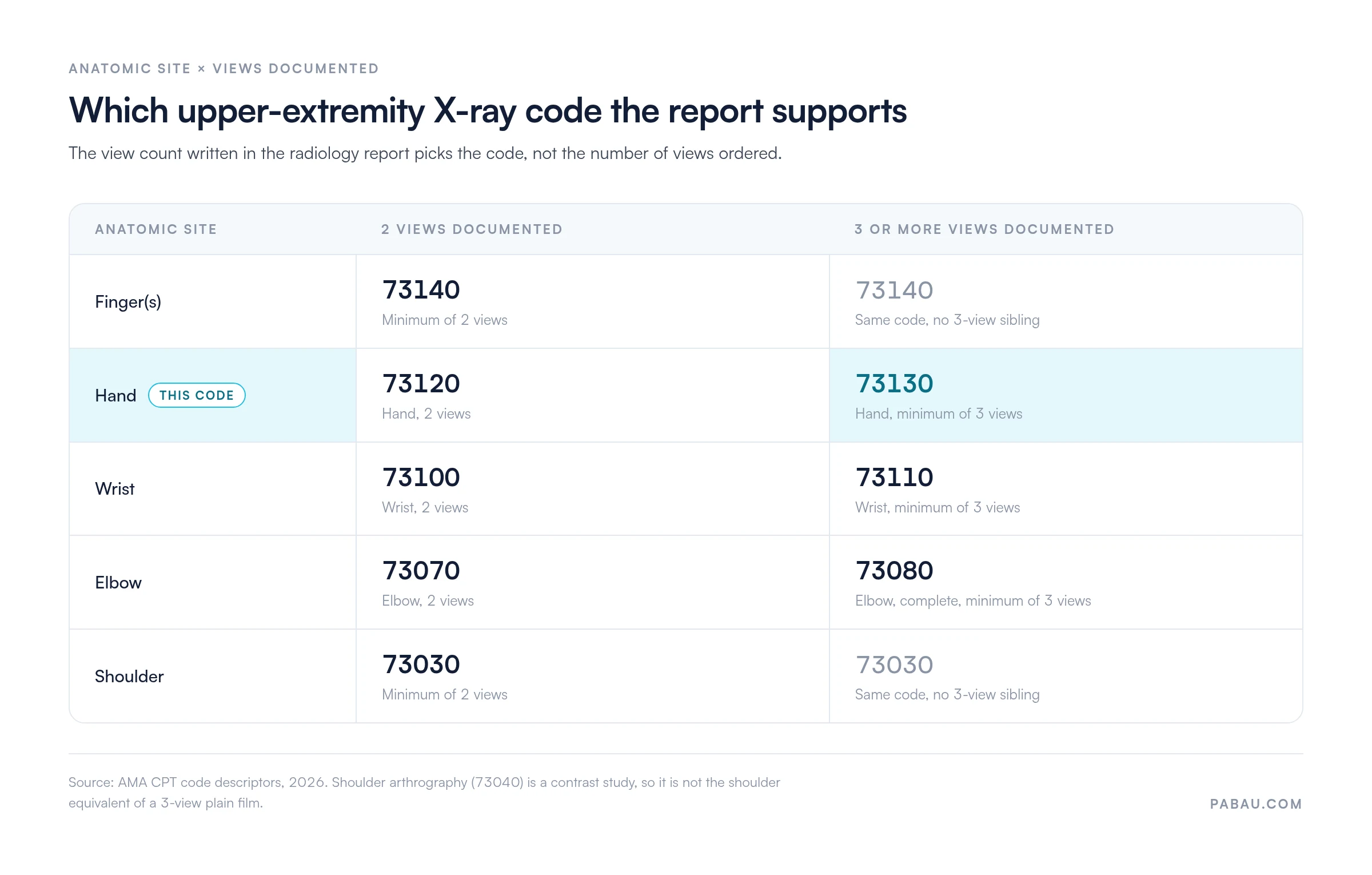
Radiology billing errors often trace back to a documentation step that never reached the claim. When imaging orders, radiology reports, and billing sit in separate systems, that handoff breaks more often. Practice management software like Pabau holds the clinical record and the claim in one system, so what the report documents is what gets submitted.
Pabau’s billing tools support the workflow that underpins accurate radiology coding:

A single 73130 denial is worth about $38, so the cost of coding it wrong shows up in volume rather than in any one claim. Pabau’s claims management software keeps every submitted claim, its status, and its remittance against the same invoice. Your team can see which hand X-ray claims paid without opening a payer portal.

Pabau’s integrated billing tools support accurate code entry, modifier tracking, and ICD-10 documentation. Your team spends less time on rework and more time on patient care.

Billing CPT Code 73130 accurately comes down to one discipline. The radiology report drives the code, not the order. Three documented views means 73130, two means 73120, and modifier selection, ICD-10 specificity, and component billing all follow from there.
The practices that stay clean on this code check the report before the claim goes out, rather than after a payer asks. That check costs minutes. A post-payment recoupment costs months. To see how Pabau keeps 73130 documentation and claim submission in step, book a demo.

Want to understand how clearinghouse submissions work end to end? 837 file submission guide covers the EDI transaction format used for electronic claim filing, including diagnostic imaging codes.
Seeing patterns of denied radiology claims? Denial management in healthcare explains how to build a structured process for tracking, appealing, and preventing recurring denials.
Need to verify insurance eligibility before imaging? Insurance eligibility verification outlines how eligibility checks cut the risk of a claim rejection when a patient’s coverage has lapsed.
CPT Code 73130 is a radiologic examination of the hand requiring a minimum of 3 views, typically posteroanterior, lateral, and oblique projections. It applies when 3 or more views are obtained to evaluate the hand for fractures, arthritis, soft tissue disorders, or surgical assessment.
CPT 73120 covers a hand radiograph with a minimum of 2 views, and CPT 73130 requires a minimum of 3 views. The code is decided by the number of views documented in the radiology report, not the number ordered. Billing 73130 when only 2 views were taken is an overcoding error.
Medicare’s 2026 national average for the global code is about $38 in a non-facility setting. That reflects a total of 1.14 RVUs and a conversion factor of $33.4009. Locality rates run from roughly $33 to $52, so check the CMS Physician Fee Schedule tool for your MAC.
The primary modifiers are -26 (professional component), -TC (technical component), -RT (right hand), and -LT (left hand). Apply -26 when the radiologist bills for interpretation only, and -TC when the facility bills for equipment and acquisition. Never append both to the same claim line from the same provider.
Commonly paired ICD-10 codes include S62.309A (metacarpal fracture, initial encounter) and M19.041 (primary osteoarthritis, right hand). Others include M06.041 (rheumatoid arthritis, right hand), M10.041 (gout, right hand), and M79.5 (residual foreign body in soft tissue). Select the most specific laterality code available, and verify coverage against the payer LCD before submitting.
Required documentation includes the ordering provider’s clinical note establishing medical necessity and a signed radiology report stating the number of views obtained. The record also needs laterality matching the claim, the ordering provider’s NPI, and a diagnosis code supported by the clinical notes. The report must name the views. Vague language is insufficient for audit purposes.
Yes, CPT 73130 is covered by Medicare when medically necessary diagnostic imaging of the hand is documented. Coverage is subject to local coverage determinations issued by the applicable Medicare Administrative Contractor (MAC). Verify the LCD for your jurisdiction, because covered ICD-10 diagnosis codes vary by MAC region.