



CCSD code G5100: Bypass of duodenum billing guide
CCSD code G5100 bills a bypass that leaves the duodenum in place CCSD code G5100...

Last Updated: Oct 16, 2026

CPT code 22858 describes total disc arthroplasty (artificial disc), anterior approach, at the second cervical level, including discectomy with end plate preparation.
22858 is always reported as an add-on to CPT 22856, so billing it without the first-level code triggers an automatic rejection.
Add-on codes are modifier 51 exempt under AMA CPT Appendix F, so 22858 should never carry modifier 51.
The M50 parent categories are not billable, so pair 22858 with a sixth-character code such as M50.122 for the C5-C6 level.
Practice management software like Pabau flags NCCI edit conflicts and prompts correct modifier use at claim creation.
CPT code 22858 describes total disc arthroplasty (artificial disc), anterior approach, second level of the cervical spine, including discectomy with end plate preparation. The CPT descriptor adds the instruction to list it separately, in addition to the code for the primary procedure. It is an add-on code, so it is reported only with CPT 22856 and never carries modifier 51.
The AMA CPT code set classifies 22858 as an add-on code within the Spinal Instrumentation Procedures on Vertebral Column section. Add-on status is critical. The code cannot be reported alone, and it is always listed in addition to the primary code 22856, which covers the first cervical level.
Coders working on two-level cervical disc arthroplasty claims must report both codes together. CPT 22856 covers the first level; CPT code 22858 covers the second. The distinction matters for modifier application, NCCI edit compliance, and claim sequencing.
AMA CPT Assistant guidance from April 2015 makes 22856 the parent code for the first level. 22858 is then reported in addition when a second cervical disc is replaced in the same operative session. Billing 22858 without 22856 on the same claim triggers an automatic NCCI edit rejection.
Knowing what the surgeon performs helps billing staff verify that the operative note supports the code before submission. At the second cervical level, the procedure mirrors the technique used at the first level under 22856.
One documentation point decides the claim. The operative note must name the disc level replaced second, such as C5-C6 in a C4-C5 and C5-C6 procedure. It must also confirm that no fusion was performed at that level, because a fusion component shifts the applicable code set.
Medicare reimbursement for CPT code 22858 comes from the CMS Physician Fee Schedule, calculated with the standard RBRVS formula. Payment equals the sum of the work, practice expense, and malpractice RVUs, multiplied by the conversion factor and the applicable GPCI adjustments.
The values below reflect the 2026 fee schedule. Always confirm current figures with the CMS Physician Fee Schedule Look-Up Tool before you submit, since rates are updated annually. Understanding revenue cycle management fundamentals helps billing teams interpret how RVU-based reimbursement reaches the practice.
These values come from the FastRVU 2026 RVU lookup tool, which also calculates the national payment amount from the 2026 conversion factor. As an add-on code, 22858 escapes the multiple procedure reduction that applies to primary codes under modifier 51 rules. That is why the second level pays at its full RVU value rather than a reduced one.
Medicare reimbursement for CPT code 22858 varies by locality through the Geographic Practice Cost Index (GPCI). Each RVU component is multiplied by its corresponding GPCI factor for the practice location. High-cost metropolitan areas such as San Francisco, Manhattan, and Boston pay more than rural localities.
Look up locality-specific GPCI values in the CMS PFS Look-Up Tool. Then confirm the figures with your Medicare Administrative Contractor (MAC), which publishes the rates your claims are paid at. Practices submitting electronic claims through practice management software like Pabau can streamline eligibility verification and ERA processing for spinal procedure claims. Pabau’s Claim.MD clearinghouse integration handles both from inside the claim record.
Correct modifier application is where many CPT 22858 claims break down. The most common error is appending modifier 51, which never belongs on an add-on code. Because 22858 is billed alongside a primary procedure, modifier selection directly affects payment and edit compliance. Review what constitutes a clean claim before submitting two-level disc arthroplasty claims to avoid preventable rejections.
Cross-reference modifier applicability with your applicable MAC LCD before billing. Modifier guidance from the AMA and MAC policies takes precedence over general coding references for Medicare claims.
Medicare covers CPT code 22858 when the medical necessity criteria in CMS Article A57021 (Billing and Coding: Cervical Disc Replacement) are satisfied. Coverage is not universal. It is MAC-specific, set through Local Coverage Determinations (LCDs), so confirm a current LCD is in effect for your jurisdiction before billing. Maintaining strong medical billing compliance protects the practice from post-payment audits on high-value spinal procedures.
Covered indications per CMS Article A57021 generally include:
Non-covered conditions include isolated axial neck pain without neurologic compromise, instability at the operative level, and severe spondylosis with complete loss of disc space. Verify insurance eligibility before scheduling. Pre-authorization and eligibility checks catch a coverage problem before the patient reaches the operating room.
Most cervical disc diagnoses need a sixth character before they are billable. M50.12, M50.22, M50.02 and M50.32 are parent categories, not codes you can submit. Each expands to a level-specific code, so a C5-C6 disc disorder with radiculopathy is reported as M50.122.
The codes below follow CMS Article A57021 and MAC LCD guidance, and each is billable as written. Only assign a code the patient’s documented presentation supports. For a searchable crosswalk between CPT and ICD-10 codes, the AAPC CPT-to-ICD-10 crosswalk is a useful reference.
Match the sixth character to the operative level named in the surgeon’s note. A C5-C6 replacement takes the C5-C6 code, not the unspecified mid-cervical option. Submitting a code for the wrong level is a clinical mismatch, and payers deny it automatically.
The operative note and pre-authorization documentation must establish both the surgical details and the medical necessity for the second-level arthroplasty. Incomplete documentation is the primary driver of post-payment audit recoupments for this code. Review how your team manages superbill creation to ensure all procedure-level documentation flows into the claim correctly.
Practices using electronic 837 claim file submission should verify that all procedure-level fields are populated before transmission. An incomplete implant record or a missing authorization number is a common reason for RAC audit targeting on spinal arthroplasty claims.
CPT code 22858 is subject to NCCI (National Correct Coding Initiative) edits. Those edits define what is already included in the global procedure and what cannot be billed separately. Familiarity with them prevents the most common unbundling denials on two-level cervical arthroplasty claims. Effective denial management begins before the claim is submitted, not after the rejection arrives.
Included in the global package for 22858 (cannot be separately billed):
Codes that may be separately reported in the same session (verify with applicable NCCI version):
The AMA CPT Assistant April 2015 update addressed bundling between 22856 and 22858 directly. Components of the second-level procedure that are integral to the arthroplasty are included in 22858 and cannot be unbundled.
Verify NCCI edit pairs against the current quarterly version in the CMS NCCI Policy Manual, which is updated four times a year. Tracking electronic remittance advice (ERA) codes on denied 22858 claims shows whether the rejection came from a bundling edit or a modifier error.
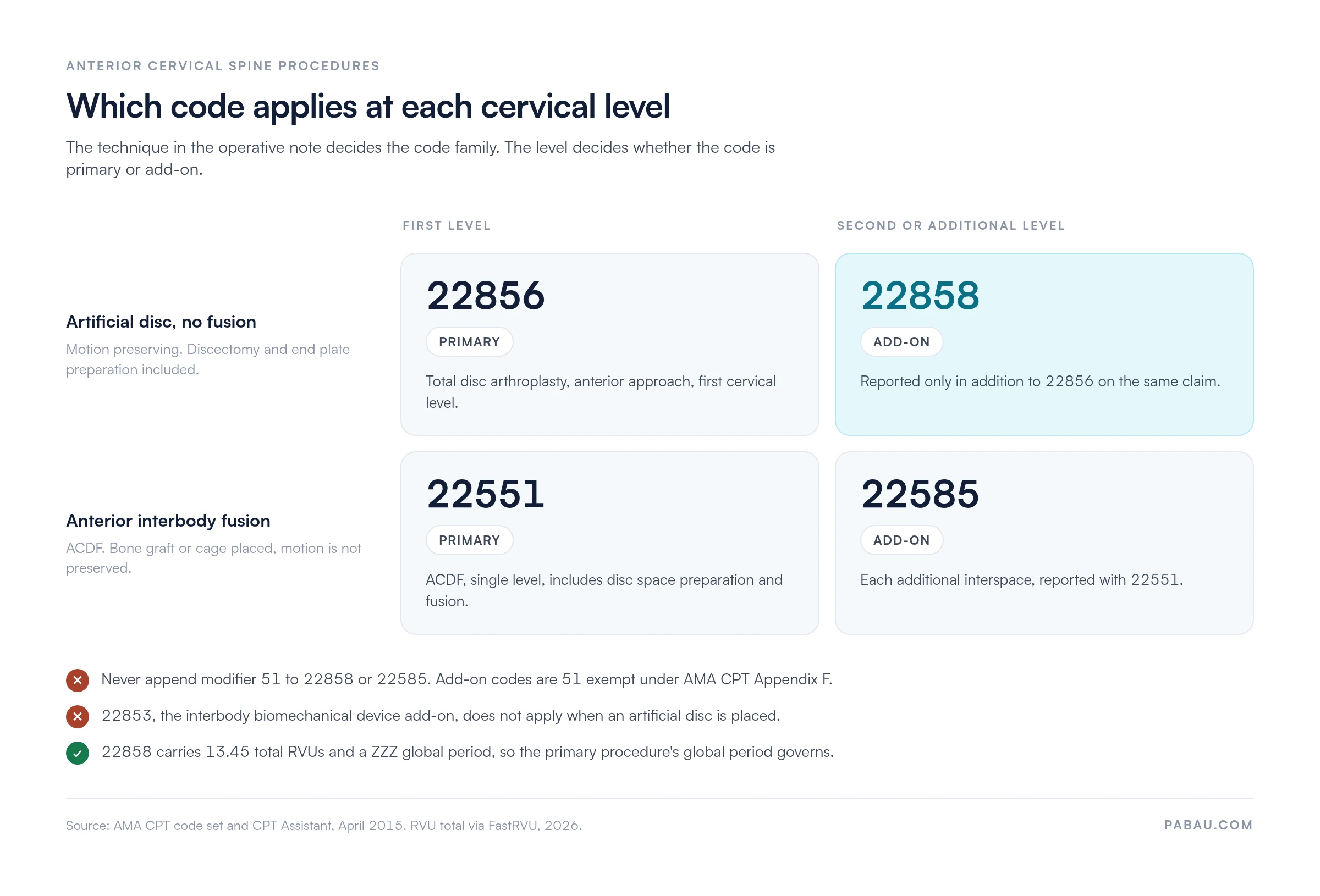
Spine surgery billing rarely involves a single code. Two decisions drive which set applies. The first is whether the surgeon preserved motion or fused the level. The second is whether the level is the first one or an additional one. The grid below maps both, and the table underneath lists the codes you will meet alongside 22858.
Billing CPT code 22858 involves more moving parts than most surgical codes. Five of them have to line up on one claim.
Tracking those five by hand creates denial risk at every step.
Pabau’s integrated claims management software surfaces NCCI edit conflicts and missing modifier prompts as the claim is created, before it leaves the practice.
The system connects directly to Claim.MD, Pabau’s US clearinghouse partner. Claim.MD processes claims across 4,000+ payers and handles eligibility verification. It returns ERA/835 remittances with CARC denial reason codes whenever a claim is rejected.
For a two-level cervical disc arthroplasty, catching a bundling error at submission beats finding it in a post-payment audit. The difference shows up as cash collected this month instead of a recoupment next year.
Clinical note templates in Pabau can be configured to capture what 22858 medical necessity documentation requires. That means operative level identification, implant records, and diagnosis linkage, all recorded at the point of care.
The surgeon’s note then carries what the billing team needs to submit a clean claim. Practices cutting denial rates on complex procedure codes pair that with structured denial management workflows.

Pabau’s billing workflow flags NCCI edit conflicts, prompts modifier application, and connects to Claim.MD for real-time claim validation. See how it works for spine surgery practices.

22858 is a narrow code with an outsized denial rate, and almost all of that is avoidable. Three habits carry the claim. Pair it with 22856 every time, leave modifier 51 off it, and choose the sixth-character ICD-10 code that matches the operative level.
The trade-off worth remembering is where the work sits. Checking the claim at creation costs a few minutes. Finding the same error in a post-payment audit costs the payment and the appeal on top.
Pabau’s claims management module validates claims before submission and returns detailed ERA data when payers respond. Book a demo to see how it handles two-level arthroplasty billing for surgical practices.

Managing billing for multiple procedure codes in one session? Medical billing fundamentals covers how claim workflows handle complex multi-code submissions.
Need to understand how RVU payments flow through your practice? Revenue cycle management explained breaks down how RVU-based payments translate into practice revenue.
Want to reduce post-payment audit exposure on high-value surgical codes? Medical billing compliance guide outlines documentation and audit-readiness best practices for surgical practices.
CPT code 22858 is an add-on code for total disc arthroplasty (artificial disc) at the second cervical level, anterior approach. It includes discectomy with end plate preparation. It is always reported in addition to CPT 22856, which covers the first level, and cannot be billed alone.
CPT 22856 is the primary code for total cervical disc arthroplasty at the first level. CPT 22858 is the add-on code for the second level. Both describe the same surgical technique, an artificial disc placed by anterior approach, but 22856 is billed first. Billing 22858 without 22856 on the same claim triggers automatic rejection.
Yes. Medicare covers CPT code 22858 when the medical necessity criteria under CMS Article A57021 are met. Those criteria include cervical disc disease at two contiguous levels (C3-C7), at least six weeks of failed conservative treatment, and supporting MRI or CT imaging. Coverage is MAC-specific, so confirm an active LCD is in effect for your jurisdiction before billing.
Modifier 51 is never used with 22858. AMA CPT Appendix F makes add-on codes exempt from it. The modifiers you will see are 62 for two surgeons and AS for a PA or NP assistant. Modifier 80 covers a physician assistant surgeon, and 22 covers unusual procedural services. Verify each against your MAC LCD before submission.
M50.12, M50.22, M50.02 and M50.32 are parent categories, so they need a sixth character before they are billable. Common billable pairings are M50.121 and M50.122 for cervical disc disorder with radiculopathy at C4-C5 and C5-C6. M50.022 covers the same level with myelopathy, and M47.12 covers other spondylosis with myelopathy of the cervical region. Assign the code that matches the operative level and the documented clinical presentation.
The operative report must identify both cervical levels and confirm artificial disc insertion at each. Pre-operative MRI or CT must confirm disc disease at both levels, alongside evidence of failed conservative treatment. Implant records need the manufacturer, model and lot number for each prosthesis. A prior authorization number confirming coverage for two-level arthroplasty completes the file.
The 2026 RVU values for CPT 22858 are 8.19 work RVUs, 2.72 practice expense RVUs and 2.54 malpractice RVUs, for a total of 13.45. Multiply that total by the 2026 conversion factor and your locality’s GPCI adjustments to get the Medicare payment. Verify current values in the CMS Physician Fee Schedule Look-Up Tool.



