HCPCS code E0198: Water pressure pad billing guide
HCPCS code E0198 is a water pad for a standard mattress HCPCS code E0198 is the ...

Last Updated: Oct 13, 2026

CPT code 22812 reports arthrodesis, anterior, for spinal deformity, with or without cast, across 8 or more vertebral segments.
It is the top tier of the anterior deformity family. 22808 covers 2 to 3 segments, 22810 covers 4 to 7, and 22812 starts at 8.
A vertebral segment is one complete vertebral bone with its articular processes and laminae. It is not a disc interspace, so T2-T5 counts as four segments.
The posterior approach uses a separate family. Its bands are 22800 for up to 6 segments, 22802 for 7 to 12, and 22804 for 13 or more.
These codes are not limited to the thoracic spine. They apply wherever an anterior deformity correction is fused.
Practice management software like Pabau flags NCCI bundling conflicts at the point of claim entry. It then routes claims through Claim.MD for electronic submission to 4,000+ US payers.
CPT code 22812 reports an anterior spinal fusion performed to correct a spinal deformity across eight or more vertebral segments. It is the highest tier of a three-code family, and the segment count in the operative note is what selects it.
Two details decide whether the claim survives review. The first is the approach, because 22812 is an anterior-only code and a posterior construct belongs to a different family. The second is the counting rule, which counts vertebral bones rather than the disc spaces between them.
This guide covers the official descriptor, segment counting with worked examples, RVUs, and Medicare reimbursement. It also covers modifiers, ICD-10 pairings, add-on codes, and the documentation that keeps a claim clean.
The American Medical Association’s CPT code set defines 22812 as arthrodesis, anterior, for spinal deformity, with or without cast, involving 8 or more vertebral segments. It sits in the musculoskeletal system chapter, under arthrodesis procedures for spine deformity.
Three elements of that descriptor do the work. The procedure has to be a fusion. The indication has to be a deformity such as scoliosis or kyphosis, and the exposure has to be anterior. Miss any one of them and the code is wrong before the segment count is even checked.
One more rule governs the whole family. Only one arthrodesis code is reported per operative session for a spinal deformity. 22812 is never stacked with 22810 or 22808 on the same claim. The construct is counted once and coded once.
A construct this long is almost always a deformity correction rather than a degenerative repair. Idiopathic scoliosis, neuromuscular scoliosis, congenital scoliosis, and progressive kyphosis are the conditions that produce curves needing eight or more segments of anterior fusion.
The anterior exposure itself shapes the operative note. Reaching the anterior column means a thoracotomy, a thoracoabdominal approach, or a retroperitoneal approach, often with a second surgeon performing the exposure. That surgeon’s role has direct billing consequences, covered in the modifier section below.
Degenerative disease is the common misfit. Multi-level spondylosis or disc disease treated with fusion is not a deformity correction, so it reports under the standard arthrodesis codes instead. Coding a degenerative case to 22812 because the construct is long is a family-level error.
A vertebral segment is one complete vertebral bone, together with its associated articular processes and laminae. It is not the disc space between two bones. That single distinction causes more miscodes in this family than any other issue.
Count the bones named in the fused span, inclusive of both ends. The interspaces are always one fewer, which is why counting spaces quietly drops the total by one and pushes a legitimate 22812 down into 22810.
Set those spans against the vertebral levels and the band change lands on one bone.
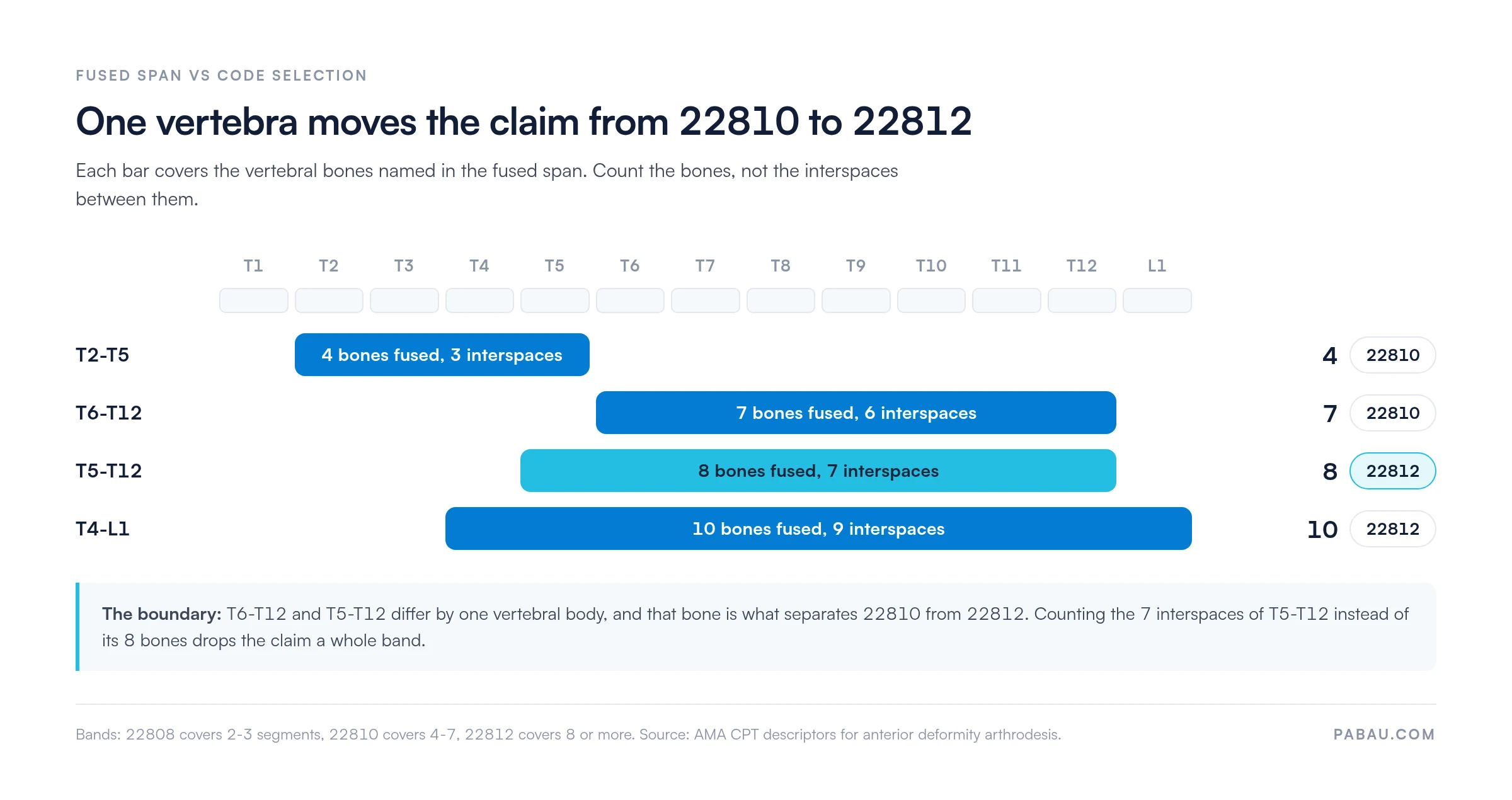
The operative report has to name the superior and inferior levels of the fusion explicitly. It also has to record any intraoperative change to the planned span, with the reason. Without those levels in writing, a payer cannot confirm the count that drove code selection.
Ask your surgeons to write the fused span as levels, not as a number. “T5 to T12” can be recounted by an auditor; “eight segments fused” cannot. Coders can then derive the count themselves and defend it on appeal.
All three codes share the same descriptor except for the segment band, so the count is the only differentiator. Each one describes anterior arthrodesis for spinal deformity, with or without cast.
The boundary that matters most is seven against eight segments. A T6-T12 fusion is 22810 and a T5-T12 fusion is 22812, one bone apart. A note that leaves the superior level vague puts the whole claim on that boundary.
Posterior deformity fusions have their own code family, and its bands are not the same. Mixing the two families is an error that can pass internal review, because both sets count vertebral segments and both treat scoliosis.
One case shows the risk. An eight-segment deformity fusion is 22812 through an anterior exposure, but the same eight segments approached posteriorly are 22802. The count alone never identifies the code.
When a case is staged or combined, each approach is coded from its own family according to what that approach fused. Reading the exposure paragraph of the operative note before touching the segment count prevents almost every cross-family error.
Relative value units determine Medicare payment for 22812. CMS updates them annually through the Medicare Physician Fee Schedule. Verify current values against the CMS Physician Fee Schedule lookup tool for the applicable payment year.
The FastRVU lookup tool retrieves work, practice expense, and malpractice values for 22812 alongside the applicable conversion factor. Check the global period indicator in the same record, since a major spinal fusion carries a 90-day global that absorbs routine postoperative visits.
Never hardcode a dollar amount into a billing workflow. CMS adjusts the conversion factor every year, so a fee schedule tied to an older year drifts into systematic underclaiming or overbilling.
Medicare pays 22812 through the fee schedule at rates that vary by facility type and geography. Geographic practice cost indices adjust the national figure for each Medicare Administrative Contractor locality. High-cost metropolitan areas pay above the national average, and rural localities pay below it.
For the current national average, filter the CMS Physician Fee Schedule Search by code 22812, facility status, and your MAC locality. Understanding electronic remittance advice processing then helps billing teams reconcile what Medicare actually paid against the expected rate.
Facility versus non-facility rates: an anterior deformity fusion of this size happens in a hospital, so the facility rate applies to the physician’s professional component. The hospital bills its technical component separately. Submitting the non-facility rate for an inpatient procedure creates a discrepancy that invites review.
Local coverage determinations: coverage sits with MAC-specific local coverage determinations, and criteria vary by jurisdiction. A claim has to satisfy the applicable determination on documented diagnosis, conservative treatment history, and imaging evidence. Correct code assignment alone will not carry it.
Modifier selection on 22812 affects both payment and audit exposure. Each modifier carries a documentation requirement that lives in the operative note. Appending one without that support is a known audit trigger.
Modifier 62 deserves extra attention on an anterior case. A thoracic or general surgeon frequently performs the exposure. Whether that counts as co-surgery or as assistance depends on what the two notes describe.
Co-surgery means each surgeon performed a distinct portion of the fusion itself. An access surgeon who only opens and closes is billing assistance, not co-surgery. Using modifier 62 for that role is an unbundling problem, so confirm the MAC’s policy before submitting either version.
22812 needs a diagnosis that establishes medical necessity for deformity correction. Payers cross-reference the ICD-10-CM code against local coverage criteria, and the diagnosis has to reflect the documented condition rather than the procedure performed.
For crosswalk research, the AAPC Codify CPT lookup pairs descriptors with diagnosis guidance. Code each diagnosis to the highest available specificity. An unspecified-site code such as M41.20 invites a medical necessity edit from any payer running coverage criteria by region.
Degenerative diagnoses are the ones to question. A spondylosis or disc degeneration code paired with 22812 tells the payer the indication was not a deformity. That contradicts the descriptor and reads as a coding error on its face.
22812 is rarely billed alone. An anterior deformity fusion usually involves instrumentation and bone graft, and each has its own add-on code. Choosing the instrumentation family that matches the approach is the first decision.
Add-on codes commonly billed with 22812:
Two instrumentation errors show up on these claims. The first is reaching for 22842 to 22844, which are posterior segmental instrumentation codes and do not belong on an anterior fusion. The second is counting instrumented segments as though they always match the fused span.
Instrumentation is coded on the segments the hardware actually spans. A 22812 fusion instrumented across six segments reports 22846, not 22847, even though the fusion itself qualifies for the highest band.
Interbody device coding changed in 2017, when 22851 was deleted and replaced by 22853, 22854 and 22859. A claim still carrying 22851 will reject outright, so check any long-standing charge template or superbill for the retired code.
NCCI bundling notes: the National Correct Coding Initiative publishes procedure-to-procedure edits quarterly. Anterior instrumentation that serves only to anchor an interbody cage is integral to the device code and is not separately reportable.
Some graft codes are also treated as bundled for Medicare, so verify the current edit and payment status before appending an add-on code. The fundamentals of medical billing treat that check as a baseline step rather than an optional one.
Run a pre-submission NCCI check on every 22812 claim that carries add-on codes. Instrumentation, graft and interbody device codes each pair with the primary fusion in specific edits, and those edits change quarterly. Catching a conflict before submission avoids the whole appeals cycle.
Denials on 22812 usually trace back to the operative report rather than the claim form. The facts a payer needs are generated during surgery, but they are often written for clinical purposes only.
Making the note billing-complete is what keeps those claims payable. Consistent medical billing compliance practices turn that into a routine step instead of a case-by-case rescue.
Required elements for a clean 22812 claim:
The failure patterns on 22812 are consistent enough to build a checklist from. Each one has a documentation fix that costs less than the appeal it prevents.
Applying structured denial management strategies to these claims shows which cause is driving the rate. Tracking denial reason codes by payer separates a documentation problem from a code selection problem, and each one gets a different fix.
For practices billing 22812 regularly, revenue leaks in the handoff between the operative report and the claim. Re-typing the fused levels, the approach and the add-on codes into a billing system introduces errors at the highest-value step of the revenue cycle.
Pabau closes that handoff, and its claims management software builds the claim from the documentation itself.
Pabau integrates with Claim.MD, our clearinghouse partner for electronic submission to 4,000+ US payers. Claims routed that way get real-time eligibility verification before submission, plus built-in CPT and ICD-10 catalogs for code validation. Remittance processing then maps each payment explanation back to its claim.
That turns revenue cycle management for a complex spine code into a trackable process instead of manual reconciliation. The superbill submission process is supported too, with CMS-1500 and 837P export for claims that need a human review before transmission.
Reporting then surfaces RVU-based revenue analytics per procedure code, so billing teams can watch 22812 performance, payer mix and denial rates over time. Standalone reference tools carry no such history, so clean claim submission becomes a measurable target instead of an aspiration.

Pabau connects operative documentation to claim submission through Claim.MD, with real-time eligibility verification, NCCI edit checking, and remittance processing for spine surgery practices.

CPT code 22812 comes down to three checks in the operative note. The approach has to be anterior and the indication has to be a spinal deformity. The fused span then has to cover eight or more vertebral bones, counted inclusively.
Get any one of those wrong and the claim lands in the wrong family, the wrong band, or an outright denial. Counting interspaces instead of bones is the most common of those errors, and also the easiest one to fix.
If your team is handling that reconciliation by hand, book a demo and see how Pabau carries operative documentation through to a clean 22812 claim.

Need to catch NCCI bundling conflicts before submission? Medical claims clearinghouse explains how electronic routing catches bundling errors before they reach the payer.
Looking for denial code explanations on a rejected 22812 claim? Denial codes in medical billing maps common CARC reason codes to corrective actions.
Want to confirm coverage before deformity surgery is scheduled? Insurance eligibility verification covers the real-time checks that confirm benefits up front.
Billing the posterior instrumentation side of a long construct? CPT code 22844 covers posterior segmental instrumentation across 13 or more vertebral segments.
CPT code 22812 reports arthrodesis, anterior, for spinal deformity, with or without cast, across 8 or more vertebral segments. It applies to anterior fusions that correct deformities such as idiopathic, neuromuscular or congenital scoliosis and progressive kyphosis. The code is not limited to one spinal region.
Only the segment band differs. All three describe anterior arthrodesis for spinal deformity. 22808 covers 2 to 3 vertebral segments, 22810 covers 4 to 7, and 22812 covers 8 or more. A T6-T12 fusion is seven segments and reports 22810, while T5-T12 is eight segments and reports 22812.
Count complete vertebral bones, not the disc spaces between them. A vertebral segment is a single vertebral bone with its associated articular processes and laminae. T2-T5 is therefore four segments and three interspaces, and a T4-L1 fusion is ten segments.
22812 is an anterior-approach code. Posterior and posterolateral deformity fusions use a separate family with different bands. Those are 22800 for up to 6 vertebral segments, 22802 for 7 to 12, and 22804 for 13 or more. An eight-segment deformity fusion is 22812 anteriorly but 22802 posteriorly.
The modifiers seen most often are 22 for substantially increased work, 62 for co-surgery, 80 for an assistant surgeon, and AS for a non-physician assistant. Modifier 51 applies when a separate procedure is reported the same day. Each one needs matching operative note documentation to survive payer review.
Anterior instrumentation is reported with 22845, 22846 or 22847 depending on the segments the hardware spans, and 22848 covers pelvic fixation. Graft codes 20930, 20931, 20936, 20937 and 20938 apply by material and harvest site. Interbody devices use 22853, 22854 or 22859, which replaced the deleted 22851.
Common pairings are M41.24 for other idiopathic scoliosis of the thoracic region and M41.125 for adolescent idiopathic scoliosis of the thoracolumbar region. M41.44 covers neuromuscular scoliosis, thoracic region, and M40.204 covers unspecified thoracic kyphosis. Q76.3 covers congenital scoliosis from a bony malformation. Each has to be coded to the highest available specificity.