



HCPCS code E0198: Water pressure pad billing guide
HCPCS code E0198 is a water pad for a standard mattress HCPCS code E0198 is the ...

Last Updated: Oct 13, 2026

CPT Code 12007 covers simple repair of superficial wounds on the scalp, neck, axillae, external genitalia, trunk, and extremities with a total repaired length of 12.6 cm to 20.0 cm.
Simple repair means single-layer closure of the epidermis, dermis, and subcutaneous tissue without layered closure – choosing the wrong repair tier is the leading audit finding.
Multiple wounds of the same repair classification within the same anatomical grouping are summed to reach the length threshold – do not bill each wound separately.
Pabau’s claims management software embeds CPT code lookup, ICD-10 crosswalk, and claim scrubbing directly in the billing workflow, reducing denial rates for wound repair claims.
Wound repair billing is one of the most denial-prone areas in outpatient coding. CPT Code 12007 sits at the top of the simple repair series, covering the longest wounds in that tier – and that position makes it a frequent target for downcoding, upcoding audits, and documentation disputes. Getting the length measurement right, the anatomical grouping right, and the repair tier right simultaneously is not optional: payers check all three before approving a claim.
This guide covers everything a medical biller, coder, or practice manager needs to bill CPT Code 12007 accurately: the official AMA descriptor, repair classification rules, length measurement and combining rules, ICD-10 crosswalk codes, reimbursement rates, applicable modifiers, documentation requirements, and the most common denial causes.
CPT Code 12007 is maintained by the American Medical Association (AMA) as part of the Integumentary System section of the CPT code set. The official descriptor reads: Simple repair of superficial wounds of scalp, neck, axillae, external genitalia, trunk and/or extremities (including hands and feet); 12.6 cm to 20.0 cm. It falls within the 12001-12021 series for simple repair, specifically the length band for the scalp/neck/trunk/extremity anatomical grouping. Practices using dermatology EMR software that integrates coding tools are less likely to misassign the length band at the point of care.
Selecting the wrong repair tier is the most common audit finding for wound repair claims. Each tier has a precise clinical definition in the AMA CPT book, and payers cross-reference the stated repair type against the documented clinical record.
CPT Code 12007 belongs to the simple repair tier. The wound requires no layered closure and no debridement beyond simple cleaning. If the clinician performs layered closure, even on a wound within the 12.6-20.0 cm range, the correct code is from the intermediate repair series, not 12007.
Deeper injuries change that calculation. A muscle-level diagnosis such as S86.309A should prompt a check of what was closed before the simple series is billed.
The AMA groups anatomical sites for wound repair coding. CPT Code 12007 covers one of the two primary groupings in the simple repair series. Understanding which sites belong together determines whether you can sum multiple wound lengths under a single code.
Combining wound lengths: Per AMA CPT guidelines, multiple wounds of the same repair classification repaired on the same anatomical grouping are summed. For example, a 7.0 cm scalp laceration and a 6.5 cm arm laceration repaired in the same session both fall in the scalp/neck/trunk/extremity group and are simple repairs. The combined length is 13.5 cm, making CPT Code 12007 the correct code. This combining rule is confirmed by the AAPC coding reference guidelines. Wounds from different anatomical groupings (e.g. one scalp wound and one facial wound) cannot be summed and must be reported with separate codes.
Lower-limb wounds sit in that same scalp/neck/trunk/extremity grouping, so a leg laceration and an arm laceration are added together. Claims carrying a leg diagnosis like S85.391D follow the identical summing rule.
Skin and reconstructive procedures generate detailed claims, so comparing the best plastic surgery software is worth the time.
Every CPT claim requires a supporting ICD-10-CM diagnosis code that documents medical necessity. For ICD-10 diagnosis code pairing with wound repair codes, the diagnosis must reflect the clinical reason for the repair. The table below lists commonly paired ICD-10-CM codes for anatomical sites covered by CPT Code 12007. Verify all codes against the current CMS ICD-10-CM tabular list before billing.
Use the 7th character “A” for the initial encounter, “D” for subsequent encounter, and “S” for sequela. Most wound repair billings use “A.” Verify the specific laterality and encounter type against the patient record before submitting.
Subsequent-encounter codes belong on the follow-up claim, which is what the D in S85.992D signals. Wound checks after closure should not reuse the initial-encounter character.
Medicare reimbursement for CPT Code 12007 varies by geographic region and place of service. The CMS Physician Fee Schedule lookup tool provides current non-facility and facility rates by locality. Dollar amounts change annually with Medicare Physician Fee Schedule (MPFS) updates – always confirm figures against the current year’s MPFS before presenting rates to patients or billing staff.
Relative Value Units (RVUs) form the basis for Medicare reimbursement calculations. The FastRVU lookup tool provides current Work, PE, and MP RVU values by code and geography. The table below shows the RVU structure for CPT 12007 – specific values should be confirmed against the current CMS MPFS data file for the applicable payment year.
Non-facility rates are consistently higher than facility rates for CPT Code 12007 because the physician’s office bears equipment, supply, and staffing costs that a hospital absorbs. Commercial payer rates vary by contract and are typically higher than Medicare rates. Confirm your contracted rates with each payer before using Medicare amounts as a proxy.
Modifiers tell payers about circumstances that altered a procedure without changing its fundamental nature. Using the wrong modifier – or omitting a required one – is one of the fastest ways to trigger a denial or a take-back audit for wound repair claims.
Modifier 59 applicability for wound repair depends on current National Correct Coding Initiative (NCCI) edits, which CMS updates quarterly. Commercial payer policies may differ from Medicare rules. Verify modifier requirements with each specific payer before submitting claims. The CMS code lists and coverage guidance provides updated NCCI bundling information.
Repairs at two separate sites in one session often need modifier 59 or 51 on the second line. Each site still carries its own diagnosis, such as S86.811D on the right lower leg.
Run a pre-claim modifier check against current NCCI edits before submitting any wound repair claim that includes modifier 59 or 51. NCCI edit pairs for wound repair codes update frequently, and a modifier that was valid last quarter may trigger a denial today. Your practice management system should flag these edits automatically at claim creation.
Missing or incomplete documentation is the single most fixable cause of wound repair claim denials. Payers reviewing CPT Code 12007 claims look for six specific data points in the medical record. Without all six, the claim is vulnerable to denial or take-back. Using digital intake forms that prompt for wound-specific data at the time of charting brings these requirements upstream to the clinical encounter, reducing billing rework. Reviewing HIPAA-compliant documentation practices is also recommended for practices handling wound repair records.
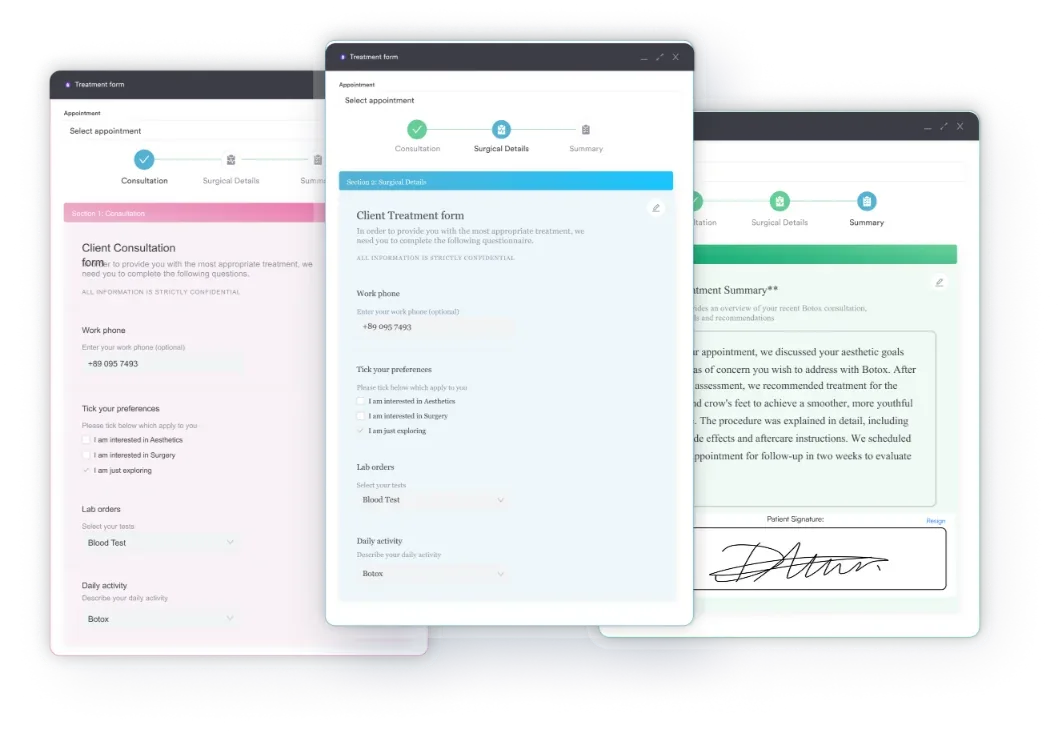
Pabau’s clinical documentation templates can be configured to prompt for each of these elements at the point of charting – building compliant wound repair records without requiring coders to chase missing data after the fact.
Measurement in centimeters stays a requirement no matter how detailed the paired diagnosis is, including a knee code such as S87.01XS. Payers ask for the recorded figure when they request the chart.
Wound repair claims fail at higher rates than most outpatient surgical codes because code selection depends on three simultaneously verified data points: repair tier, anatomical site, and wound length. Any one of the three wrong, and the claim is either denied or down-coded. The compliance management workflows built into practice management platforms help catch these errors before submission.
Diagnosis-to-procedure mismatch belongs on the same watch list. A sequela code such as S88.112S rarely supports a simple repair line on the same claim.
Standalone coding references provide accurate information, but they sit outside the billing workflow. A coder using a reference website must manually look up the code, verify the ICD-10 pairing, check NCCI edits, and then re-enter everything into a separate billing system. Each manual transfer is an opportunity for transcription error, especially for CPT Code 12007 where the length band must be entered exactly as documented.
Pabau’s claims management software embeds CPT code lookup and ICD-10 crosswalk directly in the clinical and billing workflow. Rather than exiting to a reference site, the coder selects the procedure from within the platform, which surfaces the correct code family, the applicable length bands, and the associated ICD-10 options for the documented anatomical site. Claim scrubbing flags NCCI edit conflicts before submission, catching the modifier and bundling errors that most frequently drive wound repair denials.
The documentation angle matters too. Pabau’s configurable charting templates prompt clinicians for wound length, closure method, and tissue layer involvement at the time of the encounter rather than leaving it to the billing team to extract from free-text notes. This shifts compliance from a billing-review task to a point-of-care habit – reducing rework and the claim edits that follow. Practices looking for broader operational context can explore how practice management software integrates coding, scheduling, and billing into a single workflow. Pabau’s automated billing workflows reduce the manual handoffs that drive wound repair coding errors. Skin-focused practices can also explore Pabau’s purpose-built skin clinic software for integumentary system coding workflows. Billing compliance asks a narrower question than coding accuracy: can the practice defend this claim on review.

Pabau embeds CPT code lookup, ICD-10 crosswalk, and claim scrubbing directly in your billing workflow – catching documentation gaps before a claim leaves your practice.

Audit your last 90 days of 12007 claims against the documentation checklist above. Pull any claim that was denied or down-coded and verify whether the medical record contained all six required data points. In most practices, missing wound length in centimeters accounts for over half of simple repair denials – a documentation template fix resolves this at the source.
CPT Code 12007 is straightforward in principle – simple repair, scalp/trunk/extremity grouping, 12.6-20.0 cm – but the three-variable selection process (tier, site, length) makes it one of the most frequently denied wound repair codes in outpatient billing. The combining rule for multiple wounds, the single-layer vs. layered closure distinction, and the six-point documentation requirement are where most practices leave money on the table.
Pabau’s integrated claims management software automates the crosswalk, flags NCCI edit conflicts before submission, and prompts for wound-specific documentation at the point of care. To see how Pabau handles wound repair billing workflows end to end, book a demo with the team.

Need a diagnosis code for skin discoloration? hypercarotenemia coding guide covers E67.1 for yellow-orange skin without scleral icterus, plus related sibling codes.
Documenting a cystic fibrosis diagnosis? cystic fibrosis diagnosis code covers E84.8 for cystic fibrosis manifestations not listed under the other E84 subcodes.
Pairing a diagnosis code with this procedure? dehydration billing guide covers E86.0 and its CPT pairings, including 96360 for IV hydration and E&M visit codes.
CPT Code 12007 covers simple repair of superficial wounds on the scalp, neck, axillae, external genitalia, trunk, and extremities (including hands and feet) with a total repaired length of 12.6 cm to 20.0 cm. Simple repair means single-layer closure of the epidermis, dermis, and/or subcutaneous tissue without layered closure – if the wound required deeper layer closure, the correct code is from the intermediate repair series (12031-12037).
Medicare reimbursement for CPT 12007 varies by geographic locality and place of service – non-facility rates (office setting) are higher than facility rates. CMS updates rates annually through the Medicare Physician Fee Schedule; use the CMS MPFS lookup tool to find current rates for your locality. Commercial payer rates vary by contract and are typically higher than Medicare amounts.
Yes – multiple wounds of the same repair classification repaired within the same anatomical grouping are summed to determine the total length. For example, a 7.5 cm scalp laceration and a 6.0 cm arm laceration (both simple repairs on the scalp/trunk/extremity grouping) sum to 13.5 cm, qualifying for CPT 12007. Wounds on different anatomical groupings (e.g. scalp and face) cannot be summed and must be billed with separate codes.
ICD-10-CM codes for wound repair pair based on the specific anatomical site and wound type. Common pairings include S01.01XA (scalp laceration, initial encounter), S21.011A (thorax/trunk laceration), and S71.011A (thigh laceration). The 7th character “A” indicates an initial encounter. Verify the specific code against the current CMS ICD-10-CM tabular list for the patient’s documented injury and laterality.
The medical record must document the exact wound site, measured length in centimeters before closure, repair classification (stating “simple repair”), tissue layers involved, closure method (sutures/staples/adhesive strips), and clinical indication. Missing wound length in centimeters is the most common documentation failure for wound repair claims.
The most common denial reasons are missing wound length documentation, incorrect repair tier selection (billing simple repair when layered closure was performed), failure to sum wounds from the same anatomical grouping, and incorrect modifier use. Claims denied for documentation deficiency can often be appealed with the complete medical record attached – but correcting the charting workflow upstream prevents the denial in the first place.



