ICD-10 Code S42.444P: Medial epicondyle fracture, right humerus
ICD-10 Code S42.444P: full descriptor and code validity ICD-10 Code S42.444P car...

Last Updated: Oct 13, 2026
Billable Code Specific Code
S87.01XS is the billable ICD-10-CM code for crushing injury of right knee, sequela.
Sequencing is the rule that decides most of these claims. S87.01XS never leads, so you code the residual condition the patient presents with first, then S87.01XS as its cause.
That pairing, plus the difference between the D and S characters, is where injury coders lose the most time.
Let Pabau's smart automation suggest the right codes, reduce claim denials, and keep your practice compliant—effortlessly.
Automate repetitive tasks and focus on what matters most—your patients.
Reduce coding errors and ensure compliance with the latest regulations.
Clean claims, fewer denials, and faster reimbursements.
Powerful insights and reporting to help your practice thrive.
HIPAA compliant SOC 2 certified GDPR-compliant Trusted by 4,000+ clinics worldwide

ICD-10 code S87.01XS is the billable FY2026 code for a crushing injury of the right knee documented as a sequela.
The 7th character S applies only after the original injury has healed, when the patient returns for a condition that injury caused.
Sequela coding takes two codes in order, the residual condition first and S87.01XS second, per Section I.B.10 of the ICD-10-CM guidelines.
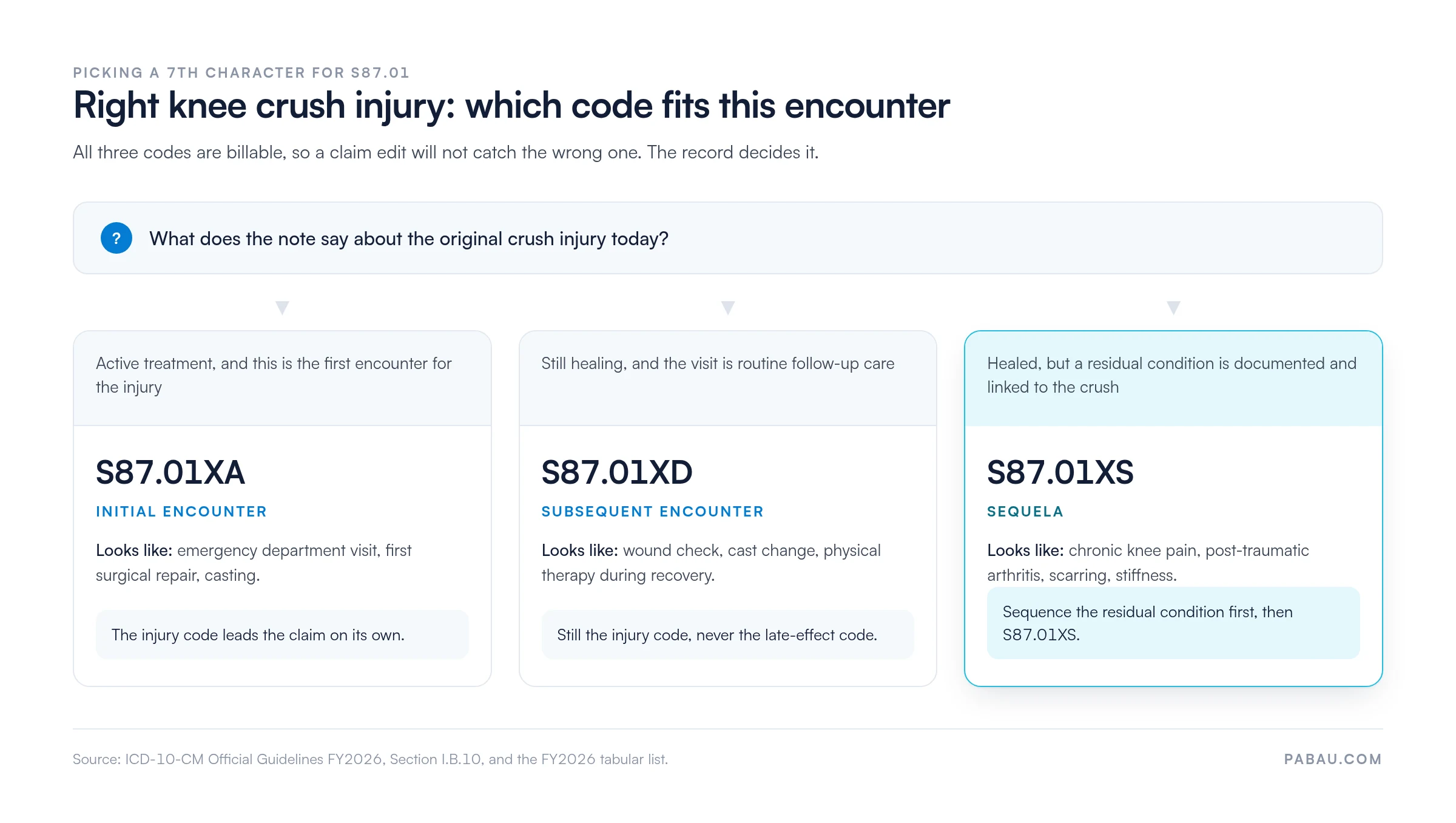
S87.01XD and S87.01XS are both valid billable codes, so a claim scrubber will not flag the wrong encounter character for you.
Pabau’s claims software pairs a built-in ICD-10-CM code library with Claim.MD submission, eligibility checks, and ERA reconciliation for US practices.
S87.01XS is valid and billable in the FY2026 ICD-10-CM edition. The table below holds every field a coder or biller checks before the claim goes out.
According to the CDC/NCHS ICD-10-CM web tool, S87.01XS took effect on October 1, 2025 and stays valid through the FY2026 coding year. The S87 group was not revised this edition, so the descriptions and rules below apply as written.
Read left to right, S87.01XS names an injury chapter, a crushing injury of the knee, the right side, and a sequela encounter. Each segment narrows the claim, and the last one carries the most weight.
The X at position 6 is structural rather than clinical. ICD-10-CM inserts it as a dummy character when a code runs shorter than six characters but still needs a 7th character extension. Drop the X and you are left with an invalid code that rejects at submission.
The 7th character tells the payer where in the injury’s life this encounter sits. S designates sequela, so the visit is for a condition caused by the original crush rather than for the crush itself.
All three options for S87.01 are billable, which is exactly why the wrong one slips through.
The S versus D distinction is the most common error in this code family. D applies while the injury is still healing. S applies once healing is complete and a new, persistent condition traces back to the original crush.
A patient in physical therapy six weeks after the injury, still under active care, is S87.01XD. The same patient two years later with chronic knee stiffness is S87.01XS, paired with a code for the stiffness.
The chart below turns that judgment into two questions you can answer straight from the note.
Section I.B.10 of the ICD-10-CM Official Guidelines sets the order. The nature of the sequela is sequenced first, and the sequela code follows it. Reverse the two and the claim carries a technical coding error, even when the clinical story behind it is correct.
S87.01XS sits in category S87, crushing injuries of the lower leg, inside the S80-S89 block for injuries to the knee and lower leg. Tracing that path is worth doing when documentation is thin. It shows which level you can fall back to without overstating the record.
The CMS ICD-10 codes page publishes the annual tabular list and the official code files for each fiscal year, S87 included. Verify against the FY2026 files for any claim dated on or after October 1, 2025.
S87 is built around laterality, so the codes either side of S87.01XS differ by a single detail. Wrong side and wrong encounter type are the two errors that turn up most often across this group.
If you code injuries regularly, our ICD-10-CM code reference is the faster way to check a neighboring category.
S87.00XS belongs on a claim only when laterality genuinely cannot be determined from the record. The guidelines ask for the highest specificity the documentation supports. A documented side means S87.01XS or S87.02XS, and a vaguer code will not hold up under review.
S87.01XS applies when a patient presents with a condition caused by an earlier right knee crush injury, and that injury has finished healing.
These five situations cover most of what arrives at an orthopedic or rehabilitation front desk.
The thread running through all five is that the original crush is no longer being treated. If any active treatment of the crush is still running, S87.01XD is the code for that visit instead.
Before you assign S87.01XS, check two lines in the record. First, the provider has noted that the original crushing injury healed. Second, the current condition is attributed to that injury in the provider’s own words. Missing either line leaves the sequela code without the documentation support an auditor will look for.
Section I.B.10 of the ICD-10-CM Official Guidelines governs sequela coding across every injury code, S87.01XS included. The core rule does not move. The nature of the sequela is sequenced first, and S87.01XS follows it as the cause.
Payers that audit injury claims flag reversed sequela sequences as a technical coding error, even where the clinical content is right. The fix lives in the note rather than in the claim scrubber, so the provider’s wording is what protects the pairing.
A claim carrying S87.01XS travels the same route as any other diagnosis, and it tends to fail at one of five points. Knowing which point saves you from rechecking the whole chain every time one comes back.
Four questions before you hit send will catch most of it:
The same sequencing error usually shows up across a whole panel of injury patients rather than on one claim. Treating it as a category, the way a structured approach to denial management does, turns a recurring write-off into a documentation fix you make once.
S87.01XS is POA exempt, so it needs no present-on-admission indicator on an inpatient claim. Sequela codes are exempt as a category under CMS policy. A sequela describes a condition arising from an earlier event, not one present at the time of admission.
For hospital billing teams, that means the code goes out with no indicator and triggers no POA-related edit. For outpatient and rehabilitation practices billing on the CMS-1500, POA never enters the picture at all.
Practices handling traumatic injury follow-up, physical therapy, or orthopedic rehabilitation carry the same sequela pairing across a long run of visits. Practice management software like Pabau keeps those codes attached to the record, rather than in a separate billing tool that someone has to re-key.
Our claims software for practices carries a built-in ICD-10-CM code library. A coder can look up S87.01XS and attach it to the client record without leaving the chart. Codes already recorded against the client seed the claim form, and required fields have to be complete before the claim can be sent.
US claims go out through our Claim.MD clearinghouse integration, which reaches thousands of US payers and supports real-time eligibility checks. Claim.MD returns 835 electronic remittance advice files into Pabau. Your billing team reconciles payments and tracks outstanding claims in the same place the note was written.
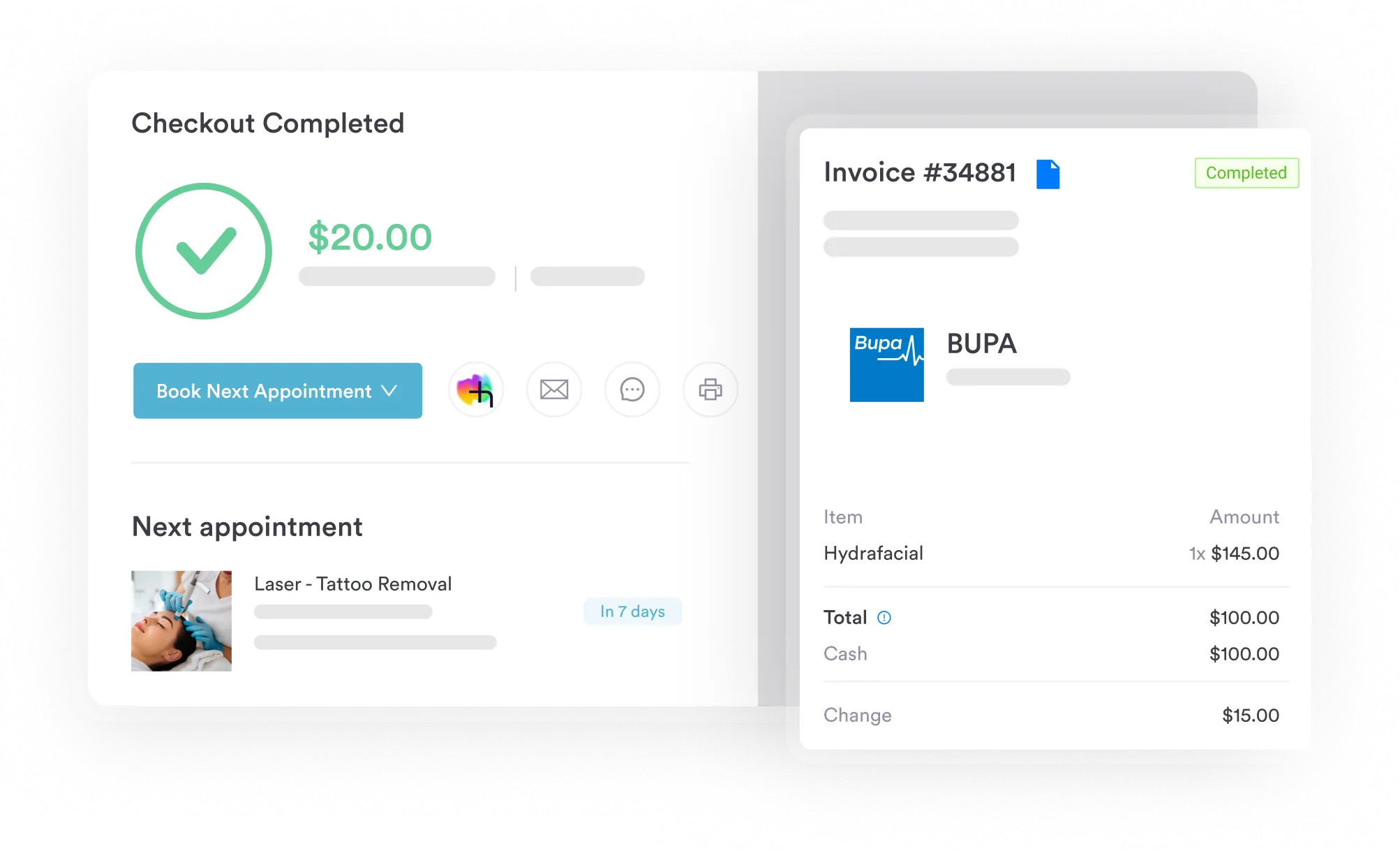

Pabau pairs a built-in ICD-10-CM code library with Claim.MD claim submission and ERA reconciliation. Your billing team files claims and posts payments without leaving the patient record.

S87.01XS is a straightforward code with one hard requirement. The record has to show that the right knee crush injury healed, and that today’s condition came from it. Once the note says both, the coding is mechanical: the residual condition leads, S87.01XS supports it, and the 7th character matches what the provider wrote.
The habit worth building is checking the documentation before you assign the code, not after the denial. One query on a vague note costs a few minutes. The recoupment it prevents lands 18 months later and costs considerably more.
Plenty of teams carry that pairing by hand across a dozen visits a week. Pabau keeps the code library, the claim, and the remittance on one record. Book a demo to see how it supports ICD-10 coding for orthopedic and rehabilitation practices.

Coding another knee sequela? S82.036S walks through a healed transverse patella fracture and the same two-code sequencing rule.
Soft tissue injury rather than a crush? S76.129S covers quadriceps laceration sequela and the documentation behind it.
Open wound of the knee on the chart? S81.009S explains when an unspecified-knee code is defensible and when it is not.
Building the visit documentation behind the claim? Superbill guide for medical practices shows how to structure a visit note so the codes come out right first time.
Want the wider revenue cycle picture? Revenue cycle management explained traces how diagnosis accuracy flows through to collections.
Use Z87.828, personal history of other (healed) physical injury and trauma, when the crush injury has healed and there is no residual condition to treat. S87.01XS belongs on the claim only when the patient has a current problem caused by that injury. If the knee is asymptomatic and the old injury is background context, the history code is the accurate choice.
Usually not. Sequela coding takes two codes, the residual condition first and S87.01XS second. A claim carrying only S87.01XS gives the payer no reason for the visit. Where the record shows no current residual condition, a personal history code fits the encounter better than a sequela code.
ICD-10-CM itself does not require external cause codes, but many workers’ compensation payers and state reporting programs do. When you report the cause-of-injury code alongside S87.01XS, it carries the 7th character S as well, so the external cause matches the sequela encounter.
The claim usually goes through, because both codes are valid and billable. The error tends to surface later, when a reviewer finds an injury documented as healed billed as active care. That makes it a post-payment audit finding rather than a front-end rejection.