ICD-10 Code S42.444P: Medial epicondyle fracture, right humerus
ICD-10 Code S42.444P: full descriptor and code validity ICD-10 Code S42.444P car...

Last Updated: Oct 13, 2026
Billable Code Specific Code
S86.811D is the billable ICD-10-CM code for strain of other muscle(s) and tendon(s) at lower leg level, right leg, subsequent encounter.
Let Pabau's smart automation suggest the right codes, reduce claim denials, and keep your practice compliant—effortlessly.
Automate repetitive tasks and focus on what matters most—your patients.
Reduce coding errors and ensure compliance with the latest regulations.
Clean claims, fewer denials, and faster reimbursements.
Powerful insights and reporting to help your practice thrive.
HIPAA compliant SOC 2 certified GDPR-compliant Trusted by 4,000+ clinics worldwide

ICD-10 code S86.811D describes a strain of other muscles and tendons at lower leg level, right leg, subsequent encounter. It is billable and valid for FY2026.
The 7th character D signals a subsequent encounter, meaning the patient is receiving routine care during the healing phase after initial treatment was established.
The S86.8 subcategory covers the calf muscles, including the gastrocnemius and soleus, and any lower leg structure the named muscle groups do not cover.
Practice management software like Pabau carries built-in ICD-10 and CPT catalogs, so a coder can enter S86.811D and submit through the Claim.MD clearinghouse.
S86.811D is a valid, billable ICD-10-CM diagnosis code for FY2026. It can be used in all HIPAA-covered transactions from October 1, 2025 through September 30, 2026, according to the AAPC ICD-10-CM code lookup. The table below captures the key reference data at a glance.
Every segment of S86.811D carries specific clinical meaning. Misread one segment and the result is the wrong laterality, the wrong encounter type, or the wrong anatomical category. Here is what each segment tells you, referenced against the CDC/NCHS ICD-10-CM classification tool.
The laterality digit is not optional. A lower leg strain submitted without confirmed laterality forces a downgrade to the unspecified code, S86.819D, and some payers treat that as incomplete documentation. The therapy team needs to confirm right versus left in every encounter note, on every visit in the episode.
The 7th character is where most coding errors happen on musculoskeletal injury claims. Providers sometimes default to A for every visit because it is the first character they learned. That single-character habit creates a mismatch between the clinical record and the claim, even when the patient is weeks into recovery.
For S86.811 and all traumatic injury codes across chapters S00-T88, three 7th characters apply. The rules sit in the ICD-10-CM Official Guidelines for Coding and Reporting, Section I.C.19.
Key rule for switching from A to D: use A for every visit where the provider is actively treating the acute injury. Switch to D as soon as treatment is established and visits become routine recovery care. That transition often happens at the second or third therapy session, not at a fixed number of days. The flow below maps each phase of the episode to its character.
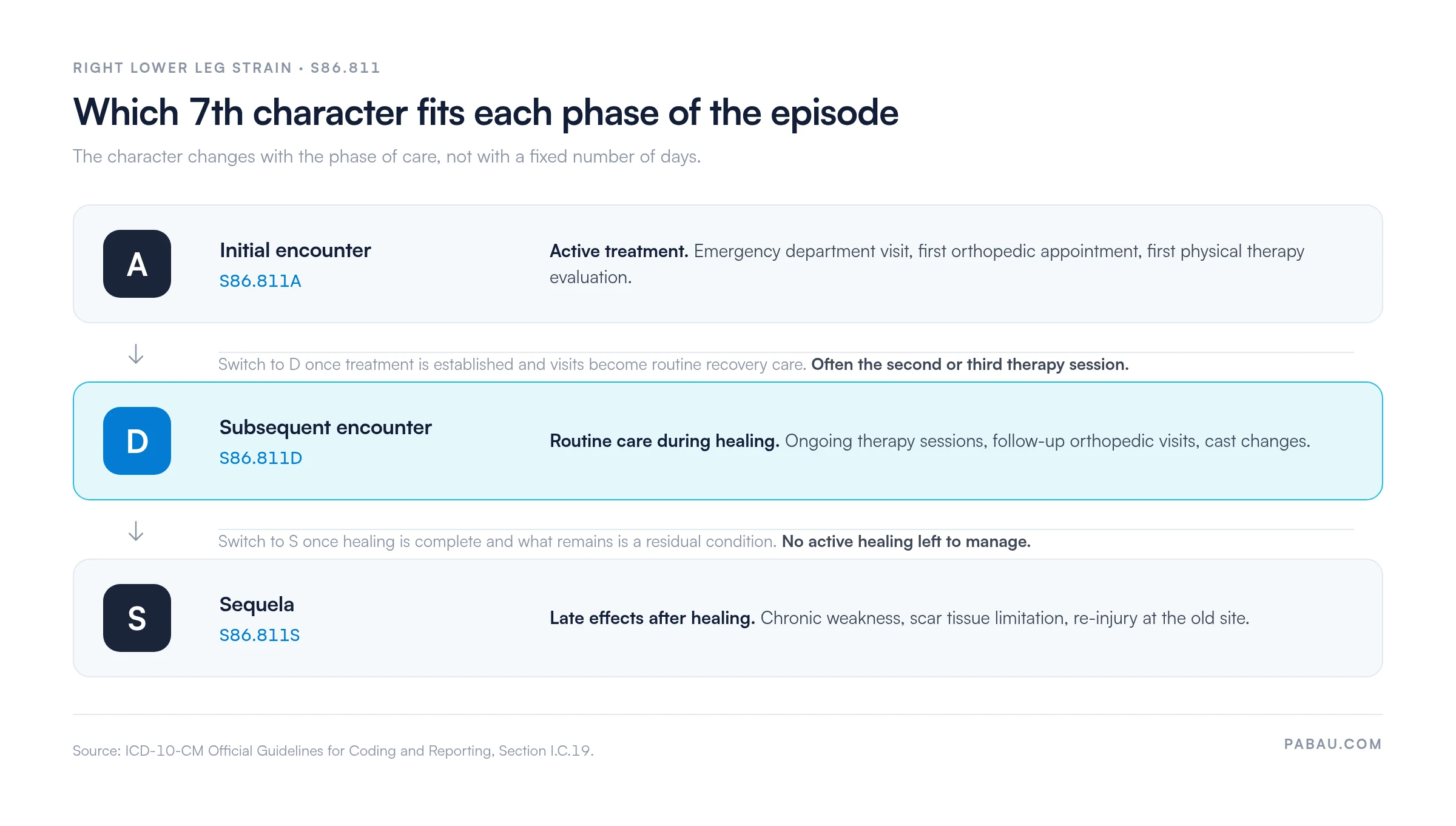
Document the treatment phase explicitly in each encounter note. Write ‘patient continuing routine physical therapy for right lower leg muscle strain, healing on track’ rather than just ‘follow-up.’ That phrase supports S86.811D over S86.811A and gives your biller the language to defend the code if a payer requests records.
Knowing where S86.811D sits in the classification helps coders navigate related codes. It also stops a parent code, which is not billable, going out in place of the specific child code. The CMS ICD-10-CM coding resources publish the full tabular list each fiscal year.
The “other” designation in S86.81 is where miscoding tends to cluster. Lower leg strains are common in athletes and active patients, so a practice that treats them regularly codes this family often. Knowing which structures sit under “other” and which belong to the named muscle groups keeps that volume accurate.
The S86 category gives each named muscle group its own subcategory. The Achilles tendon takes S86.0. S86.1 covers the posterior muscle group at lower leg level, which includes the tibialis posterior, flexor digitorum longus, flexor hallucis longus, plantaris, and popliteus. The anterior muscle group takes S86.2 and the peroneal group takes S86.3.
Patellar tendon injuries sit outside S86 altogether. They code to S76.1 at hip and thigh level, so a patellar tendon strain never belongs in this family. What remains at the lower leg level falls into the S86.8 “other” subcategory.
Structures coded under S86.81 include:
Verify the documented muscle against the current ICD-10-CM tabular list, since the “other” designation can shift across annual updates. When the note says only “lower leg strain” without naming the structure, S86.811D still fits. It needs laterality confirmed as right and an encounter in the recovery phase.
The S86.81 family covers three lateralities across three encounter types, which gives coders nine codes for this injury. Picking the wrong laterality sibling is a common error on episodes of care that span multiple providers.
Avoid the unspecified laterality codes whenever documentation supports a specific side. Some payers apply lower reimbursement or extra scrutiny to unspecified codes, treating them as incomplete documentation. Code to the highest level of specificity the record supports, in this family and in every other injury category.
A strain at head level leaves this family entirely. ICD-10 code S09.11XS reports a strain of muscle and tendon of head, with no laterality digit to pick. Its S character marks a sequela, so it applies after healing, while the D on S86.811D covers care during healing.
A claim submitted with S86.811D stands up to payer review only when the medical record supports each element of the code. Miss one piece, and the billing team is defending a claim it cannot trace back to the note.
Strain and sprain are distinct injury types in ICD-10-CM, and mixing them up changes the code entirely. A strain involves damage to a muscle or tendon, which is what S86.811D describes. A sprain involves damage to a ligament, coded from different subcategories in the S80-S89 range.
If the documentation says “sprain” and the coder submits S86.811D, a clinical documentation review can flag the discrepancy. Ask the attending clinician to specify “muscle strain” or “tendon strain” in the diagnosis.
When the note says only “soft tissue injury”, query the provider rather than defaulting to either code family. Sound coding practice means coding from documentation, not from clinical assumption.
S86.811D is valid for submission across all HIPAA-covered payer transactions for FY2026. Physical therapy, orthopedic, and sports medicine practices submit it as the primary diagnosis on subsequent-encounter claims through the healing episode.
Practices running practice management software like Pabau can enter the code from a built-in diagnosis catalog. From there the claim goes out through the Claim.MD clearinghouse to thousands of US payers.
A few billing considerations worth noting for this code family:
For practices handling a high volume of musculoskeletal injury claims, a single submission workflow keeps encounter-type errors down. The claims management software inside Pabau carries built-in CPT and ICD-10 catalogs, real-time eligibility verification, and electronic remittance advice processing through Claim.MD.
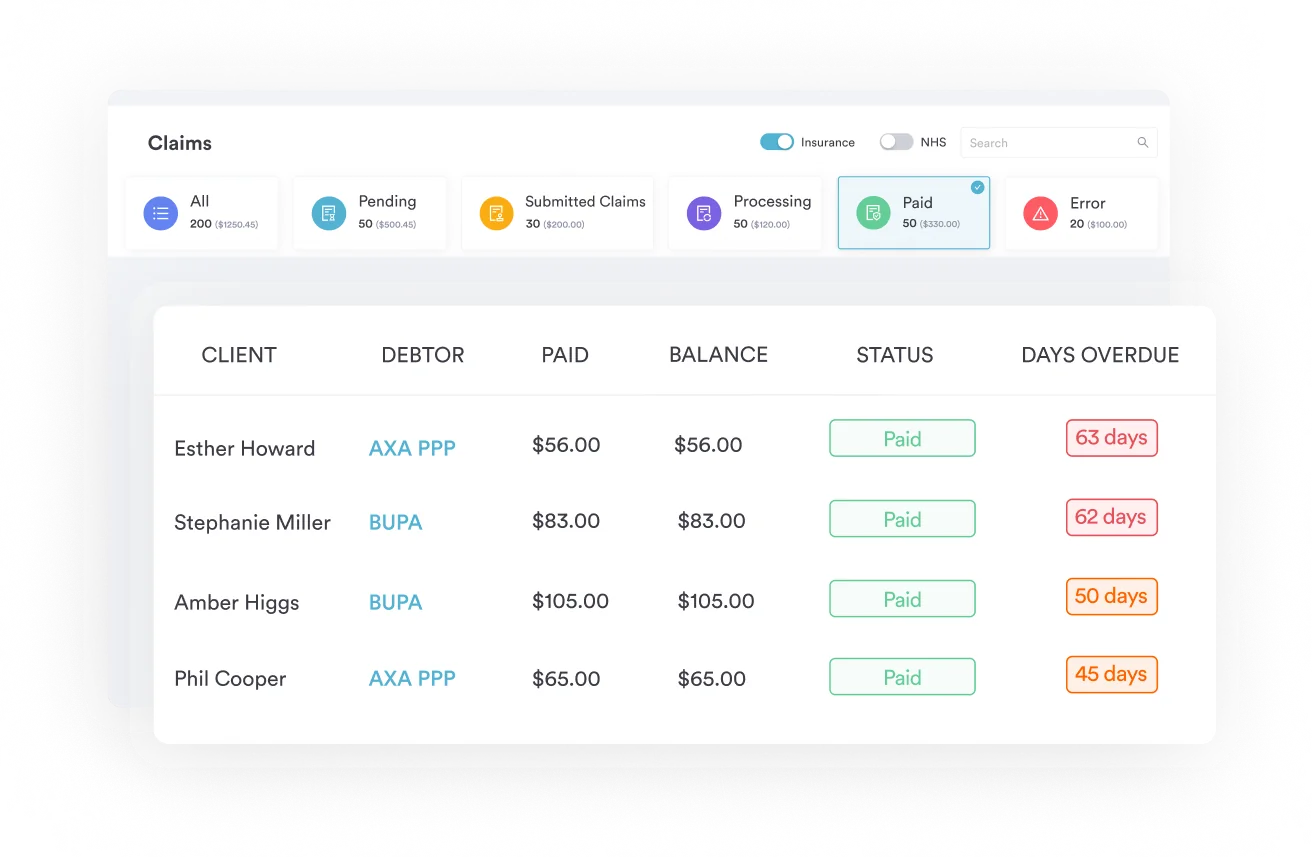
Denials on this code family usually trace back to the encounter character or to missing laterality. Reading the payer’s denial codes tells you which of the two triggered the rejection. The correction is then targeted, rather than a resubmission of the same claim.
Run a quarterly audit of all S86.811A claims submitted more than 90 days after the initial injury date. If a provider still uses the A character on visits that fall in the healing phase, the fix is documentation training. Flag the pattern before a payer audit finds it first.
A coding reference in one window and the patient record in another is a common setup. The coder reads the note, looks up the strain code, then types it into the claim at every visit. That habit is how the A character survives into the recovery phase.
Pabau holds the diagnosis on the client record, next to the appointment and the treatment note. The ICD-10 and CPT catalogs are built in, so a coder searches S86.811 and picks the encounter character on the same screen. Claims go to the payer through the Claim.MD clearinghouse, and the remittance lands back on the same record.
The outcome is fewer encounter-type mismatches on repeat visits, and less rework for the biller. When a payer questions a claim, the note, the code, and the remittance sit in one place. The biller answers from the record instead of rebuilding the episode from scratch.

Pabau’s practice management platform includes a built-in ICD-10 and CPT catalog, real-time eligibility checks, and direct claim submission via Claim.MD to thousands of US payers. Enter S86.811D and submit from the same screen.

The encounter character is the part of S86.811D a coder has to decide, and the record has to support that decision. Once treatment is established and visits become routine recovery care, D is the correct character until healing is complete.
Write the phase of care into the note in plain language, and the code choice defends itself. Leave it implicit, and the biller ends up guessing on the practice’s behalf when a payer asks.
For practices with steady physical therapy or orthopedic volume, the workflow around the code decides the denial rate. Pabau’s built-in Claim.MD clearinghouse connection submits straight from the patient record, so the character on the claim matches the character in the note. Book a demo to see a full injury episode coded and billed in one place.

Need a structured approach to musculoskeletal coding compliance? Medical billing compliance covers documentation standards and audit readiness for injury codes.
Seeing repeat denials on encounter-character errors? Denial management in healthcare sets out a workflow for tracing denials back to their root cause.
Want to understand the clearinghouse submission process? 837 file format guide breaks down the electronic claim file used to send ICD-10 diagnosis codes to payers.
Need to read what the payer sent back? Electronic remittance advice explains how to interpret an ERA when a payer adjusts a lower leg strain claim.
Checking coverage before the next therapy visit? Insurance eligibility verification walks through the checks that keep an ongoing treatment episode payable.
S86.811D is a billable ICD-10-CM diagnosis code for a strain of other muscle(s) and tendon(s) at lower leg level, right leg, subsequent encounter. It applies once initial treatment for the right lower leg strain has been established. The patient is then receiving routine care through the healing or recovery phase. It is valid for FY2026, from October 1, 2025 through September 30, 2026.
Yes. S86.811D is a billable, specific ICD-10-CM code valid for use in all HIPAA-covered transactions during FY2026. It can be submitted as a primary diagnosis on CMS-1500 and 837P claims for physical therapy, orthopedic, and sports medicine encounters.
S86.811A is used for initial encounters, meaning visits where the acute injury is being actively treated for the first time. Examples include an emergency department evaluation or the initial physical therapy intake. S86.811D applies to subsequent encounters during the healing phase, once treatment has been established and ongoing care is routine. Using A on a recovery-phase visit creates a mismatch between the clinical documentation and the submitted code.
In ICD-10-CM traumatic injury codes, which run across chapters S00-T88, the 7th character D indicates a subsequent encounter. The patient is receiving routine care during the healing phase rather than active treatment for the acute injury. The three options for this code family are A (initial encounter), D (subsequent encounter), and S (sequela after healing is complete).
Use S86.811D while the right lower leg strain is actively healing. That covers ongoing physical therapy and follow-up orthopedic visits through the recovery phase. Switch to S86.811S once healing is complete and the patient presents with a late effect of the original injury. Chronic weakness, persistent pain, and limited range of motion are the usual residual conditions.
Yes. Physical therapy providers use S86.811D as the primary diagnosis on subsequent-encounter claims through the recovery phase of a right lower leg strain. Pair it with the CPT codes for therapeutic exercise, manual therapy, or neuromuscular re-education. The clinical note should document the ongoing recovery status and the patient’s response to treatment.
In ICD-10-CM, a strain involves injury to a muscle or tendon, coded under S86 for the lower leg. A sprain involves injury to a ligament, coded from different subcategories in the S80-S89 range. S86.811D is a strain code, so “sprain” terminology in the note points to a different code. Query the provider when the documentation is unclear rather than defaulting to either family.