

ICD-10 Code S42.444P: Medial epicondyle fracture, right humerus
ICD-10 Code S42.444P: full descriptor and code validity ICD-10 Code S42.444P car...

Last Updated: Oct 13, 2026
Billable Code Specific Code
S85.992D is the billable ICD-10-CM code for other specified injury of unspecified blood vessel at lower leg level, left leg, subsequent encounter.
Claims with this code cover follow-up visits after the active treatment phase is complete. Coders who confuse the "D" encounter qualifier with the initial "A" encounter regularly trigger denials. The word "unspecified" here describes the blood vessel, not the side of the body. S85.991D covers the right leg, and S85.999D covers a record that never names a side.
Let Pabau's smart automation suggest the right codes, reduce claim denials, and keep your practice compliant—effortlessly.
Automate repetitive tasks and focus on what matters most—your patients.
Reduce coding errors and ensure compliance with the latest regulations.
Clean claims, fewer denials, and faster reimbursements.
Powerful insights and reporting to help your practice thrive.
HIPAA compliant SOC 2 certified GDPR-compliant Trusted by 4,000+ clinics worldwide

ICD-10 code S85.992D covers subsequent encounters for other specified injury of an unspecified blood vessel at lower leg level, left leg.
The word ‘unspecified’ in the descriptor refers to the blood vessel, not to the side of the body.
Laterality is fixed in this code: S85.991D covers the right leg and S85.999D covers a record that never names a side.
The code is billable and valid for HIPAA-covered transactions through fiscal year 2026, which runs October 1, 2025 to September 30, 2026.
Practice management software like Pabau validates ICD-10-CM codes before claims go out, which reduces denials on vascular injury coding.
ICD-10 code S85.992D describes other specified injury of an unspecified blood vessel at lower leg level, left leg, for a subsequent encounter.
The word “unspecified” in that descriptor refers to the blood vessel, not to the side of the body. Reading the components one at a time keeps the two apart. It also prevents the most common error on this code. Coders submit the subsequent encounter qualifier while the chart still reads like active treatment.
The “other specified” qualifier means the vascular injury is documented but does not map cleanly to a named vessel within the S85 category. Named vessels in that category include the popliteal and tibial arteries. When the injured vessel is named in the record, coders should check whether a more specific S85 code applies before settling on S85.992D. Specificity comes first throughout ICD-10-CM Chapter 19, so a named vessel always outranks an unspecified one.
Yes, S85.992D is a fully billable ICD-10-CM code valid for HIPAA-covered transactions. It is active for fiscal year 2026, which covers dates of service from October 1, 2025 through September 30, 2026.
Payers processing Medicare and Medicaid claims require ICD-10-CM codes under CMS mandate. S85.992D belongs on a claim for a follow-up visit where the record documents a left lower leg vascular injury and names no specific vessel. Payers also run their own edits against injury codes, so a clean submission depends on more than a valid code. Practices that validate diagnoses inside the claims software billers use catch a laterality mismatch before submission rather than after denial.
The 7th character D designates a subsequent encounter. The patient has completed the active treatment phase and now receives routine care, such as wound checks, cast adjustments, or physical therapy follow-up. This is distinct from A (initial encounter) and S (sequela).
Encounter-type errors cluster at the line between the A and D qualifiers. A patient presenting for a wound check two weeks after vascular repair surgery is a subsequent encounter. A patient presenting because symptoms have worsened, with the physician re-evaluating and changing the treatment plan, is still an initial encounter. The chart’s clinical narrative should make the treatment phase explicit. Submitting D when the note describes active evaluation of an acute injury is the fastest route to a denial. Encounter-qualifier mismatches remain a leading cause of vascular injury claim rejections.
The CMS ICD-10-CM coding guidelines provide the authoritative definition of each encounter type. When S85.992D is submitted, the physician’s note must show that treatment is ongoing and routine rather than investigative or acute.
S85.992D falls within ICD-10-CM Chapter 19, Injury, Poisoning, and Certain Other Consequences of External Causes. Inside that chapter it sits in the S80-S89 block, which covers injuries to the knee and lower leg. The full hierarchy is:
S85.992 is not itself a billable code. Submitting the base code without the 7th character D will result in a claim rejection. The 7th character is required to make any code in the S85.992x subcategory billable. Coders can confirm the full hierarchy and the billable 7-character options in the CDC/NCHS ICD-10-CM web tool.
A vascular injury above the knee leaves the S80-S89 block for S75, which covers blood vessels at hip and thigh level. There, an unspecified injury to an unspecified vessel of the right leg at a subsequent encounter is code S75.901D.
When querying S85.992D in your EHR or practice management system, search for the full string including the decimal: S85.992D. Systems that store the decimal separately may truncate to S85992D internally. The displayed and submitted format must still include the decimal point, as per ICD-10-CM official notation. Confirm your clearinghouse accepts the full formatted code before bulk-submitting claims.
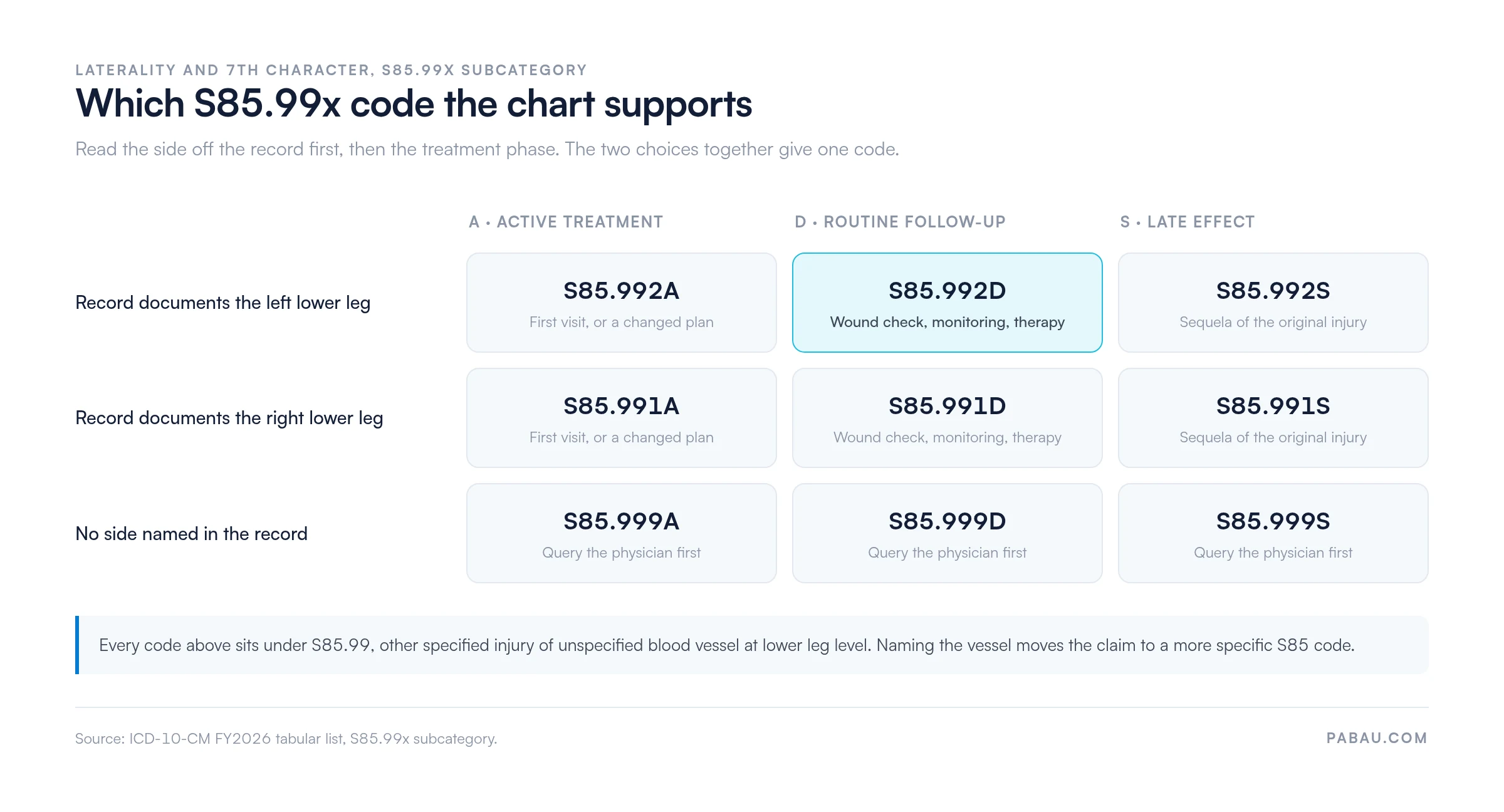
The S85.99x subcategory splits by laterality into three base codes, and each one takes the same 7th characters (A, D, or S). S85.991 covers the right leg, S85.992 covers the left leg, and S85.999 covers a record that never states a side. Select the sibling that matches the documentation, and treat S85.999D as the last resort rather than the default.
Laterality is a known audit trigger for lower extremity vascular codes. Claims-editing software compares the side named in the diagnosis code against the modifiers on procedure codes for the same date of service. A claim carrying S85.992D next to an RT modifier will stop at that edit. Check every procedure code on the claim against the CPT code library before submission. Catching the conflict at the pre-submission edit costs a minute, and catching it after the denial costs a full rework cycle.
Side and treatment phase are the only two decisions the S85.99x subcategory asks a coder to make. The grid below pairs them off, one cell per billable code.
ICD-10-CM index references map several clinical terms to S85.992D. Knowing the synonyms helps coders find the code from varied physician language, and it supports a specificity query when the record is thin.
A physician may write “left lower extremity vessel injury” or “left leg vascular trauma” without naming an artery or vein. S85.992D is the correct ICD-10-CM code for a follow-up visit on that documentation. Coders referencing the AAPC ICD-10-CM code lookup can verify index references for any synonym appearing in physician notes.
Accurate use of ICD-10 code S85.992D depends on documentation quality as much as on code selection. Three documentation problems account for most claim denials here. They are encounter type ambiguity, a laterality statement that conflicts with the rest of the chart, and missing detail about the injured vessel.
The physician’s note must explicitly indicate the patient is in the recovery or follow-up phase. Language like “patient presents for routine wound check following vascular repair” or “monitoring post-treatment vascular healing” clearly supports the D qualifier. Avoid vague phrasing such as “patient presents with lower leg pain” with no indication of the visit context. That forces the coder into an interpretation call that auditors can challenge.
Coders are not permitted to infer encounter type from clinical judgment, so the record has to state it outright. A follow-up note template that carries an encounter-type field keeps that statement in the chart without a separate query. It also gives the auditor a dated line to read rather than an inference to argue with.
S85.992D states that the injury is on the left leg, so the record has to say the same. If the note, the physical examination, or the operative report documents the right lower leg, the correct code is S85.991D. If no part of the record names a side and a physician query is not possible, S85.999D is the unspecified-leg option. Reaching for S85.992D as a default is a coding error, because it asserts a side the chart never supported. Query the physician before submission whenever the operative report specifies a leg and the office note does not.
The “unspecified blood vessel” qualifier in S85.992D means the injured vessel is not named in the record. If the operative or radiology report names the vessel (popliteal artery, anterior tibial, peroneal vein), a more specific S85 code likely exists. More specific codes reduce payer scrutiny and make remittance matching cleaner at the EOB level. Effective denial management strategies include a pre-submission audit step that looks for a more specific code whenever an NOS or unspecified-vessel code is selected.
Practices submitting claims electronically can send them through Pabau’s integration with Claim.MD, our US clearinghouse partner. Claim.MD validates ICD-10-CM codes against payer-specific edits before transmission. That catches common errors, including a laterality conflict between the diagnosis and the procedure modifiers, before they reach the payer.
Run a monthly audit of claims that pair a laterality-specific diagnosis code with a procedure code carrying an RT or LT modifier. On S85.992D the modifier should read LT. A mismatch points at a miskeyed code, or at a chart that names one side in the note and the other in the operative report. Resolve it before the next claim goes out.
ICD-10-CM codes are updated annually, within the World Health Organization’s ICD classification framework. The US-specific ICD-10-CM edition is maintained by the National Center for Health Statistics (NCHS). S85.992D has been active since ICD-10-CM’s US implementation. The S85 category carries an Excludes2 note for injury of blood vessels at ankle and foot level (S95.-). An Excludes2 note is not a prohibition, so both codes may appear on the same claim when the record documents both injuries.
The code has no record of being retired, split, or revised since that implementation. A claim for a date of service inside FY2026 will clear the code-validity edit at the clearinghouse. That assumes the rest of the claim data is correct. Verify validity against the date of service rather than the submission date, and recheck each October when the new fiscal year files are released.
A laterality conflict usually surfaces on the remittance advice, not on the claim. Someone then pulls the chart, reworks the claim, and resubmits it weeks after the visit took place. The check that would have stopped the denial takes seconds, and it tends to sit outside the billing software.
Pabau, our practice management software, keeps coding and claims in one record, so the diagnosis code sits beside the clinical note that supports it. Claims go out through Claim.MD, our US clearinghouse partner, which validates each ICD-10-CM code against payer-specific edits before transmission. A subsequent encounter code on an active treatment note, or a left-leg diagnosis against a right-side modifier, surfaces while the claim is still editable.
The result is a shorter claim cycle and less rework for the billing team. The physician query happens at the point of coding rather than after the payer responds.

Pabau brings ICD-10-CM coding into your clinical workflow, cutting manual entry errors and speeding up claim submission for vascular injury follow-up visits.

ICD-10 code S85.992D is a straightforward billable code that turns into a denial risk through three documentation failures. The first is using D while the patient is still in active treatment. The second is assigning this left-leg code when the record documents the right leg, or names no side at all. The third is accepting an unspecified vessel when the operative report names one. Handling all three before submission rather than after denial keeps the claim cycle clean.
Pabau’s claims workflow connects to Claim.MD’s clearinghouse network, which covers thousands of US payers. Code selections are validated against payer-specific edits before transmission. To see how that handles vascular injury coding in your own practice, book a demo with our team.

Need to understand how clean claims reduce denial rates? Clean claim best practices covers the documentation and coding elements that prevent common payer rejections.
Submitting vascular injury claims through a clearinghouse? How medical claims clearinghouses work explains the validation steps between your practice and the payer.
Want to reduce coding errors across your whole coding team? Superbill documentation guidance outlines how structured superbills reduce laterality and encounter-type errors at the point of care.
ICD-10 code S85.992D is the diagnosis code for other specified injury of an unspecified blood vessel at lower leg level, left leg, subsequent encounter. The word unspecified refers to the blood vessel, not to the side of the body. It applies to follow-up visits after active treatment for a left lower leg vascular injury, where the record does not name the vessel.
Yes, S85.992D is a fully billable ICD-10-CM code valid for HIPAA-covered transactions. It is active for fiscal year 2026, covering dates of service from October 1, 2025 through September 30, 2026.
All three describe the same left leg injury and differ only in the 7th character. S85.992A is the initial encounter code, used while the patient is receiving active treatment. S85.992D is the subsequent encounter code, used for routine follow-up care after active treatment ends. S85.992S is the sequela code, used for a late effect that is a direct consequence of the original vascular injury.
The parent code is S85.992, other specified injury of an unspecified blood vessel at lower leg level, left leg, without a 7th character. S85.992 is not billable on its own. The 7th character (A, D, or S) is required to make any code in this subcategory valid for claim submission.
Subsequent encounter codes are used when the patient is receiving routine care after the active treatment phase is complete. This includes wound checks, monitoring, physical therapy, and other follow-up care. If the physician is still actively evaluating and treating the acute injury, the initial encounter qualifier (A) applies regardless of how many visits have occurred.
Use S85.999D, the unspecified-leg code in this subcategory, for a subsequent encounter. S85.992D asserts the left leg and S85.991D asserts the right leg, so neither fits a record that never names a side. Query the physician first wherever a query is possible, because unspecified laterality invites extra payer scrutiny.




