

ICD-10 Code S42.444P: Medial epicondyle fracture, right humerus
ICD-10 Code S42.444P: full descriptor and code validity ICD-10 Code S42.444P car...

Last Updated: Oct 13, 2026
Billable Code Specific Code
S85.391D is the billable ICD-10-CM code for other specified injury of greater saphenous vein at lower leg level, right leg, subsequent encounter.
Coders often confuse it with S85.392D for the left leg and S85.399D for unspecified laterality. Claims are denied when the note fails to confirm the right leg and the "other specified" injury type.
Let Pabau's smart automation suggest the right codes, reduce claim denials, and keep your practice compliant—effortlessly.
Automate repetitive tasks and focus on what matters most—your patients.
Reduce coding errors and ensure compliance with the latest regulations.
Clean claims, fewer denials, and faster reimbursements.
Powerful insights and reporting to help your practice thrive.
HIPAA compliant SOC 2 certified GDPR-compliant Trusted by 4,000+ clinics worldwide

S85.391D is a billable ICD-10-CM code for the right leg, valid from October 1, 2025 under FY2026.
The 7th character D covers active treatment while the injury heals, so it replaces A once the first treatment episode ends.
Use S85.392D for the left leg and S85.399D when laterality is undocumented, because laterality errors trigger denials.
Reach for S85.311D instead when the note describes a laceration of the greater saphenous vein.
Practice management software like Pabau checks ICD-10 codes against payer rules before the claim is submitted.
ICD-10 Code S85.391D describes other specified injury of the greater saphenous vein at lower leg level, right leg, subsequent encounter.
Each segment of the code carries a specific clinical meaning that must be reflected in the patient’s documentation before billing.
The “other specified” designation (S85.39x) applies when the documented injury type does not match a more specific subcategory within S85.3. Work through the rest of the S85.3 family before you settle on S85.391D. Auditors regularly flag claims where a more precise code was available in the record.
S85.391D is a billable and specific ICD-10-CM code, valid for the submission of HIPAA-covered transactions. According to the CDC/NCHS ICD-10-CM web tool, this code is included in the FY2026 edition of ICD-10-CM, effective October 1, 2025.
Code validity on its own does not guarantee reimbursement. Coverage still depends on payer policy, medical necessity documentation, and the claim context. Check the payer’s local coverage determination, known as an LCD, before you submit.
The 7th character D in ICD-10-CM trauma codes designates a subsequent encounter. The patient is receiving active treatment for a condition in its healing or recovering phase, after the initial treatment episode. The CMS ICD-10-CM coding guidelines define subsequent encounter precisely, and coders should not conflate it with a routine follow-up visit.
A common coding error is applying D when A is still correct. If a different provider sees the patient for that injury for the first time, that visit still uses A as its 7th character. The injury’s age does not change it. The encounter type reflects the treating provider’s relationship to the injury, not the injury’s age.
Documentation must support whichever 7th character is applied. Payer auditors look for notes that describe the healing or recovery phase when D is used. A note that never states the injury’s current status is a denial risk. For practices managing trauma follow-ups across several practitioners, building clean claims from well-documented encounters cuts the rework that follows an audit flag.
Record the injury’s healing status in every subsequent encounter note, using a phrase such as ‘wound healing appropriately’ or ‘vascular repair site under monitoring’. That wording supports the 7th character D and gives an auditor the context a claim needs.
S85.391D sits inside the S85 block, which covers injury of blood vessels at lower leg level. Above that sits the S00-T88 chapter for injury, poisoning, and certain other consequences of external causes. Knowing where a code sits helps coders check the adjacent codes and confirm that the specificity is right.
Each subcategory inside S85 covers a different vessel. S85.0 covers the popliteal artery, S85.1 the tibial arteries, S85.2 the peroneal artery, and S85.3 the greater saphenous vein. A wrong subcategory misstates which structure was injured, so the mistake lands in the clinical record as well as on the claim.
The greater saphenous vein is the longest vein in the body. It runs from the dorsum of the foot along the medial aspect of the lower leg and thigh. It then drains into the femoral vein at the groin. At lower leg level it travels along the medial tibia, which leaves it exposed to lacerations, crush injuries, and surgical complications.
Common injury scenarios that generate a greater saphenous vein injury code include:
S85.391D covers an “other specified” injury to this vein. The injury type is documented, but it does not map to a more specific subcategory. A documented laceration, for instance, belongs under S85.311D, which is laceration of greater saphenous vein at lower leg level. Before applying S85.391D, confirm that no more precise code in the S85.3 family fits the record.
For practices managing post-surgical lower extremity cases, accurate vein injury coding supports the medical necessity review payers run on wound care and vascular monitoring visits. Orthopedic, vascular, and rehabilitation teams all meet these codes while coordinating follow-up with the treating surgeon.
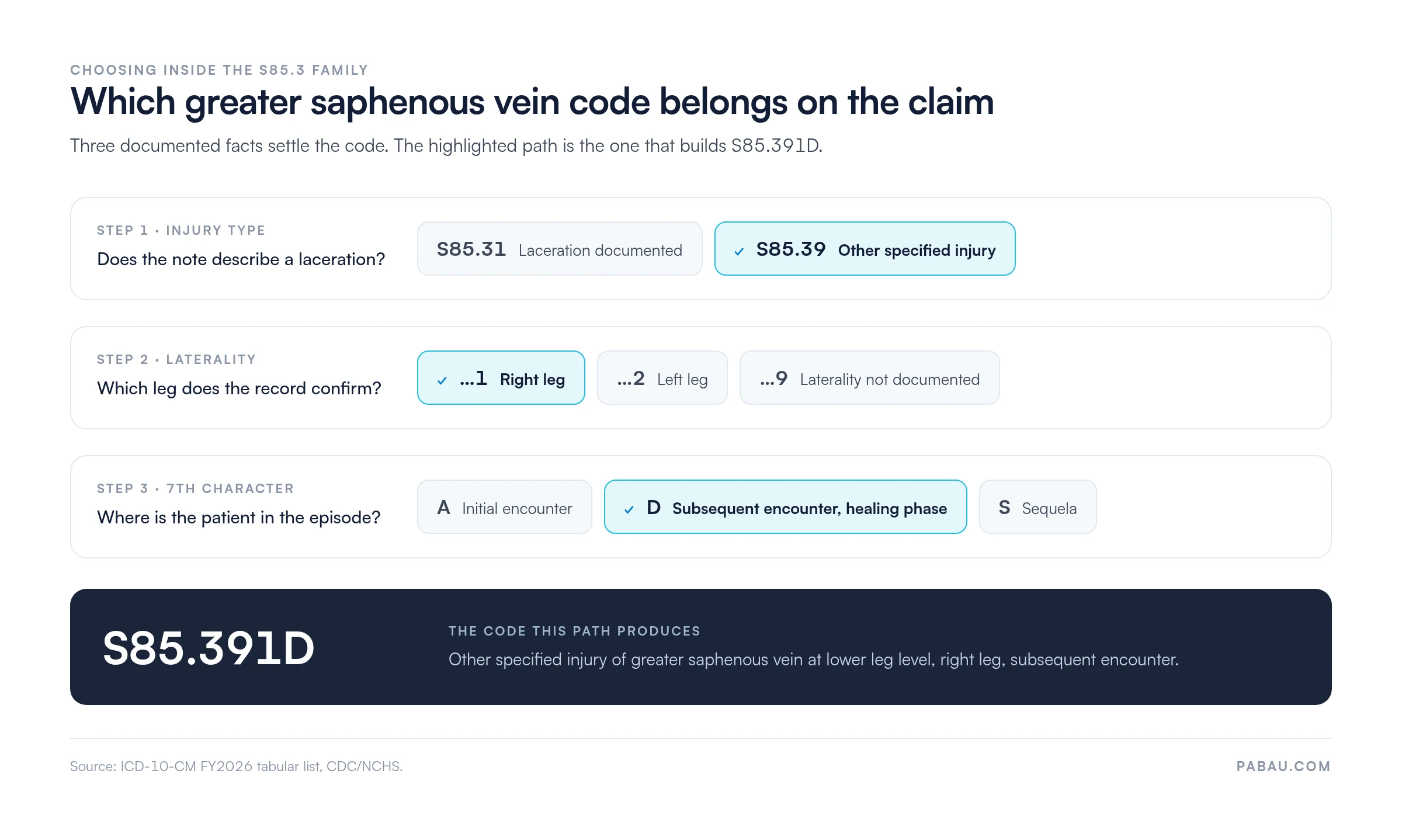
S85.391D sits within a family of laterality and encounter-type variants. Picking the wrong sibling is the most common error in this code set. Payers return claims whenever the laterality clashes with the operative note or the radiology report. The AAPC Codify ICD-10-CM lookup lists the full range of S85.3 sibling codes.
When the operative report or the clinical note describes a laceration, S85.311D is more specific than S85.391D and should be selected instead. Reaching for an “other specified” code while a more precise one exists invites payer scrutiny during claims review.
Three documented facts settle which member of the S85.3 family belongs on the claim. The decision path below follows them in the order a coder meets them.
Once the sibling is settled, the wider diagnostic codes library covers the adjacent ICD-10 families a lower leg trauma claim usually needs alongside it.
S85.391D inherits the coding notes that apply to the S85 category and the broader S80-S89 block. Understanding these notes prevents incorrect code application and avoids claim denials from bundling or sequencing errors.
For practices submitting trauma and post-surgical claims under HIPAA-covered transactions, sequencing and accompanying-code documentation drive the clean claim rate. Practices on software like Pabau route ICD-10 coded claims through its claims management software, so the coding checks run before the claim reaches the payer.
Check whether an accompanying open wound code (S81.-) is warranted every time you bill S85.391D. A missing additional code delays payment without producing a denial code that is easy to trace back.
Using S85.391D correctly depends entirely on what the clinical record contains. Payers auditing vascular injury claims on subsequent encounter visits look for specific documentation elements that justify both the code and the encounter type.
Practices managing several follow-up visits for one lower leg vascular injury benefit from a structured documentation template. Prompting the clinician to confirm laterality, injury status, and the treatment provided at each encounter reduces the risk of submitting D when A still applies. It also catches the open wound code that otherwise goes missing.
In most practices, the check on a code like S85.391D happens after the claim is rejected. A biller reads the remittance, opens the clinical note, finds that the leg was never stated, and rebuilds the claim. That loop costs a fortnight on a visit that was documented weeks earlier.
Practice management software like Pabau moves the check forward. Coded claims are validated against payer rules through our Claim.MD clearinghouse integration, before the 837P file leaves the practice. A laterality clash or a missing 7th character is flagged while the clinical note is still open. Charting, coding, and billing sit in one patient record, so the coder reads the operative note beside the claim rather than hunting for it.
An orthopedic or vascular practice ends up filing fewer corrected claims on trauma follow-ups. Payment arrives on the first submission rather than the third.

Pabau checks ICD-10-CM codes against payer rules through its Claim.MD integration. That cuts denials on trauma and vascular injury claims before they ever reach the clearinghouse.

S85.391D captures subsequent encounter care for a right-leg greater saphenous vein injury, but only where the record supports all three parts of it. The leg, the injury type, and the healing-phase status each have to appear in the note. Laterality and encounter type are what denials in this code family turn on.
Set the documentation standard at the first follow-up and the coding follows on its own. Name the vein, confirm the leg, and record the healing status at every visit. Book a demo to see how Pabau checks ICD-10 codes against payer rules before your claim leaves the practice.

Need to understand denial patterns on vascular injury claims? Denial codes in medical billing covers the most common CARC codes and how to respond.
Want to understand how clearinghouse submission works? Medical claims clearinghouse guide explains how 837P files flow from your practice to the payer.
Building a compliant billing workflow? What is revenue cycle management maps the end-to-end process from patient encounter to payment posting.
ICD-10 Code S85.391D is the diagnosis code for other specified injury of the greater saphenous vein at lower leg level, right leg, subsequent encounter. It applies when a patient receives active treatment during the healing or recovery phase of that injury.
Yes, S85.391D is a billable and specific ICD-10-CM code valid for the submission of HIPAA-covered transactions. It is included in the FY2026 edition of ICD-10-CM, effective October 1, 2025.
Use S85.391A for the initial treatment episode, including the first visit to any provider for active management of the injury. Switch to S85.391D once the initial episode is complete and treatment continues through the healing phase.
S85.391D is right-leg specific. S85.392D covers the same injury type and encounter on the left leg. Using the wrong laterality code when the operative note confirms the right leg triggers a denial and a corrected claim.
The parent code is S85.39, which covers other specified injury of the greater saphenous vein at lower leg level. Above that sit S85.3 for the greater saphenous vein and S85 for blood vessels at lower leg level.
The 7th character D designates a subsequent encounter. The patient is receiving active care during the healing phase, after the initial treatment episode is complete. It is distinct from A for an initial encounter and S for sequela.




