

ICD-10 Code S42.444P: Medial epicondyle fracture, right humerus
ICD-10 Code S42.444P: full descriptor and code validity ICD-10 Code S42.444P car...

Last Updated: Oct 13, 2026
Billable Code Specific Code
S86.309A is the billable ICD-10-CM code for unspecified injury of muscle(s) and tendon(s) of peroneal muscle group at lower leg level, unspecified leg, initial encounter.
Coders reach for it when a patient presents with a peroneal muscle or tendon injury and the note does not say which leg. The 7th character A marks the visit as an initial encounter, separating it from follow-up care (D) and late sequelae (S). Getting both details right on the first claim keeps the billing record accurate across the care episode.
Let Pabau's smart automation suggest the right codes, reduce claim denials, and keep your practice compliant—effortlessly.
Automate repetitive tasks and focus on what matters most—your patients.
Reduce coding errors and ensure compliance with the latest regulations.
Clean claims, fewer denials, and faster reimbursements.
Powerful insights and reporting to help your practice thrive.
HIPAA compliant SOC 2 certified GDPR-compliant Trusted by 4,000+ clinics worldwide

S86.309A is a valid, billable ICD-10-CM code for fiscal year 2026, effective October 1, 2025. It covers an unspecified peroneal muscle group injury at the initial encounter.
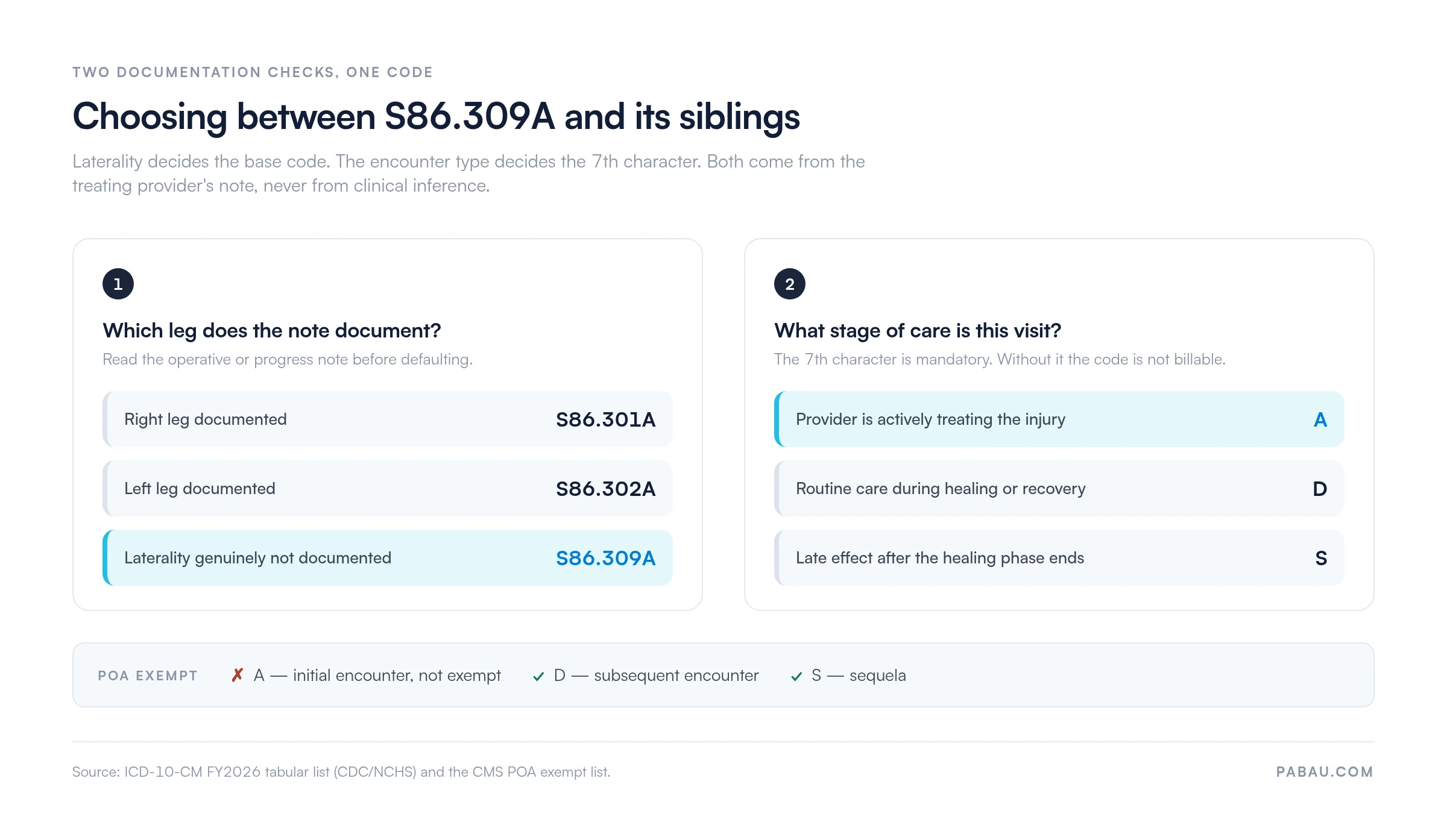
A 7th character is mandatory: A for initial encounter, D for subsequent, S for sequela. Without it, payers reject the code as non-billable.
Use S86.301A or S86.302A when the physician documents a right or left leg. Unspecified leg is correct only when laterality is genuinely undocumented.
S86.309A is not POA exempt. The subsequent encounter (D) and sequela (S) versions of the code generally are.
Pabau’s claims management software connects to Claim.MD to validate ICD-10 codes, check eligibility, and submit claims for injury encounters.
ICD-10 Code S86.309A is the billable code for an unspecified injury of the peroneal muscle(s) and tendon(s) at lower leg level, unspecified leg, initial encounter.
It is valid for the 2026 fiscal year, and the 7th character A is mandatory. The table below summarizes the code’s billing attributes, drawn from the CDC/NCHS official ICD-10-CM web tool.
The base code S86.309 requires a 7th character to become billable. Without it, payers will reject the claim. Each character signals a different stage in the patient’s care episode. Choosing the wrong one is among the most common reasons musculoskeletal injury claims are denied on first submission. The CMS ICD-10-CM coding guidelines define these encounter types precisely.
Common mistake: Many coders keep using “A” throughout a multi-visit episode after the patient has moved into routine follow-up. Once active treatment ends and the provider is monitoring healing, switch to “D.” Reserve “A” for visits where the provider is actively managing the injury.
The peroneal muscle group — also called the fibular muscles — runs along the lateral aspect of the lower leg. Understanding the anatomy helps coders recognize what the physician is documenting, and when a more specific code might apply.
Injuries to these muscles and tendons occur most often from inversion ankle sprains, direct trauma, and repetitive overuse in athletes. Sports medicine and physical therapy practices that handle a high volume of lower extremity injuries meet the S86.3 code family regularly. Because S86.309A carries “unspecified leg,” coders should confirm with the treating provider whether laterality was documented before assigning it.
Review the operative or progress note for any mention of ‘right,’ ‘left,’ or ‘bilateral’ before defaulting to the unspecified code. A query to the provider takes seconds. A corrected claim after a denial takes far longer.
S86.309A sits within a structured parent-to-child hierarchy in the ICD-10-CM tabular list. Knowing where a code lives in that hierarchy helps coders verify they are working at the correct specificity level. It also shows which sibling codes apply once laterality or injury type is documented. Our ICD-10-CM code reference maps the same structure across the rest of the tabular list.
When laterality is documented, use a laterality-specific sibling instead of S86.309A. The AAPC code lookup confirms the full S86.3 sibling set.
Adjacent subcategories in S86 cover related but distinct injury sites. S86.0 covers the Achilles tendon, and S86.1 covers other specified muscle and tendon injuries at lower leg level. S86.9 covers unspecified injuries without anatomical specificity. Choosing between them means reading the physician’s note carefully, because “peroneal” must appear explicitly or follow clearly from the clinical context.
Documentation requirements for S86.309A follow the standard ICD-10-CM guidelines for musculoskeletal injury coding. Incomplete or ambiguous documentation is the main driver of claim rework in physical therapy and sports medicine practices. Two checks decide the code, and the diagram below shows how they combine.
Query the treating provider in three situations.
Payers — particularly Medicare Advantage plans — increasingly audit laterality on musculoskeletal injury claims. A brief query before submission costs far less than reworking a denied claim.
Three situations account for most S86.309A claims in practice. Recognizing them helps coders verify the code is appropriate before submission.
In all three scenarios, the coder’s job is to code what the record documents at the time of the encounter. Anticipating what the physician “probably meant” falls outside acceptable coding practice. ICD-10-CM guidelines require codes to reflect the medical record, not clinical inference.
ICD-10 Code S86.309A is a billable code that can serve as a principal or secondary diagnosis on a claim. Reimbursement rates vary by payer, plan type, and geographic locality. Specific dollar amounts change annually and differ by contract, so none are stated here. The code is valid for reimbursement under HIPAA transaction standards, which mandate ICD-10-CM for all covered entity claims in the United States. Submitting clean claims with the full 7-character code and supporting documentation is the baseline for avoiding preventable denials.
S86.309A is not POA exempt. Present on Admission exemption generally covers injury codes carrying the 7th character D (subsequent encounter) or S (sequela). The initial encounter character A does not carry that exemption, so an inpatient claim reporting S86.309A still needs a POA indicator. Verify the current status against the active CMS POA exempt list for the applicable fiscal year, since the list is updated annually.
Practices submitting musculoskeletal injury claims benefit from real-time eligibility verification and code validation before a claim leaves the practice. Practice management software like Pabau connects to the Claim.MD clearinghouse to validate ICD-10 codes and transmit 837P claims electronically. Real-time eligibility checks cover over 400 US payers, while claims reach thousands of payers through the clearinghouse network. Claim.MD also returns 835 ERA remittances carrying CARC denial codes, so billing teams can see why an S86.309A claim was rejected. Pabau’s claims software for practices handles the submission and the remittance in one record.
For international context, the WHO ICD-10 browser shows how injury codes in this chapter are classified outside the United States. US coders should still work from the ICD-10-CM Clinical Modification maintained by NCHS and CMS.
Coding accuracy for a code like S86.309A rests on two things. The first is complete documentation at the point of care. The second is a billing workflow that validates codes before submission. Practices that keep notes in one system and build claims in another add manual transcription steps where errors accumulate.
Pabau connects the clinical note directly to the billing record. When a practitioner completes a SOAP note for a lower leg injury, the diagnosis codes can be linked at the point of documentation. Laterality fields, encounter type selectors, and ICD-10 code search catch the two errors this code family is prone to. A peroneal injury claim is far less likely to leave the practice missing its 7th character or carrying the wrong laterality.
The Claim.MD integration then validates the assembled claim, checks the patient’s current eligibility, and surfaces code-level edits before the 837P file is transmitted. Documentation happens at the note and validation happens at the claim. That sequence is where practices reduce denial rates without adding administrative headcount.
Run a monthly audit of claims denied on S86.309A and its sibling codes. If laterality denials cluster around particular providers, a short documentation session usually resolves the pattern within one billing cycle. Focus it on recording right or left in the initial note.

Pabau connects documentation, coding, eligibility verification, and claim submission into a single workflow. See how practices using Pabau with Claim.MD cut rework and speed up reimbursement on musculoskeletal injury encounters.

S86.309A is the right code only when the note genuinely leaves laterality open. Treat that as a temporary state rather than a default. Most peroneal injuries are lateralized within a visit or two. A claim that stays on the unspecified code across a whole episode usually signals a documentation habit worth correcting.
The practical move is to fix it upstream. Prompting for laterality and encounter type inside the note costs the provider a few seconds and removes the query, the correction, and the resubmission later.
Pabau’s documentation and claims workflow, including the Claim.MD clearinghouse connection, keeps that prompt in front of the clinician while the visit is still open. Book a demo to see how a peroneal injury encounter moves from note to submitted claim in one system.

Need to understand denial codes on a rejected claim? Denial codes in medical billing explains common CARC codes and how to respond to rejected musculoskeletal claims.
Billing across multiple injury codes in one episode? Superbill documentation guide covers how to structure a superbill that captures all diagnosis and procedure codes cleanly.
Want to verify payer eligibility before the encounter? Insurance eligibility verification walks through the real-time eligibility check process and how it prevents claim rejections.
ICD-10 Code S86.309A is the billable code for an unspecified injury of the peroneal muscle(s) and tendon(s) at lower leg level, unspecified leg, initial encounter. It is valid for fiscal year 2026, effective October 1, 2025. It can be reported as a primary or secondary diagnosis on a claim.
Yes, S86.309A is a specific, billable ICD-10-CM code valid for reimbursement. The 7th character “A” must be present for the code to be billable. Payers do not accept the base code S86.309 on its own.
The difference is the encounter type. S86.309A covers an initial encounter, meaning visits where the provider is actively treating the injury. S86.309D covers subsequent encounters, which are routine follow-up and monitoring during healing. S86.309S covers sequela, the late effects or complications that develop after the injury has healed. Only the 7th character changes. The anatomy and the laterality stay the same.
Use S86.309A only when the treating physician’s documentation genuinely does not specify which leg is affected. If the note says “right leg” or “left leg,” use S86.301A or S86.302A instead. ICD-10-CM guidelines require laterality specificity wherever it is clinically documented. Defaulting to unspecified when laterality is known creates a billing compliance problem.
A peroneal tendon tear with a confirmed injury type and documented laterality takes a laterality-specific code within the S86.3 family. Where the tear type and the leg are both unspecified, S86.309A is appropriate for the initial encounter. When the physician documents a specific tear, such as a peroneus brevis longitudinal split, a more specific code may apply. Query the physician if the documentation is unclear.
No. Present on Admission exemption generally covers injury codes whose 7th character is D (subsequent encounter) or S (sequela). The initial encounter character does not qualify, so an inpatient claim reporting S86.309A still needs a POA indicator. Check the current CMS POA exempt list for the fiscal year you are billing.
Yes, S86.309A is valid for the 2026 ICD-10-CM fiscal year. It became effective October 1, 2025. The code appears in the FY2026 tabular list maintained by the CDC’s National Center for Health Statistics and CMS.




