ICD-10 Code S42.444P: Medial epicondyle fracture, right humerus
ICD-10 Code S42.444P: full descriptor and code validity ICD-10 Code S42.444P car...

Last Updated: Oct 13, 2026
Billable Code Specific Code
S88.112S is the billable ICD-10-CM code for complete traumatic amputation at level between knee and ankle, left lower leg, sequela.
The code is accepted on both CMS-1500 and UB-04 claim forms. The CMS ICD-10 codes page lists it in the FY 2026 tabular list with no restriction on billable use.
Three elements have to appear in the description and, more importantly, in the clinical record. Completeness rules out a partial amputation. Laterality names the left side specifically. Encounter type marks this as a sequela, meaning a late effect of the earlier traumatic event.
Let Pabau's smart automation suggest the right codes, reduce claim denials, and keep your practice compliant—effortlessly.
Automate repetitive tasks and focus on what matters most—your patients.
Reduce coding errors and ensure compliance with the latest regulations.
Clean claims, fewer denials, and faster reimbursements.
Powerful insights and reporting to help your practice thrive.
HIPAA compliant SOC 2 certified GDPR-compliant Trusted by 4,000+ clinics worldwide

S88.112S covers a complete traumatic amputation between the knee and ankle of the left lower leg, coded as a sequela.
The 7th character ‘S’ applies when the encounter treats a late effect of the earlier amputation, not the injury itself.
Sequela coding and aftercare Z codes are mutually exclusive, so a routine prosthetic check takes Z codes rather than S88.112S.
S88.112S is never the principal diagnosis. Code the sequela condition first, then S88.112S to identify the traumatic event.
Practice management software like Pabau captures ICD-10-CM codes at the point of care and files claims through Claim.MD.
The 7th character extension tells the payer which phase of care the encounter belongs to. Per the CDC/NCHS ICD-10-CM official coding tool, Section I.C.19 of the ICD-10-CM Official Guidelines defines three options for traumatic injury codes.
With ‘S’, the encounter has to treat a condition that arose because of the original amputation. Phantom limb pain, residual limb neuromas, stump contractures, and osseous overgrowth at the amputation site all qualify.
Sequela, initial, and subsequent designations run right through the injury chapter of the ICD-10-CM diagnosis code set. Learning the pattern once makes every other S-code and T-code readable.
This is the most commonly misapplied decision in post-amputation coding. Sequela and aftercare are not interchangeable, and payers treat them differently.
The governing rule: Use S88.112S to identify the originating traumatic event whenever a sequela condition is the reason for the encounter. When the visit is maintenance or routine follow-up with no active sequela condition, use Z codes only.
The whole choice comes down to one question about the encounter, and the chart below runs that question through all four phases of care.
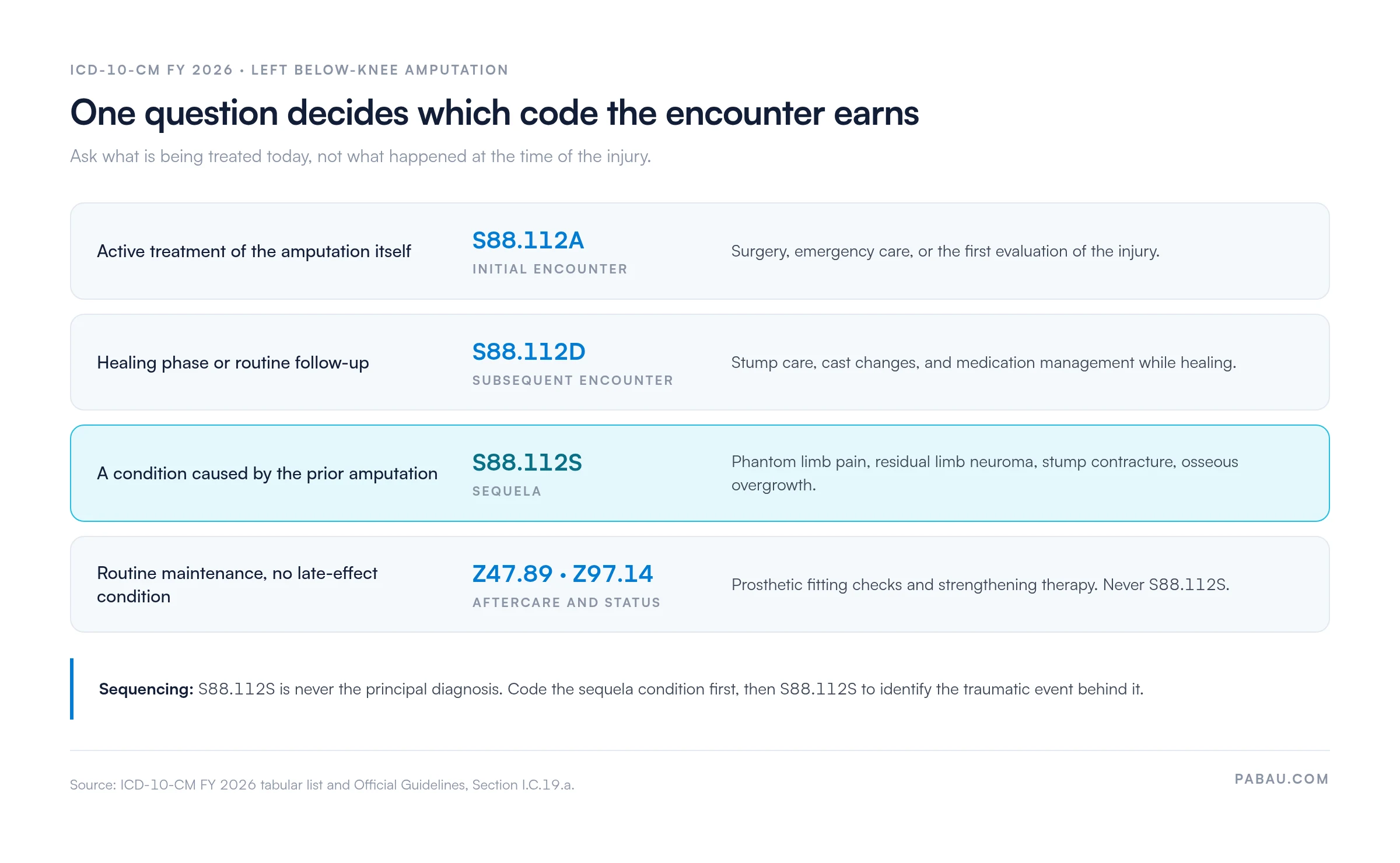
Reading the code tree confirms that S88.112S is the most precise code available for the documented condition.
S88.112 without a 7th character is not a valid submission code. Payers reject claims that stop at the six-character level, and the same hierarchy pattern holds across the whole S00-T88 injury block.
Laterality and completeness are both coded specifically in the S88.11 family. Picking the wrong sibling, particularly left for right or complete for partial, is a coding error that creates audit exposure.
The AAPC ICD-10-CM code lookup and ICD List both publish full sibling tables for the S88 category, which helps when the documentation is ambiguous.
S88.112S is a secondary code rather than a principal diagnosis. The sequela condition itself carries the principal position, whether that is phantom pain, a neuroma, or a contracture. S88.112S then identifies the causal event. Section I.C.19.a of the ICD-10-CM Official Guidelines makes that sequence mandatory, and reversing it is what triggers the denial.
Laterality errors and incorrect principal/secondary placement are the two most common denial triggers for this code family. Denial management strategies built around those two failure points catch most of them before the claim leaves the practice.
For inpatient claims, S88.112S groups under the CMS MS-DRG v43.0 Definitions Manual. The specific DRG assigned depends on the principal diagnosis, the procedures performed, and whether a complication or comorbidity (CC) or major CC (MCC) is present.
DRG assignment is always settled by the grouper software processing the full claim, not by S88.112S alone. The code’s CC/MCC status in a given claim context affects the reimbursement weight. Verify current assignments against the CMS MS-DRG v43.0 Definitions Manual, since weights and groupings change every year.
Payers auditing S88.112S claims look for four elements in the clinical record. Missing any one of them gives the auditor grounds to query or deny the code assignment.
Where the causal link is implied but never stated, query the provider before assigning S88.112S. Coding a sequela relationship on assumption is an audit vulnerability. If it is not in the record, it cannot be coded.
Flag any encounter where the provider documents ‘below-knee amputation sequela’ without stating laterality, and query before coding. Assigning S88.119S when the side is knowable and simply undocumented leaves an incomplete record behind the claim.
Sequela coding errors start at the point of documentation, not at the billing desk. When the provider note leaves the causal link unstated, the coder has to either query or make a judgment call. Both outcomes slow the revenue cycle.
Practice management software like Pabau moves ICD-10-CM code selection into the clinical note itself. Point-of-care coding is what accurate claims management software is for, and the provider can attach S88.112S alongside the sequela condition in the same session.
The platform also connects to Claim.MD for claim validation, including code-level eligibility checks and ERA processing. Fewer correction cycles on sequela claims means less time spent reworking what the note already said.
See how Pabau handles these workflows by booking a demo.

Pabau captures diagnosis codes inside the clinical note and connects directly to Claim.MD for electronic claim submission, eligibility verification, and ERA processing. See how it works for post-injury and sequela encounters.

The line between sequela and aftercare is where this code is won or lost. If a late effect of the amputation is being treated, S88.112S belongs on the claim behind the condition itself. If the visit is a prosthetic check or a strengthening session, it does not.
The fix sits upstream of the coder. A provider note that names the original injury and states the causal link removes the query, the delay, and the denial in one step. Book a demo to see how Pabau captures that detail while the encounter is still open.

Coding a partial amputation instead? ICD-10 code S88.929D covers the partial traumatic amputation siblings in the same S88 category.
Need another sequela amputation code? ICD-10 code S78.121S applies the same 7th character logic at the thigh rather than the lower leg.
Want to reduce claim denials on sequela encounters? Denial management in healthcare walks through the most common denial triggers for injury claims and how to address them.
Looking for a clearinghouse that handles ICD-10-CM coded claims? Medical claims clearinghouse overview explains how Claim.MD processes CMS-1500 and 837P submissions.
S88.112S is the billable ICD-10-CM diagnosis code for complete traumatic amputation at the level between knee and ankle, left lower leg, sequela. Use it when a patient presents with a condition that is a direct late effect of a prior left below-knee traumatic amputation. Phantom limb pain and a residual limb neuroma are typical examples. The code became effective October 1, 2025 under the FY 2026 ICD-10-CM edition.
Yes. S88.112S is a billable, specific ICD-10-CM code valid for FY 2026, effective October 1, 2025. It is accepted on both CMS-1500 and UB-04 claim forms, and it is exempt from POA reporting requirements.
Sequela (7th character S) applies when the encounter treats a condition that arose as a late effect of a prior injury. Aftercare (Z codes) applies when the encounter is routine maintenance or follow-up with no active late-effect condition. Treating phantom limb pain after a left below-knee amputation is sequela. A routine prosthetic fitting check is aftercare. The two approaches are mutually exclusive for any given encounter.
S88.112S applies when the complete traumatic amputation is documented as the left lower leg. S88.111S applies when it is the right lower leg. Laterality is mandatory specificity in ICD-10-CM. Using the wrong side is a coding error rather than a workaround for thin documentation.
S88.112S is a secondary code and does not independently drive DRG assignment. The DRG follows the principal diagnosis and the procedures performed. On an inpatient aftercare admission, the verified mapping is DRG 559, 560 or 561. Those cover aftercare of the musculoskeletal system and connective tissue, with MCC, with CC, or without CC/MCC. Verify current assignments in the CMS MS-DRG v43.0 Definitions Manual, since groupings are updated annually.
S88.112S is confirmed valid for FY 2026, effective October 1, 2025. For FY 2025 validity, check it against the FY 2025 ICD-10-CM tabular list in the CDC/NCHS coding tool. Codes are added and deleted in every annual update cycle. The structure and clinical description of this code have been stable across recent editions.