CPT code 59618: Cesarean after attempted VBAC billing guide
CPT code 59618 bills a cesarean after a VBAC attempt CPT code 59618 is the globa...

Last Updated: Nov 4, 2026
M0280 is the CCSD code for laparoscopic nephrectomy on one side, where the surgeon removes a whole kidney through keyhole ports. UK private medical insurers use it to identify the operation on a claim.
The code fits only when the operative note shows three facts: a laparoscopic approach, the whole kidney, and one side. A robotic or partial removal, or one that takes the ureter too, needs a different CCSD code.
Let Pabau's smart automation suggest the right codes, reduce claim denials, and keep your practice compliant—effortlessly.
Automate repetitive tasks and focus on what matters most—your patients.
Reduce coding errors and ensure compliance with the latest regulations.
Clean claims, fewer denials, and faster reimbursements.
Powerful insights and reporting to help your practice thrive.
HIPAA compliant SOC 2 certified GDPR-compliant Trusted by 4,000+ clinics worldwide

CCSD code M0280 is laparoscopic nephrectomy on one side, listed in Chapter 12 under sub-chapter 12.1.0 Kidney / Renal Pelvic.
The approach and extent decide the code, so open, robotic and partial kidney removals each need a different CCSD entry.
CCSD lists seven codes as unacceptable alongside M0280, including M0210, M0282, M0302 and M0303.
The operative note has to show a laparoscopic approach, the side, and removal of the whole kidney.
CCSD sets no fees, so the insurer’s own schedule and the patient’s policy decide what M0280 pays.
CCSD code M0280 is the UK private medical insurance code for a laparoscopic nephrectomy on one side. The surgeon removes a whole kidney through laparoscopic ports rather than an open incision. The schedule descriptor reads “Laparoscopic nephrectomy – unilateral”.
M0280 sits in Chapter 12 of the CCSD schedule, Urinary system and male reproductive, under sub-chapter 12.1.0 Kidney / Renal Pelvic. Its neighboring kidney entries are all in our searchable CCSD code library.
CCSD stands for Clinical Coding & Schedule Development. The group maintains the procedure schedule that UK private medical insurers use to identify surgery on a claim. Our guide to Bupa CCSD codes explains how that schedule is structured.
Three words in the descriptor carry the claim. “Laparoscopic” fixes the approach. “Nephrectomy” means the whole kidney, not part of it. “Unilateral” means one side. If the operation differs on any of those three points, M0280 is the wrong code. The grid below shows where each change in approach or extent lands.
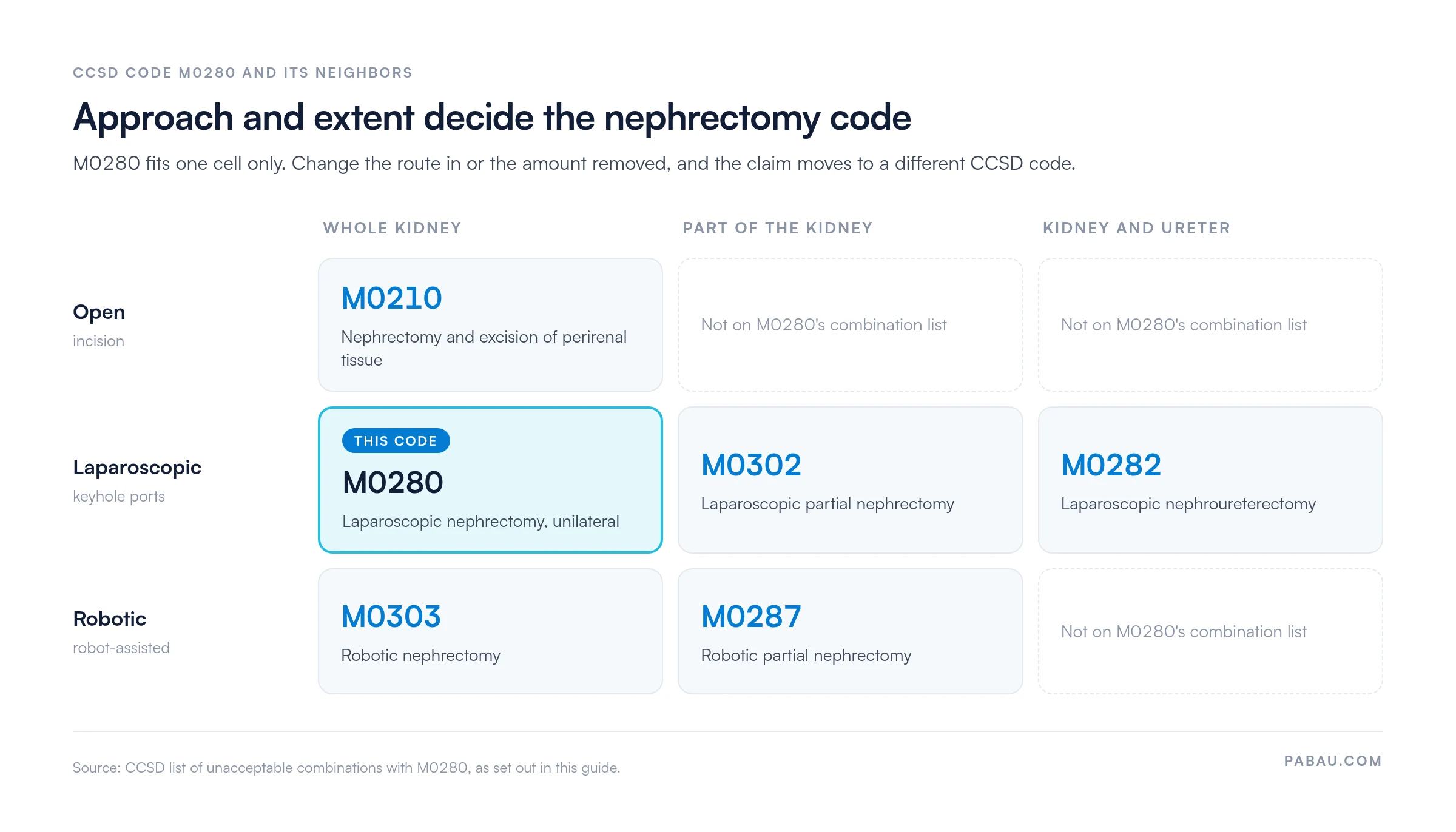
Each code below appears on the CCSD list of unacceptable combinations with M0280.
They describe a different operation on the same kidney, a different route in, or a separate endoscopic procedure. That makes them the codes most likely to be mixed up with M0280, or added to the same claim by mistake.
An unacceptable combination is a CCSD rule that the two codes shouldn’t normally appear together for the same episode. CCSD publishes the rule, and each insurer decides whether its policy adopts it. Plan as if a claim pairing M0280 with any code above will be queried.
The CCSD register itself sits behind a login. Check the current descriptor and combination list there, or through the insurer’s provider resources, before you rely on an older printout.
Insurers read the operative note against the code. When the note and the code tell different stories, the claim stalls. For M0280, the note should make these points easy to find:
A note that says “nephrectomy” with no approach leaves the coder unable to confirm M0280. Ask surgeons to dictate the approach in the first line, so nobody has to infer it from the port sites.
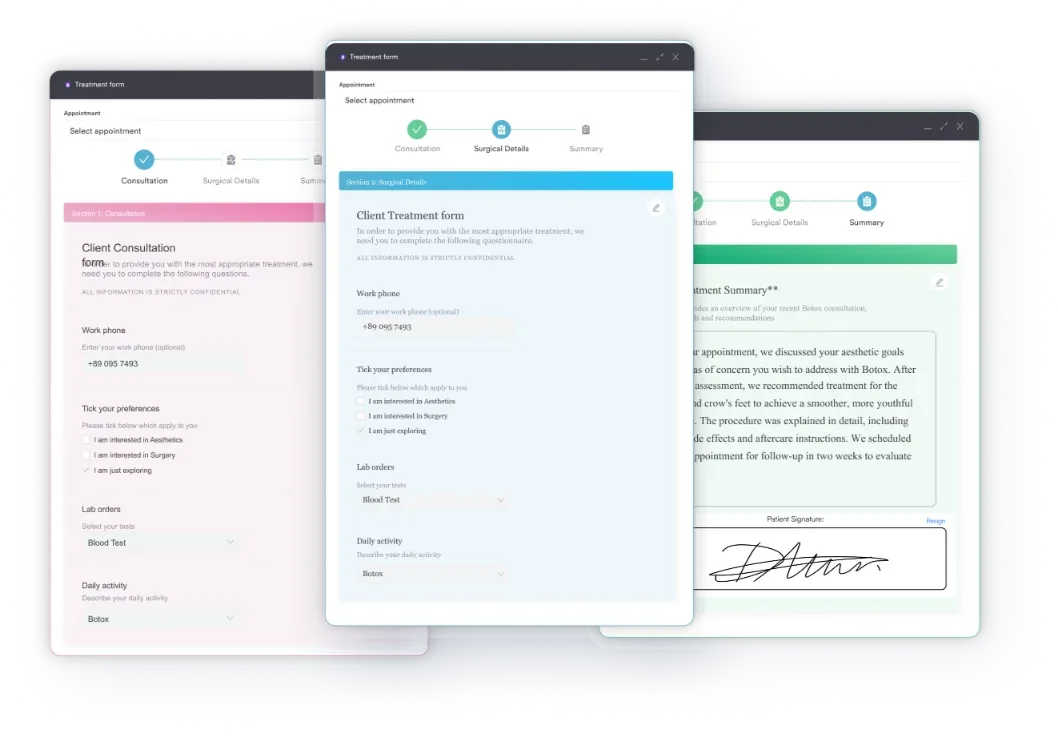
Consent needs the same detail. The signed form should name the procedure, the side, the laparoscopic approach and the possibility of conversion to open surgery. A digital consent form keeps that signed record on the patient file, where the billing team can find it at claim time.
Pre-authorization rules differ by insurer and by policy, so treat it as a check on every M0280 case. The authorization is issued against the code and the plan you describe.
Have these details ready when you contact the insurer:
Record the authorization number on the patient file. Contact the insurer again if the plan changes, for example to a partial or robotic procedure. An authorization for M0280 doesn’t cover M0302 or M0303.
The claim itself is short. Most of the work is making sure it matches what the surgeon did. A typical run looks like this:
Run this check on every M0280 claim before it leaves the practice:
Each rejection below traces back to a mismatch between the code, the note and the authorization.
If a claim is queried, reply with the operative note and the authorization reference. A note that states the approach and extent up front usually settles a question about either.
Each insurer sets its own fee for M0280 and decides how its policies treat the code. CCSD publishes codes and combination rules but no fees. The figure can differ between insurers and can change between schedule updates.
Check the current fee with the insurer when you request authorization. Anesthetist and assistant fees, where a policy pays them, are claimed separately under that insurer’s rules.
In many urology practices, consent sits on paper, the operative note sits in the hospital system, and the claim is typed into a portal. Each handoff is a chance for the side, the approach or the authorization number to drift.
Pabau, the practice management and billing platform we build, keeps consent forms, clinical notes and invoices on one patient record. Its Healthcode integration submits CCSD-coded claims straight from that record and tracks their status. Payments are reconciled against the invoice when they arrive.
With Pabau’s error-checked claims management, the claim is pre-filled from the patient record. Required fields, such as the membership number and authorization code, must be complete before it can be sent. Your team spends less time retyping, and an M0280 claim doesn’t go out without its authorization number.

Pabau keeps consent, clinical notes and invoices together, then submits CCSD-coded claims through Healthcode. Your M0280 claims leave with the authorization number and the details your insurer asks for.

M0280 is a narrow code, which makes it an easy one to get right. Laparoscopic, whole kidney, one side. When the note, the consent form and the authorization all say those three things, the claim has little for an insurer to question.
The risk sits at the edges. A robotic case, a partial removal or a ureter taken with the kidney each moves the claim to another code. An authorization for M0280 won’t follow it there. Build the approach and side into your note template now, and the week-long query never starts.
Book a demo to see how Pabau links consent, clinical notes and Healthcode claims for your surgical practice.

Billing a transplant kidney removal? CCSD code M0260 explains when a transplant nephrectomy needs its own code.
Treating a renal cyst instead? CCSD code M0412 covers de-roofing and aspiration of a renal parapelvic cyst.
Removing stones through an open approach? CCSD code M0610 sets out how open removal of renal calculi is coded and claimed.
Fragmenting stones endoscopically? CCSD code M0910 walks through endoscopic fragmentation of renal calculi.
New to the CCSD schedule? Bupa CCSD codes explains how CCSD codes are organized and used on private claims.
No. M0280 describes a unilateral procedure, so it covers one kidney. If both kidneys are removed, ask the insurer how it wants the case coded before surgery, and get the authorization to match.
US claims use CPT codes instead, such as CPT 50545 for laparoscopic radical nephrectomy. CCSD and CPT aren’t mapped one to one, so never copy a code from one system into the other.
The diagnosis comes from the indication in the operative note. Kidney cancer, a common reason for nephrectomy, is coded under C64 in the WHO ICD-10 used on UK claims. Whatever the indication, use the diagnosis code that went on the pre-authorization.
Usually, yes, on separate invoices. The consultant claims the professional fee under M0280, and the hospital bills its own charges for the stay and theater. Both should carry the same authorization number.