CCSD Code E1310: Antral puncture and washout billing guide
CCSD Code E1310: Definition and official descriptor CCSD Code E1310 is the Clini...

Last Updated: Nov 4, 2026
M0104 is the CCSD code for transplantation of kidney into patient with abnormal, augmented or absent bladder. The recipient's bladder is abnormal, surgically enlarged or absent. The donor ureter may therefore join a reconstructed bladder or a urinary diversion.
It sits in Chapter 12 of the CCSD schedule, Urinary system and male reproductive organs, under Kidney / Renal Pelvic. CCSD lists it as an unacceptable combination with M0102, the first or second kidney transplant code. A claim carries one or the other.
Let Pabau's smart automation suggest the right codes, reduce claim denials, and keep your practice compliant—effortlessly.
Automate repetitive tasks and focus on what matters most—your patients.
Reduce coding errors and ensure compliance with the latest regulations.
Clean claims, fewer denials, and faster reimbursements.
Powerful insights and reporting to help your practice thrive.
HIPAA compliant SOC 2 certified GDPR-compliant Trusted by 4,000+ clinics worldwide

CCSD code M0104 covers transplantation of a kidney into a patient whose bladder is abnormal, augmented or absent.
CCSD lists M0104 and M0102, the first or second kidney transplant code, as an unacceptable combination, so bill one or the other.
The operative note must describe the bladder and where the donor ureter was joined, or the insurer will query the code.
Pabau, the practice software we build, keeps the code, pre-authorization number and operative note in one record before the claim goes to Healthcode.
Most kidney transplants end with the donor ureter stitched into a healthy bladder. CCSD code M0104 covers the cases where that isn’t possible, because the recipient’s bladder is abnormal, augmented or absent. The official descriptor reads “transplantation of kidney into patient with abnormal, augmented or absent bladder.”
The code sits in Chapter 12 of the CCSD schedule, Urinary system and male reproductive organs, under Kidney / Renal Pelvic. CCSD codes follow the OPCS-4 chapter letters, and chapter M holds the urinary tract procedures. Our CCSD code library collects the other codes in the schedule we cover.
CCSD added M0104 on January 20, 2010, alongside the rule that it cannot be billed with M0102. Most UK kidney transplants take place in NHS transplant centers, so private M0104 claims are uncommon and tend to be checked closely.
M0104 applies when the transplant surgeon has to work around the recipient’s bladder. The descriptor names three situations, and the operative note should say which one applies.
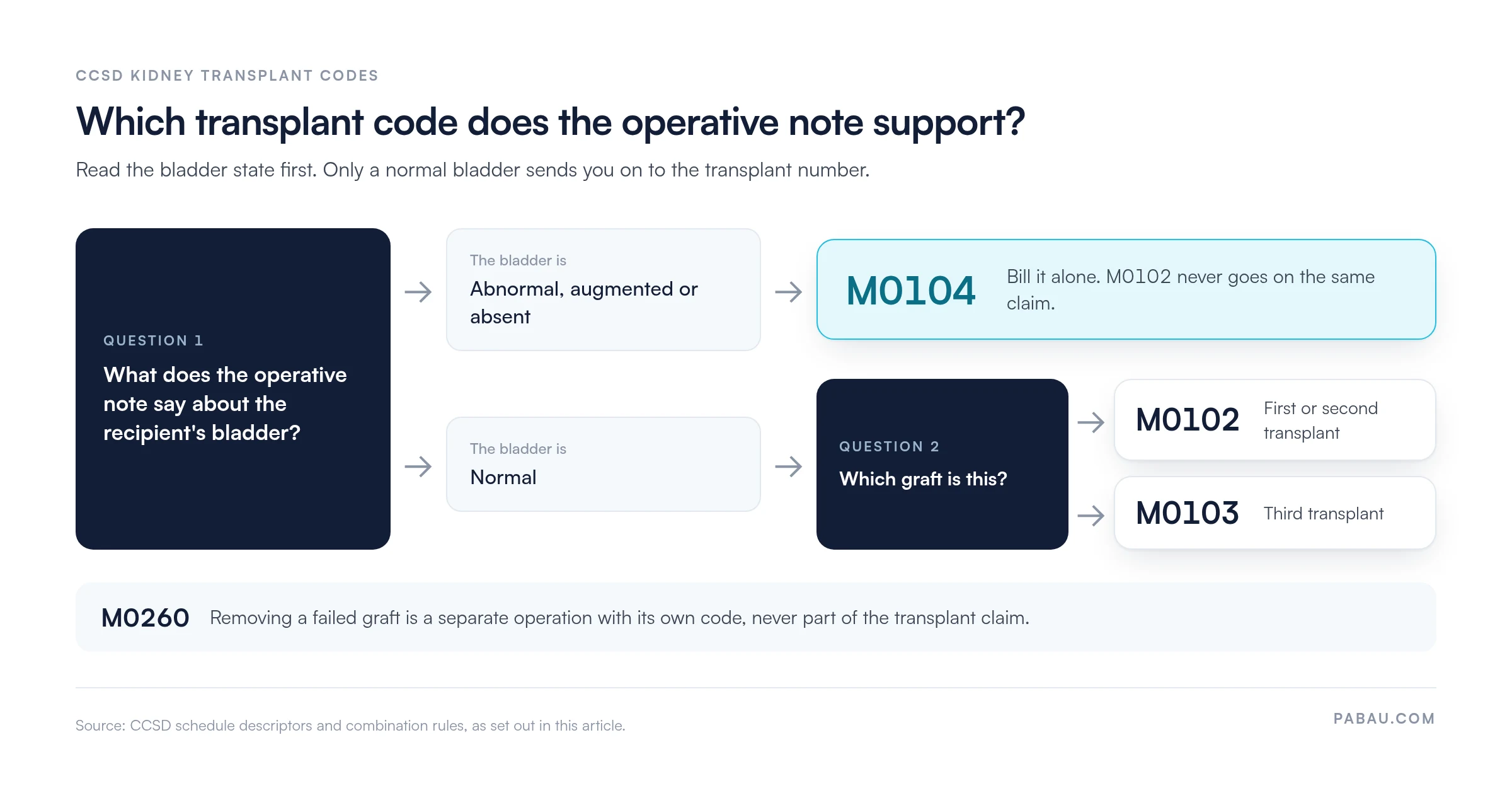
M0104 excludes a standard first or second transplant into a normal bladder, which is M0102. A third transplant has its own code, M0103. Removing a failed graft is a separate operation, coded M0260.
The bladder reconstruction or diversion itself is not part of M0104. If it was done at an earlier operation, it was coded then, and M0104 describes only the transplant.
The costly error here is billing M0102 for a transplant that belongs under M0104, or billing both. The codes below sit next to M0104 in Chapter 12.
The choice comes down to two questions, and the diagram below follows them in order. Read the operative note for the state of the bladder first. If it describes a normal bladder, the code is M0102 or M0103, depending on the transplant number. If it describes an abnormal, augmented or absent bladder, the code is M0104 alone.
An M0104 claim stands or falls on the bladder history. The insurer needs proof that the recipient’s bladder justified this code over M0102. Keep these records on file and attach them when asked.
A note that says only “renal transplant performed” reads as M0102 to an auditor. Name the bladder state in the note’s first lines, and the code choice explains itself.
Build an operative note template for M0104 with fields for bladder state, ureteric drainage site and transplant number. Digital forms in Pabau let you make those fields required before the note is completed.
Pre-authorization rules for CCSD code M0104 vary by insurer and by the patient’s policy. The table below summarizes the general approach of the main UK private medical insurers. Always confirm the requirement for the specific patient before admission.
A deceased-donor kidney can arrive with only hours of notice, so planned pre-authorization is not always possible. Admit the patient, then notify the insurer as soon as possible and record the reference against the case.
Healthcode is the main electronic billing clearinghouse for UK private healthcare, and most PMI payers process CCSD-coded invoices through it. The steps below follow the standard Healthcode invoicing workflow.
Each check below matches one of the rejection reasons in the next section. Two minutes on the invoice now saves a resubmission later.
Most M0104 rejections fall into a few categories. The insurer usually returns a reason code with the invoice, and the fix depends on which one applies.
Reimbursement for CCSD code M0104 is not published as a single figure. Each insurer keeps its own fee schedule, and a consultant’s rate can differ again under their recognition agreement. Look up the current rate through the insurer’s own channel.
Schedules are usually updated once a year. Check that you are quoting the current schedule year before you agree a fee with the patient. If Bupa is the payer, our guide to the Bupa fee schedule explains how its rates are structured.
M0104 can share a claim episode with other codes, but never with M0102. CCSD lists M0102 and M0104 as an unacceptable combination, because both describe the same transplant operation. M0286, bilateral robotic nephroureterectomy, is listed as an unacceptable combination with M0104 too.
Other codes can appear in the same episode when each one reflects a separate service.
The CCSD Technical Guide sets out the unbundling principles, and each insurer decides how it applies them. When a combination is unclear, ask the insurer before you submit.
Manual billing adds an error point at every handoff, from code entry to the pre-auth number to the Healthcode field. Purpose-built claims management software keeps the whole billing record in one place from the moment the admission is booked.
In Pabau, your team records the CCSD code against the appointment and stores the pre-authorization number in the patient record. Structured clinical documentation templates capture the bladder and transplant history that insurers ask for.
For consultants moving from the NHS into private practice, a consistent CCSD workflow set up early saves time as the list grows. If Bupa is your main payer, the full list of Bupa CCSD codes shows which codes it accepts.

Track pre-authorization numbers, enter CCSD codes against patient records and prepare Healthcode-ready invoices in Pabau. Your transplant claims reach the insurer complete, with the bladder history already on file.

M0104 is a narrow transplant code, and its whole value rests on one fact in the operative note, the state of the bladder. Record that fact clearly, keep M0102 off the claim, and secure the authorization reference, and the insurer has little left to query.
With the code, the note and the reference held in one record, your team spends less time chasing transplant claims. To see how Pabau handles CCSD billing in a practice like yours, book a demo.

Removing a failed graft? CCSD code M0260 covers transplant nephrectomy, the operation that takes out a previously transplanted kidney.
Billing multiple CCSD codes for Bupa? Bupa CCSD codes covers the full code set accepted by Bupa, chapter by chapter.
Need to understand Bupa’s fee schedule in detail? Bupa procedure codes and fee schedule explains how Bupa structures reimbursement rates across procedure categories.
Choosing a billing system for UK private work? Best medical billing software in the UK compares the billing platforms built for UK private practices.
M0104 is the CCSD code for a kidney transplant into a patient whose bladder is abnormal, augmented or absent. UK private medical insurers use it to pay the transplant surgeon.
No. CCSD lists them as an unacceptable combination. When the recipient’s bladder is abnormal, augmented or absent, M0104 replaces M0102 on the claim.
An augmented bladder has been surgically enlarged, usually with a patch of bowel stitched into the bladder wall. The operation is called augmentation cystoplasty. It is often done when the bladder is too small or holds urine at high pressure.
A urinary diversion gives urine a new route out of the body when the bladder is missing or unusable. The most common type is an ileal conduit, where the ureters drain through a short loop of bowel to a stoma bag.
No. OPCS-4 is the NHS classification used to record procedures in hospital data. CCSD codes form the schedule UK private insurers use for billing, and they follow the OPCS-4 chapter letters.