HCPCS Code L0472: Hyperextension TLSO billing guide
HCPCS code L0472: Official descriptor and device definition HCPCS code L0472 des...

Last Updated: Nov 5, 2026
M0880 is the CCSD code for open drainage of perinephric abscess. It covers an operation to drain pus from the fat around the kidney through an incision, usually in the flank, under general anaesthesia.
M0880 sits in Chapter 12 of the CCSD schedule, Urinary system and male reproductive organs, under Kidney / Renal Pelvic. National Friendly ranks it as Major. UK private medical insurers use it to pay the surgeon, and claims pair it with ICD-10 code N15.1, Renal and perinephric abscess.
Let Pabau's smart automation suggest the right codes, reduce claim denials, and keep your practice compliant—effortlessly.
Automate repetitive tasks and focus on what matters most—your patients.
Reduce coding errors and ensure compliance with the latest regulations.
Clean claims, fewer denials, and faster reimbursements.
Powerful insights and reporting to help your practice thrive.
HIPAA compliant SOC 2 certified GDPR-compliant Trusted by 4,000+ clinics worldwide

CCSD code M0880 covers open drainage of a perinephric abscess and is billed to UK private medical insurers.
It sits in Chapter 12 of the CCSD schedule, Urinary system and male reproductive organs, under Kidney / Renal Pelvic.
National Friendly ranks M0880 as Major with a £618 surgeon fee, and Freedom Health Insurance lists £500.
The operative note must record an incision, because an image-guided drain inserted through the skin is not billed as M0880.
Pair M0880 with ICD-10 code N15.1, Renal and perinephric abscess, as the main diagnosis.
CCSD code M0880 covers open drainage of a perinephric abscess, the operation to drain pus from the fat around the kidney through an incision. The official descriptor is Open drainage of perinephric abscess.
The code sits in Chapter 12 of the CCSD schedule, Urinary system and male reproductive organs, under the Kidney / Renal Pelvic category. CCSD is the procedure schedule UK private medical insurers use to pay consultants and hospitals.
The CCSD Group maintains the schedule and publishes it at ccsd.org.uk. Its board brings together insurers and private hospital groups such as Spire Healthcare, Nuffield Health and HCA Healthcare.
Bupa, AXA Health, Aviva, Vitality and WPA all recognise CCSD codes, and claims reach them electronically through Healthcode. NHS hospitals record the same operation with OPCS-4 codes, so M0880 only matters for privately insured patients.
A perinephric abscess is a collection of pus in the fat between the kidney and Gerota’s fascia. It usually follows an ascending urinary tract infection, a ruptured renal abscess or spread through the bloodstream.
Gram-negative bacteria such as Escherichia coli and Klebsiella pneumoniae cause most cases. Staphylococci are more common after spread through the bloodstream. Diabetes, kidney stones and urinary obstruction all raise the risk.
Many perinephric abscesses are drained percutaneously first. Open drainage under M0880 is chosen when one of these applies.
The surgeon reaches the perinephric space through a flank incision, without entering the peritoneum. They open Gerota’s fascia, evacuate the pus, irrigate the cavity and debride dead tissue. A drain is left in the cavity and brought out through a separate stab incision.
The costliest coding error here is billing an image-guided drain as an open operation. The codes below sit near M0880 in Chapter 12. The complexity and fee columns come from the National Friendly schedule of fees.
Decision rule: bill M0880 only when the operative note describes an incision and open drainage of the perinephric space. A drain placed under CT or ultrasound guidance needs a different code, so confirm it with the insurer first. For the wider schedule, see our Bupa CCSD codes guide.
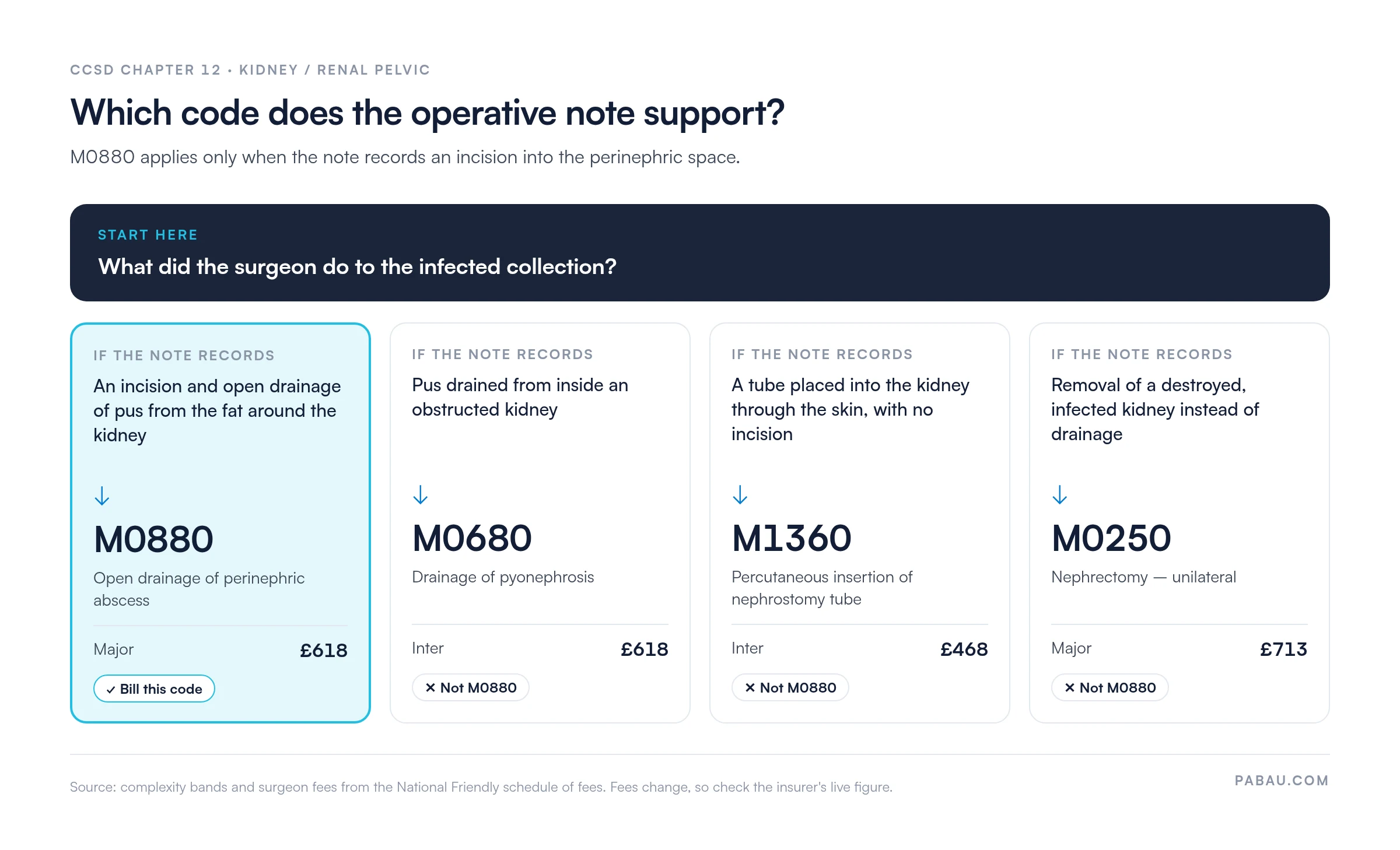
The surgeon fee depends on whose schedule the patient’s policy follows. National Friendly ranks M0880 as Major and lists a £618 surgeon fee. Freedom Health Insurance lists £500 for the surgeon and £285 for the anaesthetist.
Here’s a worked example. A consultant charges £800 for the operation, and the patient’s insurer covers £618. That leaves a £182 shortfall, which the patient pays unless the consultant works within the insurer’s fees.
Agree any shortfall with the patient in writing before planned surgery, or as soon as possible after an emergency. Fees change, so check the live figure on the Bupa code search or the insurer’s own schedule. Our guide to the Bupa fee schedule explains how complexity bands shape what each code pays.
Every M0880 claim needs a diagnosis code that explains why the abscess was drained. N15.1, Renal and perinephric abscess, is the main diagnosis in both the WHO version of ICD-10 and ICD-10-CM.
Add a secondary code only when the clinical record documents that condition. For example, add N10 only when the notes name acute pyelonephritis as the source of the abscess. Insurers weigh the clinical summary alongside the codes, so a correct code on its own does not guarantee payment.
Most queried M0880 claims trace back to a thin operative note. The insurer needs proof the drainage was open and that a less invasive approach had failed or was unsuitable.
Keep these records on file for every claim, and attach them when the insurer asks.
Record the volume and character of the pus, and send a sample for culture. The microbiology report gives objective evidence of infection, which supports both the claim and any appeal.
UK private medical insurers expect pre-authorisation before planned surgery. Usually the patient calls the insurer, gives the consultant’s name and the procedure code, and receives an authorisation number.
Many M0880 cases are urgent, though. A septic patient cannot wait for a phone call. Treat first, then notify the insurer as soon as possible, usually on the next working day.
When you request or notify the authorisation, have these details ready.
Record the reference against the case. If the operation changes, for example to a nephrectomy, tell the insurer the final code. A nephrectomy that also removes the perirenal fat and Gerota’s fascia is billed as M0210.
M0880 claims are uncommon, but their rejections follow a predictable pattern. Claims software for consultants that flags missing fields before submission prevents most of them.
When a resubmission won’t fix the rejection, use the insurer’s own appeals process.
An open perinephric abscess drainage produces several invoices from several parties. Knowing who bills what, a core part of medical billing, prevents both missed fees and unbundling rejections.
Check what each insurer pays alongside M0880, especially for the assistant. If the hospital quotes a fixed-price package, confirm which fees sit inside it.
In many private practices, an urgent M0880 claim gets typed twice. The operative note lives in one system, and the billing team re-keys it into Healthcode with an authorisation number copied from an email.
Pabau, the practice management software we build, creates the claim from the patient record instead. Its Healthcode integration carries the CCSD code, membership number and authorisation reference across. Pabau checks the required fields before the claim can be sent.
Remittances then come back to the same place and match against each invoice. Your team can see which M0880 claims are paid, which are short and which still need a chase.

Pabau builds CCSD claims like M0880 from the patient record and checks required fields before submission. Then you can track each claim’s status in one place.

M0880 pays a Major fee for an operation that is often done in a hurry. Most of its rejections start with an operative note that never says the drainage was open.
Make the operative note do the work. When it records the incision, the findings and the drain, and the claim carries N15.1, the claim stands on its own. Add the insurer’s authorisation reference, even when it follows an emergency, and nothing is left for the insurer to query.
Book a demo to see how Pabau takes an M0880 claim from the operative note to Healthcode without retyping a field.

Removing a failed kidney graft instead? CCSD code M0260 covers transplant nephrectomy and how to tell it apart from a native nephrectomy.
M0880 covers open drainage of a perinephric abscess through an incision, usually in the flank. It includes exposure, evacuation of pus, irrigation, debridement and drain placement. The anaesthetist’s fee, hospital charges and microbiology are billed separately.
M0880 sits in Chapter 12, Urinary system and male reproductive organs, under the Kidney / Renal Pelvic category. National Friendly ranks it as Major.
National Friendly lists a £618 surgeon fee, and Freedom Health Insurance lists £500. Check the live figure with the patient’s insurer before surgery, because fees change.
No. M0880 covers open drainage only. A drain inserted through the skin under image guidance needs a different code, so confirm it with the insurer before you submit the claim.
N15.1, Renal and perinephric abscess, is the main diagnosis. Add N10, N20.0, an E11 code or an A41 code only when the notes document that condition.
Yes, for a planned operation. In an emergency, treat first, then notify the patient’s insurer as soon as possible, usually the next working day.
No. CCSD codes exist for UK private medical insurance claims. NHS hospitals record the same operation with OPCS-4 procedure codes instead.