

CPT Code 52352: Ureteroscopic stone removal billing guide
CPT Code 52352: Official descriptor and procedure overview CPT Code 52352 descri...

Last Updated: Oct 30, 2026
M0210 is the CCSD code for nephrectomy and excision of perirenal tissue. CCSD stands for Clinical Coding and Schedule Development, the group that maintains the procedure schedule used by UK private medical insurers. The code covers removal of the whole kidney together with Gerota's fascia and the perinephric fat in one operation.
M0210 sits in Chapter 12 of the CCSD schedule, Urinary system and male reproductive organs, with an Xmajor complexity rating. Bupa, AXA Health, Aviva and Vitality price the code against their own fee schedules. Claims for kidney cancer surgery usually pair it with ICD-10 code C64, malignant neoplasm of kidney.
Let Pabau's smart automation suggest the right codes, reduce claim denials, and keep your practice compliant—effortlessly.
Automate repetitive tasks and focus on what matters most—your patients.
Reduce coding errors and ensure compliance with the latest regulations.
Clean claims, fewer denials, and faster reimbursements.
Powerful insights and reporting to help your practice thrive.
HIPAA compliant SOC 2 certified GDPR-compliant Trusted by 4,000+ clinics worldwide

CCSD Code M0210 bills nephrectomy and excision of perirenal tissue together as one bundled procedure.
The operative report must explicitly confirm perirenal tissue (Gerota’s fascia, perinephric fat) was excised, or the claim may be downgraded to a simpler nephrectomy code.
UK private medical insurers expect pre-authorisation before an elective M0210 procedure, with a clinical justification letter and imaging as standard supporting documents.
Pabau, the practice management platform we build, lets urology practices code, link ICD-10 diagnoses and send claims to UK private medical insurers in one workflow.
CCSD Code M0210 describes nephrectomy and excision of perirenal tissue. That means surgical removal of the kidney together with Gerota’s fascia, the perinephric fat and the immediately surrounding connective tissue.
The code sits in Chapter 12 of the CCSD schedule, Urinary system and male reproductive organs, with an Xmajor complexity rating. CCSD stands for Clinical Coding and Schedule Development. The CCSD Group maintains the procedure schedule that UK private medical insurers use to recognise and pay for private treatment.
Two anatomical elements define M0210. First, the kidney itself must be removed. Second, the perirenal tissue must be excised in the same operation. Removing the kidney alone, without documented excision of the surrounding fascial envelope, does not meet the M0210 descriptor. Code it under the appropriate simpler nephrectomy code instead.
The approach question is the most common source of coding uncertainty for M0210 claims. Whether the schedule uses one code for open and laparoscopic nephrectomy, or a distinct code for the minimally invasive route, depends on its current edition.
Always verify against the CCSD schedule published at ccsd.org.uk, because the CCSD Group revises it regularly.
The CCSD technical guide sets out the business rules that govern laparoscopic variants and when a separate procedure code applies. Document the surgical approach explicitly in the operative note whichever code route applies. Insurer claims reviewers frequently ask for it.
A procedure begun laparoscopically and converted to open mid-surgery causes specific billing difficulty. In that case, bill for the procedure completed. If the nephrectomy and perirenal tissue excision were completed open after conversion, M0210 applies to the open procedure. Record the conversion and the reason for it clearly in the operative report.
Radical nephrectomy and partial nephrectomy are different procedures with different CCSD codes. M0210 describes the radical (complete) nephrectomy with perirenal tissue excision, which removes the entire kidney.
Partial nephrectomy, also called nephron-sparing surgery, removes only part of the renal parenchyma and carries a different code in Chapter 12.
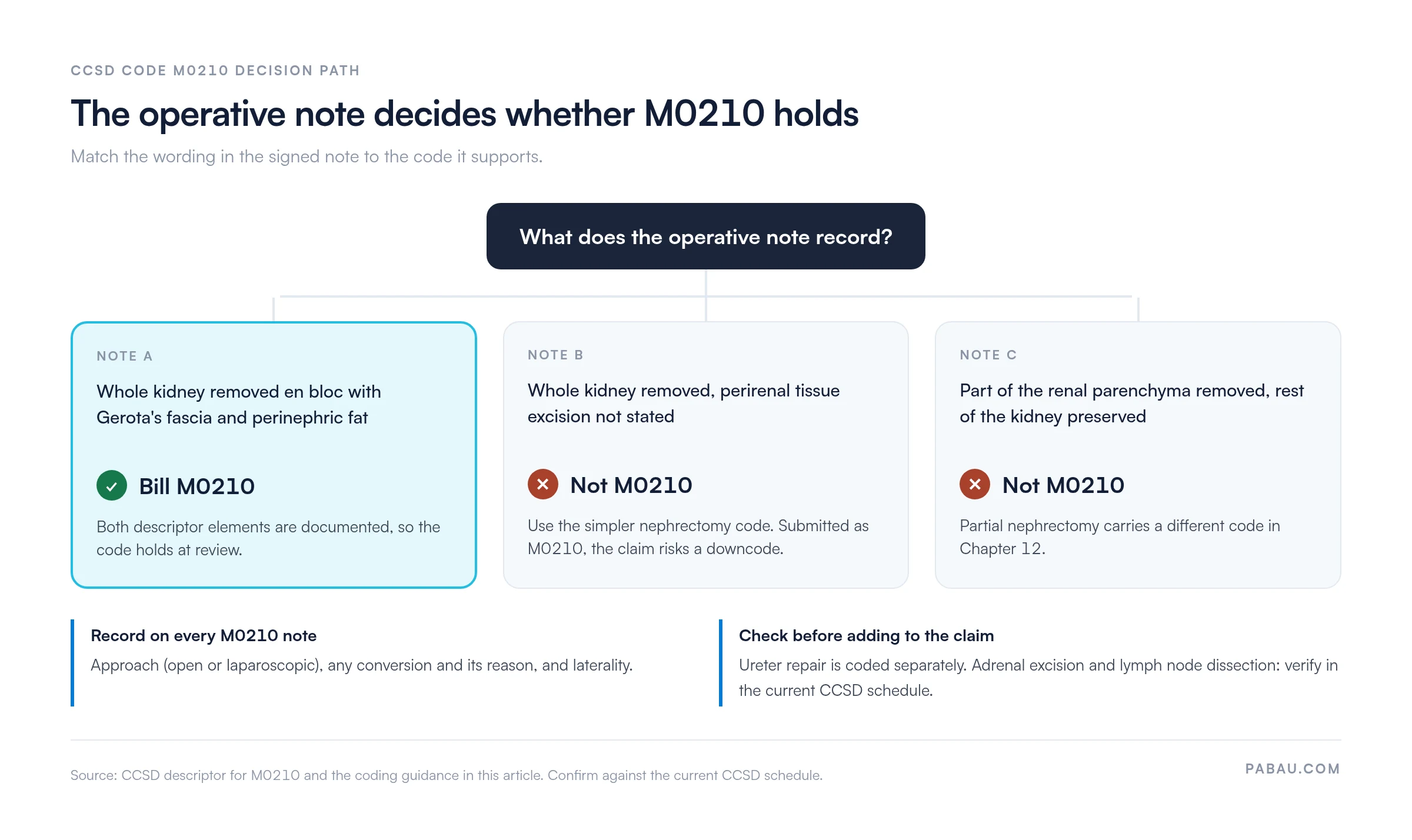
The operative report language is the deciding factor. A note that says “kidney removed” without specifying the extent of perirenal tissue dissection may be downcoded during review.
Notes that confirm excision of the fascial envelope support M0210 without ambiguity. The decision path below maps each common wording to the code it supports.
UK private medical insurers expect an ICD-10 diagnosis code alongside the CCSD procedure code on a surgical claim. The diagnosis must justify the procedure, and for M0210 it is almost always oncological or structural renal disease.
Renal cell carcinoma (ICD-10 C64) is the most common primary diagnosis submitted with M0210. Choose the subcode that reflects laterality where the classification allows it.
Some insurers ask for both a primary and a secondary diagnosis code, so check each insurer’s requirements. Using a non-specific code such as N28.9 when the clinical record documents a more precise diagnosis is an audit risk. It may also trigger a request for further clinical information.
M0210 comes from the CCSD schedule, which the CCSD Group maintains for UK private healthcare billing. The group includes Bupa, AXA Health, Aviva and Vitality.
Each insurer prices the code against its own fee schedule and applies its own benefit rules. The Bupa CCSD codes guide explains how the largest of them applies the schedule to submissions.
Other UK insurers outside the group, such as Freedom Health Insurance, also publish their procedure fees by CCSD code. Before surgery, confirm the patient’s insurer, policy and remaining benefit for an Xmajor urology procedure. Our library of CCSD codes lists the other procedures in the schedule with the same billing detail.
Elective nephrectomy is major surgery, and UK private medical insurers expect pre-authorisation before M0210 is performed. Proceeding without it on a non-emergency case risks the claim being rejected in full, whatever its clinical merit.
Bupa, AXA Health, Aviva and Vitality each issue an authorisation number against a named consultant and procedure code. Turnaround times, recognition criteria and benefit limits differ between insurers and between policies. Check the specific insurer’s rules for each patient rather than generalising from another insurer.
Apply for pre-authorisation as soon as the surgery is booked, not on the day of theatre. Send the imaging, the clinical letter and any MDT outcome with the first request. The insurer then has no reason to come back for more.
Radical nephrectomy CCSD billing depends on the quality of the operative report more than almost any other urology code. The report must show that the procedure performed matches the M0210 descriptor exactly.
Some M0210 cases involve more than one clinician or both kidneys. Each UK insurer sets its own rules for how those cases are billed and paid, so confirm them before the claim goes out.
Insurers update their fee schedules and benefit rules regularly. Check each insurer’s current rules at the start of the year, so a fee the insurer no longer pays never reaches the claim.
UK insurers treat routine post-operative care during the admission as part of the consultant’s procedure fee, so it cannot be billed separately. Rules on outpatient follow-up after discharge differ between insurers. Check the insurer’s fee schedule and benefit rules before invoicing a follow-up consultation.
Rejection patterns for M0210 claims are predictable. Most rejected claims share one of a small set of root causes that a structured pre-submission check can prevent. Each cause below breaks one condition of a clean claim.
A rejected CCSD Code M0210 claim can be challenged with the insurer first and then externally. UK insurers run an internal review and complaints process, and the Financial Ombudsman Service is the independent escalation route for policyholders.
Strong appeals for M0210 rejections centre on the operative report. If the rejection rests on thin documentation of perirenal tissue excision, a clarifying consultant statement may resolve it at the review stage. So may an addendum to the operative note made through your practice’s clinical governance process.
Submitting M0210 accurately takes more than entering the code number. The claim must carry the procedure code, the correct ICD-10 diagnosis code, laterality and the authorisation number. Each element must be present for the claim to process without a query.
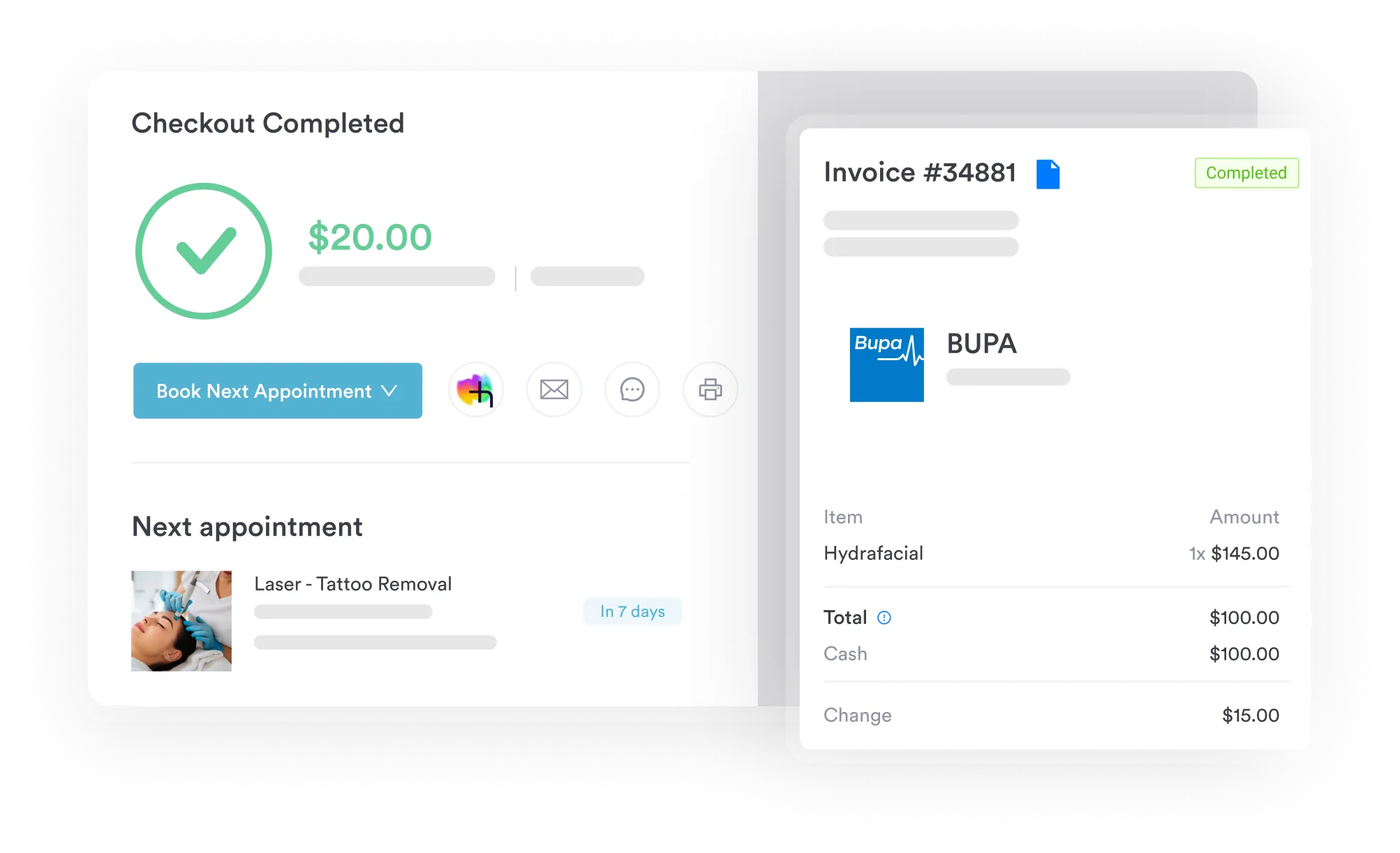
Run a pre-submission check before every M0210 claim. Confirm the authorisation number is present, the operative note confirms perirenal tissue excision and the ICD-10 code is the most specific available. A five-minute check at claim creation prevents weeks of appeals work later.
Many urology practices still type the procedure code, diagnosis and authorisation number into an insurer portal by hand. Pabau keeps them on the patient record instead. Its claims management software attaches M0210 and the ICD-10 code to the same claim, then sends it to the insurer.
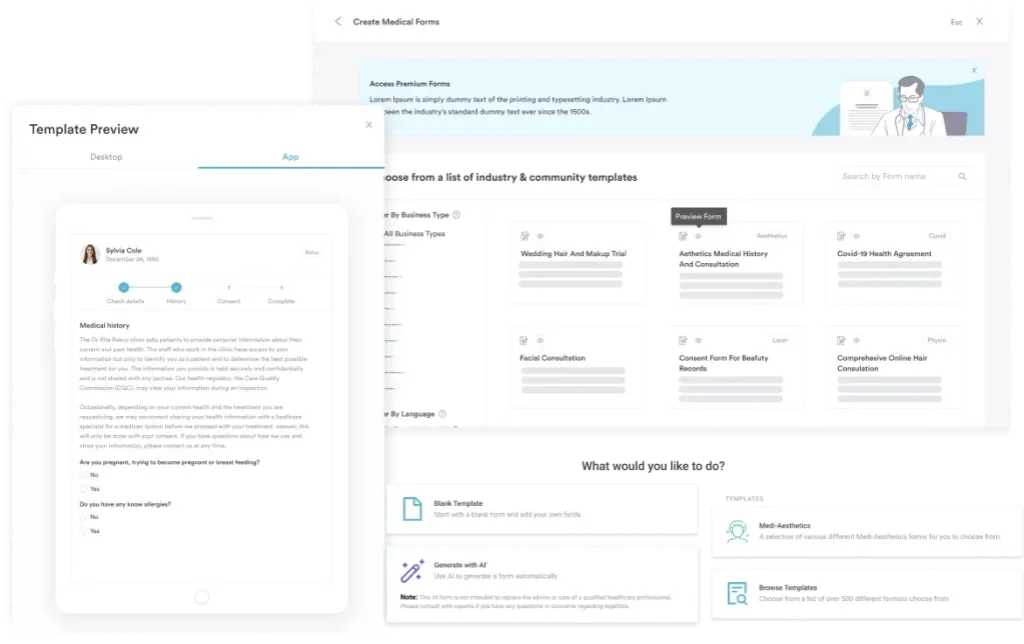
Pabau’s digital forms capture laterality, approach and the perirenal tissue detail at the point of care. That information feeds the billing workflow directly, so the claim starts complete. When an insurer queries an M0210 claim, the authorisation, the operative note and the invoice are already together.

Pabau links the authorisation number, the ICD-10 diagnosis and the M0210 procedure code on one patient record. Urology claims leave for Bupa, AXA Health, Aviva or Vitality complete, so billing staff stop rebuilding them after a query.

M0210 is an Xmajor claim that stands or falls on one line of the operative report. Where the note records the kidney removed en bloc with Gerota’s fascia and perinephric fat, the code holds. Where it records only “kidney removed”, the insurer has grounds to pay a simpler nephrectomy code. That wording is easiest to settle before the consultant signs the note.
Practices that bill M0210 well file the authorisation number and the operative note with the claim from the day it is created. Book a demo to see how Pabau keeps both attached to the invoice before it reaches the insurer.

Unsure how far ahead authorisation has to be arranged? The prior authorization process walks through each step, from clinical justification to the number on the claim.
CCSD Code M0210 is the UK private medical insurance code for nephrectomy and excision of perirenal tissue. It covers removal of a kidney together with Gerota’s fascia and the surrounding perinephric fat as one bundled procedure. Separately billable components such as lymph node dissection or ureter repair are not automatically included.
M0210 applies when the entire kidney and its surrounding perirenal tissue are removed (radical nephrectomy). Partial nephrectomy removes only a portion of the renal parenchyma and uses a different CCSD code. UK insurers decide which code is correct from the operative report language, not from the surgical indication alone.
Bupa, AXA Health, Aviva and Vitality all expect pre-authorisation before an elective nephrectomy billed under M0210. Each insurer issues an authorisation number against the named consultant and the procedure code. Policy terms differ between plans, so never assume one insurer’s rules apply to another.
Renal cell carcinoma (C64) is the most common primary diagnosis paired with M0210 for oncological nephrectomy. N28.9 covers an unspecified disorder of kidney and ureter in non-oncological cases. Use the most specific ICD-10 code the clinical record supports. Vague diagnosis coding is an audit risk and a common rejection trigger with UK insurers.
Routine post-operative care during the hospital admission is normally part of the consultant’s M0210 fee and is not billed separately. Rules on outpatient follow-up after discharge differ between insurers, so check the insurer’s fee schedule before invoicing it. Treatment of complications and procedures for unrelated conditions may be separately billable.
The two most common reasons are missing pre-authorisation and an operative report that does not explicitly confirm perirenal tissue excision. Other frequent causes include a non-specific ICD-10 code when a precise diagnosis is documented, and billing services the fee already includes. An assistant fee the insurer does not pay for this code is another common trigger.



