CPT code 93503: Swan-Ganz catheter billing and modifiers
CPT code 93503: Official descriptor and procedure overview In the AMA CPT code s...

Last Updated: Oct 23, 2026
L1880 is the CCSD code for repair of leaking aneurysm of arch of aorta. It covers open surgical repair of an aortic arch aneurysm that has started to leak. The surgeon replaces the arch with a graft and reimplants the arch vessels under cardiopulmonary bypass.
The code applies only to the arch, only to a leaking sac and only to an open approach. Ascending, descending, intact and endovascular repairs use other codes in the CCSD L-series.
Let Pabau's smart automation suggest the right codes, reduce claim denials, and keep your practice compliant—effortlessly.
Automate repetitive tasks and focus on what matters most—your patients.
Reduce coding errors and ensure compliance with the latest regulations.
Clean claims, fewer denials, and faster reimbursements.
Powerful insights and reporting to help your practice thrive.
HIPAA compliant SOC 2 certified GDPR-compliant Trusted by 4,000+ clinics worldwide

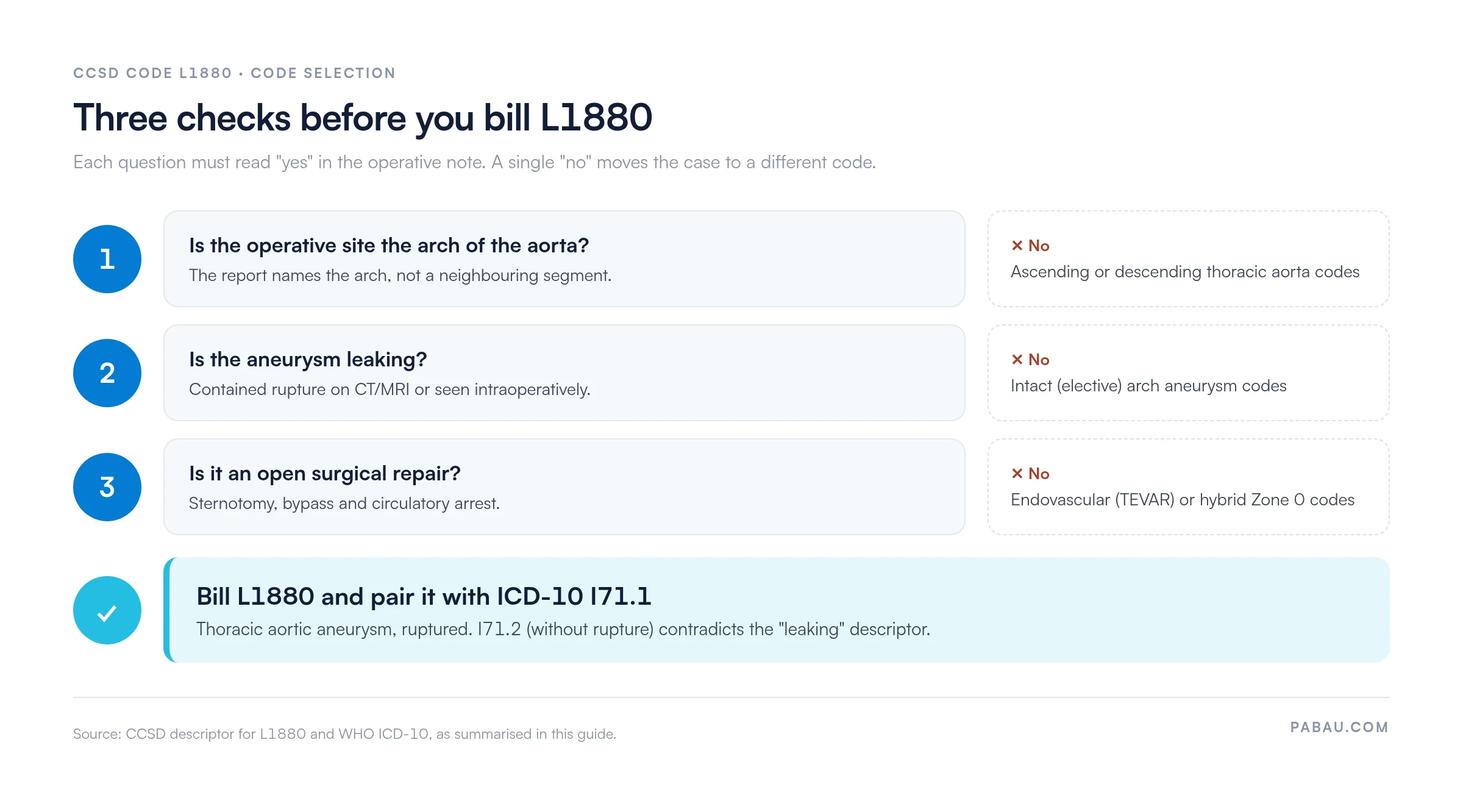
CCSD code L1880 covers open surgical repair of a leaking aneurysm of the aortic arch only. Endovascular repairs and other aortic segments use different codes.
ICD-10 I71.1 (thoracic aortic aneurysm, ruptured) is the usual diagnosis pairing, because a leaking aneurysm is clinically a contained rupture.
Bypass, circulatory arrest and cerebral perfusion are parts of the arch repair. Check the CCSD unbundling combinations before invoicing any of them separately.
Most UK private medical insurers don’t cover emergency treatment, so a funded L1880 claim needs the insurer to confirm cover and issue an authorisation number.
Pabau’s billing software keeps the CCSD code, the diagnosis and the authorisation number on one claim record and submits it through Healthcode.
CCSD Code L1880 is the Clinical Coding and Schedule Development code for “Repair of leaking aneurysm of arch of aorta.” It belongs to the L-series of the CCSD schedule, which covers vascular surgical procedures.
The schedule is maintained by the CCSD Group, a body of four UK private medical insurers that sets standard procedure codes for UK private healthcare.
Two features of the descriptor decide whether L1880 applies to a given procedure. First, the repair must involve the arch of the aorta specifically. The ascending aorta, the descending thoracic aorta and the thoracoabdominal segment all fall outside it.
Second, the aneurysm must be leaking. A leaking aneurysm is a contained or near-rupture presentation. The sac has begun to lose integrity but has not fully ruptured into the pericardium or pleural space. Clinically, it is treated as an emergency or urgent procedure.
The surgical steps explain why L1880 differs from its neighbouring codes and what the claim narrative has to show. Arch repair is the most complex segment of open aortic surgery. The arch gives rise to the brachiocephalic, left common carotid and left subclavian arteries, and all three must be managed during circulatory arrest.
The standard surgical sequence for an open leaking arch repair involves the following stages:
Each of these steps should be individually documented in the operative report to support L1880 and any associated add-on codes. The report must also record the leak explicitly, whether it was confirmed on pre-operative imaging or intraoperatively.
L1880 is a specialist cardiothoracic surgeon code. The procedure requires a consultant-level cardiothoracic or vascular surgeon as the primary operator, a perfusionist to manage cardiopulmonary bypass, and an experienced cardiac anaesthetic team. It cannot be billed as the primary code by an anaesthetist or assistant surgeon.
Every L1880 claim must be accompanied by an ICD-10 diagnosis code that accurately reflects the patient’s presentation.
A leaking aortic arch aneurysm is clinically equivalent to a contained rupture, which maps to the ruptured/dissection category rather than the intact aneurysm codes. A mismatched diagnosis code is a common trigger for an insurer query on L1880.
Check current descriptions against the WHO ICD-10 edition used in the UK before submission. The pairings above reflect standard clinical practice, so confirm the diagnosis code with the insurer when the pathology is unclear.
The CCSD L-series contains several adjacent aortic repair codes that coders often meet alongside L1880. The wrong choice leads to rejection or a request for clinical justification. It usually comes from confusing the anatomical segment or the repair approach.
The open-versus-endovascular split matters most. L1880 is an open surgery code, while endovascular and hybrid approaches have their own codes in the CCSD schedule. Applying L1880 to a TEVAR or hybrid Zone 0 procedure is upcoding. Run the three checks below before you compare L1880 with its neighbours in our CCSD code library.
Verify exact adjacent code numbers against the current CCSD schedule and the insurer’s fee schedule. The Bupa code search tool lists the L-series codes Bupa accepts, with any fee or bundling notes attached. Healix and Aviva also publish CCSD-coded procedure fees with unbundling guidance.
An arch repair involves several techniques besides the graft itself. Under the CCSD coding principles, most of them are components of L1880 rather than separate codes. The few genuine second procedures are paid under each insurer’s own rules.
Because bundling rules differ between insurers, keep an insurer-specific reference sheet for L1880. Pabau’s claims management software lets you attach insurer billing notes to the claim record, so the wrong combination doesn’t go out.
Before billing CPB as a separate code alongside L1880, check the insurer’s current fee schedule. Bupa, Aviva, AXA Health and Healix each publish their own guidance, and the rules are not uniform. Billing CPB separately when the insurer treats it as part of L1880 invites an overpayment recovery request.
A complete operative report is the cornerstone of a defensible L1880 claim. Incomplete documentation is hard to fix after the event. Insurers can ask for more clinical evidence months after submission, when the operating surgeon may be difficult to reach.
The operative report must explicitly confirm all of the following:
Bupa may ask for a funding request form or a medical report before it confirms cover. The patient must consent to that report under the Access to Medical Reports Act 1988, so a clear pre-operative record speeds up the answer.
UK private medical insurers expect treatment to be pre-authorised before it starts, and the authorisation number goes on the invoice. L1880 adds a complication, because a leaking arch aneurysm is usually an emergency.
Bupa’s guide for consultants says its policies don’t cover treatment in A&E departments, NHS or private. Patients who need emergency care are directed to NHS emergency services. AXA Health notes that most health insurers leave emergency treatment to the NHS.
A funded L1880 claim therefore depends on the insurer confirming cover before surgery. In practice, that means an urgent repair planned at a recognised hospital with a critical care unit. Where the insurer declines, the patient can still choose to fund the repair privately.
Denials on L1880 follow predictable patterns. Most of them can be caught before the invoice leaves the practice.
Tracking denials at code level shows which insurers routinely query which elements. Our Bupa CCSD codes guide explains how Bupa handles CCSD claim submissions in more detail.
CCSD codes carry no modifiers. The rules that change what an L1880 invoice pays come from the CCSD technical guide and from each insurer’s fee schedule.
Fees for L1880 come from each insurer’s fee schedule, because CCSD maintains the codes rather than the prices. Bupa publishes its surgeon and anaesthetist benefit limits in its Schedule of Procedures and updates it monthly. Never invoice from a previous year’s fee without checking the current schedule.
Check the hospital as well as the code before an urgent arch repair. Bupa covers intensive care only after planned Bupa-funded treatment at a recognised hospital with a critical care unit. The wrong hospital can leave the ITU stay unfunded even when the surgery is authorised.
Cardiothoracic billing teams often track an urgent case across theatre notes, emails and insurer portals. When an arch repair is authorised in a hurry, the authorisation number and the critical care approval are easy to lose.
Pabau, the practice management software we build for private practices, keeps the CCSD code, the ICD-10 diagnosis and the authorisation number on one claim record. You submit the claim through Healthcode and track its status in the same place. Pabau doesn’t choose the code, so the site, leak and approach checks above still apply.

Pabau helps cardiothoracic billing teams attach operative documentation, track authorisation with UK private medical insurers and monitor claim outcomes. See how it fits your workflow.

L1880 fits one operation: an open repair of a leaking aneurysm of the aortic arch. Change the segment, the approach or the leak status, and the code changes with it.
For UK private billing, cover is the harder question. Most insurers leave emergency care to the NHS. A funded L1880 claim therefore rests on authorisation before surgery and an operative note that proves the leak.
Settle the code, the diagnosis and the authorisation number before the claim leaves the practice. Our Bupa fee schedule guide shows how one insurer prices each code. To see how Pabau keeps the whole claim in one place, book a demo.

Coding a congenital arch defect rather than an aneurysm? CCSD code L2360 covers repair of an interrupted aortic arch and how it differs from aneurysm repair.
Is the aneurysm documented without rupture or site? ICD-10 code I71.9 explains when an unspecified, unruptured aortic aneurysm code applies and why insurers query it.
Is the aneurysm secondary to another condition? ICD-10 code I79.0 covers aortic aneurysm in diseases classified elsewhere, such as syphilitic aortitis.
Billing a valve procedure alongside the arch repair? CCSD code K2600 sets out the aortic valve replacement code and its documentation rules for UK insurers.
CCSD Code L1880 covers open surgical repair of a leaking aneurysm of the arch of the aorta. That includes the graft, the arch vessel management, cardiopulmonary bypass and deep hypothermic circulatory arrest. Endovascular approaches and repairs of other aortic segments use other codes.
ICD-10 I71.1 (thoracic aortic aneurysm, ruptured) is the usual diagnosis code with L1880, because a leaking aneurysm is clinically a contained rupture. Pairing I71.2 (without mention of rupture) with L1880’s “leaking” descriptor creates a mismatch that insurers query.
No, in most cases. Deep hypothermic circulatory arrest is part of the open arch repair technique, so L1880 normally covers it. Check the CCSD unbundling combinations and the insurer’s rules before submitting DHCA as an additional code.
No. L1880 is an open surgical repair code. Endovascular approaches, including thoracic endovascular aortic repair (TEVAR) and hybrid Zone 0 arch procedures, use separate CCSD codes. Applying L1880 to a TEVAR procedure is upcoding.
The most frequent reasons are a wrong anatomical site, an endovascular code on an open repair, and an operative report that doesn’t confirm the leak. Missing pre-authorisation and an intact aneurysm code paired with L1880 are also common.
Yes. UK private medical insurers expect L1880 to be pre-authorised before surgery, with the authorisation number on the invoice. Most insurers don’t cover emergency treatment, so an emergency repair is usually NHS-funded or self-funded unless the insurer confirms cover.