CPT Code 19361: Latissimus dorsi flap breast reconstruction
CPT code 19361: Official descriptor and payment basics CPT code 19361 is the Cat...

Last Updated: Nov 18, 2026
L7010 is the CCSD code for open embolectomy of artery. The surgeon opens the artery through an incision, passes a balloon catheter beyond the clot and draws the embolus or thrombus out. UK private medical insurers expect this code when the clot comes out through a surgical arteriotomy.
L7010 sits in CCSD sub-chapter 9.6.0, Non-specific, within chapter 9, Vascular system. One code covers any peripheral artery, so the operative note has to name the vessel and the side. A clot cleared only through a catheter puncture, with no arteriotomy, falls outside this descriptor.
Let Pabau's smart automation suggest the right codes, reduce claim denials, and keep your practice compliant—effortlessly.
Automate repetitive tasks and focus on what matters most—your patients.
Reduce coding errors and ensure compliance with the latest regulations.
Clean claims, fewer denials, and faster reimbursements.
Powerful insights and reporting to help your practice thrive.
HIPAA compliant SOC 2 certified GDPR-compliant Trusted by 4,000+ clinics worldwide

CCSD code L7010 covers open embolectomy of artery, where the surgeon opens the vessel and draws the embolus or thrombus out with a balloon catheter.
Acute limb ischemia is the usual indication. Pair L7010 with the I74 code for the artery the operative note names, such as I74.3 for a femoral embolectomy.
L7010 needs a clot removed through a surgical arteriotomy. Clot removal through a percutaneous catheter alone takes an endovascular code instead.
Most UK private medical insurers require pre-authorization for elective vascular surgery. Emergency cases use each insurer’s retrospective pathway, so confirm the route before billing.
Pabau, the practice software we build, keeps the vessel, side, and instrument detail insurers check in the same record as the L7010 claim.
CCSD code L7010 is the procedure code for open embolectomy of artery, its official descriptor in the CCSD schedule. It covers any open operation that extracts an arterial embolus or thrombus through a surgically created arteriotomy. The CCSD publishes each code with its full narrative in its searchable code schedule, which opens to registered users.
L7010 sits in sub-chapter 9.6.0, Non-specific, within chapter 9, Vascular system. You’ll find it beside the other vascular entries in our library of CCSD codes. For how one major insurer applies the schedule, see the Bupa CCSD codes guide.
The table below summarizes the attributes that UK private medical insurers (PMIs) check on an L7010 claim.
Open embolectomy is a procedure in which a vascular surgeon cuts directly into an artery (an arteriotomy) to remove an obstructing embolus or thrombus. Endovascular approaches reach the clot with a catheter from a remote puncture site, while this one needs open surgical access to the vessel.
The procedure typically follows this sequence:
The open approach is coded L7010 whichever peripheral artery is treated. The operative note must still record the side. A bilateral procedure in one session needs the insurer’s guidance before you submit two L7010 claims.
L7010 is coded when a vascular surgeon performs open arterial embolectomy as the definitive treatment for arterial occlusion. Acute limb ischemia is the usual clinical driver. The ICD-10 code paired with L7010 names the occluded artery, and it must match the operative findings in the clinical record. The chart below walks through both coding decisions.
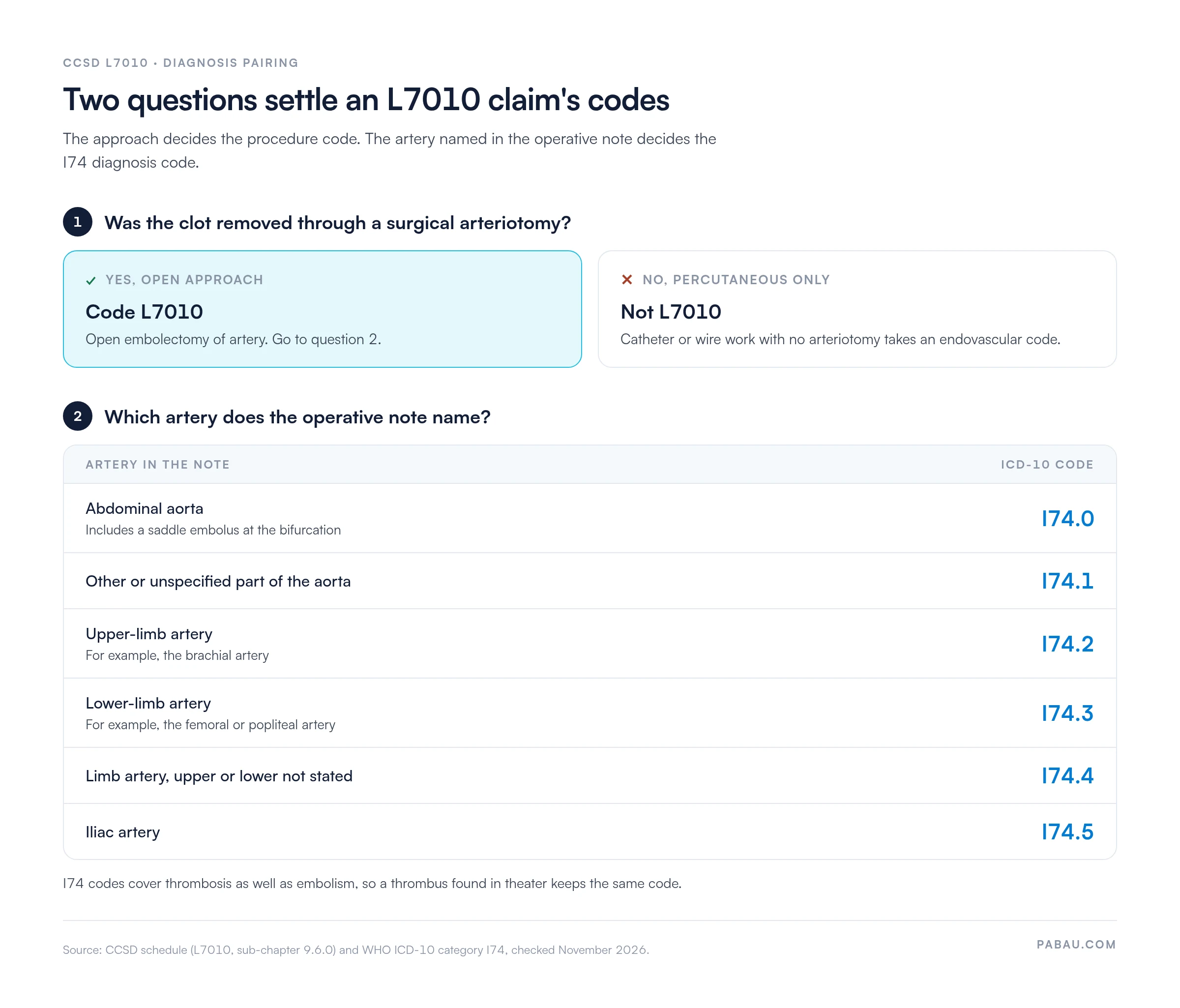
I74 codes cover thrombosis as well as embolism, so a thrombus found at operation keeps the same code. An iliac occlusion takes I74.5, for example, whichever clot the surgeon finds.
Confirm the ICD-10 code against the operative findings. Submitting I74.3 (lower-limb arterial embolism) when the operative note describes a brachial artery embolectomy creates a diagnosis-procedure mismatch, a common denial trigger. UK private insurers, including Bupa and AXA Health, cross-reference the diagnosis code against the operative report during claims review.
Several codes share CCSD sub-chapter 9.6.0 with L7010, and the descriptor decides which one fits the case. The table lists the neighbors most likely to be confused with open embolectomy, in the schedule’s own wording.
Other vascular operations carry codes of their own. Revision of a femoral bypass graft is coded L6530, and open cannulation of an intra-abdominal artery is coded L7040. Check the adjacent codes and their unacceptable combinations in the CCSD schedule before you add a second vascular code to an L7010 claim. Clot removal during open repair of a dialysis access fistula may instead be bundled into CCSD procedure L7580.
Open vs endovascular: If the surgeon used only a percutaneous approach, with a wire, catheter, or aspiration device and no arteriotomy, L7010 does not apply. When a case converts from endovascular to open in the same session, code the approach that completed the procedure. The CCSD Technical Guide lists an open and a percutaneous code for the same organ as an inappropriate combination. Don’t bill the abandoned approach alongside L7010.
An L7010 claim fails review when the operative note lacks the detail an insurer’s coding team needs to verify the procedure. A structured operative note template that prompts for each element below means the note arrives complete.
These elements belong in the operative note to support a valid L7010 claim:
The CCSD Technical Guide sets out the coding principles behind every CCSD code, including its rules on unacceptable combinations. Each insurer’s provider guidance may add requirements for vascular surgical codes.
UK private medical insurers generally require pre-authorization for planned vascular surgery. Acute limb ischemia complicates this, because it is a time-critical emergency. Waiting for insurer approval before operating would put the limb at risk, so each major PMI runs a separate emergency pathway. Billing staff need to know which route applies before they submit the claim.
These rules are indicative and subject to change. Verify the current pre-authorization requirement with the patient’s insurer and policy before billing. Missing authorization, even for a clinically appropriate emergency, is a leading cause of L7010 claim denial.
Bilateral open embolectomy in one session is uncommon, but it happens when a saddle embolus affects both iliac or femoral arteries at once. Whether a practice can submit two L7010 codes for a bilateral case is insurer-specific guidance, not a universal CCSD rule.
Contact the patient’s PMI provider line before submitting a bilateral L7010 claim. Flag the case as bilateral in the covering letter, and attach the operative note at first submission to head off a documentation request.
L7010 denials in UK private practice follow a predictable pattern, with the same documentation and administrative errors behind most rejected claims. Claims management software that prompts for mandatory fields before submission catches several of them automatically.
Attach the operative note at first submission for every L7010 claim instead of waiting for the insurer to ask. Vascular surgery claims draw more documentation review than lower-complexity codes, so sending the note up front saves a round of correspondence.
Each insurer sets its own fee for L7010. The rate depends on the insurer, the consultant’s recognition status, and any locally agreed terms. The table shows where each insurer publishes its fee guidance, so check the current schedule before invoicing.
Reimbursement for L7010 excludes the anesthetist’s fee, which is billed separately under the relevant CCSD anesthesia code. Hospital facility charges and implant or disposable costs are billed separately too. Confirm with each insurer whether Fogarty catheter consumables sit within the procedure fee or need their own line.
In many private practices the operative note and the claim live in different places. A medical secretary reads the note, picks the codes, and keys them into the insurer’s portal days later. Any vessel or side missing from the note turns into a query from the insurer.
Pabau holds the operative note, the codes, and the claim in one patient record. Structured note templates prompt the surgeon for the artery, side, approach, and distal-flow check while the case is fresh. The authorization code sits on the patient’s case, and Pabau warns you when one is missing.
The claim then goes to the insurer through Healthcode or Bupa with codes taken from the same record. Fewer L7010 claims come back with a documentation request, and your team spends less time rebuilding surgical detail for an insurer weeks later.

Pabau keeps the operative note, the CCSD and ICD-10 codes, and the Healthcode claim in one patient record. Your L7010 claims reach the insurer carrying the detail it checks.

L7010 claims rarely fail on the code itself. They fail when the note leaves the insurer guessing about the approach, the artery, or the authorization route.
Before you submit, read the operative note the way the insurer will. Confirm it names an arteriotomy, a specific artery, and a side. Then pick the I74 code from that artery and log the authorization reference. If any of those is missing, query the surgeon first, because a corrected note is far cheaper than a rejected claim.
Book a demo to see how Pabau keeps operative notes and CCSD claims in one record for your vascular practice.

Need a broader CCSD billing reference? Bupa CCSD codes covers the Bupa procedure code schedule and how it maps to private practice billing workflows.
Struggling with claim rejection rates across your practice? Claims management for private practice explains how structured pre-submission checks reduce denial rates for surgical billing codes.
Coding a lower-limb bypass instead? CCSD code L5950 covers femorodistal calf bypass using a prosthesis and the operative detail insurers expect for it.
CCSD code L7010 covers open embolectomy of artery. A vascular surgeon removes an arterial embolus or thrombus through a direct arteriotomy, typically with a Fogarty balloon catheter. The code applies to the open approach whichever peripheral artery is treated.
L7010 needs an open arteriotomy, with the clot drawn out through an incision in the artery. A clot removed only through a percutaneous catheter, wire, or aspiration device takes an endovascular code instead. Check the adjacent codes in the CCSD schedule to find the right one. The CCSD lists open and percutaneous codes for the same organ as an inappropriate combination, so never bill both.
Yes, for elective vascular procedures. For emergency acute limb ischemia, UK private insurers such as Bupa, AXA Health, and Aviva offer retrospective authorization pathways. The practice typically notifies the insurer within 24 to 48 hours of the emergency admission. Always verify the current emergency pathway with the patient’s insurer before billing.
Bilateral submission of L7010 depends on the insurer and is not a universal CCSD rule. Some insurers accept two L7010 codes for a bilateral case with matching operative note documentation. Others require prior agreement or apply a bilateral reduction. Contact the patient’s insurer before submitting, and document each arteriotomy site, catheter pass, and distal-flow check separately.
Yes, when the Fogarty catheter is passed through a surgical arteriotomy as part of an open arterial embolectomy. L7010 covers the whole open procedure, including the catheter step. If the catheter is used percutaneously without an arteriotomy, the case is endovascular and a different CCSD code applies.
The leading reasons are missing pre-authorization, an incomplete operative note, a diagnosis code that names the wrong artery, and open-versus-endovascular miscoding. An incomplete note usually lacks the vessel name, the side, or the instrument. Attaching the operative note at first submission and checking the I74 code against the operative findings prevents most of these rejections.