CCSD code K4902: IVUS-guided coronary angioplasty billing guide
CCSD code K4902 covers IVUS-guided coronary angioplasty CCSD code K4902 covers p...

Last Updated: Oct 26, 2026
L1960 is the CCSD code for open (not endovascular) repair of an infrarenal abdominal aortic aneurysm using a bifurcated graft. It sits in the Abdominal Vessels section of Chapter 9 of the UK CCSD schedule, which added it on 7 February 2014.
Let Pabau's smart automation suggest the right codes, reduce claim denials, and keep your practice compliant—effortlessly.
Automate repetitive tasks and focus on what matters most—your patients.
Reduce coding errors and ensure compliance with the latest regulations.
Clean claims, fewer denials, and faster reimbursements.
Powerful insights and reporting to help your practice thrive.
HIPAA compliant SOC 2 certified GDPR-compliant Trusted by 4,000+ clinics worldwide

CCSD code L1960 covers open repair of an infrarenal abdominal aortic aneurysm with a bifurcated (Y-shaped) graft, not a tube graft and not EVAR.
The operative note must confirm the open approach and the bifurcated graft, paired with an ICD-10 code such as I71.4 or I71.3.
UK private medical insurers such as Bupa, AXA Health and Aviva usually expect pre-authorisation before elective repair, under each insurer’s own rules.
Pabau’s claims management software sends CCSD claims through Healthcode and tracks them, while the coding decision stays with your coder.
CCSD code L1960 describes the open surgical repair of an infrarenal abdominal aortic aneurysm (AAA) using a bifurcated graft. The Clinical Coding and Schedule Development (CCSD) Group maintains the schedule. UK private medical insurers, including Aviva, AXA Health and Bupa, own and license it, and consultant surgeons use its codes to bill them.
Among the CCSD codes, L1960 sits in the Abdominal Vessels section of Chapter 9, and CCSD added it on 7 February 2014. Its schedule descriptor is “Open infrarenal abdominal aortic aneurysm bifurcation graft”. US HCPCS also uses L1960, for a custom-fabricated ankle-foot orthosis, so check which code system a search result covers.
Three characteristics define this code. The repair is open rather than endovascular, and the aneurysm is infrarenal, below the renal arteries. The graft is bifurcated: Y-shaped, with two distal limbs. All three must be confirmed in the operative record before L1960 is assigned.
An infrarenal AAA forms below the renal arteries. Approximately 90% of all abdominal aortic aneurysms are infrarenal, making this the most common anatomical site for open aortic surgery. Some aneurysms extend to the aortic bifurcation, where the aorta divides into the two common iliac arteries. Those need a bifurcated graft rather than a simpler tube graft.
The operative sequence that the coder will see documented in the theatre report follows these key steps:
The Y-configuration of the graft is the operative detail that separates L1960 from the open tube graft code, L1940. If the operative note describes a single distal anastomosis without branching, L1960 does not apply.
Coders must understand why the procedure was performed to verify that the claim is clinically supported. The main indications for open infrarenal AAA repair with a bifurcated graft are:
Every L1960 claim needs a supporting diagnosis. The UK uses the WHO ICD-10 classification, and these are the primary pairings for this procedure.
The ICD-10 code must reflect the clinical presentation documented in the operative note and pre-operative imaging report. An elective repair billed with I71.3 (ruptured) for an intact aneurysm is a coding error and is likely to prompt an insurer query.
The most common coding error for this procedure is choosing the wrong CCSD code after an incomplete reading of the operative report. The CCSD billing codes guide explains how the schedule is structured, and the table below maps the key distinctions for aortic aneurysm repair.
CCSD lists both L1960 + L1940 and L1960 + L2710 as unacceptable combinations, so only one of each pair is billed for the same repair. The full schedule sits behind a licensed login, so confirm these entries there before you submit. The decision path below runs the same checks in the order a coder meets them in the operative note.
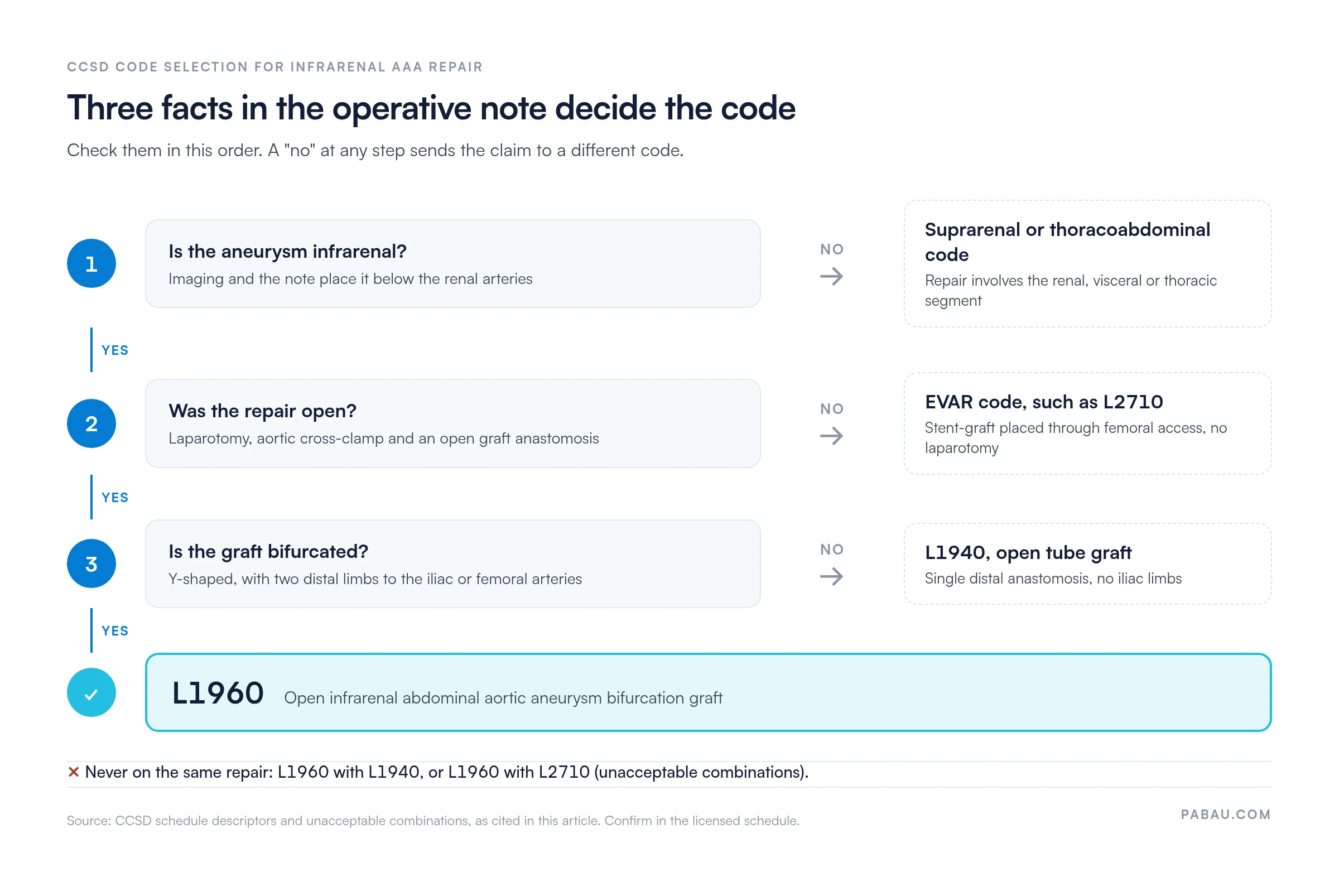
CCSD code L1960 applies only to open surgical repair. EVAR deploys a stent-graft through femoral artery access without a laparotomy, and it takes a separate endovascular code such as L2710.
The operative note is the deciding document. L1960 needs a documented laparotomy, aortic cross-clamp and open graft anastomosis. A report describing percutaneous or femoral-cutdown access and fluoroscopic graft deployment describes EVAR and must be coded that way.
Check the operative note for two phrases before assigning L1960: ‘aortic cross-clamp’ and ‘bifurcation graft’. Both must be present. If the note mentions a ‘delivery system’, ‘sheath’, or ‘fluoroscopic guidance’ without a laparotomy entry, the procedure is EVAR and a different CCSD code applies.
A well-supported L1960 claim rests on the operative note. Sound medical billing documentation practice requires the coder to verify each of the following elements before submitting.
If any of these elements is absent or inconsistent, the insurer is likely to query or reject the claim. Coders should request missing documentation from the clinical team before submission rather than submitting and appealing later.
CCSD codes do not carry CPT-style modifiers. The CCSD technical guide sets the business rules for combining codes, including which codes cannot be billed together. What an insurer pays for each line is set by that insurer, not by the schedule.
Open AAA repair routinely needs a surgical assistant, because aortic control and graft handling happen at the same time. The anaesthetist also bills separately. Each insurer sets its own rules for assistant fees and for paying a second procedure in the same operation. Check the current rules for the patient’s insurer before you add a line to the claim.
Renal artery reimplantation or a separate endarterectomy can happen during the same open repair. Bill an extra CCSD code only when the operative note documents it as a distinct procedure. Then check that code against the schedule’s unacceptable combinations for L1960.
Where two consultants each perform a distinct part of the operation, the operative note must record who did what. Two surgeons being present is not enough. Insurers differ on whether and how they pay a second consultant, so confirm the policy before submitting.
UK private medical insurers usually expect the patient to obtain pre-authorisation before elective open AAA repair. The authorisation should name the same procedure the surgeon performs, so the codes need settling early.
Emergency (ruptured AAA): Many UK private medical insurance policies exclude emergency admissions, so most ruptured aneurysms are repaired in the NHS. Where a private claim does follow an emergency repair (ICD-10 I71.3), follow the insurer’s published process for retrospective authorisation. Send the operative report and emergency clinical notes with the request.
Claims for open AAA repair are high-value and draw close review from insurer claims teams. The most common rejection reasons and their corrective actions are:
A short pre-submission checklist that tests every claim against these rows stops each problem before the claim leaves the practice.
Follow these steps for every L1960 claim before you send it to the insurer.
Build a single L1960 claim checklist that your billing team uses for every open AAA repair. The seven-step sequence above works as the structure. Attach it to the patient’s billing file alongside the operative note the day after surgery, before the claim is assembled. Claims prepared this way have every required element in place before submission.
Vascular practices billing L1960 tend to lose time in the same places. Authorisation numbers sit in emails, invoices get typed twice, and nobody chases unpaid claims. Pabau, the practice management platform we build, keeps the patient, insurer details and invoice on one record.
From that record, Pabau’s claims management software builds the claim from the details already on file and sends it through Healthcode. Your team then tracks each claim’s status in one place. Pabau does not choose the CCSD or ICD-10 codes, so the coding decision stays with your coder.
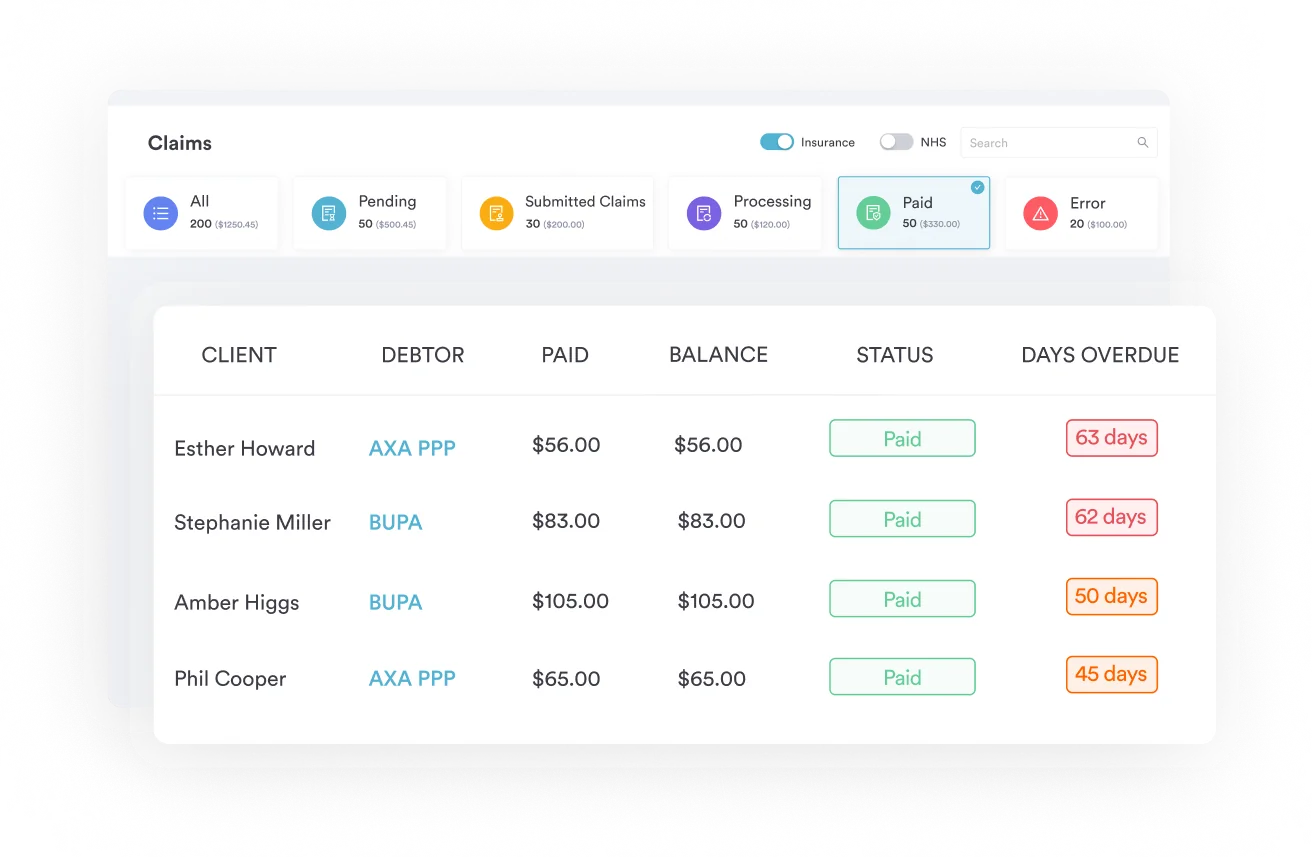
The outcome is fewer high-value claims stuck in a spreadsheet, and a clear view of which insurer still has to pay.

Pabau keeps authorisation numbers, insurer details and invoices on one patient record. It sends each claim through Healthcode and tracks it until the insurer settles.

L1960 is a narrow code: open repair, infrarenal aneurysm, bifurcated graft. Change any one of those facts and a different CCSD code applies, usually L1940 or L2710. The operative note is what proves which one is right.
Code from the note, make sure the authorisation covers the open repair, and test every extra line against the schedule’s unacceptable combinations. Those three habits head off the queries that delay a high-value claim. To see how Pabau keeps CCSD claims moving through Healthcode, book a demo.

Need a broader view of CCSD procedure codes? Bupa CCSD codes explains how the CCSD schedule is structured and how UK insurers apply it.
Coding another arterial procedure? CCSD code L6710 covers biopsy of artery and what UK insurers expect on the claim.
Want fewer insurer queries on surgical claims? Claims management software shows how Pabau submits and tracks claims through Healthcode.
CCSD code L1960 is the UK private procedure code for open repair of an infrarenal abdominal aortic aneurysm with a bifurcated (Y-shaped) graft. It covers the open approach only. Endovascular repair (EVAR) and tube graft repair take separate CCSD codes.
L1960 applies when the graft is Y-shaped, with two distal limbs joined to both iliac or femoral arteries. A straight tube graft with a single distal anastomosis is coded L1940. Endovascular repair of the same aneurysm is coded L2710. CCSD lists both L1940 and L2710 as unacceptable combinations with L1960, so confirm the current entries in the licensed schedule.
No. L1960 covers open surgery only. EVAR deploys a stent-graft percutaneously or through a femoral cutdown without a laparotomy, and it takes a separate endovascular code such as L2710. Submitting L1960 for an EVAR procedure is a coding error.
Yes, subject to the insurer’s rules. Assistant fees are commonly claimed for open AAA repair, and the assistant’s role must be documented in the operative note. A second consultant’s fee needs a distinct, separately documented part of the operation. Each insurer sets its own assistant and multiple-procedure rules, so confirm them before billing.