Pabau Engage inbox

Pabau Engage is here: every patient conversation in one inbox.

Learn more
CCSD Code

CCSD code L5300 – Open operations on iliac artery


Code Definition

L5300 is the CCSD code for open operations on iliac artery. It is the general code for an open iliac artery operation that no more specific CCSD code describes. Open repair of an isolated iliac aneurysm is one example.

Named procedures have their own codes. Bypass grafting is L5100 or L5180, iliac endarterectomy and patch repair is L5210, and endovascular iliac work is L5400.

Group
9.0.0 Vascular System
Category
9.5.0 Ileo-femoral Vessels
CCSD reference
FI.033
Billable
No
Code also known as
open iliac artery surgery, open iliac artery operation
Save time. Improve accuracy. Get paid faster.
Automate coding with Pabau

Let Pabau's smart automation suggest the right codes, reduce claim denials, and keep your practice compliant—effortlessly.

  • AI-powered code suggestions
  • Real-time compliance checks
  • Faster claims, fewer denials
Why practices choose Pabau
Save hours every week

Automate repetitive tasks and focus on what matters most—your patients.

Improve accuracy

Reduce coding errors and ensure compliance with the latest regulations.

Get paid faster

Clean claims, fewer denials, and faster reimbursements.

Grow with confidence

Powerful insights and reporting to help your practice thrive.

HIPAA compliant SOC 2 certified GDPR-compliant Trusted by 4,000+ clinics worldwide

Key takeaways

Key takeaways

CCSD code L5300 is the general code for open operations on the iliac artery that no more specific CCSD code describes.

Bypass grafting and iliac endarterectomy have their own codes, L5100, L5180 and L5210, so check those before you reach for L5300.

Endovascular iliac work, such as angioplasty or stenting, is coded L5400, transluminal operations on iliac artery.

Pair L5300 with an iliac-level WHO ICD-10 diagnosis, such as I70.2, I72.3, I74.5 or S35.5.

Most UK insurers expect pre-authorisation for planned surgery, so record the authorisation code before the operation.

CCSD code L5300: Definition and clinical scope

CCSD code L5300 is the procedure code for open operations on iliac artery. It is the general code for an open iliac artery operation that no more specific CCSD code describes. The CCSD Group’s schedule holds the standard procedure codes for UK private healthcare, and it files L5300 under 9.5.0 Ileo-femoral Vessels.

That general role decides how the code is used. Bypass grafting and iliac endarterectomy each carry their own codes in the same section, and endovascular iliac work is L5400. L5300 is the code you reach for once those have been ruled out.

Bupa, AXA Health, Aviva, Vitality, WPA and other UK private medical insurers work from CCSD codes. Our guide to Bupa CCSD codes explains how the schedule works, and our CCSD procedure codes library collects the individual code guides. Practitioners send their bills electronically through Healthcode. Fee levels, pre-authorisation rules and multiple-code policies vary by insurer.

  • Code type: CCSD procedure code
  • Official descriptor: Open operations on iliac artery
  • CCSD reference: FI.033
  • Chapter: 9.0.0 Vascular System, section 9.5.0 Ileo-femoral Vessels
  • Role: the general code for open iliac artery operations that have no more specific code
  • Endovascular counterpart: L5400, transluminal operations on iliac artery
  • Closest OPCS-4 category: L53, other open operations on iliac artery, which is also a residual category
  • Common ICD-10 pairings: I70.2, I72.3, I74.5 and S35.5 (WHO ICD-10)

When L5300 applies: Check the named codes first

L5300 works as the fallback for open iliac surgery. Before you code it, check the operation against the named codes in section 9.5.0 and the wider vascular chapter. Work through the signed operative note in this order:

  1. Catheter or sheath access only? The code is L5400, transluminal operations on iliac artery.
  2. A bypass graft placed? Aorto-iliac, aorto-femoral and ilio-femoral bypass is L5100. Aorto-bifemoral bypass is L5180.
  3. Plaque removed and the iliac artery patched? That is L5210, endarterectomy and patch repair of iliac artery.
  4. An open embolectomy? L7010, open embolectomy of artery, covers it in section 9.6.0 Non-Specific.
  5. The aorta the main target? Open aortic aneurysm grafts sit in 9.4.0 Abdominal Vessels, as L1940 and L1960.
  6. None of the above? The open iliac operation falls to L5300.

Each yes ends the check at a named code. Only an open iliac operation that clears all five questions lands on L5300.
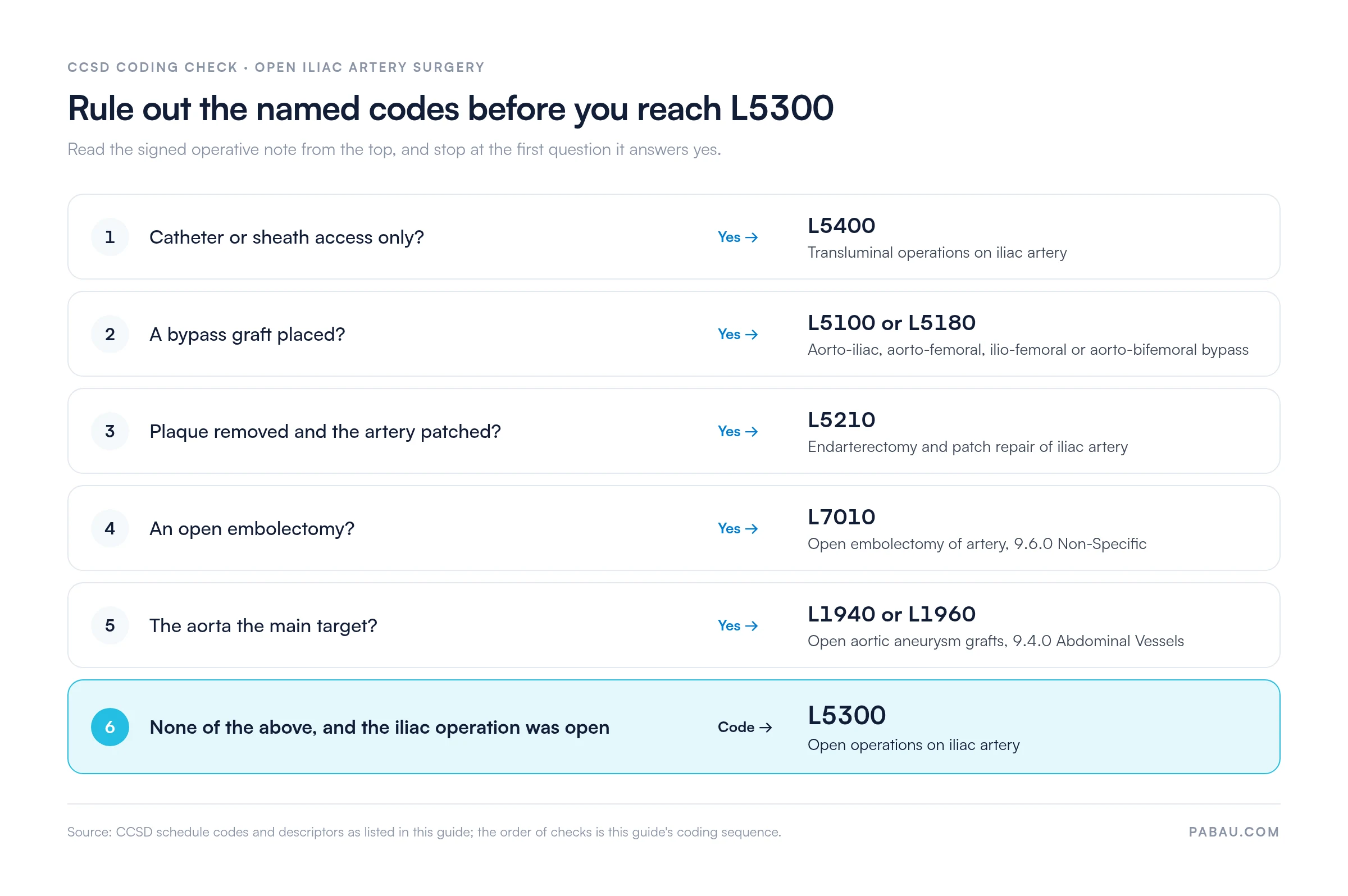
Decision ladder for CCSD code L5300: catheter or sheath access only is L5400; a bypass graft is L5100 or L5180; endarterectomy and patch repair is L5210; open embolectomy is L7010; aortic aneurysm grafts are L1940 or L1960; any other open iliac artery operation is L5300
The check stops at the first yes, so L5300 only covers an open iliac operation that no named code describes. Codes and descriptors are from the CCSD schedule.

Operations that can fall under L5300

Typical examples, each assuming no named code describes the operation better:

  • Open repair of an isolated iliac artery aneurysm, such as an interposition graft, where no bypass code fits.
  • Open repair or ligation of an injured iliac artery after trauma.
  • Open surgery after a failed iliac stent, such as removal of the stent and repair of the artery.
  • Other open iliac operations that no named CCSD code describes, backed by a clear operative note.

Why L5300 is not added to a named code

The CCSD Technical Guide (October 2025) sets a single code principle. One code should usually describe the whole procedure, including pre-operative assessment, anaesthesia and post-operative care.

The same guide treats two therapeutic codes for the same organ as an inappropriate combination. It does the same for an open and a percutaneous code on the same organ. L5300 alongside L5100, L5210 or L5400 for the same artery is therefore a combination to avoid, unless the insurer confirms otherwise.

Clinical indications for open iliac artery surgery

Surgeons choose an open iliac operation when disease or injury cannot be treated safely or durably from inside the vessel. Failed endovascular treatment is the other common route to open surgery. The indication also steers the code, because several indications usually lead to a named procedure.

  • Aortoiliac occlusive disease (Leriche syndrome): Stenosis or occlusion of the aortic bifurcation and iliac arteries, causing claudication, rest pain or critical limb ischaemia. Open treatment is usually a bypass, coded L5100 or L5180, or endarterectomy and patch repair, coded L5210.
  • Isolated iliac artery aneurysm: An aneurysm that needs repair where the anatomy rules out endovascular exclusion. An open repair with no bypass code is where L5300 applies most directly.
  • Iliac artery trauma: Penetrating or blunt injury that needs open haemorrhage control, ligation or repair.
  • Failed endovascular treatment: Stent occlusion, restenosis or stent fracture that needs open surgery. Record the earlier procedure and the reason for conversion in the operative note.
  • Acute embolic or thrombotic occlusion: An open embolectomy is coded L7010, not L5300. Check what the operative note says was done before you choose the code.

Open vs endovascular iliac procedures: L5300 or L5400

The approach decides between the two codes. An open incision on the iliac artery points to L5300 or a named open code. Catheter-based iliac work is L5400, transluminal operations on iliac artery.

FactorOpen approach (L5300 or a named open code)Endovascular approach (L5400)
Surgical accessOpen incision, such as midline laparotomy, retroperitoneal or groin approachPercutaneous puncture, or a small cut-down for sheath insertion
Technique examplesAneurysm repair, ligation and repair after injury under L5300; bypass and endarterectomy under their own codesBalloon angioplasty, stenting and stent-graft placement
AnaesthesiaGeneral or regional anaesthesia is usualLocal anaesthesia with sedation is common, with general anaesthesia for complex cases
Operative note wording“Arteriotomy”, “vessel clamped”, “retroperitoneal exposure”“Sheath inserted”, “wire advanced”, “balloon inflated”, “stent deployed”
Femoral equivalentOpen femoral codes, such as L6000 endarterectomy of femoral arteryL6300, transluminal procedures on femoral artery

When an endovascular procedure converts to open surgery, code from the final signed operative note and record why the approach changed. The Technical Guide treats an open and a percutaneous code for the same organ as an inappropriate combination. Ask the insurer before you bill L5400 alongside the open code.

Pro Tip

Code from the final signed operative note, never from the theatre booking. A planned open repair can end as an endovascular one, and the reverse happens too. Check the access description first, then the named codes, and only then L5300.

Adjacent CCSD codes: Check these before L5300

Each code below is listed in the CCSD schedule, and each covers an operation that belongs on its own code. Seven of them sit in the same section as L5300, 9.5.0 Ileo-femoral Vessels.

CCSD codeCCSD descriptorSectionUse it instead of L5300 when
L5100Aorto-iliac, aorto-femoral, ilio-femoral bypass9.5.0 Ileo-femoral VesselsA bypass graft runs from the aorta or iliac artery to the iliac or femoral artery
L5180Aorto-bifemoral bypass9.5.0 Ileo-femoral VesselsA bifurcated graft runs from the aorta to both femoral arteries
L5210Endarterectomy and patch repair of iliac artery9.5.0 Ileo-femoral VesselsPlaque is removed from the iliac artery and the arteriotomy is closed with a patch
L5400Transluminal operations on iliac artery9.5.0 Ileo-femoral VesselsThe iliac work is angioplasty, stenting or another catheter-based operation
L5910Femoro-femoral bypass9.5.0 Ileo-femoral VesselsA crossover graft runs from one femoral artery to the other
L6000Endarterectomy of femoral artery9.5.0 Ileo-femoral VesselsThe endarterectomy is confined to the femoral artery
L6300Transluminal procedures on femoral artery9.5.0 Ileo-femoral VesselsThe catheter-based work is on the femoral artery
L7010Open embolectomy of artery9.6.0 Non-SpecificThe open operation removes an embolus, including from the iliac artery
L1960Open infrarenal abdominal aortic aneurysm bifurcation graft9.4.0 Abdominal VesselsThe iliac work is part of an open aortic aneurysm repair with a bifurcated graft

Where the operation stays in the groin, below the inguinal ligament, the femoral codes apply instead. An endarterectomy confined to the femoral artery is L6000, and a crossover graft between the femoral arteries is L5910. Reopening an earlier femoral bypass graft to revise it falls under code L6530.

Renal artery operations sit in a separate section, 9.3.0 Renal, so they never fall under L5300. Endarterectomy of the renal artery, for example, is billed as L4140. Diagnostic angiography on its own is not an open iliac operation either.

ICD-10 diagnosis codes to pair with L5300

UK insurers expect a diagnosis from the WHO ICD-10 classification, not the US ICD-10-CM. The diagnosis should name the iliac artery, or the disease that affects it.

ICD-10 codeDescriptionTypical L5300 context
I70.2Atherosclerosis of arteries of extremitiesOcclusive iliac disease treated with an open operation that has no named code
I72.3Aneurysm of iliac arteryOpen repair of an isolated iliac aneurysm
I74.5Embolism and thrombosis of iliac arteryOpen iliac surgery for an acute occlusion; an open embolectomy alone is L7010
S35.5Injury of iliac blood vessel(s)Open repair or ligation after iliac trauma
I73.9Peripheral vascular disease, unspecifiedAvoid where a vessel-specific code fits, because it does not name the iliac artery

Code to the vessel and the pathology wherever you can. An unspecified diagnosis such as I73.9 does not confirm that the iliac artery was the diseased vessel, so it invites a query.

Documentation requirements for L5300 claims

Because L5300 is a general code, the operative note must confirm an open operation on the iliac artery. It must also make clear why no named code fits.

The operative note should include:

  • Approach: An explicit statement of open access, such as midline laparotomy, retroperitoneal or groin incision.
  • Vessel: The iliac segment operated on, whether the common, external or internal iliac artery.
  • Laterality: Right, left or both sides. Ask the insurer how it wants a bilateral operation billed.
  • Technique: What was done, in enough detail to rule out bypass, endarterectomy and patch repair, embolectomy and transluminal work.
  • Indication: The clinical reason for surgery, matching the ICD-10 code on the bill.
  • Graft or patch material: Prosthetic or vein, where used, because insurers handle implant charges differently.
  • Conversion: If the case began as an endovascular procedure, the reason the approach changed.
  • Completion imaging: Angiogram or duplex findings, where performed.

A digital operative note with required fields captures these details at the point of care. In Pabau, the practice software we build for private healthcare, a vascular team can build that note as a form with required fields. The patient record then holds the note, so an audit request is answered from one place.
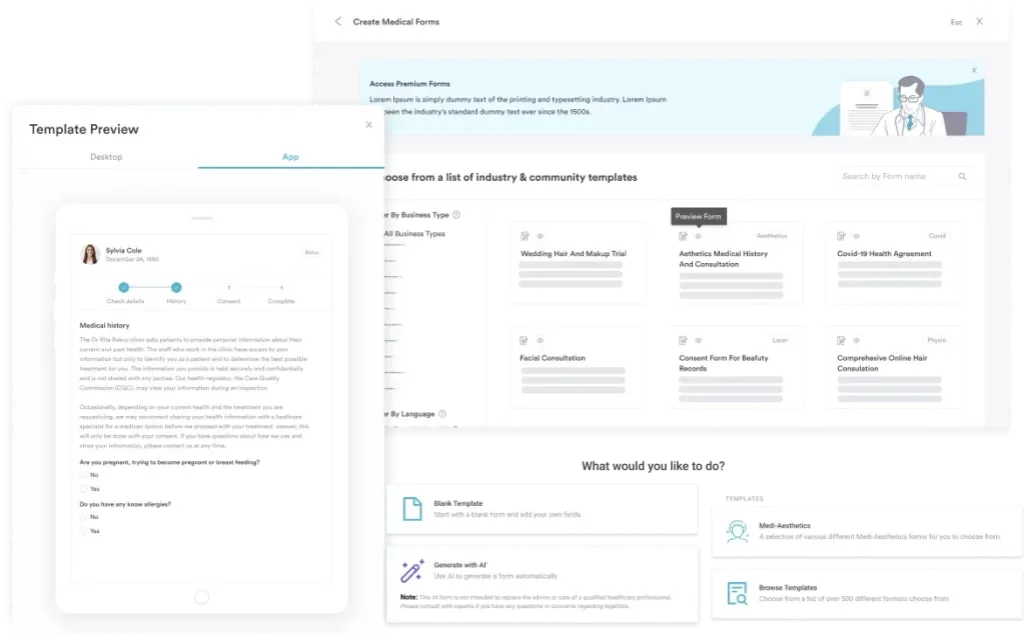
Pabau digital forms template library and form preview
Pabau’s digital forms let a vascular team build an operative note with required fields for approach, vessel and side. Each L5300 note then answers the insurer’s first questions.

Pre-authorisation: What private insurers require before L5300

Most UK private medical insurers expect pre-authorisation before planned open iliac artery surgery. Requirements differ by insurer and policy, so confirm them before you schedule the operation. Treatment carried out without a required authorisation may be paid at a reduced rate, or not at all.

Standard pre-authorisation evidence for L5300 typically includes:

  • A written referral from the patient’s GP or referring physician.
  • Imaging evidence of iliac artery disease, such as a CT angiography, MR angiography or duplex ultrasound report.
  • A record that conservative treatment or endovascular options were considered or tried.
  • The planned CCSD procedure code and the supporting ICD-10 diagnosis code.
  • A supporting letter or clinical summary from the surgeon, where the insurer asks for one.

Insurer notes:

  • Bupa: Bupa generally asks members to pre-authorise planned in-patient treatment. The Bupa code search portal shows how Bupa lists L5300 before you submit.
  • AXA Health: Pre-authorisation is usually needed for planned surgical admissions. Put the authorisation number on the invoice you send through Healthcode.
  • Aviva: Check the Aviva fee schedule for the current L5300 entry and any pre-authorisation note.
  • Vitality, WPA, Cigna UK and Healix: Requirements and fees vary by policy. Contact the insurer’s provider line or portal before you proceed.

Reviewing the Bupa private fee schedule alongside your coding workflow keeps insurer rules current as schedules change.

Billing L5300 with anaesthesia and assistant surgeon fees

Under the CCSD single code principle, L5300 describes the whole operation, including the anaesthetic. The anaesthetist and any separately employed assistant still bill the insurer for their own fees. Each bill should reference the same procedure, date and authorisation number.

RoleHow the bill is raisedWhat to check
SurgeonBills L5300 with the patient, insurer and authorisation detailsThe operative note confirms open access, vessel, side and technique
AnaesthetistBills separately, quoting the same procedure, date and authorisation numberThe insurer’s anaesthetic fee rules, and the ASA grade where the insurer asks for it
Assistant surgeonBills separately where employed independently, quoting the primary procedure and dateSome insurers cap assistant fees, so confirm before the operation
Grafts and implantsUsually charged by the hospital, depending on the insurer agreementThe insurer’s policy on prosthetic graft charges

Every party should quote the same pre-authorisation number on their Healthcode bill. A mismatch between the surgeon’s and the anaesthetist’s bills is an avoidable reason for a rejection.

Common claim denials for L5300 and how to prevent them

L5300 claims are queried for a small set of recurring reasons. Each one is easier to fix before submission than on appeal.

Denial reasonRoot causePrevention
Named procedure coded as L5300A bypass, endarterectomy and patch repair, or embolectomy billed under the general codeCheck L5100, L5180, L5210 and L7010 before L5300
Wrong approach codedAn endovascular procedure billed as L5300Use L5400 when the note describes catheter or sheath access only
Inappropriate code combinationL5300 billed with another open or percutaneous code for the same arteryBill one code per artery unless the insurer confirms a second
Missing pre-authorisationPlanned surgery performed without a required authorisationRecord the authorisation number before the operation date
Thin operative noteThe note does not confirm open access, vessel, side or techniqueUse a structured operative note template
Diagnosis not consistent with procedureAn unspecified code such as I73.9 that does not name the iliac arteryUse the most specific iliac-level ICD-10 code
Unbundling queryGraft materials or assistant fees billed outside the insurer’s policyCheck the insurer’s fee schedule and the Healix fee schedule guidelines

How to record and submit L5300 claims

A fixed order of steps keeps L5300 claims consistent. The steps below suit UK private vascular practices billing insurers through Healthcode.

  1. Record the diagnosis at the point of care. Enter the WHO ICD-10 code, such as I72.3, before you close the case.
  2. Check the named codes first. Rule out L5100, L5180, L5210, L5400 and L7010 against the signed operative note.
  3. Enter L5300 as the procedure code. Confirm the descriptor reads open operations on iliac artery.
  4. Record the authorisation number. Enter the insurer’s pre-authorisation reference on the bill.
  5. Submit through Healthcode. Send the bill electronically and keep the submission confirmation.
  6. Reconcile the payment. Match the insurer’s remittance to the bill and invoice the patient for any agreed shortfall.

How Pabau keeps L5300 claims in order

A private vascular case produces an authorisation, an operative note and bills from several clinicians. Each of them has to quote the same details, and a missing authorisation code is enough to stop payment.

Pabau tracks the authorisation code, its dates and its sessions on the patient’s case, and shows a warning when the code is missing. Pabau’s claims management software then sends UK insurer claims through Healthcode and Bupa from the same record.

Your billing team works from the record the surgeon wrote, so the authorisation is on file before the claim goes out.
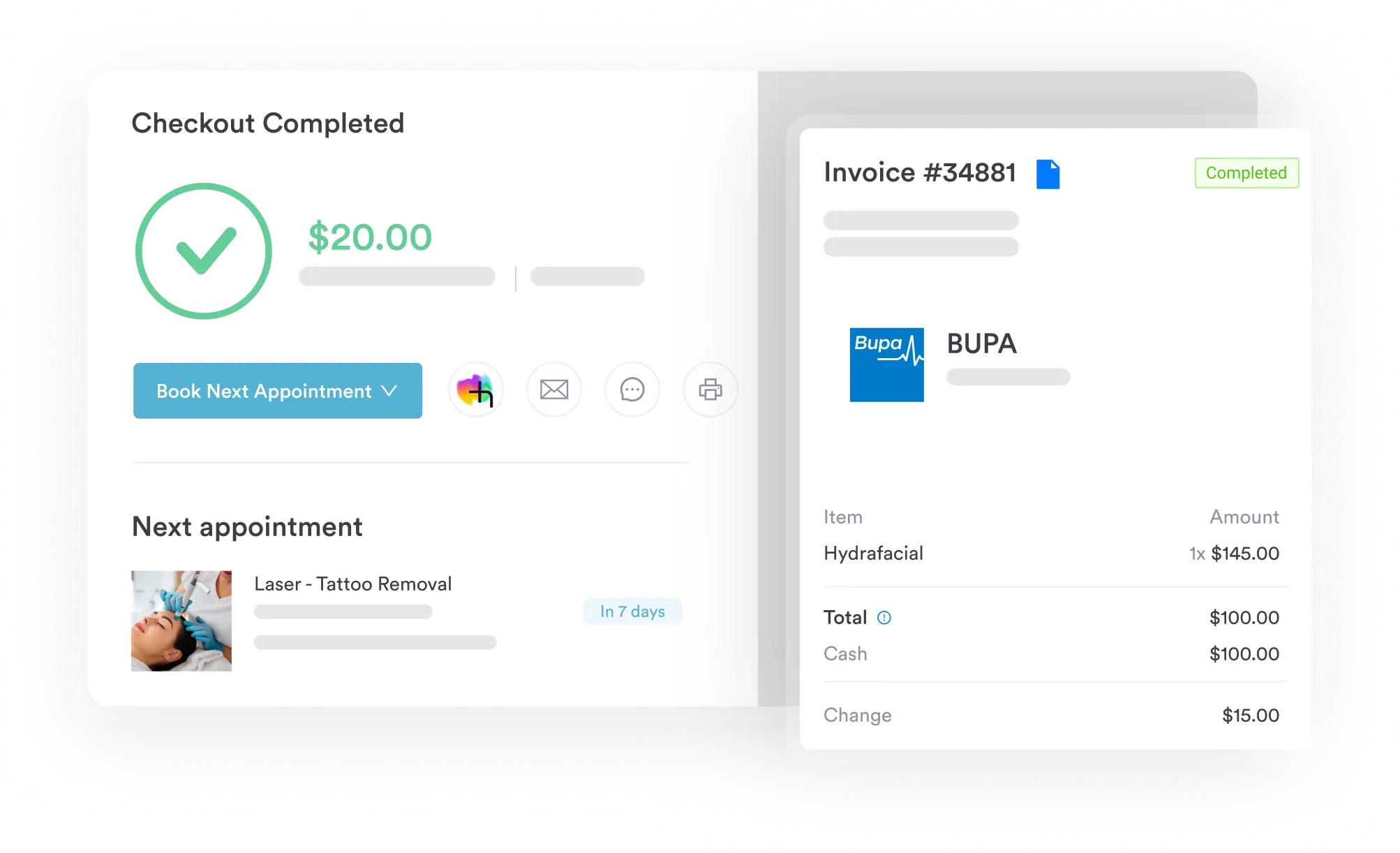
Pabau checkout screen showing a completed invoice with Bupa as the insurer
Pabau’s checkout records the insurer on the invoice alongside any patient payment. The insurer bill for an L5300 operation and the patient’s shortfall stay on one record.

Keep authorisations and claims on one record

Pabau tracks the authorisation code on each case and warns you when one is missing. It sends UK insurer claims through Healthcode and Bupa from the same record.

Pabau practice management software dashboard

Conclusion

L5300 is a narrow code with a wide name. It covers open iliac artery operations that no named CCSD code describes, and it gives way whenever a named code fits.

Bypass, endarterectomy and patch repair, embolectomy and endovascular work all have codes of their own. Check those first, then let the operative note show why L5300 was the right choice. A note that does that, with the authorisation code on file, is what keeps an open iliac claim paid.

To see how Pabau keeps the authorisation and the claim on one record, book a demo.

Continue your research

Continue your research

Need a full Bupa CCSD code reference? Bupa CCSD codes explains how the schedule works across UK private healthcare billing.

Billing a crossover graft instead? CCSD code L5910 covers femoro-femoral bypass.

Billing a bypass below the groin? CCSD code L5950 covers femoro-distal calf bypass using prosthesis.

Looking up another UK private insurance code? The CCSD codes library lists every code guide we publish for UK private practice.

Sending insurer claims from your practice? Claims management software shows how Pabau sends UK claims through Healthcode and Bupa.

Frequently asked questions

What does CCSD code L5300 cover?

CCSD code L5300 covers open operations on the iliac artery that no more specific CCSD code describes. Examples include open repair of an isolated iliac aneurysm and repair or ligation after injury. Bypass, endarterectomy and patch repair, embolectomy and endovascular work have their own codes.

Is aortoiliac bypass coded as L5300?

No. Aorto-iliac, aorto-femoral and ilio-femoral bypass is L5100, and aorto-bifemoral bypass is L5180. Endarterectomy and patch repair of iliac artery is L5210. L5300 is for open iliac operations that none of those codes describes.

What is the CCSD code for endovascular iliac procedures?

Endovascular iliac work is coded L5400, transluminal operations on iliac artery. It covers catheter-based work such as angioplasty and stenting. Catheter-based femoral work is L6300, transluminal procedures on femoral artery.

Which CCSD codes are adjacent to L5300?

The closest codes sit in the same section, 9.5.0 Ileo-femoral Vessels. They include L5100, L5180, L5210, L5400, L5910, L6000 and L6300. Open embolectomy is L7010 in section 9.6.0, and open aortic aneurysm grafts sit in 9.4.0.

Does L5300 require pre-authorisation from private insurers?

Most UK private medical insurers expect pre-authorisation for planned open iliac artery surgery, though rules vary by insurer and policy. Confirm with the insurer before you schedule the operation. Treatment carried out without a required authorisation may be paid at a reduced rate, or not at all.

Which ICD-10 codes pair with L5300?

UK insurers use WHO ICD-10. Common pairings are I70.2, atherosclerosis of arteries of extremities, and I72.3, aneurysm of iliac artery. I74.5, embolism and thrombosis of iliac artery, and S35.5, injury of iliac blood vessel(s), also fit. Avoid I73.9 where a vessel-specific code fits.

Why are L5300 claims commonly denied?

Common reasons include a named procedure billed under L5300, an endovascular case coded as open, and a missing authorisation. A thin operative note and an unspecified diagnosis such as I73.9 cause further queries. Each one is easier to fix before submission than on appeal.

How should L5300 be billed alongside anaesthesia and assistant surgeon fees?

The surgeon bills L5300 on their own Healthcode claim. The anaesthetist and any separately employed assistant surgeon bill their own fees, quoting the same procedure, date and pre-authorisation number. Check the insurer’s policy on assistant surgeon fee caps before the operation.
Avatar photo
Maja Popovska
Content Writer

Maja is a Senior Content Writer at Pabau, where she covers everything from practice management and compliance to medical aesthetics and patient experience. Off the clock: binging true crime docuseries, baking and dreaming about travel.
×