CCSD code H3322: Laparoscopic abdominoperineal resection
CCSD code H3322: Definition and procedure scope CCSD code H3322 is the private h...

Last Updated: Oct 27, 2026
L6000 is the CCSD code for endarterectomy of femoral artery. It covers open surgery in which the surgeon opens the femoral artery and removes atherosclerotic plaque under direct vision. The usual site is the common femoral artery and the profunda femoris origin.
The code sits in sub-chapter 9.5.0, Ileo-femoral Vessels, of the CCSD schedule that UK private insurers use. Catheter-based femoral work is coded separately, and CCSD lists femoral bypass codes as unacceptable combinations with L6000.
Let Pabau's smart automation suggest the right codes, reduce claim denials, and keep your practice compliant—effortlessly.
Automate repetitive tasks and focus on what matters most—your patients.
Reduce coding errors and ensure compliance with the latest regulations.
Clean claims, fewer denials, and faster reimbursements.
Powerful insights and reporting to help your practice thrive.
HIPAA compliant SOC 2 certified GDPR-compliant Trusted by 4,000+ clinics worldwide

CCSD Code L6000 covers open surgical endarterectomy of the femoral artery, not endovascular treatment.
CCSD lists bypass codes L5910, L5923 and L5950, and graft revision L6530, as unacceptable combinations with L6000.
UK private medical insurers usually require pre-authorisation for elective femoral endarterectomy, tied to the procedure code and date.
Op reports missing the patch type, arteriotomy site or final scan are a common reason payers query L6000 claims.
Pabau’s claims management software submits L6000 claims through Healthcode and tracks authorisation and claim status.
CCSD Code L6000 is defined by the Clinical Coding & Schedule Development Group (CCSD) with the official descriptor: endarterectomy of femoral artery. CCSD maintains the procedure schedule that UK private insurers and hospitals use for claims. The code applies to open surgical endarterectomy, where the surgeon exposes the artery, opens it and removes the atherosclerotic plaque under direct vision. Endovascular procedures such as angioplasty, stenting and atherectomy have their own codes.
In anatomical terms, L6000 most commonly covers the common femoral artery (CFA), including the orifice of the profunda femoris (deep femoral artery). The superficial femoral artery (SFA) is its own vessel. When the surgeon extends the endarterectomy significantly into the SFA, coders should review the payer’s guidance before defaulting to L6000 alone.
The CCSD technical guide sets out the business rules for how codes in the schedule are structured, combined and reported. Review the current version before filing L6000 claims. For other procedures, our reference list of CCSD codes covers each code in the same format.
Peripheral arterial disease (PAD) with haemodynamically significant stenosis or occlusion of the common femoral artery is the primary indication for L6000. Payers assess medical necessity against their own clinical criteria, which can include ankle-brachial index (ABI) measurements, duplex ultrasound or CTA findings, and Rutherford stage. An ICD-10 code that understates the severity in the operative report (op note) puts the claim at risk.
CCSD claims pair with WHO ICD-10, in the UK version, which records leg atherosclerosis at the I70.2 category level. Laterality-specific codes such as I70.211 belong to the US ICD-10-CM. The table shows them only as ICD-10-CM examples, and they do not go on a UK CCSD claim.
Payers may set clinical thresholds, such as an ABI cut-off or a duplex stenosis grade, in their own pre-authorisation criteria. Record the measured values in the pre-operative and op notes so the reviewer can check them against those criteria.
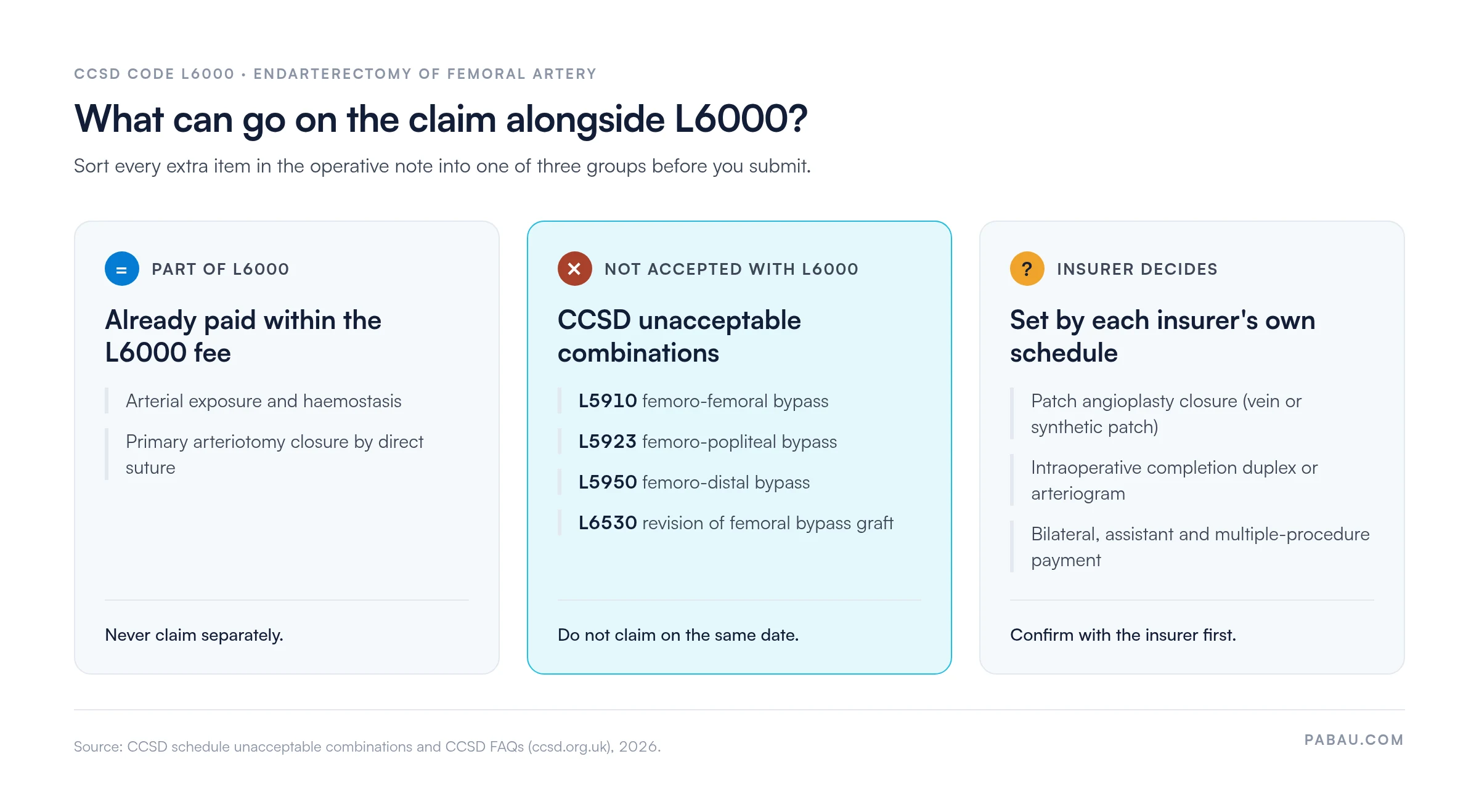
Knowing what the L6000 fee covers by default prevents both undercoding and unbundling. The table below summarises the position for common accompanying procedures. Payer rules take precedence over general guidance, so confirm with the payer before adding a second code.
The chart below sorts those items into three groups, so a coder can check each extra line in the op note before filing.
Several CCSD codes sit close to L6000 in the vascular chapter. Choosing the wrong one is a common error when the op note describes several arterial segments, or a mix of open and endovascular work. The Bupa CCSD procedure codes guide shows how Bupa applies vascular codes in practice.
Catheter-based treatment of the femoral artery is coded as L6300, not L6000. When the op note describes a femoral endarterectomy alongside a bypass, check the bypass code against the barred pairings first. Payers apply the same check to every multi-code claim on one date of service.
Before billing L6000 alongside any second code the payer accepts, confirm the op report describes two distinct surgical components. Look for distinct arteriotomy entries and distinct closure descriptions. A single paragraph covering both procedures without clear demarcation may prompt a payer audit.
CCSD does not publish modifiers or payment percentages for L6000. Each payer sets its own rules for bilateral surgery, several procedures and assistants in its fee schedule, so check that schedule before you submit.
Payers auditing L6000 claims focus almost entirely on the op report. A thin or ambiguous op note is the fastest route to a query or a medical necessity review. The checklist below covers the elements coders should confirm before filing the claim.
Elective femoral endarterectomy usually needs pre-authorisation from the patient’s UK private medical insurer, such as Bupa, AXA Health, Aviva, Vitality or WPA. Filing without an authorisation number is an easy denial to prevent. It still happens when administrative teams assume an existing authorisation covers another procedure or surgical date.
Payers’ pre-authorisation teams typically ask for ABI results, duplex ultrasound or CT angiography findings, and the Rutherford stage. Most also want a referral letter from the consultant vascular surgeon. Urgent endarterectomy for acute femoral occlusion (ICD-10 I74.3) may be authorised retrospectively. Check the payer’s urgent-case process before filing.
CCSD itself does not set fees or decide cover. As the CCSD FAQs explain, each payer sets its own fees and decides which codes it covers. The payer reviews the clinical evidence against its own protocol for peripheral vascular disease before issuing an authorisation number.
L6000 claim denials cluster around four root causes, and each one can be caught at the point of coding, before filing.
A consistent step-by-step workflow reduces coding errors and shortens the claim lifecycle from op note to payment. The following sequence applies to standard elective L6000 filings.
Run a claim scrub before filing that checks the authorisation number against the date of service and the procedure code, not just the patient name. A mismatch between the authorised code and the submitted code can lead the payer to reject the claim.
Without a central record, pre-authorisation numbers end up in emails and spreadsheets. A claim can then go out against an authorisation for another date or procedure, and the payer returns it.
Pabau, the practice management platform we build, submits payer claims through Healthcode and tracks the status of each one. Its claims management software also records the pre-authorisation status against the booked procedure. Coders can confirm the authorisation matches L6000 and the surgery date before the claim goes out.
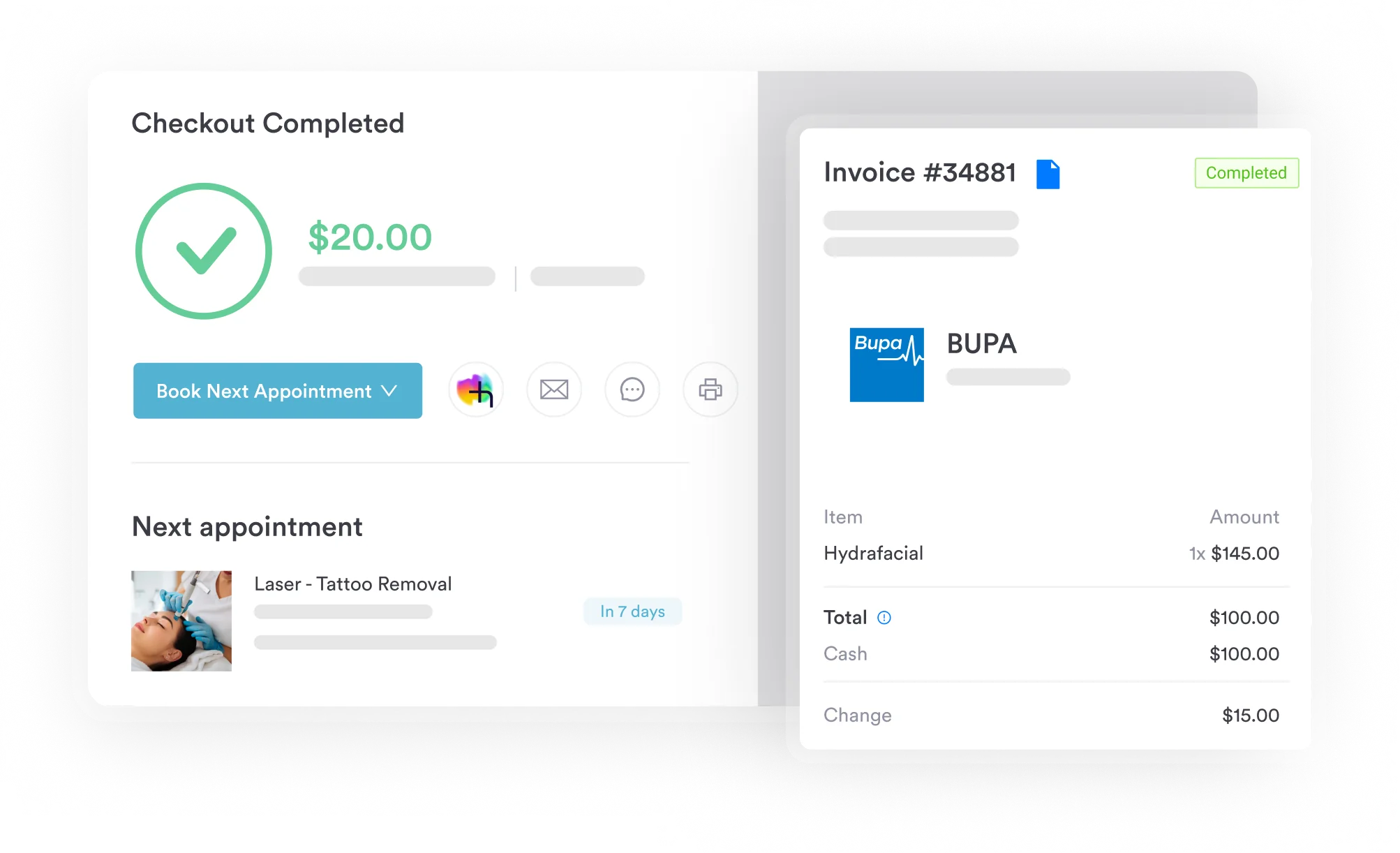
Clinical notes sit in the same patient record. A coder can check the op note for a missing patch type and send it back to the surgeon before filing.

Pabau’s claims management tools help vascular surgery practices submit L6000 claims through Healthcode and track authorisation and claim status in one place.

L6000 claims succeed or fail on the checks made before filing. Hold the op note to the documentation checklist, drop any CCSD barred pairing, and match the authorisation number to the code and the surgery date.
The trade-off is a few extra minutes at the coding stage. A surgeon addendum before filing is quicker than an appeal after the payer has returned the claim.
Pabau keeps the operative record, the authorisation status and the Healthcode claim in one system. Book a demo to see how it fits your vascular billing workflow.

Need to see how one payer applies CCSD codes? Bupa CCSD codes overview explains how Bupa applies CCSD procedure codes, including vascular surgery filings.
Coding catheter-based work on the femoral artery? CCSD code L6300 covers transluminal procedures on the femoral artery and how they differ from open surgery.
Looking up another procedure in the schedule? CCSD codes lists our guides to individual CCSD procedure codes.
Want fewer returned claims across your surgical practice? Pabau claims management submits claims through Healthcode and tracks authorisation and claim status.
CCSD Code L6000 covers open surgical endarterectomy of the femoral artery. That includes exposing the vessel, the arteriotomy, removing atherosclerotic plaque under direct vision and closing the arteriotomy. It applies to the common femoral artery and typically the orifice of the profunda femoris. Endovascular procedures such as angioplasty or stenting are coded on its own.
It depends on the payer. Some treat patch angioplasty as part of the endarterectomy and bundle it into L6000. Others allow an extra code when the op note documents the patch and its type, such as vein, Dacron or bovine pericardium. Confirm the payer’s coding rules before billing patch angioplasty as an extra code.
Four causes come up most often. The first is a prior authorisation that does not match the procedure code or date of service. The second is an ICD-10 code that understates the severity recorded before surgery. The third is billing patch angioplasty without checking the payer’s rules. The fourth is an op note missing the arteriotomy site, closure method or final scan. A pre-filing notes and coding checklist prevents each one.
No, not for the main femoral bypass codes. CCSD lists femoro-femoral bypass L5910, femoro-popliteal bypass L5923, femoro-distal bypass L5950 and graft revision L6530 as unacceptable combinations with L6000. These pairings are not accepted under CCSD. For any other pairing, confirm the payer’s rule before you submit.