CCSD Code H5080: Repair of anal trauma billing guide
What CCSD code H5080 covers CCSD code H5080 is the CCSD schedule code for repair...

Last Updated: Nov 2, 2026
L6230 is the CCSD code for reconstruction/bypass for popliteal aneurysm. It covers open surgery in which the surgeon excludes the aneurysmal segment of the popliteal artery and bypasses it with a vein or synthetic graft.
UK private medical insurers such as Bupa, AXA Health, Aviva and Vitality use it for vascular surgery claims, usually paired with ICD-10 code I72.4. Endovascular stent-graft repair of the same aneurysm takes a separate CCSD code.
Let Pabau's smart automation suggest the right codes, reduce claim denials, and keep your practice compliant—effortlessly.
Automate repetitive tasks and focus on what matters most—your patients.
Reduce coding errors and ensure compliance with the latest regulations.
Clean claims, fewer denials, and faster reimbursements.
Powerful insights and reporting to help your practice thrive.
HIPAA compliant SOC 2 certified GDPR-compliant Trusted by 4,000+ clinics worldwide

CCSD Code L6230 covers open reconstruction or bypass for a popliteal aneurysm. Endovascular repair maps to a different code.
The preferred conduit is autologous saphenous vein; synthetic grafts are used when vein is unavailable or inadequate.
ICD-10 code I72.4 (aneurysm and dissection of artery of lower extremity) is the usual primary diagnosis code paired with L6230.
Missing pre-authorisation from the patient’s insurer is a common reason L6230 claims are rejected.
Pabau’s claims management helps UK practices submit CCSD claims and track claim status in one workflow.
CCSD Code L6230 has the official descriptor “Reconstruction/bypass for popliteal aneurysm.” It sits within the Vascular system chapter (Chapter 9), Ileo-femoral Vessels sub-chapter, of the CCSD schedule. L6230 is a surgical procedure code, not a diagnostic or anaesthetic code. It captures the surgeon’s operative work in excluding the aneurysmal popliteal artery segment and restoring distal perfusion.
The Clinical Coding and Schedule Development (CCSD) Group maintains the schedule for UK private healthcare. Insurers such as Bupa, AXA Health, Aviva and Vitality use it, as do hospital billing teams. Our index of private practice CCSD codes lists the other procedures in each chapter.
The code applies only to open surgical repair. Endovascular approaches to popliteal aneurysm repair (stent-graft exclusion without direct arterial exposure) are classified under separate CCSD codes and should never be billed as L6230. An operative report describing percutaneous stent-graft deployment will not support an L6230 claim. The mismatch is a recognised audit trigger.
The popliteal artery is the most common site for peripheral arterial aneurysm, accounting for roughly 70% of all peripheral aneurysms in published vascular surgery series.
Surgery is indicated when the aneurysm reaches 2 cm or more in diameter, or when mural thrombus poses an embolic risk. It is also indicated when thromboembolism from the aneurysm sac causes acute or chronic limb ischaemia.
Untreated popliteal aneurysms carry a significant risk of limb-threatening complications. Acute thrombosis or distal embolisation can produce critical limb ischaemia requiring emergency bypass. Elective repair before that point dramatically improves limb salvage rates. The clinical rationale documented in the operative notes must reflect one of these indications clearly. Insurers expect clinical justification alongside the code.
The procedure billed as CCSD Code L6230 involves four main operative stages: Exposure, aneurysm exclusion, conduit preparation, and bypass grafting with anastomosis. Understanding each stage helps billing staff match operative report language to the code and identify any concurrent procedures that require separate coding.
The surgeon accesses the popliteal fossa through a medial thigh or posterior popliteal incision, depending on the aneurysm’s anatomical extent. Proximal and distal control of the popliteal artery is achieved with vascular clamps.
The aneurysm sac is then excluded from circulation by ligation or oversewing at the proximal and distal necks. It is not excised in full, which reduces operative risk to the popliteal vein and tibial nerve.
Autologous great saphenous vein is the preferred conduit for popliteal bypass because of superior long-term patency rates over synthetic alternatives. The vein may be used reversed, non-reversed, or in situ depending on size matching and length availability.
When adequate saphenous vein is unavailable, a synthetic prosthetic conduit (PTFE or Dacron) is used. The operative report must record the conduit type and source, as some insurers ask for these details when they review the claim.
The bypass graft is tunnelled anatomically through the popliteal fossa. It is anastomosed end-to-side or end-to-end to the native popliteal artery above and below the excluded segment. Intraoperative duplex assessment or angiography confirms graft patency and adequate distal runoff before wound closure.
Correct bundling is one of the most common sources of L6230 claim disputes. The table below sets out what the code typically includes and what needs a separate CCSD code at the same session.
Verify bundling rules against the current-year CCSD schedule. The CCSD technical guide is updated regularly, and harvest or imaging rules may change between editions.
The schedule also bars two pairings outright. Open embolectomy (L7010) and artery biopsy as a sole procedure, billed as L6710, cannot be billed with L6230.
This distinction is the most clinically significant coding decision for popliteal aneurysm surgery. L6230 applies exclusively to open surgical reconstruction or bypass. Some popliteal aneurysms are treated by stent-graft deployment without direct popliteal exposure or bypass grafting. A different CCSD code in the endovascular arterial series applies to those cases.
Submitting L6230 for an endovascular case is a misclassification that insurer claims reviewers identify quickly. The operative report will describe catheter access and fluoroscopy rather than a popliteal incision and bypass conduit, making the code-to-documentation mismatch obvious on review.
Several adjacent codes in the CCSD Vascular system chapter describe procedures that overlap anatomically or technically with L6230. The table below lists the most common sources of confusion and the decision rule for each.
Three checks settle most of these decisions: the indication, the aneurysm’s site and the surgical approach. The chart below runs them in order.
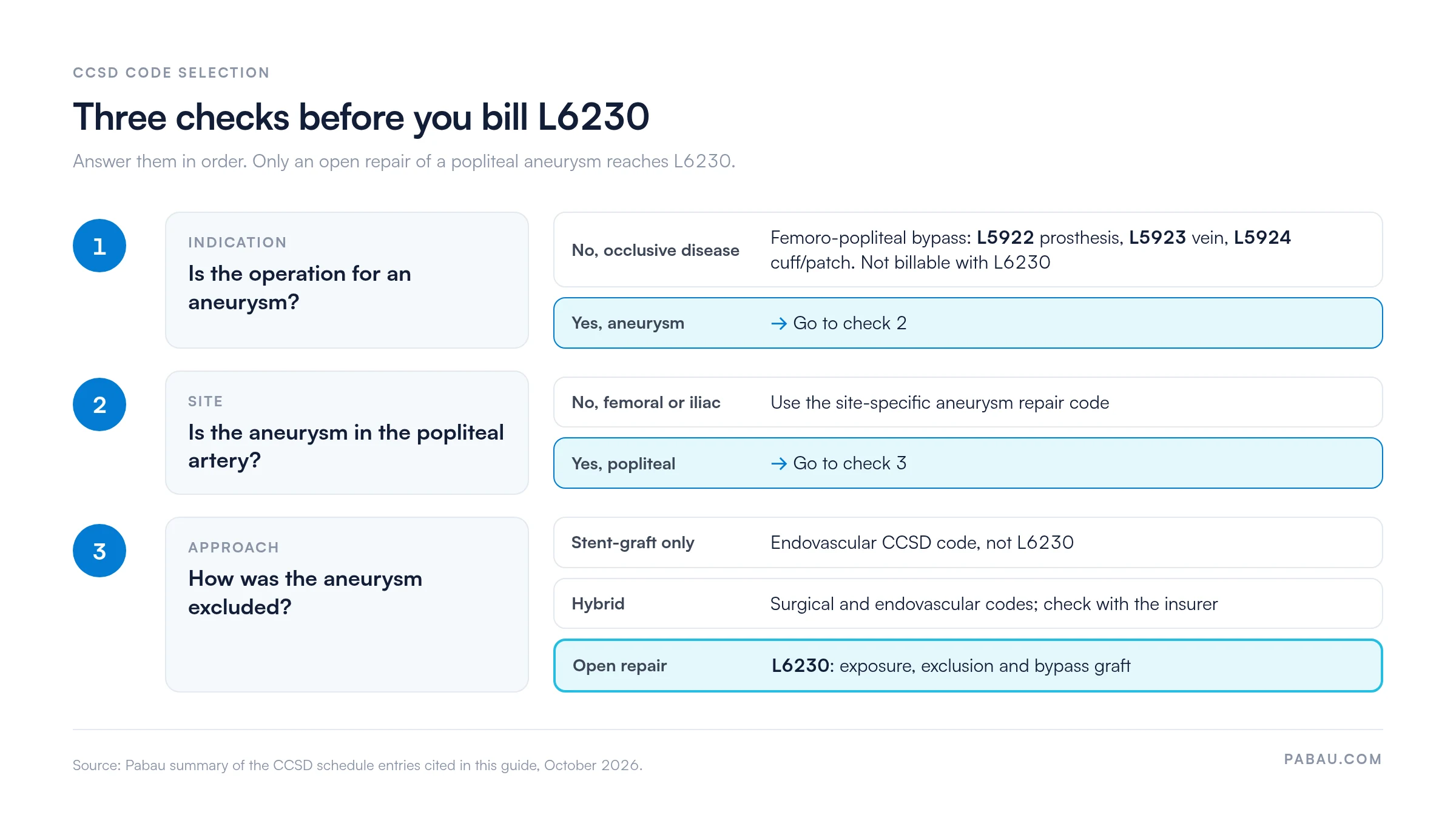
When uncertain, check the Bupa code search or the insurer’s own code lookup tool. Then cross-reference it with the operative report’s site, approach and conduit. Our Bupa CCSD code reference explains how Bupa applies the schedule across surgical specialties.
Every L6230 claim requires one or more ICD-10 diagnosis codes that justify the surgical procedure. The primary code is I72.4. Additional codes are added to capture laterality, complications, and contributing conditions.
Confirm every ICD-10 code against the edition the insurer adopts for the claim date. Laterality (left or right popliteal artery) is not coded within I72.4. Record it in the operative report and, where the insurer asks for it, in the claim narrative.
Always include the aneurysm diameter and the specific operative indication (size, thrombus burden, or ischaemia) in the claim narrative or supporting clinical summary. Insurers assessing medical necessity for popliteal aneurysm repair look for documented size thresholds and symptomatic indicators, not only the diagnosis code.
An L6230 claim without an adequate operative report is the fastest route to denial. Insurers review high-cost vascular surgery claims closely because of the procedure’s complexity and cost. The operative report must be available on request and should contain all of the following elements.
Structured operative templates help practices capture each of these elements at the time of surgery.
UK private medical insurers expect the patient or practice to request pre-authorisation before elective popliteal aneurysm surgery. Bupa, AXA Health, Aviva and Vitality each set their own requirements, so check with the insurer before the surgery date.
A pre-authorisation request for L6230 typically includes the following elements.
Operating without authorisation can leave the claim unpaid, even when the case was clinically urgent. If surgery must happen quickly, contact the insurer as early as possible and document the conversation. Keep the authorisation reference with the claim file.
Denial patterns for CCSD Code L6230 are predictable and largely preventable. The five causes below are behind many unpaid or underpaid vascular bypass claims.
The CCSD schedule has no billing modifiers. Bilateral work is billed with a bilateral code if the schedule lists one. Each insurer sets its own rules for multiple procedures and assistant surgeons, so check with the insurer before you submit.
A structured submission workflow reduces the chance of administrative denial and speeds up payment. The steps below reflect standard practice for claims to UK private medical insurers.
On a vascular case, the operative report, the authorisation reference and the claim often sit in three different places. Each handover is a chance for the conduit type or the authorisation number to drop out of the claim.
Pabau, the practice management software we build, keeps the operative note, the diagnosis and the authorisation reference on one patient record. Its private practice claims software pulls the details already on that record into a claim sent through Healthcode to UK insurers.
You then track each L6230 claim from submission to settlement on the same record. When an insurer queries a missing detail, the operative report is one click away rather than in another system.

Pabau claims management helps UK practices submit CCSD claims to private medical insurers and track claim status, so payments don’t stall between surgery and settlement.

CCSD Code L6230 pays for open popliteal aneurysm repair only when the record proves it was open repair. The code, the I72.4 diagnosis, the operative report and the insurer’s pre-authorisation must all describe the same operation. Where an insurer’s rules are unclear, ask the insurer before surgery rather than after a rejection.
Getting that match right at the pre-authorisation stage costs far less than defending it after a rejection. Book a demo to see how Pabau keeps operative records and CCSD claims together for vascular practices.

Working with Bupa on CCSD procedures? Bupa CCSD codes overview explains how Bupa applies the CCSD schedule across surgical specialties including vascular surgery.
Billing an endovascular femoral case? CCSD code L6300 covers transluminal procedures on the femoral artery.
Want to cut claim rejections? Claims management software shows how Pabau tracks each claim from submission to payment.
CCSD Code L6230 is the procedure code for open surgical reconstruction or bypass for a popliteal aneurysm. It covers arterial exposure, aneurysm exclusion, and bypass grafting with an autologous vein or synthetic conduit. It does not cover endovascular repair of the same aneurysm, which maps to a separate code.
The usual primary ICD-10 diagnosis code is I72.4 (aneurysm and dissection of artery of lower extremity), which covers popliteal aneurysm. Add I74.3 if acute thromboembolism from the aneurysm sac is documented as the operative indication, and include any relevant comorbidity codes for atherosclerosis or ischaemia.
No. L6230 applies to open surgical reconstruction or bypass only. Endovascular stent-graft exclusion of a popliteal aneurysm requires a separate CCSD code from the endovascular arterial series. Submitting L6230 for an endovascular procedure is a misclassification and a common audit trigger.
The operative report must record the confirmed diagnosis with aneurysm diameter, the surgical approach and the aneurysm exclusion technique. It must also record the conduit type and source, both anastomosis levels and the intraoperative patency assessment. Missing any of these elements is the most common cause of documentation-related denials.
The most common mix-ups involve femoro-popliteal bypass codes L5922 (prosthesis), L5923 (vein) and L5924 (vein cuff/patch), which CCSD lists as not billable with L6230. Tibial bypass codes, aneurysm repair codes at other arterial sites and endovascular popliteal codes are also confused with it. Open embolectomy (L7010) and artery biopsy as sole procedure (L6710) cannot be billed with L6230 either.