HCPCS Code J1110: Dihydroergotamine mesylate injection billing guide
HCPCS Code J1110: Official descriptor and drug overview HCPCS Code J1110 is the ...

Last Updated: Oct 29, 2026
H3365 is the CCSD code for laparoscopic anterior resection – low (i.e. colorectal anastomosis at or below the peritoneal reflection). It covers a keyhole resection of the rectum in which the surgeon joins the colon to the remaining rectum at or below that landmark.
A laparoscopic join above the reflection is coded H3364 instead, and an open low resection is H3334. The code sits in CCSD chapter 11.0.0, section 11.6.0 Rectum/Anus, and UK private medical insurers use it for billing.
Let Pabau's smart automation suggest the right codes, reduce claim denials, and keep your practice compliant—effortlessly.
Automate repetitive tasks and focus on what matters most—your patients.
Reduce coding errors and ensure compliance with the latest regulations.
Clean claims, fewer denials, and faster reimbursements.
Powerful insights and reporting to help your practice thrive.
HIPAA compliant SOC 2 certified GDPR-compliant Trusted by 4,000+ clinics worldwide

CCSD code H3365 covers a laparoscopic low anterior resection, where the colorectal anastomosis sits at or below the peritoneal reflection.
A laparoscopic resection with the anastomosis above the reflection is coded H3364, and an open low resection is coded H3334.
The operative note must confirm the laparoscopic approach, give the anastomosis level in centimeters, and record any total mesorectal excision (TME).
CCSD lists its own TME codes, so check the coding principles and each insurer’s rules before billing one alongside H3365.
A case converted to open is coded as completed, under the open equivalent, and usually needs a revised authorization from the insurer.
CCSD code H3365 is the procedure code for a laparoscopic anterior resection (low), where the colorectal anastomosis is formed at or below the peritoneal reflection. It sits in chapter 11 (Abdomen), section 11.6.0 Rectum/Anus, of the CCSD Schedule of Procedures. The Clinical Coding and Schedule Development Group maintains the schedule, and UK private medical insurers (PMI) use it for billing. For how Bupa applies these codes, see the Bupa CCSD procedure codes reference.
The code applies only when two conditions are met. The surgery is performed laparoscopically, and the anastomosis sits at or below the peritoneal reflection, in the extraperitoneal rectum. A laparoscopic resection with the join above that landmark is coded H3364 instead. Both codes exist because surgical complexity, risk and resource use differ between high and low resections, and insurers may reimburse them at different rates.
A laparoscopic low anterior resection removes the rectum and, in most cases, the rectosigmoid junction. The surgeon then restores bowel continuity with a colorectal anastomosis below the peritoneal reflection. Pelvic dissection in the narrow extraperitoneal space makes the operation technically demanding. Compared with higher colonic resections, it carries a higher risk of urogenital nerve injury, anastomotic leak and conversion to open surgery.
Rectal and rectosigmoid cancer is the most common indication for H3365. Staging and histology from the multidisciplinary team (MDT) assessment should sit in the patient record, ready for any insurer that asks to see them. The accepted indications are:
Total mesorectal excision removes the rectum within its mesorectal fascial envelope, and it is the oncological standard for mid and low rectal cancer. CCSD lists its own TME codes: H3383 (robotic), H3384 (open), H3385 (laparoscopic) and H3386 (transanal). Whether a TME code can be billed alongside H3365 depends on the CCSD coding principles and on each insurer’s rules. Check both before a TME code goes on the same claim.
Either way, the operative note should state explicitly that TME was carried out. Insurers and their auditors want to confirm that a low, oncologically appropriate resection took place. A note that records only “anterior resection”, with no mention of mesorectal dissection, can trigger a request for further evidence or an audit query.
The most consequential decision with H3365 is whether the anastomosis level meets the “low” criterion. The table below shows the codes most likely to cause confusion, with the distinguishing criterion for each. The CCSD code library covers the rest of the rectum and anus section.
In practice, the H3365/H3364 boundary is decided by where the surgeon divides the bowel and creates the join. The peritoneal reflection is not a fixed point. It sits higher on the posterior wall, about 12-15 cm from the anal verge. Anteriorly it is lower, at about 7-9 cm in men and 5-7 cm in women. Individual variation is significant on top of that.
This is why the operative note must give the anastomosis level in measured centimeters from the anal verge or dentate line. Descriptors such as “low rectal” or “colorectal” invite audit queries and downcoding to H3364. Once the level and the approach are on record, the code follows from the two answers in the grid below.
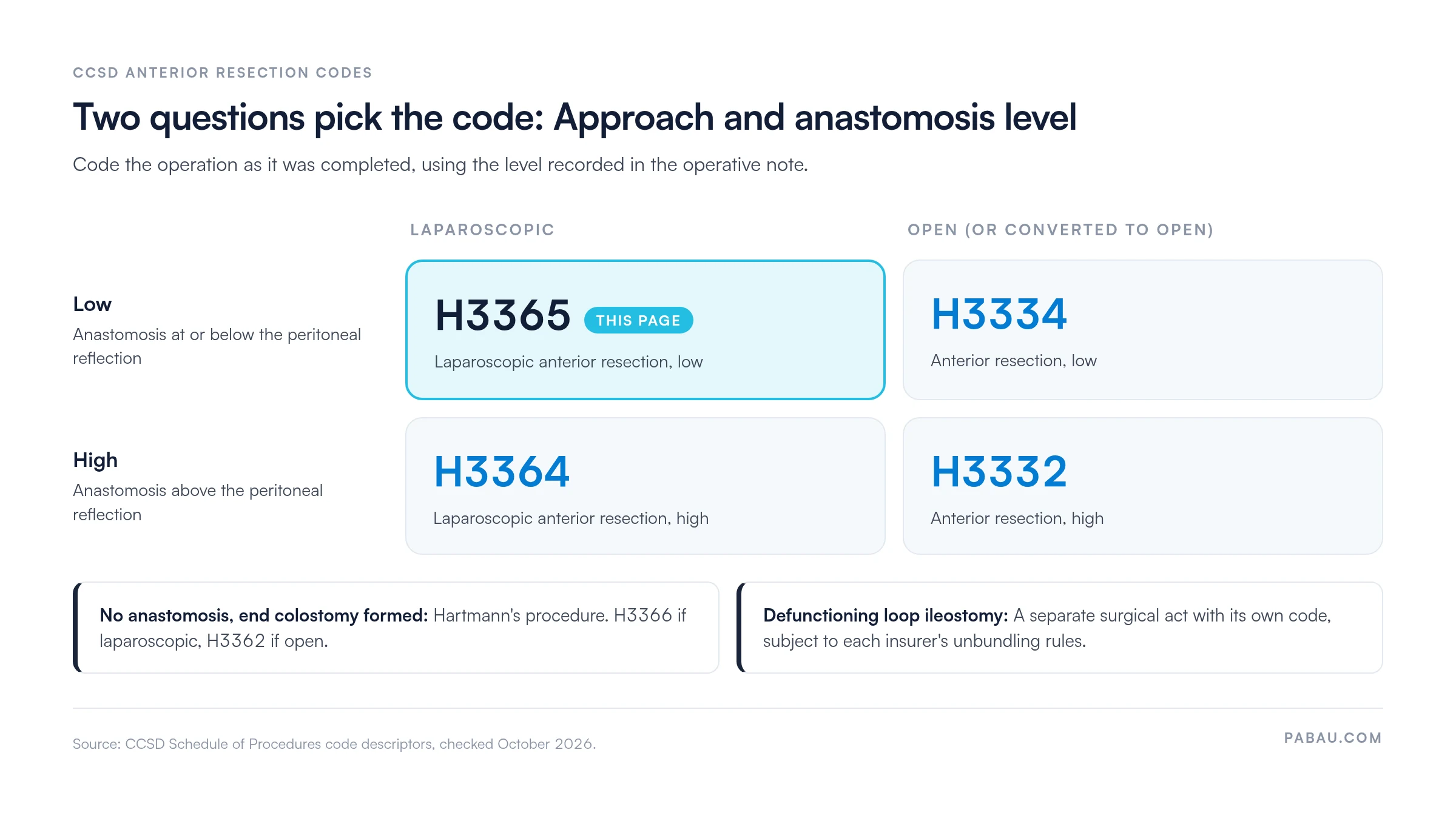
Yes, the surgical approach determines which CCSD code applies. H3365 is defined as laparoscopic, so a resection planned and performed open from the outset is coded H3334 instead. The CCSD schedule separates laparoscopic from open for most colorectal resections. Using the laparoscopic code for an open procedure is a coding error that exposes the claim to denial on audit.
Intraoperative conversion from laparoscopic to open causes the most confusion. Standard CCSD convention is to code the procedure as completed, which means the open equivalent. The original H3365 preauthorization may then not cover the claim. A revised authorization or a post-conversion notification to the insurer is typically required.
Confirm the current rule with each insurer’s provider guidance, as handling varies slightly across Bupa, AXA Health and Aviva. The operative note must state the reason for conversion and the point in the procedure at which it occurred.
Several procedures often share the operative session with a laparoscopic low anterior resection. Each may be separately billable under CCSD if it is a distinct surgical act with its own operative documentation. Folding them into H3365 without checking insurer unbundling rules leaves revenue unclaimed. Claiming them without checking for bundling restrictions invites rejection.
The defunctioning loop ileostomy is the most common concurrent procedure with H3365. Surgeons routinely form one to protect a low colorectal anastomosis. This is especially likely when the anastomosis is within 5-6 cm of the anal verge or the patient has had neoadjuvant radiotherapy. Because it involves a separate segment of bowel and a stoma, it is generally treated as a distinct surgical act and coded separately. Verify this against the insurer’s current guidance before submitting.
Check your insurer’s unbundling rules before adding concurrent codes to an H3365 claim. Bupa and AXA Health publish procedure-specific unbundling guidelines via their provider portals. A concurrent code that one insurer permits separately, another may bundle into H3365. Document the clinical rationale for each concurrent procedure in the operative note, not just the code.
The operative note is the primary document an insurer reviews when auditing an H3365 claim. Missing or ambiguous documentation is a common cause of downcoding to H3364 and of denial. A structured operative note template captures the required elements the same way in every case.
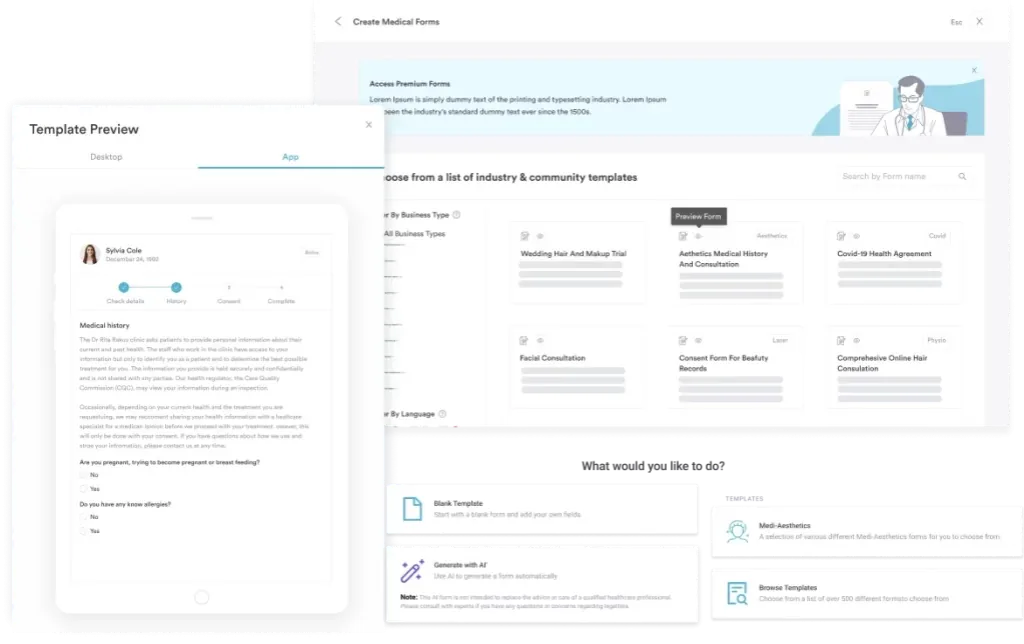
The following checklist covers the minimum documentation standard for an H3365 claim. Each element should appear as a named, explicit statement in the note, never as an inference from surgical context.
Insurers including Bupa and AXA Health may request the full operative note and histology report for elective colorectal cancer cases. The request can come at claim submission or during a retrospective audit. A complete, structured note stored in the patient record from the outset avoids delays and makes a challenge less likely to succeed.
All major UK private medical insurers require preauthorization for elective laparoscopic colorectal resections. Get it before the procedure, because retrospective requests are frequently declined or paid at a reduced rate. Authorization criteria change every year, so check the insurer’s provider portal for current requirements. Track open authorizations, expiry dates and submission deadlines for every case in one place.
Preauthorization for H3365 is specific to the laparoscopic low anterior resection. If the case converts to open, a revised authorization may be needed before the claim goes in. Notify the insurer promptly after conversion, not at the point of invoicing, to reduce the risk of a full denial on procedural grounds.
Denial patterns for H3365 are largely predictable. Most come from thin documentation, code-selection errors or administrative slips that a structured pre-submission check would catch.
A denied H3365 claim is worth appealing in most cases where the documentation supports the code. With UK private insurers, the appeal typically follows these steps.
Keep the original authorization reference, the operative note and all insurer correspondence in the patient billing file. If a denial escalates to an independent review, a complete paper trail significantly strengthens the appeal. A verbal agreement with an insurer representative carries little weight at that stage.
Most colorectal teams keep the operative note in one system, the authorization number in an email thread and the invoice in a third. When an insurer queries an H3365 claim weeks later, someone has to rebuild the case from all three. That is where low resections get downcoded to H3364.
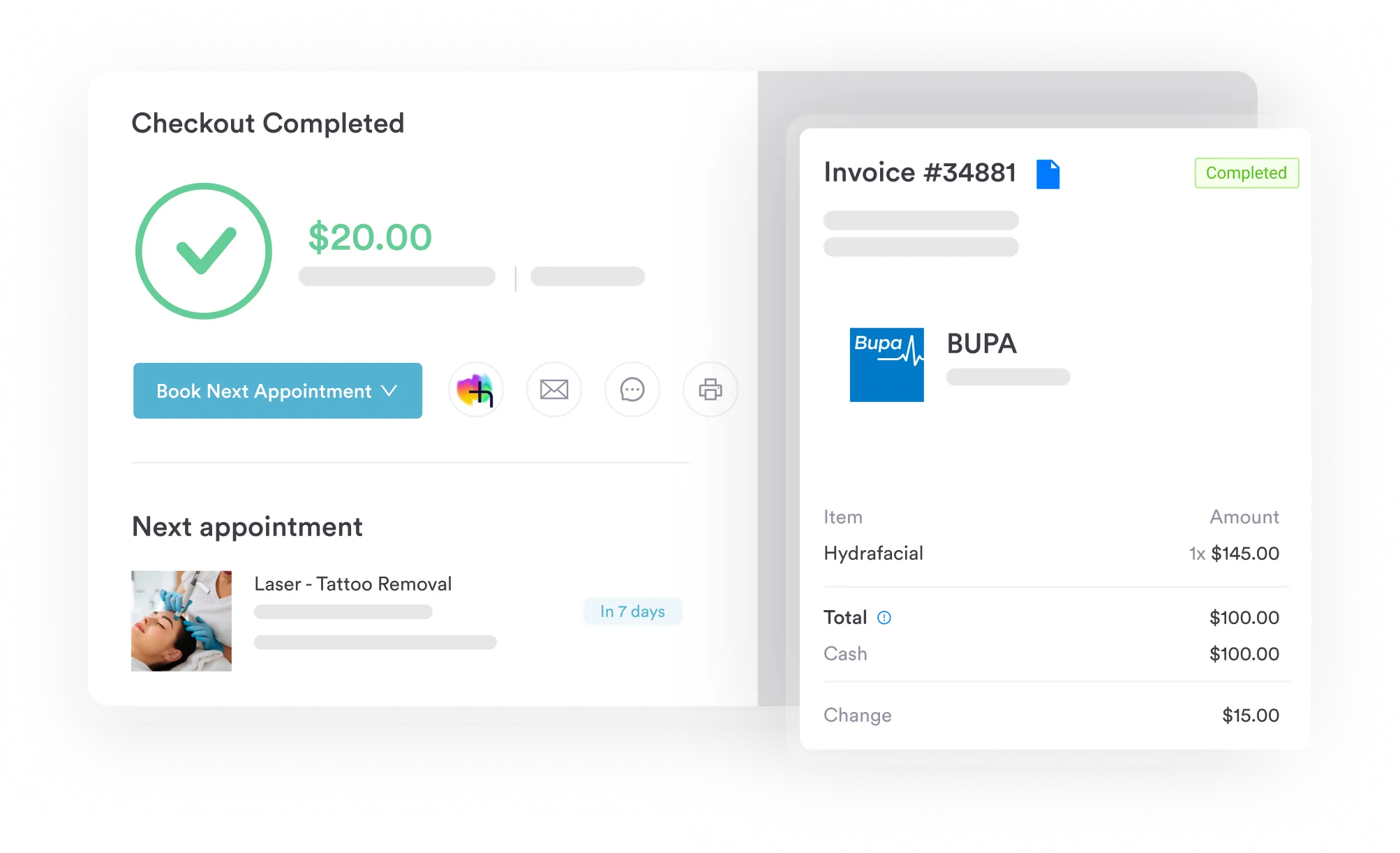
Pabau, the practice management platform we build for private practices, keeps those records on one patient file. Its accurate claims management tools let you invoice the insurer directly and submit claims electronically through Healthcode. The authorization reference, CCSD code and operative note all sit against the same episode.
For the note itself, Pabau’s form builder turns the checklist above into an operative note template. Mark the anastomosis level, the approach and any concurrent procedures as required fields, and the note cannot be completed without them. The result answers an audit query on the first read, with no need to chase the surgeon for details.
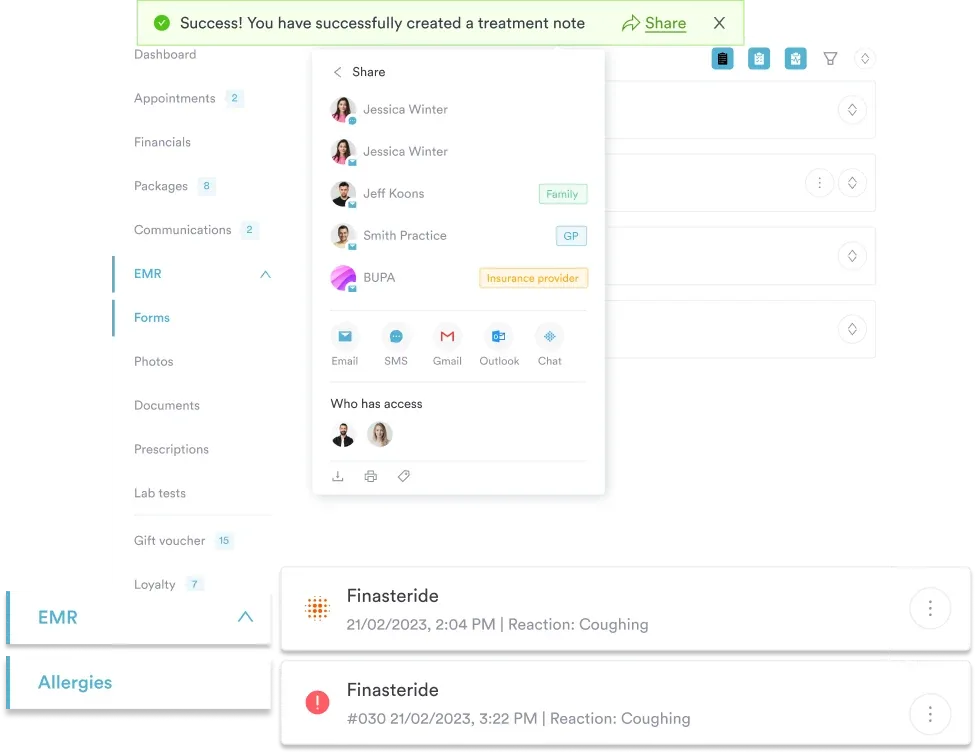

Pabau keeps the operative note, insurer authorization and CCSD invoice on one patient file. Your team can answer an audit query the day it arrives.

For H3365, the anatomy is the billing decision. A claim stands when the operative note places the anastomosis at or below the peritoneal reflection, in centimeters, and confirms the laparoscopic approach. Without those statements in writing, it gets downcoded to H3364 or denied on audit, whatever happened in the operating room.
So fix the template before you fix the claim. A required-field operative note costs the surgeon a minute per case. An appeal costs weeks of correspondence and delayed payment.
To see how Pabau keeps the note, the authorization and the invoice together for every colorectal case, book a demo.

Coding the same operation with a higher join? CCSD code H3364 covers the laparoscopic high anterior resection and the documentation that separates it from H3365.
Was the low resection done open? CCSD code H3334 explains the open low anterior resection code and when a converted case lands there.
Billing an open high resection? CCSD code H3332 walks through the open high anterior resection and its anastomosis-level criterion.
Is the tumor too low for an anastomosis? CCSD code H3322 covers the laparoscopic abdominoperineal resection, the usual alternative when the sphincter cannot be preserved.
Need the wider Bupa picture? Bupa CCSD procedure codes explains how Bupa applies CCSD codes, fees and preauthorization across chapters.
CCSD code H3365 is the procedure code for a laparoscopic anterior resection (low), where a colorectal anastomosis is created at or below the peritoneal reflection. UK private medical insurers use it for elective cases such as rectal cancer, complicated diverticular disease and benign rectal tumors that need a low anastomosis.
H3365 is a laparoscopic low anterior resection, with the anastomosis at or below the peritoneal reflection. H3364 is the laparoscopic high anterior resection, with the anastomosis above it. The anastomosis level, measured in centimeters from the anal verge and documented in the operative note, decides which code applies.
No. If a laparoscopic anastomosis sits above the peritoneal reflection, the correct code is H3364, not H3365. Using H3365 in that scenario is a coding error that may lead to denial or a clawback on audit.
Generally yes, provided the operative note documents the defunctioning loop ileostomy as a distinct surgical act with its own clinical rationale. CCSD permits concurrent coding for separately identifiable surgical acts, but each insurer’s unbundling rules apply. Confirm with the insurer’s provider guidance before billing both codes on the same claim.
Standard CCSD convention codes the procedure as it was completed. A low resection that converts to open is billed under H3334, the open low anterior resection code, rather than H3365. The original H3365 preauthorization may not cover the converted procedure, so prompt notification and a revised authorization are typically required.
All major UK private medical insurers, including Bupa, AXA Health, Aviva and Cigna Healthcare UK, require preauthorization for elective laparoscopic colorectal resections. Get it before the procedure. Retrospective requests are frequently declined or settled at a reduced rate.
It can be, depending on the rules. CCSD lists TME codes for robotic (H3383), open (H3384), laparoscopic (H3385) and transanal (H3386) approaches. Whether one is billable alongside H3365 depends on the CCSD coding principles and on each insurer. Either way, the operative note should state explicitly that TME was performed.