HCPCS Code E0272: Foam rubber mattress billing guide
HCPCS Code E0272: official descriptor and code overview HCPCS Code E0272 is the ...

Last Updated: Nov 6, 2026
Billable Code Specific Code
G7513 is the CCSD code for revision of ileostomy - laparotomy. The surgeon opens the abdomen to repair or refashion an existing ileostomy, instead of working only through the stoma site.
CCSD has no single code for redo surgery on the ileum or colon, and G7880 is not in its published schedule. A redo operation takes the code for what the surgeon did, and a local ileostomy revision is G7512 instead.
Let Pabau's smart automation suggest the right codes, reduce claim denials, and keep your practice compliant—effortlessly.
Automate repetitive tasks and focus on what matters most—your patients.
Reduce coding errors and ensure compliance with the latest regulations.
Clean claims, fewer denials, and faster reimbursements.
Powerful insights and reporting to help your practice thrive.
HIPAA compliant SOC 2 certified GDPR-compliant Trusted by 4,000+ clinics worldwide

CCSD code G7513 covers revision of an ileostomy where the surgeon opens the abdomen through a laparotomy.
G7880 is not in the published CCSD schedule, and the schedule has no single code for redo surgery on the ileum or colon.
A revision done locally through the stoma site is G7512, so the operative approach decides the code.
CCSD lists nine published codes, including G7402, G7512 and G7530, as unacceptable combinations with G7513.
The operative note should record the original stoma, the indication and the reason a laparotomy was needed.
CCSD code G7513 is the private insurance code for revision of ileostomy – laparotomy. The surgeon opens the abdomen to repair or refashion an existing ileostomy, instead of working only through the stoma site.
It is a redo operation on the ileum by definition. The patient already has an ileostomy, and the surgeon returns to it because the first result needs correcting.
The code comes from the CCSD schedule, maintained by the Clinical Coding and Schedule Development group. UK private insurers and providers use it to describe which operation took place. G7513 sits in chapter 11.4.0, jejunum and ileum, within the abdomen chapter.
CCSD’s own history note explains the code’s shape. It was split from G7500, attention to ileostomy, to describe the extent of the procedure. That split is why a local revision and a laparotomy revision now carry different codes.
Not as a code you can bill. G7880 is not in the published CCSD schedule, so a claim that quotes it uses a code insurers will not find. CCSD’s record for G7513 cross-links an entry titled G7880, but that entry is unpublished.
The number most likely comes from OPCS-4, the NHS procedure classification, where G78 groups other open operations on the ileum. OPCS-4 and CCSD use similar-looking codes, but they are separate systems. A private claim needs the CCSD code.
CCSD also has no catch-all code for redo surgery on the ileum or colon. Its technical guide discourages local, non-CCSD codes, and it aims for one code to describe each operation in full. So a redo operation is coded by what the surgeon did the second time.
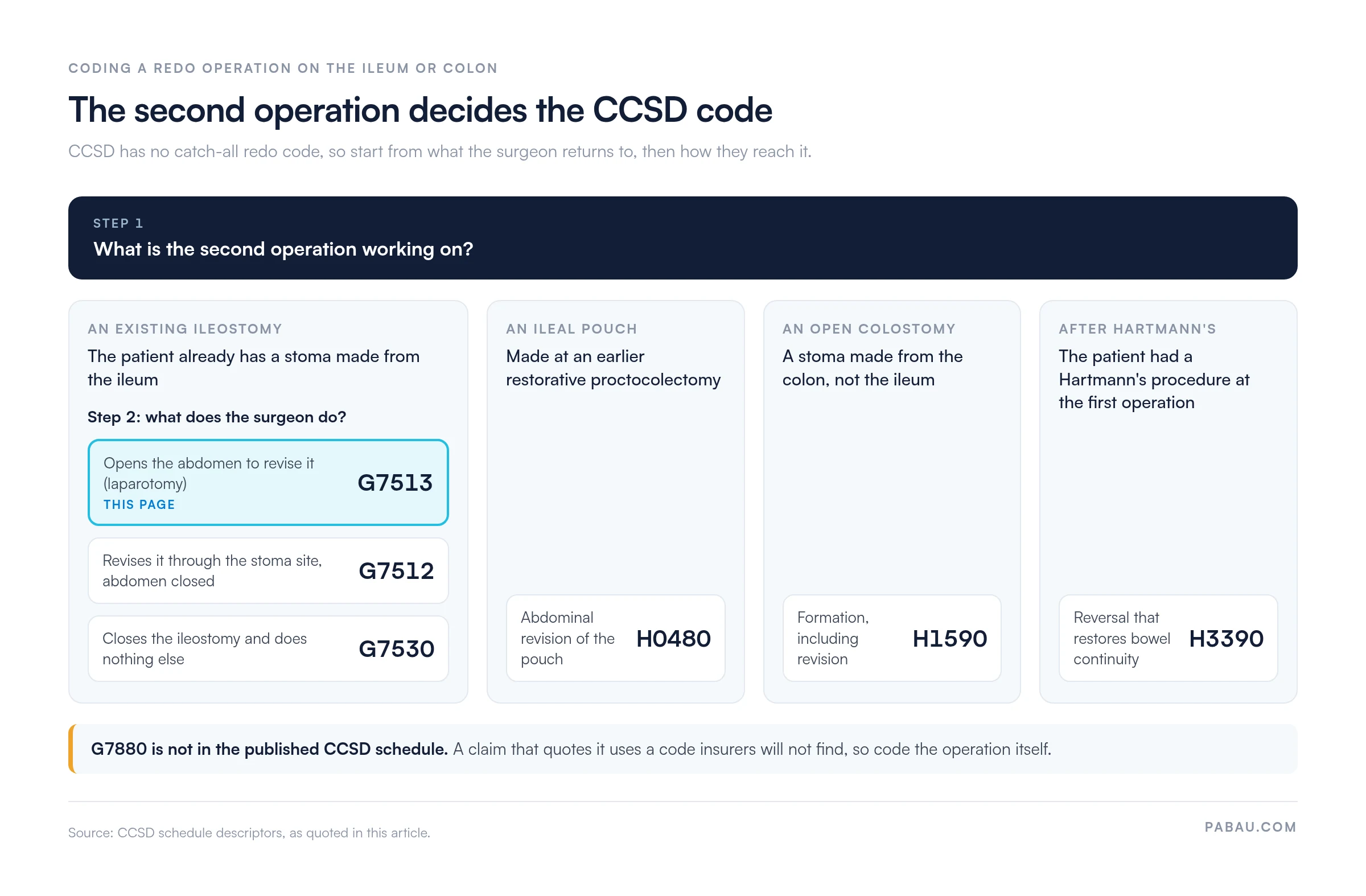
When the redo is a revision of an ileostomy through the abdomen, that code is G7513. Other redo operations have their own codes, covered in the table further down.
The deciding detail is access. G7513 fits a revision where the surgeon has to open the abdomen to reach the bowel behind the stoma, for example:
Several related operations sit outside the code and take their own CCSD code:
The right code depends on what the second operation does. Each code below is listed in the published CCSD schedule, with its official descriptor.
Here is how the choice plays out. A patient has a retracted end ileostomy a year after a colectomy. Adhesions stop a local repair, so the surgeon opens the abdomen and refashions the stoma. The claim goes in as G7513.
Change one detail and the code changes too. If the surgeon refashions the same stoma through a peristomal incision alone, the claim is G7512. It never carries both codes for one revision.
Revising an ileal pouch is a different operation again. That work is coded as CCSD code H0480, not G7513.
The diagram below sorts a redo by what the surgeon returns to, and then by how they reach it.
CCSD records unacceptable combinations, meaning pairs of codes that should not appear together for one operation. For G7513, the published schedule lists these codes:
Several of these codes, such as G6080 and H0410, already allow for a stoma in their descriptors. Adding G7513 to the same operation would describe the stoma work twice.
The CCSD technical guide calls these combinations guidelines, and each insurer applies its own contract rules. If you think two codes are justified, ask the insurer before you submit.
Insurer queries on G7513 usually turn on whether the note supports a laparotomy. Before the secretary raises the invoice, check the operative note covers each of these points:
A note that only says “stoma revised” leaves the insurer guessing between G7512 and G7513. Naming the approach removes that question before anyone asks it.
Preauthorization rules belong to each insurer and policy, so settle three questions with each one before the operation.
Does this patient need approval? Ask the insurer, or check its provider portal. Bupa, for example, offers a code search tool for recognized providers.
What should you quote? Give the code G7513, the diagnosis and the planned date. If the surgeon plans a local revision but may convert, ask how the insurer wants that handled.
What do you keep? Record the authorization number in the patient file. You will need it again on the invoice.
Rejections on this code tend to repeat, which makes them easy to prevent. These are the ones to watch:
That last point deserves a word. Insurers publish their own rates, such as the Vitality fee finder. If your fee is higher, tell the patient about the shortfall in writing before surgery.
Surgical secretaries often hold the authorization email, the operative note and the invoice in three different places. When an insurer queries a claim, someone has to find all of them again.
Pabau’s practice software for private surgeons sends private medical insurance claims through Healthcode. Its claims management software also tracks preauthorization. The authorization is stored as a case that follows the appointment through to the claim.
You still choose the code and check the note yourself. The difference is that the approval and the claim stay linked, so a query takes minutes rather than an afternoon.
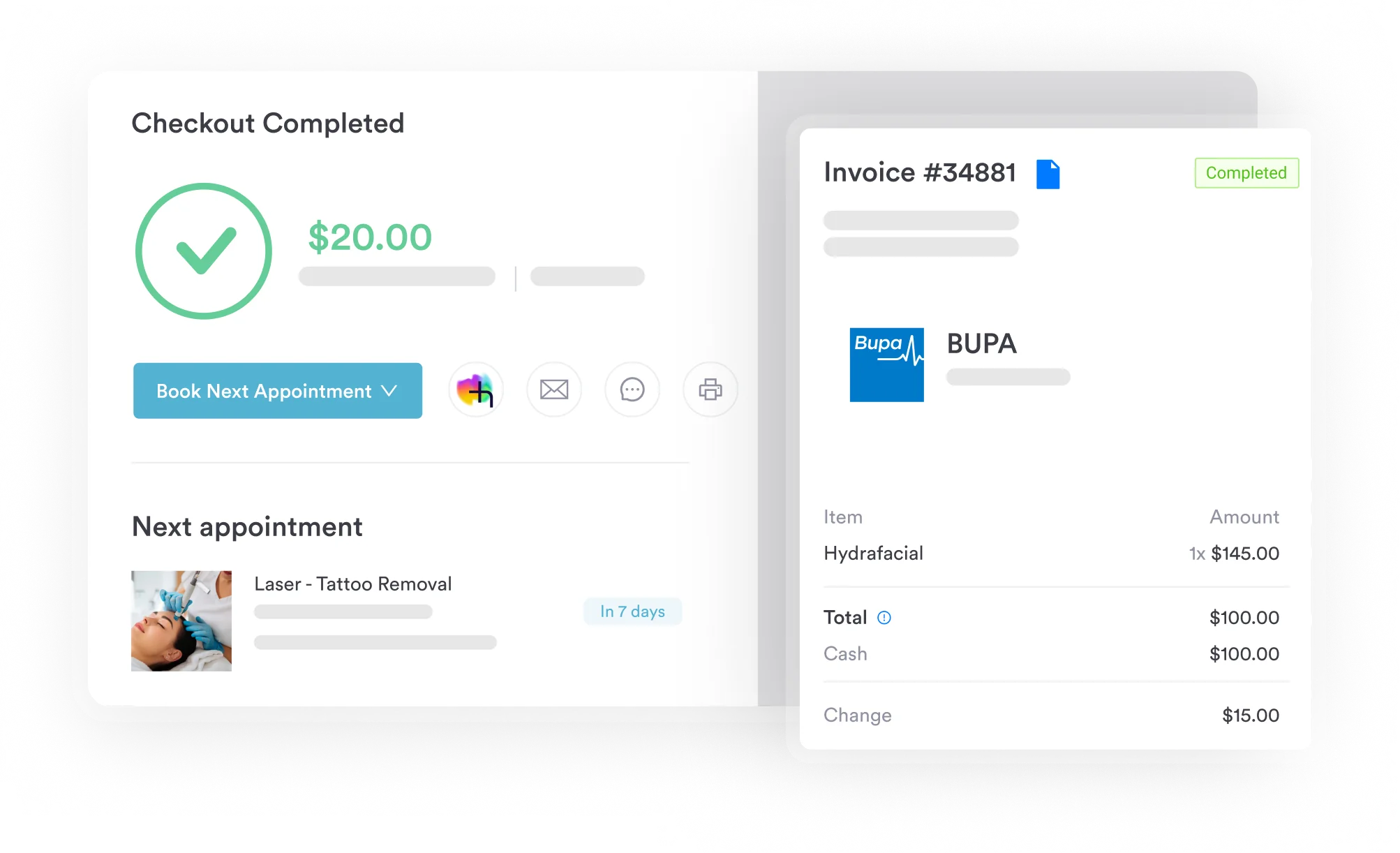

Pabau sends private medical insurance claims through Healthcode and keeps each preauthorization attached to the case, so stoma revision claims are easier to follow up.

A redo operation on the ileum is coded by what the surgeon did, not by the fact that it was a redo. For an ileostomy revised through the abdomen, that code is G7513. G7880 has no place on the claim.
Most problems sit at the edges of the code. A local revision billed as a laparotomy, or a pairing with G7402 or G7512, will stall payment. Get the approach into the note and the approval on file, and the claim has little left to dispute.
Book a demo to see how Pabau links preauthorization and Healthcode claims for private surgical practices.

Revising the stoma locally? CCSD code G7512 covers ileostomy revision through the stoma site without a laparotomy.
Revising an ileal pouch? CCSD code H0480 explains abdominal revision of restorative proctocolectomy.
Need the wider schedule? CCSD codes covers how the schedule is organized and how insurers use it.
Working with Bupa? Bupa CCSD codes walks through how Bupa applies CCSD codes to private claims.
Reversing a Hartmann’s procedure? CCSD code H3390 covers restoring bowel continuity after an earlier Hartmann’s procedure.
No. G7880 is not in the published CCSD schedule, which lists no G78 codes. For an ileostomy revised through the abdomen, use G7513.
G7512 is a local revision of an ileostomy through the stoma site. G7513 is a revision where the surgeon opens the abdomen through a laparotomy.
No. G7513 describes an ileostomy, which is made from the small bowel. CCSD includes revision within H1590, open formation of colostomy, so check that code instead.
There is no single redo code. CCSD codes the operation itself, such as H3390 for reversal of Hartmann’s procedure or H0480 for abdominal revision of restorative proctocolectomy.
No. CCSD publishes codes and coding rules, not fees. Each insurer sets its own benefit for the code, and the surgeon sets their own charge.
The claim uses G7513 rather than G7512, and never both. The operative note should record the conversion and the reason for it.