ICD-10 Code T31.77: Burns involving 70-79% of body surface
ICD-10 code T31.77: Quick reference and code details ICD-10 code T31.77 is the b...

Last Updated: Nov 5, 2026
ICD-10 Code Y95 is the supplementary external cause code for a nosocomial condition. That means a condition the patient acquired in the hospital rather than brought in at admission. Its inclusion term is “hospital-acquired condition.” Y95 is never the principal diagnosis. It follows the code for the condition itself, which usually carries a present on admission (POA) indicator of “N.”
Reporting Y95 is optional, and it matters mainly on inpatient claims. It doesn’t trigger HAC payment rules or Hospital-Acquired Condition Reduction Program (HACRP) penalties. Those run on the POA indicator, Patient Safety Indicator data and CDC infection surveillance.

Y95 is always a secondary code. It records that a condition was hospital-acquired, and the condition itself gets its own code.
Assign Y95 only when the provider documents hospital-acquired or nosocomial status, and query the provider when the record is unclear.
Y95 is optional and mainly relevant on inpatient claims. No ICD-10-CM guideline bans it from outpatient claims.
Y95 isn’t on the CMS POA exempt list, so it takes its own POA indicator, usually ‘N’ like the condition it follows.
HAC payment rules act on the POA indicator of listed conditions, and HACRP scores use PSI 90 and CDC data. Neither program reads Y95.
ICD-10 Code Y95 belongs to the Y90-Y99 block, “Supplementary factors related to causes of morbidity classified elsewhere,” in Chapter 20 of ICD-10-CM. The table below gives the quick-reference data to check before you open the clinical record.
A nosocomial condition is an illness, infection, or complication that a patient develops during a hospital stay, rather than the reason for admission. The term comes from the Greek nosokomeion (hospital). In clinical and coding contexts, it’s used interchangeably with “hospital-acquired” and “healthcare-associated.”
Y95 captures where the condition started. It doesn’t describe what the condition is. The condition gets its own ICD-10-CM code, normally reported as a secondary diagnosis because it arose after admission, unless the record supports otherwise. Y95 then follows as an additional code to show the hospital origin.
The Y90-Y99 block holds supplementary codes that add circumstances to a condition coded elsewhere. Its other members include Y90 (blood alcohol level), Y92 (place of occurrence), Y93 (activity) and Y99 (external cause status). Y92.23- can record a hospital as the place an injury happened. Y95 is the code that marks a condition itself as hospital-acquired.
Assign Y95 only when both of the following criteria are met. If either one is missing, leave the code off.
Even when both criteria are met, Y95 stays optional. No guideline limits it to inpatient claims, but that’s where it’s mainly relevant, because inpatient claims carry POA indicators.
When documentation is ambiguous, send a clinical documentation improvement (CDI) query to the attending provider rather than inferring the answer. The POA guidelines leave unclear or conflicting documentation for the provider to resolve.
Y95 pairs with the specific ICD-10-CM code for the nosocomial condition. The table below lists hospital-acquired conditions often seen in inpatient coding, with their condition codes and where Y95 goes.
Organism codes (B95-B97) are added to the condition code when documentation names the pathogen and no combination code already captures it. MRSA pneumonia is a good example. J15.212 includes the organism, so B95.62 isn’t added with it.
The present on admission indicator is a single-character field attached to each diagnosis code on inpatient claims. CMS requires POA reporting on inpatient claims paid under the Inpatient Prospective Payment System, under the Deficit Reduction Act of 2005. Y95 and the POA indicator answer related questions, but neither replaces the other.
POA “N” on the condition code tells CMS the condition wasn’t present at admission. Y95 adds that the provider documented the hospital as its source. Reporting POA “N” without Y95 is acceptable, because Y95 is optional. When you do add Y95, give it POA “N” as well.
Before you finalize a POA ‘N’, check whether the condition is on the CMS hospital-acquired condition (HAC) list. For a listed condition, POA ‘N’ stops that diagnosis from raising the MS-DRG as a CC or MCC. Y95 has no effect on that grouping, so the POA indicator is what protects payment. CMS updates the HAC list with each IPPS final rule.
Correct sequencing prevents claim edits and audit findings. Follow these steps in order for every nosocomial condition in the medical record.
Here’s how those steps look for a hospital-acquired catheter-associated UTI, from the principal diagnosis down to Y95.
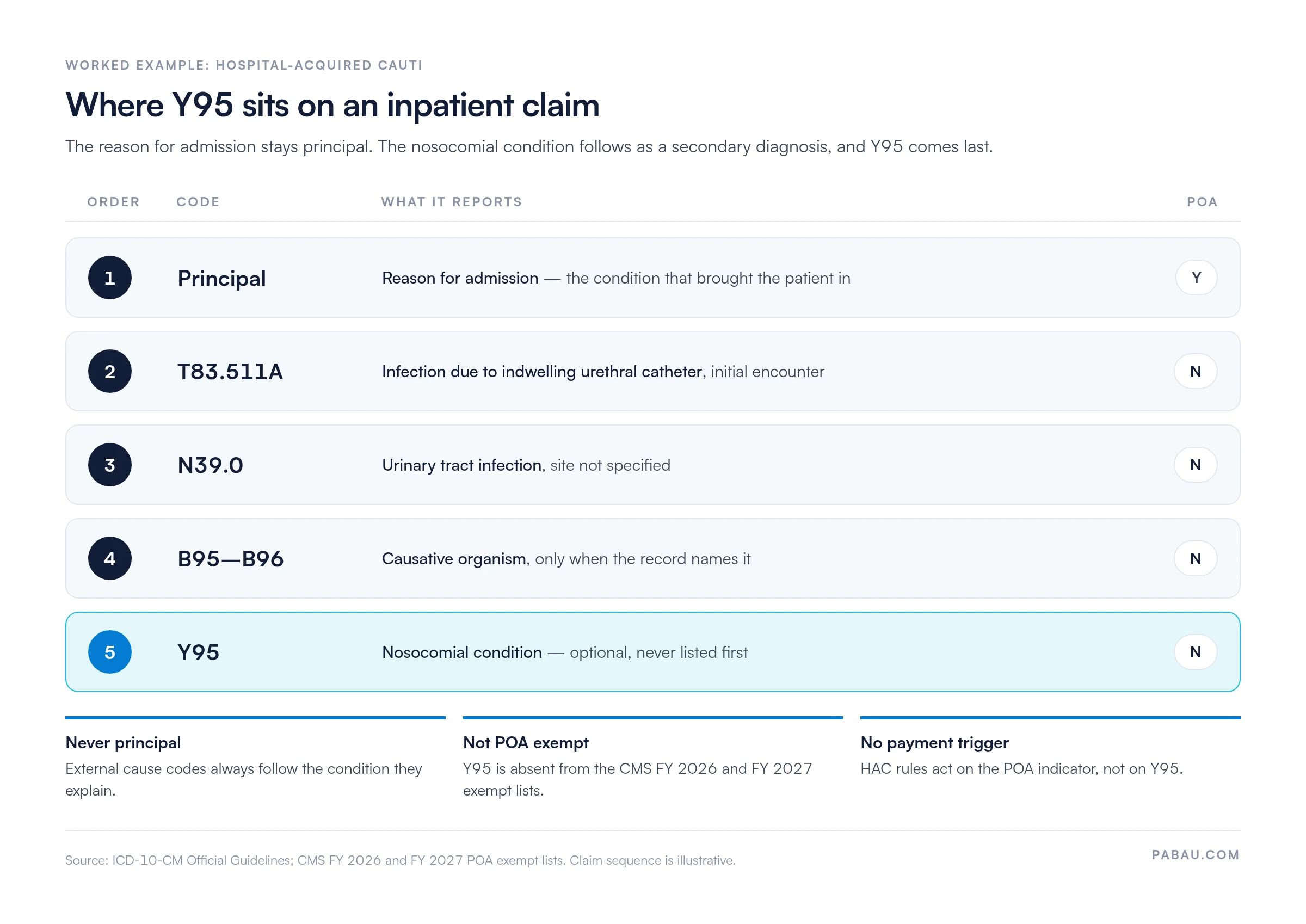
Y95 has no Excludes1 or Excludes2 notes in the ICD-10-CM tabular list. However, several codes from the same block are often confused with it.
Several codes in the Y90-Y99 block look similar in function but serve different purposes. This side-by-side comparison, including each code’s POA status, resolves the most common mix-ups.
Y95 doesn’t change payment on its own. Two separate CMS programs act on hospital-acquired conditions, and neither one reads Y95.
What protects payment is an accurate POA indicator on a specific condition code. That makes POA review a revenue cycle management task as much as a coding one. Y95 adds context for quality review and internal infection tracking.
Y95 errors cluster around a handful of recurring mistakes, and each one can be caught before the claim goes out. Teams coding a high volume of inpatient HAIs can build these checks into their denial management process.
For facilities tracking error patterns across HAI coding, reviewing denial codes systematically shows whether Y95-related problems are documentation-driven or sequencing-driven. That decides the right fix.
The medical record must support Y95 before a coder assigns it. Knowing the medical billing compliance requirements helps CDI teams build the right query templates and audit checklists. The record needs to show four things.
When records are incomplete, send a concurrent or retrospective CDI query rather than making a coding assumption. Query turnaround affects submission timelines, so facilities with high HAI volumes benefit from query workflows built into EHR documentation.
Run a pre-bill audit on every inpatient claim containing Y95. Check four things. (1) Is Y95 sequenced after the condition code? (2) Do the condition code and Y95 both carry POA ‘N’? (3) Is the provider’s nosocomial statement in the discharge summary or a completed CDI query response? (4) Is an organism code present if the pathogen is documented? These checks catch the most common Y95 errors before the claim leaves the facility.
No ICD-10-CM guideline restricts Y95 to inpatient claims. Coding Clinic (Fourth Quarter 2013) confirms only that Y95 is appropriate when the provider documents a healthcare-acquired condition. Like every Chapter 20 code, it’s optional unless a state mandate or a payer requires it.
In practice, Y95 is mainly relevant on inpatient claims. That’s where POA indicators are reported and where the CMS HAC programs operate. In outpatient medical billing, a follow-up visit is coded for the condition treated that day, so check payer policy before adding Y95.
Whatever the setting, a clean claim needs its codes to tell the same story as the record. The condition, organism and Y95 should all trace back to provider documentation.
Y95 lives mostly on hospital inpatient claims, which hospitals code in their own systems. Pabau, the practice management and billing platform we build, works on professional and outpatient claims instead. It doesn’t code inpatient hospital stays.
Where it helps is the care that comes after. When a patient visits your practice after a hospital-acquired infection, Pabau’s claims management software builds the CMS-1500 claim from the invoice you already raised. Eligibility checks run before the visit, and remittances are matched to the claim when payment comes back.
So your team stops retyping codes into a separate billing tool, and you can see which claims have paid and which need follow-up.
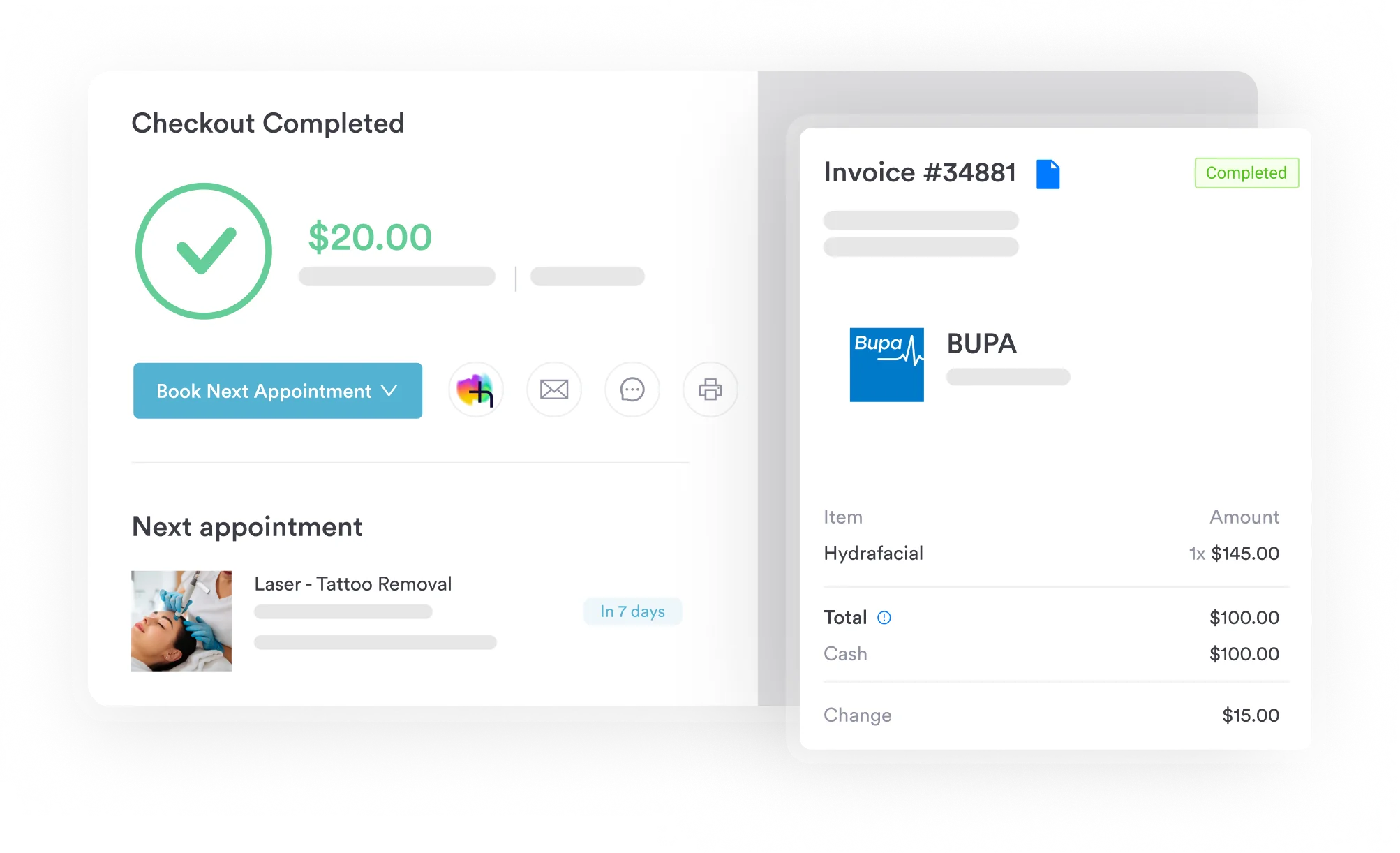

Pabau turns your invoices into pre-filled professional claims, checks eligibility before the visit, and matches remittances when payment lands. Fewer resubmissions, less chasing.

Y95 earns its place as a documentation flag. Payment rides on the POA indicator and the condition code, so put your audit effort there first.
Add Y95 when the provider documents hospital origin, sequence it after the condition and any organism code, and give it POA “N.” When the record is silent, send a query instead of guessing. That keeps your HAI data consistent for quality review without risking a sequencing edit.
Does your practice bill the follow-up care? Book a demo to see how Pabau turns invoices into clean professional claims and tracks them to payment.

Need a framework for tracking recurring claim problems? Denial management in healthcare covers systematic approaches to finding and resolving repeat rejection patterns.
Coding inpatient stays regularly? Inpatient billing cheat sheet puts the inpatient claim essentials on one page.
Want to know how a clearinghouse handles your claims? Claim.MD clearinghouse overview explains how claims, eligibility checks and remittances move between a practice and its payers.
Trying to cut resubmissions? What makes a clean claim walks through the checks that get a claim paid on first submission.
ICD-10 Code Y95 is a supplementary external cause code that identifies a condition as nosocomial. That means the patient acquired it in a hospital rather than having it at admission. It belongs to the Y90-Y99 block of ICD-10-CM. It is always an additional code, never a principal diagnosis, and reporting it is optional.
Y95 is always a secondary code. The ICD-10-CM Official Guidelines never allow an external cause code as the principal or first-listed diagnosis. The nosocomial condition, such as hospital-acquired pneumonia or CAUTI, is coded first, and Y95 follows as an additional code.
They answer related questions. The POA indicator is a single-character field on each diagnosis. It tells CMS whether the condition existed at admission (Y) or developed during the stay (N). Y95 is an optional code that records the provider’s statement that the hospital was the source. A nosocomial condition always needs POA N on its code, and Y95 may be added with its own POA N.
Yes. No ICD-10-CM guideline restricts Y95 to inpatient claims. Like other Chapter 20 codes it is optional unless a state or payer requires it. It is mainly relevant on inpatient claims, so check payer policy before adding it to an outpatient claim.
A nosocomial infection develops during a hospital stay and is documented by the provider as hospital-acquired. It takes its own infection code with POA N, and Y95 may be added. A community-acquired infection was present or incubating before admission, so it takes POA Y and no Y95. The coding distinction rests on the POA indicator and the provider’s documentation.