ICD-10 code Y83.0: Surgical operation with whole organ transplant
ICD-10 code Y83.0 names the transplant as the cause, not the problem ICD-10 code...

Last Updated: Nov 19, 2026
Billable Code Specific Code
Y93.9 is the billable ICD-10-CM code for activity, unspecified. It is the residual code for an activity the record states as unknown. A typical case is a patient who can't recall what they were doing when hurt.
Y93.9 is not a fallback for a blank activity field. Under the Chapter 20 guidelines, you leave the activity code off when the note never mentions the activity. A named activity with no subcategory of its own takes Y93.89 instead.
Let Pabau's smart automation suggest the right codes, reduce claim denials, and keep your practice compliant—effortlessly.
Automate repetitive tasks and focus on what matters most—your patients.
Reduce coding errors and ensure compliance with the latest regulations.
Clean claims, fewer denials, and faster reimbursements.
Powerful insights and reporting to help your practice thrive.
HIPAA compliant SOC 2 certified GDPR-compliant Trusted by 4,000+ clinics worldwide

Y93.9 is a billable ICD-10-CM activity code for an injury or condition where the record states the patient’s activity as unknown.
When the note never mentions the activity, leave the activity code off. The official guidelines bar Y93.9 in that case.
Activity codes are secondary codes, reported once at the initial encounter and used in conjunction with a Y92 place code and a Y99 status code.
External cause reporting is voluntary nationally, so check whether a state mandate or the payer, such as a workers’ compensation carrier, requires it.
Pabau’s claims tools submit US claims through Claim.MD and track claim status, so denied claims and their reasons stay visible.
ICD-10 code Y93.9, Activity, unspecified, is the billable ICD-10-CM code for an unknown activity. It applies when the record states that the patient’s activity at the time of an injury or condition is unknown. The FY 2027 coding guidelines set one firm limit on it: do not assign Y93.9 if the activity is not stated.
That limit is the whole game with this code. A blank activity field doesn’t call for Y93.9. It calls for no activity code at all. A note that names an activity with no subcategory of its own takes Y93.89 instead.
The table summarizes the core facts for the current FY2027 ICD-10-CM release. Check the billable status again each October 1, when the annual update takes effect.
Category Y93 groups activities by type, from walking and running to animal care and other outdoor activity. Y93.89 catches named activities that fit no group. Y93.9 follows it as the residual code for an activity the record calls unknown.
The Y93 note in the Tabular List and the Chapter 20 guidelines govern every code in the block, Y93.9 included. Here’s what they say, in plain terms.
The block carries no Excludes1 note. Reporting is optional, too. There’s no national requirement for external cause codes unless a state mandate or a payer requires them, as the CMS ICD-10-CM guidelines explain.
Whose words count matters as well. Guideline I.B.14 bases code assignment on the patient’s provider, and activity codes aren’t on its short list of exceptions. If a triage nurse or EMS report names an activity the provider didn’t, query the provider before coding it.
These two codes get swapped more than any other pair in the block. Y93.89 means the activity is named but has no subcategory. Y93.9 means the record addresses the activity and says it is unknown.
The diagram below adds the third outcome coders forget: no code at all.
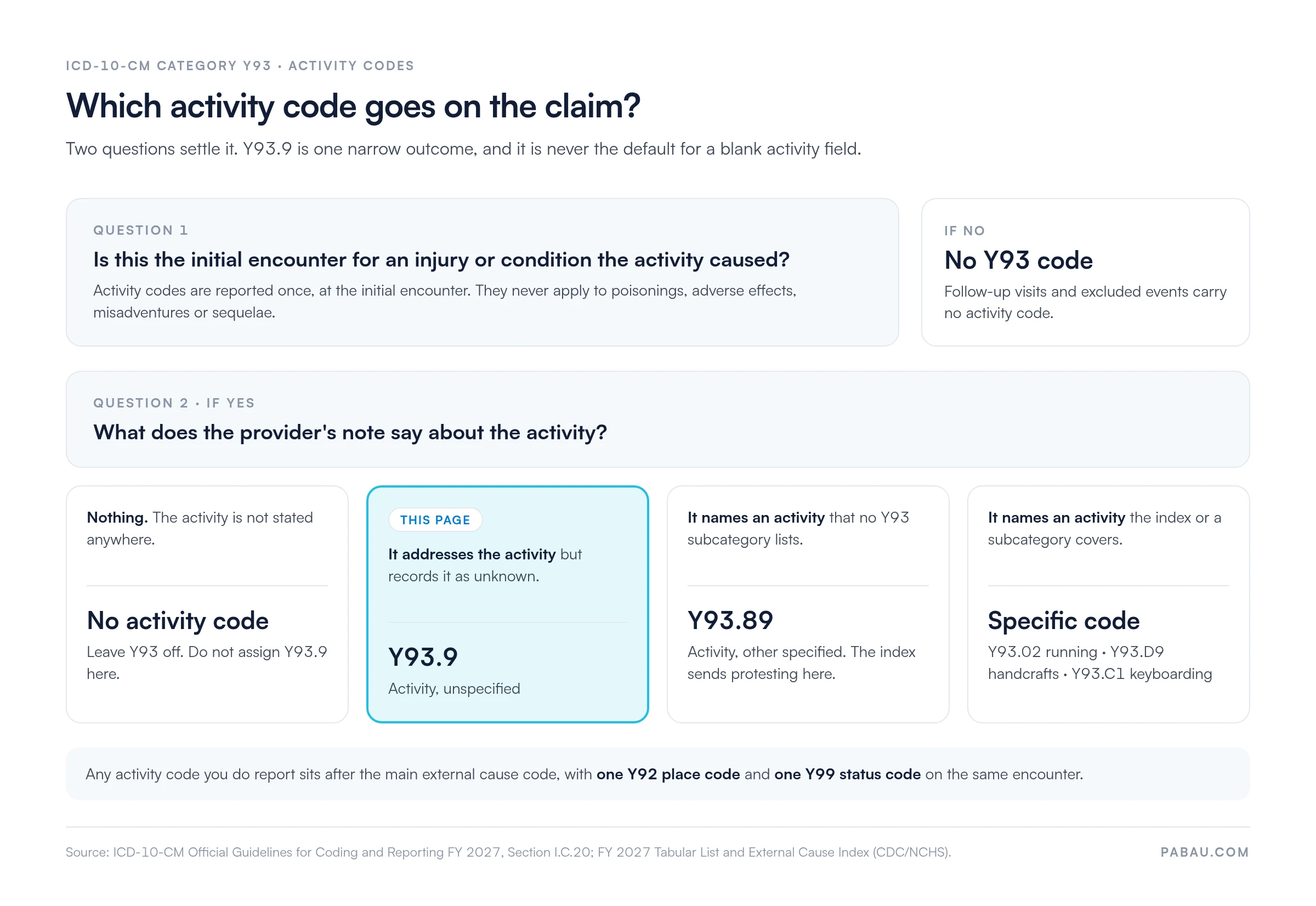
Five scenarios show how the choice plays out in day-to-day coding.
The quick test: if the provider’s note names what the patient was doing, the activity isn’t unspecified. If it says nothing, the answer is no code, not Y93.9.
Sequencing follows the Chapter 20 guidelines. The injury or condition comes first, and every external cause code follows it.
Here’s a worked example. A patient comes in with a right wrist fracture after a fall while off work. The ED note records both the place and the activity as unknown.
The code set is S62.101A, fracture of unspecified carpal bone, right wrist, initial encounter for closed fracture. Add W19.XXXA for the fall, then Y93.9, Y92.9 for the unknown place and Y99.8 for the non-work status.
The order matters because of how medical billing works. The payer reads the first-listed code as the reason for the visit, so an external cause code in that slot gets the claim rejected.
The same codes travel with the claim at the follow-up visit, with one change. The injury and fall codes switch to a D seventh character. Y93.9, Y92 and Y99 drop off, because they belong to the initial encounter only.
Before you assign Y93.9, read the provider’s history of present illness from start to finish. If triage or EMS notes say the patient “fell while jogging” and the provider’s note is silent, query the provider. A confirmed answer supports Y93.02, running, in place of Y93.9.
Medicare and Medicaid don’t require activity codes. Some state reporting mandates and some payers do, and workers’ compensation and liability carriers are the ones most likely to ask.
Requirements vary by state law and by carrier, so read the payer’s rules before you submit. Our guide to medical billing compliance covers how to keep those payer-specific rules straight.
On a work injury, the status code is Y99.0 for civilian activity done for pay. When the provider documents the work activity, such as climbing a ladder, code that activity. Y93.9 fits only when the provider records the activity as unknown.
An employer’s incident report often names the activity, but you can’t code from it directly. Use it to send the provider a query. If the provider confirms the activity in the record, replace Y93.9 with the specific Y93 code.
Most problems with this code are coding errors that surface as payer edits or questions. Each one has a quick fix.
When a claim does come back, a steady denial management workflow stops the same error repeating. Matching the remittance message against medical billing denial codes tells you whether the external cause set was the problem.
A claim that clears these five points is far more likely to be a clean claim on first submission.
The Y93 block and its companion categories hold a few codes coders regularly confuse with Y93.9. The mechanism code most often paired with it is W19.XXXA, and leisure injuries usually close with Y99.8.
Getting the external cause set right is the coder’s job. Getting the claim to the payer, and seeing quickly when it comes back, is where software helps.
Pabau, a practice management platform with denial-tracking claims management, builds US claims from the patient record. The ICD-10-CM lookup library sits inside the claim form, so you add Y93.9, Y92 and Y99 codes without leaving it.
Claims go out through the Claim.MD clearinghouse integration, and required fields are checked before you can send. Claim status and ERA remittances come back into Pabau, so a denied claim and its reason are in front of your team the same day.

Pabau submits US claims through the Claim.MD integration and tracks claim status and remittances. Denied claims surface with their reasons, so your team can fix and resubmit them quickly.

Treat Y93.9 as a deliberate answer, not a placeholder. If the provider’s note is silent on the activity, the right move is to leave Y93 off or send a query.
That one habit removes most Y93.9 errors before a payer ever sees them. It also keeps your injury data honest, which is the reason external cause codes exist in the first place.
The trade-off is a few extra queries on workers’ comp and liability claims. Those payers are the ones that read activity codes closely, so the queries pay for themselves. Book a demo to see how Pabau submits your claims and flags the ones that come back.

Need the full journey from code to payment? What is revenue cycle management walks through each stage, from charge capture to payment posting.
Sending ICD-10 claims through a clearinghouse? Claim.MD clearinghouse guide covers how electronic claims are checked and routed to payers.
Curious where diagnosis codes sit in an electronic claim? 837 file guide explains the format that carries ICD-10 codes, external cause codes included.
Coding the fall that usually comes with Y93.9? ICD-10 code W19.XXXA covers unspecified falls at the initial encounter.
The ICD-10-CM code for activity, unspecified is Y93.9. It’s a billable secondary code from Chapter 20, used only when the record states the patient’s activity was unknown.
Y92 codes record where the event happened, such as a kitchen or a street. Y93 codes record what the patient was doing. Both are secondary codes, reported once at the initial encounter.
No. Y93 codes are complete as published, so Y93.9 takes no seventh character. Y92 codes don’t use one either. The injury and external cause codes still carry A, D or S.
Yes. Y93 codes also fit conditions caused or worsened by an activity, including the cumulative effects of repetitive activity. The Tabular List’s own example is a heart attack while shoveling snow.
No. Activity codes are reported once, at the initial encounter for treatment. Subsequent visits keep the injury and external cause codes with a D seventh character, but drop Y93.