ICD-10 Code T45.7X1S: Coagulant and vitamin K poisoning
ICD-10 Code T45.7X1S: Quick reference summary ICD-10 Code T45.7X1S reports a res...

Last Updated: Nov 25, 2026
Billable Code Specific Code
Y78.1 is the billable ICD-10-CM code for therapeutic (nonsurgical) and rehabilitative radiological devices associated with adverse incidents. It identifies a radiation therapy device, such as a linear accelerator or brachytherapy applicator, as the external cause of a patient's injury. That includes injury from the device breaking down or malfunctioning during use.
Y78.1 is always a secondary code, reported after the code for the injury or reaction. Use Y78.0 when the device was used for imaging, and Y84.2 for a reaction to radiotherapy with no device fault.
Let Pabau's smart automation suggest the right codes, reduce claim denials, and keep your practice compliant—effortlessly.
Automate repetitive tasks and focus on what matters most—your patients.
Reduce coding errors and ensure compliance with the latest regulations.
Clean claims, fewer denials, and faster reimbursements.
Powerful insights and reporting to help your practice thrive.
HIPAA compliant SOC 2 certified GDPR-compliant Trusted by 4,000+ clinics worldwide

Y78.1 is a billable ICD-10-CM external cause code that identifies a therapeutic radiological device involved in an adverse incident, including breakdown or malfunction.
Report Y78.1 as a secondary code, after the code for the injury or reaction the patient had.
Y78.0 covers diagnostic and monitoring radiological devices, while Y78.1 covers therapeutic and rehabilitative ones, so the device’s purpose decides the subcode.
A reaction to radiotherapy with no device fault and no error in care takes Y84.2, and a radiation overdose takes Y63.2.
Documentation should name the device, describe its role in the incident, and state the injury it caused.
ICD-10 Code Y78.1 identifies a therapeutic (nonsurgical) or rehabilitative radiological device as the external cause of a patient’s adverse incident. The code appears in CMS’s FY 2027 ICD-10-CM files, effective October 1, 2026, as a valid billable code. Its block, Y70-Y82, explicitly includes breakdown or malfunction of a device during use.
Y78.1 never stands alone on a claim. You report the injury or reaction first, then add Y78.1 to show which device was involved.
Y78.1 applies when a therapeutic radiological device is involved in an adverse incident that harms a patient. That includes incidents caused by the device breaking down or malfunctioning during use.
The official descriptor names “therapeutic (nonsurgical) and rehabilitative radiological devices.” In practice, that means equipment that delivers radiation to treat the patient rather than to produce an image. Common device types within Y78.1 scope include:
Purpose is the deciding question. A radiological device used to treat the patient maps to Y78.1. A device used to image or monitor the patient maps to Y78.0, even when the same room houses both.
Two scenarios fall outside Y78 altogether. A reaction to radiotherapy with no device fault and no error in care takes Y84.2, because the Y70-Y82 block excludes those later complications. An error in care, such as a wrong dose, takes a misadventure code from Y62-Y69.
Y78.1 sits in Chapter 20 of the ICD-10-CM code set, within the Y70-Y82 block for medical devices associated with adverse incidents. Its place in that hierarchy explains why it can never be a principal diagnosis.
Chapter 20 holds supplementary external cause codes. Under the ICD-10-CM Official Guidelines published by CMS, external cause codes are never sequenced as the principal or first-listed diagnosis. They describe the circumstance behind the condition being treated. The condition itself, such as a radiation burn or radiodermatitis, is coded first.
Category Y78 has five subcodes: Y78.0, Y78.1, Y78.2, Y78.3, and Y78.8. Each maps to a different type of radiological device, and choosing Y78.0 where Y78.1 belongs is the most common slip.
The Y78.0 vs Y78.1 split comes down to the device’s job. A CT scanner fault during a staging scan falls under Y78.0. A linear accelerator malfunction during cancer treatment falls under Y78.1. Use Y78.8 only when the device fits none of the named subcodes.
The guide below sorts the three code families a radiotherapy incident can take, starting with the device question.
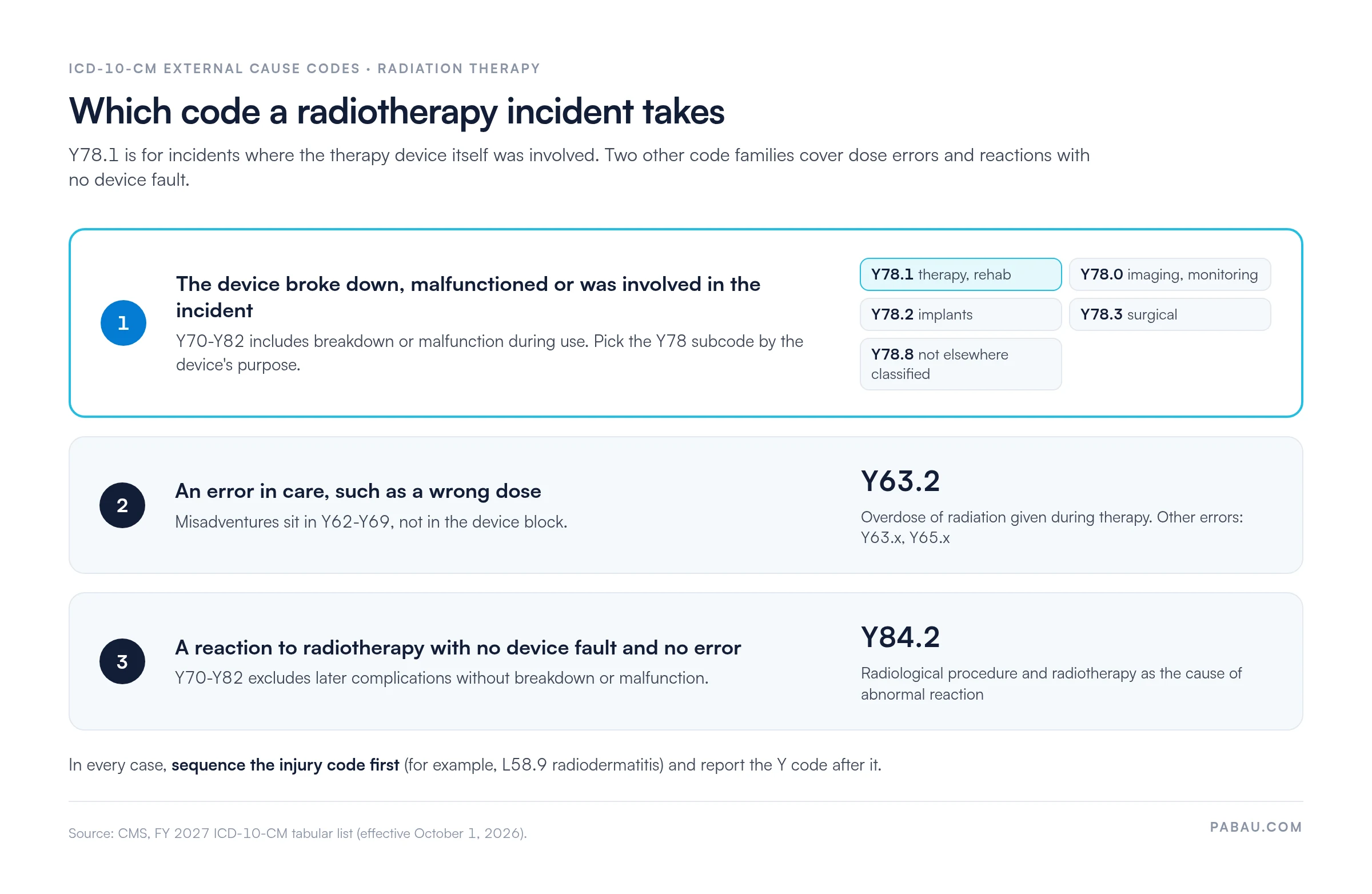
Y78.1 is always a secondary code. The injury, reaction, or complication comes first. Under Chapter 20 guidelines, an external cause code cannot be a principal diagnosis and must accompany a condition code from Chapters 1-19.
Follow this order when Y78.1 is supported by the record:
Before submission, confirm that every claim carrying Y78.1 lists at least one Chapter 1-19 condition code ahead of it. An external cause code sitting in the first position is the error a quick final check catches.
Y78.1 is only defensible when the medical record supports it. Payers can review external cause codes after payment, so thin documentation creates risk even on claims that paid.
The physician or radiation oncologist should document these elements before a coder assigns Y78.1:
A medical billing compliance program should add these elements to the radiation oncology coding checklist. Periodic record audits then confirm that clinical notes and submitted codes agree.
Y78.1 does not itself require prior authorization. Any authorization attaches to the condition and the radiation services behind the visit. How payers handle external cause codes varies between Medicare, Medicaid, and commercial plans.
The ICD-10-CM Official Guidelines make external cause reporting optional unless a payer or a state mandates it. When you report one, code it to the greatest specificity the documentation supports. Medicare does not pay on external cause codes, because payment attaches to the condition and procedure codes.
Some payers and state reporting programs do require external cause codes, so check each payer’s policy. Placing Y78.1 in the first-listed position conflicts with the guidelines, so keep it after the condition codes.
Most Y78.1 problems trace back to a handful of avoidable errors. Each has a documentation or workflow fix.
A denial management process should log the claim adjustment reason code (CARC) for each Y78-category denial. That log shows patterns quickly and points staff education at the right documentation habit. Getting a clean claim out on the first attempt speeds payment and cuts rework.
Y78.1 is most often confused with the other Y78 subcodes, with Y84.2, and with misadventure codes. This table gives the deciding rule for each comparison.
The T66 and Y78.1 pairing is often misunderstood. T66.XXXA is a condition code that records what happened to the patient. ICD-10 Code Y78.1 is an external cause code that records the device involved. A claim for radiation sickness after a therapy device malfunction lists T66.XXXA first, then Y78.1.
Recheck Y78.1 each October, when the new fiscal year’s ICD-10-CM code files take effect. Use the CDC ICD-10-CM tool before coding the first claim of the new year.
ICD-11 is not mandated for US clinical billing as of 2026. ICD-10-CM remains the code set for US claims, as CMS publishes it, and no ICD-11 adoption date has been set. Do not apply ICD-11 codes to US claims until CMS announces a timeline.
ICD-11 handles external causes differently. It uses post-coordinated extension codes rather than a separate supplementary chapter, and it handles device cause through those extension codes.
Coders in radiation oncology can preview that structure in the WHO ICD-11 browser. Under both systems, the condition is still coded first, with the external cause reported alongside it.
A Y78.1 claim depends on details spread across the chart: the device, the incident, and the injury. When those sit in separate systems, the coder works from fragments and the external cause code is the first detail lost.
Pabau, a practice management platform with built-in claims management software, keeps the clinical note and the claim on one patient record. Pabau submits CMS-1500/837P claims through Claim.MD and tracks them, with the diagnosis codes you record on the patient record.
Remittance details come back to the same record, so your team can see which claims paid and which need follow-up. For more on how claims move from encounter to payment, see our guide to medical billing.
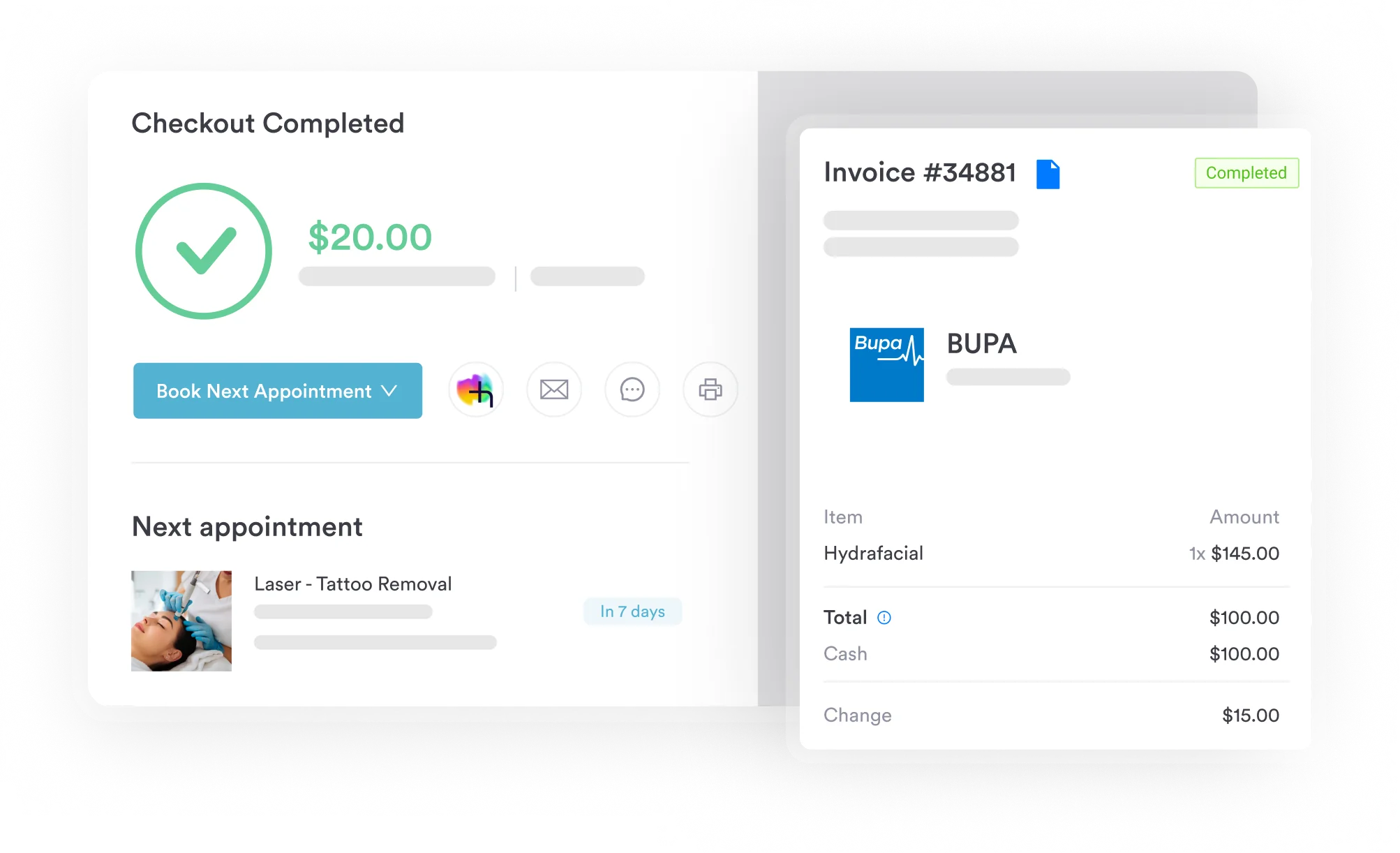

Pabau submits CMS-1500 and 837P claims through Claim.MD with the diagnosis codes your team records on the patient record. Each claim is tracked in one place, so follow-up starts sooner.

Y78.1 tells a payer that a therapeutic radiological device was involved in a patient’s injury, including when it malfunctioned. Code it when the record ties the incident to the device, not for every reaction to radiotherapy.
Make the device question part of every radiation oncology chart review. That one habit sorts Y78.1 from Y84.2 and Y63.2 before the claim is built.
Book a demo to see how Pabau carries the diagnosis codes your team records into every claim it submits.

Need a framework for reducing claim denials across your practice? Denial management in healthcare covers systematic approaches to tracking, appealing, and preventing payer denials.
Want to understand how claims move through the clearinghouse? Claim.MD clearinghouse guide explains how electronic claims are checked and transmitted to payers.
Looking to strengthen your overall billing compliance? Medical billing compliance outlines the documentation and audit practices that reduce retrospective denial risk.
Coding an imaging device incident instead? ICD-10 code Y78.0 covers diagnostic and monitoring radiological devices.
ICD-10 Code Y78.1 is the external cause code for a therapeutic (nonsurgical) or rehabilitative radiological device involved in an adverse incident. That includes device breakdown or malfunction. It sits in category Y78 and block Y70-Y82. It is always a secondary code that follows the code for the patient’s injury or reaction.
Yes. Y78.1 is valid for FY 2027 (confirm each October) and remains an active billable code. It cannot be the principal diagnosis, so report it after at least one condition code from Chapters 1-19. Check its status in the CDC ICD-10-CM tool when each fiscal year’s code files take effect.
Y78.0 covers diagnostic and monitoring radiological devices, such as CT scanners and plain X-ray units. Y78.1 covers therapeutic and rehabilitative radiological devices, such as linear accelerators, brachytherapy equipment, and cobalt units. The device’s purpose decides it. Both are external cause codes sequenced after the condition code.
Assign Y78.1 whenever a therapeutic radiological device was involved in an incident that injured the patient, including a breakdown or malfunction. The treating physician must document the link between the device and the injury. Y78.1 carries no 7th character, so the same code applies at every encounter the documentation supports.
The record should name the therapeutic radiological device, describe its role in the incident, and state the injury the patient had. It should also carry the treating physician’s attestation of the causal link. Vague references to radiation equipment without naming the device often trigger additional documentation requests.
Y78.1 identifies a therapeutic radiological device involved in an incident, including malfunction. Y63.2 is a misadventure code for an overdose of radiation given during therapy, an error in care. A reaction to radiotherapy with no device fault and no error takes Y84.2 instead.