ICD-10 Code T45.7X1S: Coagulant and vitamin K poisoning
ICD-10 Code T45.7X1S: Quick reference summary ICD-10 Code T45.7X1S reports a res...

Last Updated: Nov 25, 2026
Billable Code Specific Code
S82.026S is the billable ICD-10-CM code for nondisplaced longitudinal fracture of unspecified patella, sequela.
It identifies the kneecap fracture behind a residual condition, such as knee pain or post-traumatic arthritis, once the acute phase has ended. The residual condition is coded first and S82.026S second. Use S82.024S or S82.025S instead when the record documents the right or left knee.
Let Pabau's smart automation suggest the right codes, reduce claim denials, and keep your practice compliant—effortlessly.
Automate repetitive tasks and focus on what matters most—your patients.
Reduce coding errors and ensure compliance with the latest regulations.
Clean claims, fewer denials, and faster reimbursements.
Powerful insights and reporting to help your practice thrive.
HIPAA compliant SOC 2 certified GDPR-compliant Trusted by 4,000+ clinics worldwide

S82.026S is a billable ICD-10-CM code for the sequela of a nondisplaced longitudinal patella fracture when the side is not documented.
The 6th character 6 means nondisplaced with the side unspecified. Use S82.024S for the right patella or S82.025S for the left when the record names the side.
The 7th character S means sequela, so the residual condition, such as knee pain or post-traumatic arthritis, is coded first and S82.026S second.
S82.026 has 16 valid 7th characters in the FY 2027 tabular list, from A for the initial encounter to S for sequela.
Pabau, a practice management platform, sends US claims through Claim.MD from the same patient record that holds the fracture history.
ICD-10 code S82.026S is the billable ICD-10-CM code for nondisplaced longitudinal fracture of unspecified patella, sequela. The FY 2027 ICD-10-CM code files published by CMS list it as a valid, reportable 7-character code. It records a healed vertical crack in the kneecap that left a residual problem, when the record does not say which knee.
The code sits in block S80-S89, Injuries to the knee and lower leg, under category S82, Fracture of lower leg, including ankle. Each character narrows the meaning:
S82.026 is a header with 16 children, so it cannot be billed without a 7th character. S82.026S is one of those 16 and carries the full specificity a claim needs.
The patella, or kneecap, is a small bone in front of the knee joint. According to the American Academy of Orthopaedic Surgeons (AAOS), it protects the knee and connects the thigh muscles to the tibia. That connection makes it part of the mechanism that straightens the leg.
A longitudinal fracture, also called a vertical fracture, runs from the top of the kneecap to the bottom. Most patellar fractures follow a fall directly onto the knee or a sharp blow, such as a dashboard impact in a car crash. In a nondisplaced fracture, the pieces stay in place.
AAOS notes these may not need surgery, and a cast or splint often keeps the knee straight while it heals.
Healing does not always end the problem. AAOS lists the long-term effects that follow patellar fractures, and each one can become the sequela that brings a patient back:
When one of these residual conditions is what the visit treats, S82.026S records the fracture that caused it.
The 7th character S marks a sequela: A condition that arises as a direct result of an injury once its acute phase has ended. The FY 2027 ICD-10-CM Official Guidelines for Coding and Reporting set the rules in Sections I.B.10 and I.C.19.a. They also state there is no time limit on when a sequela code can be used.
Two sequencing rules apply every time you report S82.026S:
The guidelines add one more rule. The code for the acute phase of an injury is never reported with a code for its late effect. S82.026D and S82.026S therefore never appear together for the same encounter.
Example: A patient returns with knee pain months after a nondisplaced vertical patellar fracture, and the record names no side. Report the knee pain as M25.569 first and S82.026S second. If the note says left knee, the pair becomes M25.562 and S82.025S.
The FY 2027 tabular list gives S82.026 exactly 16 valid 7th characters. They run from A to S, skipping the letters I, L and O. The options below are the ones a nondisplaced patellar fracture usually needs.
The other eight letters (E, F, H, J, M, N, Q and R) cover subsequent encounters for open fractures. Under guideline I.C.19.c, a fracture not documented as open or closed is coded as closed.
These encounter types follow different code paths, and mixing them up is a frequent source of sequela errors. The table uses the unspecified-side codes. Swap 026 for 024 (right) or 025 (left) whenever the side is documented.
Z47.89, Encounter for other orthopedic aftercare, does not apply to this fracture. The guidelines bar aftercare Z codes for traumatic fractures. They point to the fracture code with the 7th character D instead.
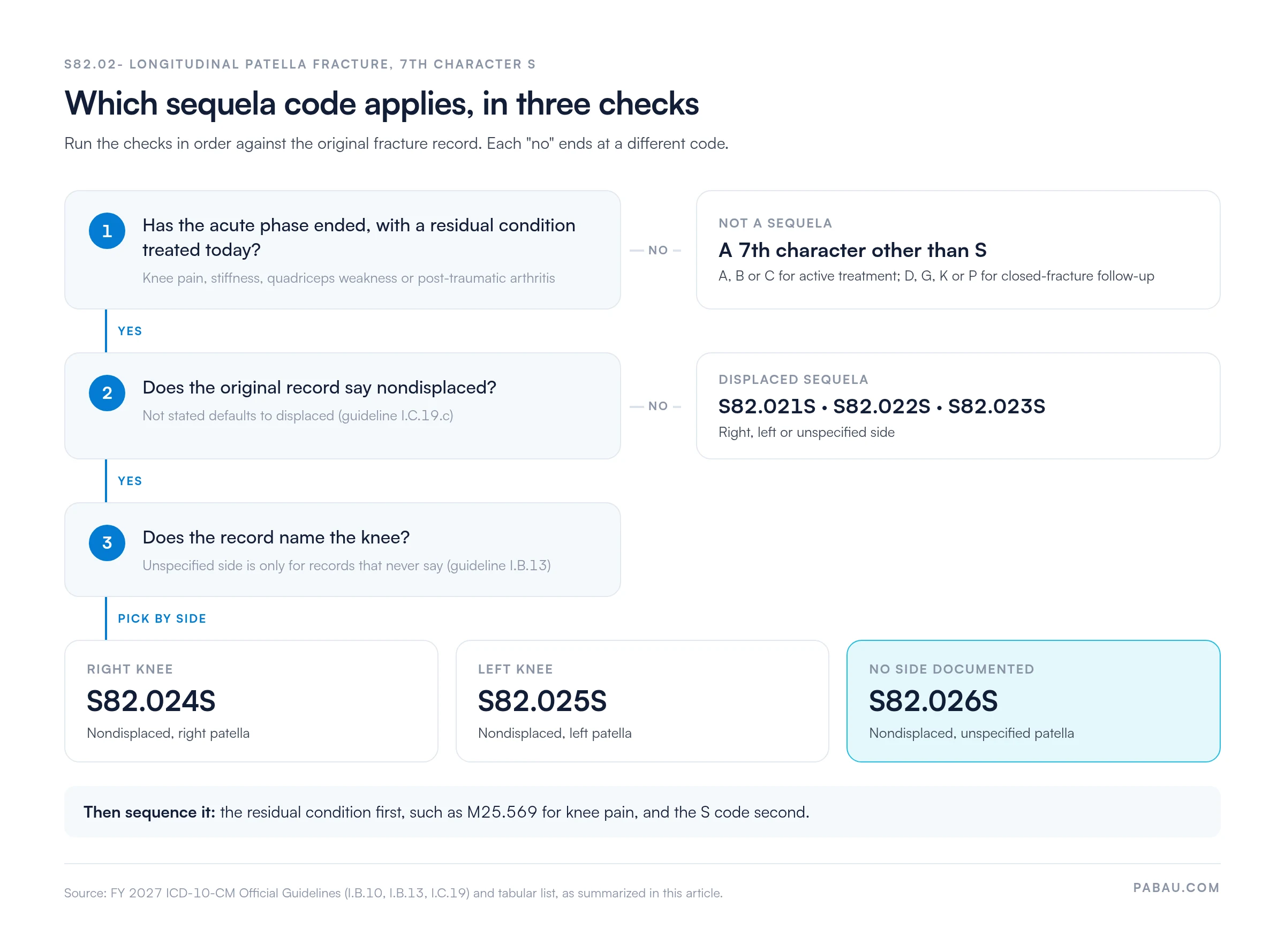
S82.026S is the unspecified-side code. Guideline I.B.13 reserves unspecified-side codes for records that do not identify the side. Most fracture records name the knee, and when yours does, report S82.024S for the right patella or S82.025S for the left.
The sequela condition code gives you a quick check. If you can assign M25.561 or M25.562 for knee pain, the record names the side. Pair that code with S82.024S or S82.025S, not S82.026S. A claim that lists a left-knee condition next to an unspecified-side fracture contradicts itself.
Displacement follows the original injury record. Under guideline I.C.19.c, a fracture not documented as displaced or nondisplaced is coded as displaced. Use the nondisplaced codes only when the original record says nondisplaced.
Taken together, the encounter, displacement and side checks narrow the family to a single code.
Other S82.0 subcategories describe different patellar fracture patterns. They are osteochondral (S82.01-), transverse (S82.03-), comminuted (S82.04-) and other (S82.09-), with unspecified fracture of patella at S82.00-. Match the pattern on the imaging report before you settle on the longitudinal family.
The tibial tuberosity is a separate site, the bony prominence below the kneecap where the patellar tendon attaches. A nondisplaced left tibial tuberosity fracture, sequela, is S82.155S. S82.154S covers the right side and S82.156S an unspecified side. Use those codes, not S82.026S, when the injury was to the tuberosity.
Check the original fracture record before you assign S82.026S. If it names a side, use S82.024S or S82.025S instead. If it never says nondisplaced, the guidelines default to displaced, which moves the code to S82.021S, S82.022S or S82.023S.
Four elements in the record support S82.026S. A payer can deny or query the claim when any one of them is missing.
Workers’ compensation claims add a step. State rules decide who declares the acute phase over, the treating provider or the case manager. Note the date the fracture was declared healed, and cross-reference any independent medical examination (IME) findings.
Physical and occupational therapy claims for patellar fracture sequela list S82.026S as a secondary diagnosis, never first. Physical therapy billing workflows need that order built in, or a valid code still fails on sequencing.
A typical outpatient PT claim looks like this:
Therapists nearly always know which knee they are treating. When they do, the sided condition codes pair with S82.024S or S82.025S. A PT claim carrying S82.026S is a prompt to check the referral for the side.
Medicare Part B also requires the note to show that skilled therapy is needed. A home exercise program the patient can do alone does not meet that bar. The note has to show why the clinician’s judgment and skill are essential, tied to the documented sequela condition.
Medicare Part B accepts S82.026S as a valid diagnosis for outpatient and physician services. Coverage still depends on the service. Medicare Administrative Contractors (MACs) publish Local Coverage Determinations (LCDs) for services such as physical therapy, orthotics and durable medical equipment. Check the LCD for the service you bill rather than assuming blanket coverage.
In the US, Pabau runs eligibility checks through the Claim.MD clearinghouse before the visit. The authorization code, its dates and its sessions are tracked on the case, with a warning when one is missing.
S82.026S denials follow predictable patterns. Each one maps to a coding or documentation fix.
Structured denial management workflows cut the rework on these rejections. Track denials by Claim Adjustment Reason Code (CARC).
CARC 50 signals a medical necessity denial, and CARC 11 a diagnosis that does not fit the procedure. CARC 16 points to missing information or a billing error. Read against a denial code reference, the pattern shows whether the fix belongs with the coder, the clinician or the billing team.
Submitting clean claims the first time protects revenue on sequela codes like S82.026S, because each resubmission delays payment.
Sequela errors on this code family start at one hand-off. The clinician documents the knee, the healing status and the residual problem. Someone else later picks a 7th character and a side from that note. When the note is vague, the unspecified code becomes the easy fallback.
Pabau keeps treatment notes, intake forms and imaging reports on one patient record. The coder reads the side and the healing status from the same place the clinician wrote them. US claims then go out as 837P claims through Claim.MD, and ERA remittances come back through the same connection.
Pabau’s claims management software also tracks prior authorizations for long therapy episodes and warns when one is missing. The result is fewer claims that stall on a side, a sequence or an authorization.

Pabau keeps the fracture history, treatment notes and claims on one patient record. US claims go out through Claim.MD, so the side and sequence you document are the ones you bill.

S82.026S is a narrow code. It fits only a healed, nondisplaced, longitudinal patellar fracture that left a residual problem, in a record that never names the knee. That last condition is rare, so treat every S82.026S on a claim as a prompt to check the chart for a side.
Three checks prevent the denials covered above: The residual condition first, the fracture code second, and a side that matches the note. End-to-end revenue cycle management keeps those checks in one workflow. Book a demo to see how Pabau carries patella fracture documentation through to a clean US claim.

Coding a patella fracture that healed out of alignment? ICD-10 code S82.026P covers the follow-up visit for a nondisplaced longitudinal patella fracture with malunion.
Coding the knee pain that comes first on the claim? ICD-10 code M25.569 covers pain in an unspecified knee, the usual first-listed diagnosis beside S82.026S.
Confused about when a denied claim can be appealed? Denial codes in medical billing breaks down CARC codes and the appeals process for sequela and injury code denials.
Want to understand how the clearinghouse validates your codes before submission? Claim.MD clearinghouse overview explains how EDI validation, payer enrollment, and 835 remittances work together.
ICD-10 code S82.026S is the billable ICD-10-CM code for nondisplaced longitudinal fracture of unspecified patella, sequela. It records a healed vertical kneecap fracture that left a residual condition, when the record does not state which knee. It is valid for FY 2027.
Yes. S82.026S is a billable, specific 7-character ICD-10-CM code that can be reported directly on a claim. As a sequela code, it is listed after the code for the residual condition the fracture caused.
All three describe the sequela of a nondisplaced longitudinal patella fracture. S82.024S is the right patella, S82.025S the left, and S82.026S an unspecified side. Use S82.026S only when the record does not identify the side.
No. S82.026S is a patella code. The sequela of a nondisplaced tibial tuberosity fracture is S82.154S for the right side, S82.155S for the left, and S82.156S when the side is unspecified.
Use the 7th character “S” once the fracture’s acute phase has ended and the visit treats a condition it caused. Examples include knee pain, stiffness and arthritis. Use A, B or C during active treatment. During routine follow-up of a closed fracture, use D, G, K or P.
No. The guidelines sequence the sequela condition first and the injury code second. On a PT claim, list the condition driving therapy first, such as M25.569 for knee pain, and S82.026S second.
S82.026 has 16 valid 7th characters in the FY 2027 tabular list. They are A, B, C, D, E, F, G, H, J, K, M, N, P, Q, R and S, with S marking sequela.
The usual causes are a missing or reversed sequela condition code and a 7th character D billed after healing. Thin documentation of the residual problem is another. A side conflict can also trigger a denial, when a sided condition code sits next to S82.026S.