ICD-10 Code Y78.1: Therapeutic radiation device incidents
ICD-10 Code Y78.1: definition and quick reference ICD-10 Code Y78.1 identifies a...

Last Updated: Nov 25, 2026
Billable Code Specific Code
T45.7X1S is the billable ICD-10-CM code for poisoning by anticoagulant antagonists, vitamin K and other coagulants, accidental (unintentional), sequela. It covers agents that reverse anticoagulants or promote clotting, such as phytonadione (vitamin K1), protamine sulfate and thrombin.
Use it when a condition remains after the acute poisoning has ended, such as a stroke after a vitamin K dosing error. The residual condition is coded first and T45.7X1S second. Accidental poisoning by warfarin, heparin or another anticoagulant, sequela, is a different code, T45.511S.
Let Pabau's smart automation suggest the right codes, reduce claim denials, and keep your practice compliant—effortlessly.
Automate repetitive tasks and focus on what matters most—your patients.
Reduce coding errors and ensure compliance with the latest regulations.
Clean claims, fewer denials, and faster reimbursements.
Powerful insights and reporting to help your practice thrive.
HIPAA compliant SOC 2 certified GDPR-compliant Trusted by 4,000+ clinics worldwide

T45.7X1S is a billable ICD-10-CM code for the sequela of accidental poisoning by anticoagulant antagonists, vitamin K and other coagulants.
It covers clot-promoting and reversal agents such as phytonadione, protamine sulfate and thrombin, not warfarin, heparin or DOACs.
Accidental poisoning by warfarin, heparin or another anticoagulant uses T45.511S instead.
The residual condition is sequenced first and T45.7X1S second, per Official Guidelines I.C.19.a and I.B.10.
The code is billable for the current fiscal year, so verify it each year in the CDC/NCHS tabular list.
ICD-10 Code T45.7X1S reports a residual condition left by an accidental poisoning with an anticoagulant antagonist, vitamin K or another coagulant. The CDC’s FY2027 Tabular List builds it from subcategory T45.7X1 plus the category’s 7th character S, for sequela. Phytonadione, protamine sulfate and topical thrombin are typical agents. The residual condition is coded first, and T45.7X1S follows to name its cause.
T45.7X1S covers drugs that promote clotting or reverse an anticoagulant. These are the opposite of the blood thinners in T45.5. In practice that means vitamin K preparations, heparin antagonists and topical hemostatic agents.
The table below lists the FY2027 ICD-10-CM Table of Drugs and Chemicals entries that point to T45.7X-. Official Guidelines I.C.19.e.1 says never to code straight from the Table of Drugs. Always confirm the code in the Tabular List before you report it.
Several clotting-related drugs sit outside T45.7. Aminocaproic acid and tranexamic acid index to T45.62-, hemostatic drugs. A reaction to a correctly given dose of either drug, seen at a follow-up visit, is T45.625D.
Human factor IX complex, factor VIII, fibrinogen and plasma index to T45.8X-. The table does not name newer reversal agents such as idarucizumab and andexanet alfa. Confirm their code with the Tabular List and the payer.
Coding warfarin, heparin or DOAC poisoning? Those drugs are anticoagulants, not antagonists. Their accidental poisoning sequela is T45.511S, poisoning by anticoagulants, accidental (unintentional), sequela.
Five neighboring codes are often assigned where T45.7X1S belongs, or the other way round. Each one turns on a different fact in the chart.
The 7th character S marks a sequela, the residual effect left after the acute phase of a poisoning has ended. Guideline I.B.10 sets no time limit, so a residual can appear early or months later.
The three codes share a base code but report different points in the patient’s course. Under guideline I.C.19.a, the choice turns on whether the patient is receiving active treatment, not on who sees them.
Ask one question before you choose S. Is the visit for a condition the poisoning left behind? Use A during active treatment for the poisoning, and D for routine care during recovery. To support S on audit, record the original event, the agent and its date in the note.
The same vitamin K or protamine dose can land in three different code paths. What happened at the bedside decides which one applies.
ICD-10-CM Official Guidelines Section I.C.19.e.5 draws the line. A correctly prescribed and properly given drug that causes a reaction is an adverse effect. An overdose, a wrong drug or a wrong route is a poisoning. IV phytonadione given when the order said oral or subcutaneous is a wrong-route error, so a reaction to it codes as poisoning.
Two guidelines govern sequela sequencing. Under guideline I.C.19.a, the specific sequela comes first and the poisoning code with S follows it. Guideline I.B.10 sets the same order for every sequela. Before sequencing, three checks confirm the code itself, and the diagram below walks through them.
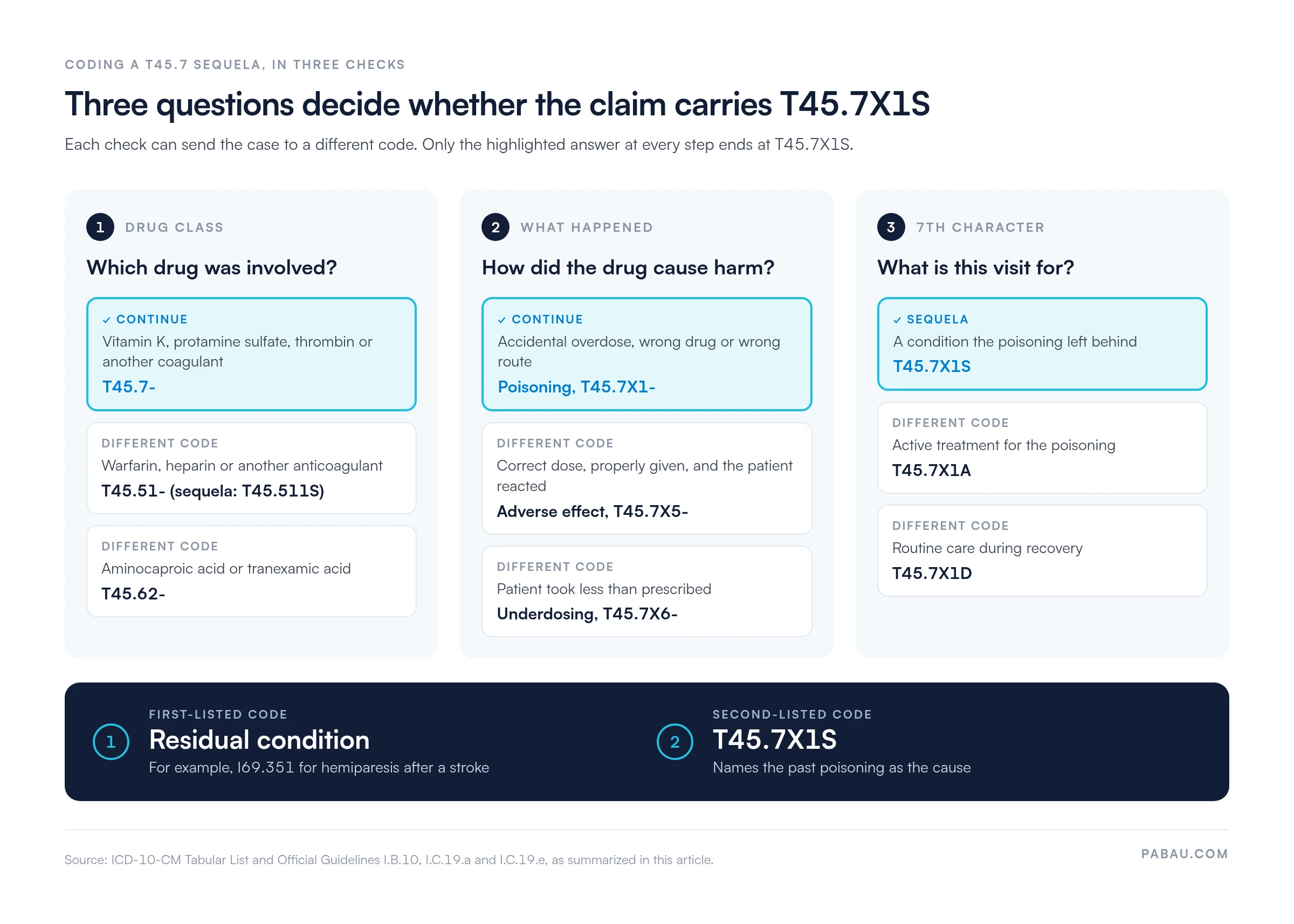
During an initial or subsequent encounter, the poisoning code leads and its manifestations follow. A sequela encounter reverses that order. The residual condition leads, and T45.7X1S follows.
T45.7X1S never stands alone. If the note names no residual condition, the visit is not a sequela encounter. Code the visit from what the note does document.
The residual conditions below follow the clinical risks of these agents. Vitamin K overcorrection can leave a warfarin patient unprotected, which raises the risk of stroke and venous thrombosis. A protamine overdose or a reaction to wrong-route phytonadione can cause cardiovascular collapse. Confirm each code with the CDC/NCHS ICD-10-CM web tool for the current fiscal year before billing.
Eight codes sit close enough to T45.7X1S to be picked by mistake. Each row names the fact in the chart that points to it instead.
Medicare, Medicaid and commercial payers expect the chart to support both codes on a sequela claim. The record has to show the past poisoning and the residual condition it caused.
Denials on this code trace back to the drug class, the 7th character, the code order or the chart. These six patterns cover them. When a remittance comes back, our guide to decoding denial codes explains each CARC reason code.
Run through this checklist before each T45.7X1S submission. Denial management best practices covers the wider framework.
A sequela claim stands or falls on a note written months after the original event. That note has to name the poisoning, the agent and the residual condition. It also has to be in the record when a payer asks to see it.
Pabau, a practice management platform, keeps the clinical note and the claim on one patient record. Its claims management software pulls the diagnosis codes your coder assigns into the claim. It then submits the claim through Claim.MD, a US clearinghouse that sends CMS-1500 and 837P claims to thousands of US payers.
Claim.MD also runs eligibility checks and returns electronic remittance advice (ERA) to Pabau. Your team sees each claim’s status and payment next to the documentation that supports it.

Pabau keeps the clinical note, the diagnosis codes your coder assigns and the Claim.MD submission on one patient record. Your team can check the note before the claim goes out.

Check the drug before you check the 7th character. T45.7 holds the agents that reverse anticoagulants or promote clotting, so a warfarin or heparin case on this code is wrong from the start.
Once the drug class is right, the rest is order and evidence. The residual condition leads, T45.7X1S follows, and the note ties the two together. Skip that note and a payer has no reason to accept the link, however clear it was at the bedside.
For the wider billing picture around a claim like this, start with our medical billing guide. Then book a demo to see how Pabau keeps sequela documentation and claims on the same record.

Coding a sequela from a different drug class? T43.214S applies the same residual-condition-first sequencing to SNRI poisoning.
Confused by denial codes on a T45.7X1S claim? Denial codes in medical billing maps the most common CARC reason codes to actionable fixes.
Want to understand the electronic claim file behind T45.7X1S submissions? 837 file format guide covers how ICD-10 diagnosis codes are structured in the 837P transaction.
ICD-10 Code T45.7X1S is the billable code for poisoning by anticoagulant antagonists, vitamin K and other coagulants, accidental (unintentional), sequela. It is used when a residual condition remains after an accidental poisoning with an agent such as phytonadione, protamine sulfate or thrombin has ended.
Yes. T45.7X1S is a billable, specific ICD-10-CM code for the current fiscal year. Codes are reviewed every year, so verify its status each year in the CDC/NCHS tabular list.
The 7th character shows where the patient is in their care. A is for encounters where the patient receives active treatment for the poisoning. D is for routine care during recovery, after active treatment ends. S is for a residual condition the poisoning left behind, coded after the code for that condition.
Poisoning (T45.7X1_) applies to an overdose, a wrong drug, a wrong route, or a prescribing or administration error. Adverse effect (T45.7X5_) applies when the vitamin K or protamine dose was correctly prescribed and properly given, and the patient still reacted.
Use T45.511S, poisoning by anticoagulants, accidental (unintentional), sequela. Warfarin, heparin and other anticoagulants sit in T45.51-. T45.7X1S covers only the agents that reverse them or promote clotting, such as vitamin K and protamine sulfate.