ICD-10 Code T31.77: Burns involving 70-79% of body surface
ICD-10 code T31.77: Quick reference and code details ICD-10 code T31.77 is the b...

Last Updated: Nov 5, 2026
Billable Code Specific Code
Y90.1 is the billable ICD-10-CM code for a blood alcohol level of 20-39 mg/100 ml. Assign it when the record documents a level in that range, and code the value as written, with no specimen-type conversion.
It is a supplementary external cause code, so it never stands alone. It follows the condition it describes, such as an F10 alcohol related disorder, an injury, or R78.0 (finding of alcohol in blood).
Let Pabau's smart automation suggest the right codes, reduce claim denials, and keep your practice compliant—effortlessly.
Automate repetitive tasks and focus on what matters most—your patients.
Reduce coding errors and ensure compliance with the latest regulations.
Clean claims, fewer denials, and faster reimbursements.
Powerful insights and reporting to help your practice thrive.
HIPAA compliant SOC 2 certified GDPR-compliant Trusted by 4,000+ clinics worldwide

ICD-10 Code Y90.1 reports a documented blood alcohol level of 20-39 mg/100 ml, which equals a BAC of 0.020-0.039%.
Y90.1 is a supplementary external cause code, so it is always reported alongside another diagnosis and never as the principal diagnosis.
Assign the Y90 subcode that matches the level written in the record, because ICD-10-CM sets no specimen-type rule or conversion.
The tabular tells you to code first any associated alcohol related disorder (F10), and R78.0 asks for a Y90 code to add the level.
Y91 exists only in the WHO version of ICD-10, so US coders report clinically observed intoxication with F10 codes instead.
ICD-10 Code Y90.1 is a billable ICD-10-CM code with the official descriptor “Blood alcohol level of 20-39 mg/100 ml.” It sits in category Y90, Evidence of alcohol involvement determined by blood alcohol level. That category belongs to the Y90-Y99 block of Chapter 20, External causes of morbidity.
A blood alcohol level of 20-39 mg/100 ml corresponds to a BAC of roughly 0.02-0.039%. That is the low end of measurable alcohol exposure. Many adults show only mild relaxation or minimal impairment at this level.
Body weight, tolerance and other substances all change how a patient presents. The lab value alone cannot predict the clinical picture, which is why the record should describe both.
Lab reports also differ in how they measure ethanol. Many hospital labs test serum or plasma, which typically reads higher than whole blood (Rainey, Clinical Chemistry, 1993). That difference is clinical and forensic context only. ICD-10-CM defines the Y90 subcodes by the blood alcohol level documented, with no specimen-type adjustment.
The units are interchangeable: 1 mg/dL equals 1 mg/100 ml. A BAC percentage converts by multiplying by 1,000, so 0.03% equals 30 mg/100 ml. Match that number to the range in the descriptor and stop there.
Category Y90 has nine level-specific codes plus Y90.9 for alcohol present at an unstated level. Y90.1 is the second range, above Y90.0 and directly below Y90.2. The scale below shows where each band starts, which settles a value that sits on a boundary.
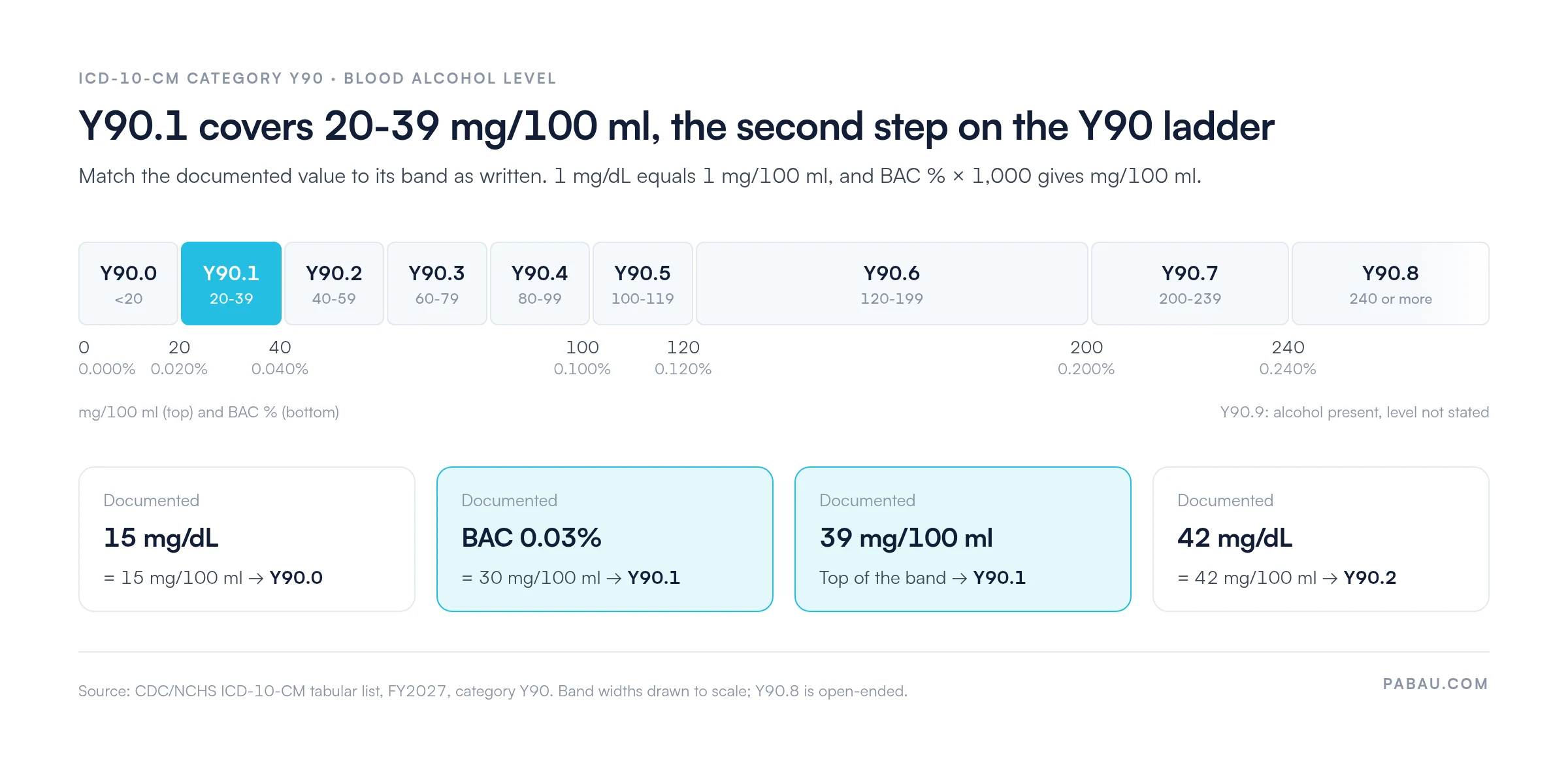
Y90.9 is for records that confirm alcohol in the blood without stating a level. When a measured value is in the record, select the specific subcode instead.
Y90.1 is an additional code. The Y90-Y99 block note says these codes supply extra information and are not used for single-condition coding. External cause codes are never sequenced as the principal diagnosis.
Read the number on the lab report and match it to the Y90 range exactly as written. ICD-10-CM has no specimen-type conversion, so a result of 42 mg/dL is Y90.2 whatever the specimen was. Query the provider only when the level itself is missing or unclear.
Older references pair Y90 with Y91, Evidence of alcohol involvement determined by level of intoxication. Y91 belongs to the WHO version of ICD-10. The US ICD-10-CM tabular does not include it: category Y90 is followed directly by Y92.
That matters for US claims. A Y91 code will not validate, so a clinician’s observed intoxication needs a different route. In ICD-10-CM, documented intoxication is coded to F10 codes, such as F10.120, F10.220 or F10.920.
Choose the F10 code from the provider’s documentation of use, abuse or dependence. Then add Y90.1 when the record also states a level of 20-39 mg/100 ml.
R78.0 (Finding of alcohol in blood) reports that alcohol was found. Its tabular note says to use an additional external cause code from Y90 for detail on the level. The two codes work as a pair.
Category R78 carries an Excludes2 note for mental and behavioral disorders due to psychoactive substance use (F10-F19). Excludes2 means the disorder is not part of R78, but a patient can have both. When the provider documents an F10 condition and a blood alcohol finding, R78.0 may sit alongside the F10 code, with Y90.1 reporting the level. With no F10 diagnosis, R78.0 plus Y90.1 gives the payer both the finding and the level.
Because Y90.1 is supplementary, it always travels with another code. The pairings below reflect the encounters where a measured blood alcohol level is most often documented.
To support Y90.1, ICD-10-CM needs only a documented blood alcohol level in the 20-39 mg/100 ml range. The habits below are recommended practice, not ICD-10-CM requirements. They make the code easier to defend in an audit.
Y90.1 is a valid code for CMS ICD-10-CM reporting, but payers use it differently. Knowing the medical billing fundamentals for supplementary codes helps prevent avoidable denials.
Most Y90.1 errors come from treating it as a standalone code or from rules that ICD-10-CM does not contain. Each mistake below has a simple prevention step.
Good denial management workflows group Y90 denials by reason code. That shows whether the root cause is sequencing, a missing level or an invalid code. Our guide to denial codes in billing explains what each reason code means. The AAPC ICD-10-CM code lookup helps when cross-checking adjacent codes.
Run a quarterly audit of claims carrying Y90 codes. Check that each one lists the related condition first, carries a documented level, and contains no Y91 code. Catching the pattern early stops the same denial repeating every billing cycle.
Supplementary codes go wrong when a claim is assembled by hand from two sources. The level sits in a lab report, and the diagnosis sits in a provider note. Pabau, the practice management and billing platform we build, keeps the result, the note and the claim on one patient record.
Pabau’s claims management software lets your team order diagnosis codes on the claim and track denials by code. US practices can submit claims electronically through the Claim.MD clearinghouse and follow each response.
The outcome is fewer claims rejected for sequencing, and faster resubmission when one comes back.

Pabau’s claims management tools let your team sequence diagnosis codes on the claim, track denial patterns, and resubmit corrected claims through the Claim.MD clearinghouse.

Y90.1 is one of the simpler codes in Chapter 20 once the folklore is stripped away. Read the documented level, match it to 20-39 mg/100 ml, and report it after the condition it describes.
The errors that cost practices money come from rules ICD-10-CM never wrote, such as specimen conversions and Y91 codes on US claims. The R78 note on F10-F19 is an Excludes2, so R78.0 can sit beside an F10 code when the record supports both. Strip the invented rules out of your claim templates, and the code becomes routine.
Book a demo to see how Pabau helps your team sequence supplementary codes correctly and track every denial to its cause.

Need a reference for managing claim denials by code type? Denial management in healthcare covers how to build a denial tracking workflow that catches supplementary code sequencing errors before they recur.
Want to understand how electronic claims route through a clearinghouse? Claim.MD clearinghouse guide explains how 837P claims are validated, submitted, and tracked across US payers.
Looking for a clean-claim checklist before submission? Clean claim requirements outlines the elements that must be complete for a claim to pass payer edits without manual intervention.
ICD-10 code Y90.1 reports a documented blood alcohol level of 20 to 39 mg per 100 ml, a BAC of 0.020-0.039%. It is a supplementary external cause code. It is reported alongside another diagnosis to show the measured level at the encounter.
Yes. Y90.1 is a valid billable code in the FY2027 ICD-10-CM code set. It is always reported as an additional code, never as a standalone or principal diagnosis.
No. Y91, Evidence of alcohol involvement determined by level of intoxication, exists only in the WHO version of ICD-10. The US tabular moves from Y90 to Y92. Code clinically documented intoxication with the matching F10 code instead.
Often both. R78.0 (Finding of alcohol in blood) reports the finding, and its tabular note asks for a Y90 code to add the level. The R78 note on F10-F19 is an Excludes2, so R78.0 can also accompany an F10 code when the record documents both.
No. Y90.1 is a supplementary external cause code and cannot be the principal diagnosis. Code first any associated alcohol related disorder (F10), or the injury or poisoning being treated. Many payer edits reject claims that list Y90.1 first.
ICD-10-CM needs the blood alcohol level stated in the record, and you code the value as documented. As best practice, record the number with units and the collection time. Specimen type is useful clinical context, but it does not change the Y90 subcode.