ICD-10 Code Y74.2: General hospital and personal-use implant failure
ICD-10 code Y74.2: Definition, descriptor, and billable status ICD-10 code Y74.2...

Last Updated: Oct 29, 2026
Billable Code Specific Code
Y83.9 is the billable ICD-10-CM code for an unspecified surgical procedure that caused a patient's abnormal reaction or later complication. It applies only when no misadventure occurred during the procedure.
Y83.9 is an external cause code, so it is never the first-listed code. The complication drives the claim, and Y83.9 follows to show what triggered it. A common cause of denials is sequencing it as the principal diagnosis.
Let Pabau's smart automation suggest the right codes, reduce claim denials, and keep your practice compliant—effortlessly.
Automate repetitive tasks and focus on what matters most—your patients.
Reduce coding errors and ensure compliance with the latest regulations.
Clean claims, fewer denials, and faster reimbursements.
Powerful insights and reporting to help your practice thrive.
HIPAA compliant SOC 2 certified GDPR-compliant Trusted by 4,000+ clinics worldwide

Y83.9 marks an unspecified surgical operation as the external cause of a patient’s abnormal reaction or later complication.
It is always an additional code, so the complication code leads the claim and Y83.9 follows it.
A common cause of denials is sequencing Y83.9 as the principal diagnosis.
Use Y83.9 only when the record cannot support Y83.0 through Y83.8, and query the clinician when causation is unclear.
External cause reporting depends on payer and state policy, so check each payer’s rules before you submit.
ICD-10 code Y83.9 tells a payer that a surgical operation caused a patient’s abnormal reaction or later complication. The record doesn’t say which operation, and no misadventure happened during it.
Y83.9 sits in Chapter 20 of ICD-10-CM, External Causes of Morbidity. Per the CDC/NCHS ICD-10-CM release, it is currently valid and billable. Because it explains a cause rather than a condition, it can never anchor a claim on its own.
Y83.9 identifies a surgical operation as the external cause of an abnormal reaction or later complication. The specific procedure type can’t be determined from the record. Each part of the official descriptor narrows when you can use it.
The WHO ICD-10 browser carries the same title for the parent Y83 category.
Y83 covers surgical operations. Y84 covers other medical procedures, such as catheterization, endoscopy and radiological procedures. Its own unspecified code, Y84.9, is the non-surgical counterpart to Y83.9.
ICD-10-CM has no Y83.7. The AAPC Codify ICD-10-CM lookup shows the series jumping from Y83.6 to Y83.8. Work through the specific codes first, so an organ removal goes to Y83.6 rather than Y83.9.
Y83.9 covers surgical operations in the broad sense, including incisions, excisions, resections and other operative work. The unspecified qualifier applies only to the type of operation, never to the complication.
In scope for Y83.9: Any operation the record confirms took place and caused the reaction, where the procedure type isn’t recorded.
Not in scope for Y83.9:
T88.9 and Y83.9 often appear on the same claim, but they do different jobs. T88.9 is a Chapter 19 complication code. It can be the principal diagnosis when a complication of care is the reason for the encounter. Y83.9 is a Chapter 20 external cause code, and it can’t.
A claim that lists Y83.9 with no complication code fails payer edits. It names a cause without saying what the patient has. A claim with T88.9 but no Y83.9 may still pass with some payers. It does, however, drop the record of what caused the complication.
ICD-10-CM reserves unspecified codes for cases where the documentation can’t support a more specific one. Y83.9 isn’t a default, a time-saver or a catch-all for complex operative histories.
Work through these steps before you assign it:
The decision path below puts those steps on one page, along with the misadventure and non-surgical exits.
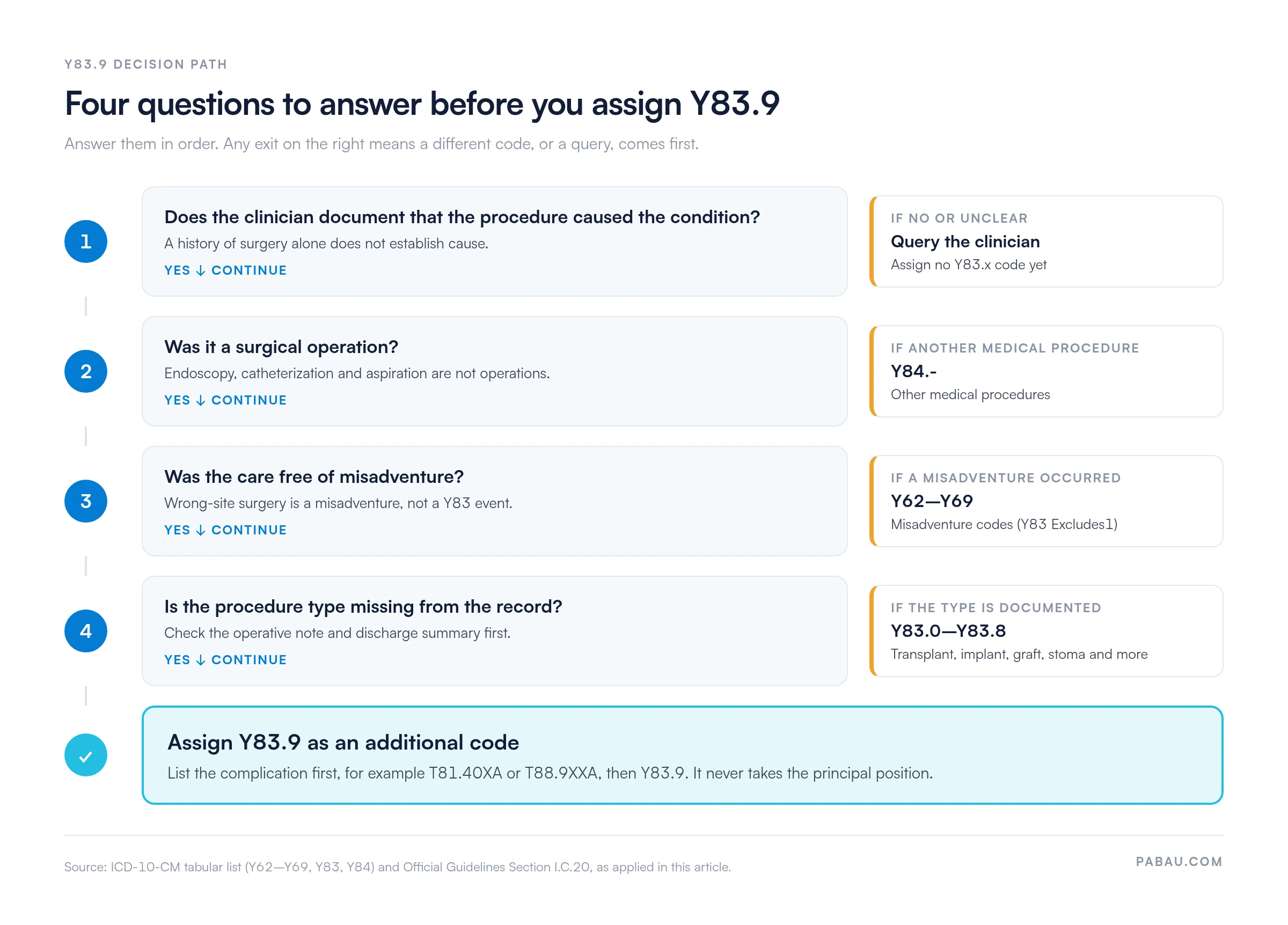
Here’s a case where Y83.9 is correct. A patient arrives with a post-operative wound complication after surgery at an outside facility. The operative report is unavailable, and nobody can confirm the procedure type. Y83.9 fits because the record itself lacks that detail.
Y83.9 is never the principal or first-listed diagnosis. Under ICD-10-CM Official Guidelines Section I.C.20, external cause codes are reported only as additional codes. The condition code leads, and Y83.9 follows.
The CMS ICD-10 coding and billing page is the starting point for the official code sets and guidelines. Getting the order right often decides whether the claim pays or bounces.
Correct sequence:
Checking code order while the claim is built saves a full rework cycle later. Good denial management workflows start at that stage, before any denial arrives.
Hold any claim where Y83.9 sits in position 1. A pre-submission scrub rule can reject any claim with a Y83.x or Y84.x code in the principal diagnosis field. That one edit stops a common external cause denial before it starts.
A surgical complication claim passes through several hands, and each one can break the sequence. Here’s the usual path:
On a facility claim, the UB-04 form has dedicated fields for external cause codes. On a professional claim, Y83.9 goes after the complication code in the diagnosis list.
External cause codes, Y83.9 included, aren’t universally required on Medicare and Medicaid claims. The ICD-10-CM Official Guidelines leave external cause reporting to state mandates and payer policy. Medical billing compliance requirements also vary by program and geography.
When a payer requires external cause codes, report the most specific Y83.x the documentation supports. Use Y83.9 only if the procedure type is genuinely undocumented. Knowing what makes a clean claim for each payer in your mix settles the required-or-optional question.
Y83.9 denials follow a predictable pattern. Each has its own root cause and a clear fix. The payer’s denial codes tell you which one you’re dealing with.
Each of these starts upstream of submission. Tracing the full medical billing workflow, from documentation to payment, shows where each one begins.
The clinical record must establish three facts before Y83.9 can be assigned. If one is missing, the code is unsupported and exposed at audit.
ICD-10-CM Official Guidelines Section I.B.16 bases complication coding on the provider’s documented link between the condition and the care. Coders shouldn’t infer cause from the clinical picture alone. When the link is unclear, send a physician query before you code.
Run these checks on every claim that carries Y83.9:
These four vignettes show correct and incorrect use. Each one tests the sequencing rule and the documentation requirement.
Scenario: A patient transferred from an outside facility develops a wound infection. The transferring facility’s operative report hasn’t arrived yet. The discharge summary states “wound infection following surgical procedure” but doesn’t name the operation.
Scenario: A patient presents with graft failure. The operative report documents a coronary artery bypass graft (CABG) procedure six weeks earlier.
Scenario: A billing team codes Y83.9 as the principal diagnosis for a post-operative complication encounter, with T81.89XA as secondary.
Scenario: A patient develops an unspecified complication after surgery, and the procedure type is undocumented.
In many billing teams, coders check code order and claim fields by hand, then wait for the payer’s verdict. A missing detail means a rejection, a fix and a resubmission.
Pabau, the practice management platform we build, fills the claim from the patient record. Its claims management software then scrubs each claim for missing or invalid details before it goes to Claim.MD.
Claim.MD adds real-time eligibility checks, plus claim status and remittance tracking. Sequencing Y83.9 stays the coder’s call. What changes is that a rejected claim shows up straight away instead of sitting unnoticed.
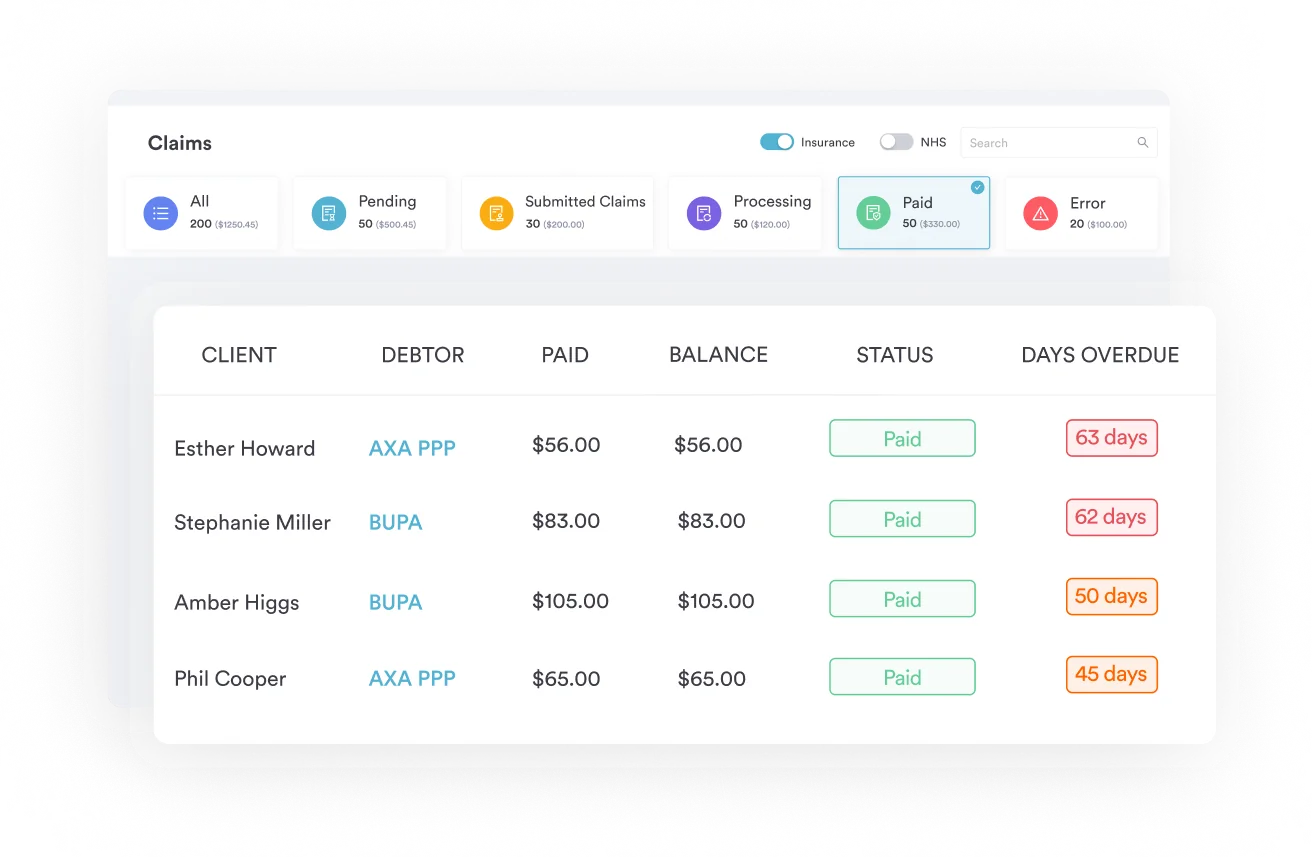

Pabau’s claim validation checks claims for missing or invalid details before submission. See how it fits your surgical complication billing.

Y83.9 rarely causes trouble on its own. Denials come from where it sits on the claim, and from records that can’t support it.
So build the checks into the work before submission. Pair Y83.9 with the right complication code, list it second, and confirm the record proves both the surgery and the causal link. When the record names the procedure, pick the specific Y83.x code instead.
The trade-off is a little more time at coding for fewer reworked claims later. Book a demo to see how Pabau catches incomplete claims before your surgical complication billing reaches the payer.

Need a framework for managing claim denials? Denial management in healthcare covers the end-to-end process for reducing and resolving claim rejections.
Want to understand what makes a claim pass edits? Clean claim submission explains the elements payers check before processing a surgical complication claim.
Looking for the full medical billing picture? What is medical billing walks through the complete workflow from patient encounter to payment posting.
Coding a complication from a non-surgical procedure? ICD-10 code Y84.9 covers an unspecified medical procedure as the cause of an abnormal reaction.
Reporting external cause status as well? ICD-10 code Y99.8 explains when to report other external cause status on a claim.
Yes. Y83.9 is currently valid and billable per the CDC/NCHS release. It can go on a claim only as an additional code, after the complication code.
No. Y83.9 is complete at four characters and takes no seventh character. The complication code it pairs with, such as T81.40XA, carries the encounter character instead.
Y83.9 points to a surgical operation of unknown type as the cause. Y84.9 points to an unspecified medical procedure that wasn’t an operation.
No. ICD-10-CM Official Guidelines Section I.C.20 bar external cause codes from the principal or first-listed position. A claim with Y83.9 in position 1 fails payer edits.
No. Y83 carries an Excludes1 note for misadventures, Y62-Y69. If an error in care occurred, code the misadventure instead of Y83.9.
There’s no national Medicare mandate for external cause codes. State rules and payer policies decide, so check each payer’s billing guide first.