ICD-10 code S31.30XD – Open wound of scrotum and testes
ICD-10 code S31.30XD covers a scrotal or testicular wound at follow-up ICD-10 co...

Last Updated: Nov 2, 2026
ICD-10 code Y66 is the billable ICD-10-CM external cause code for nonadministration of surgical and medical care. It records that care a patient needed was withheld, or stopped before it was complete.
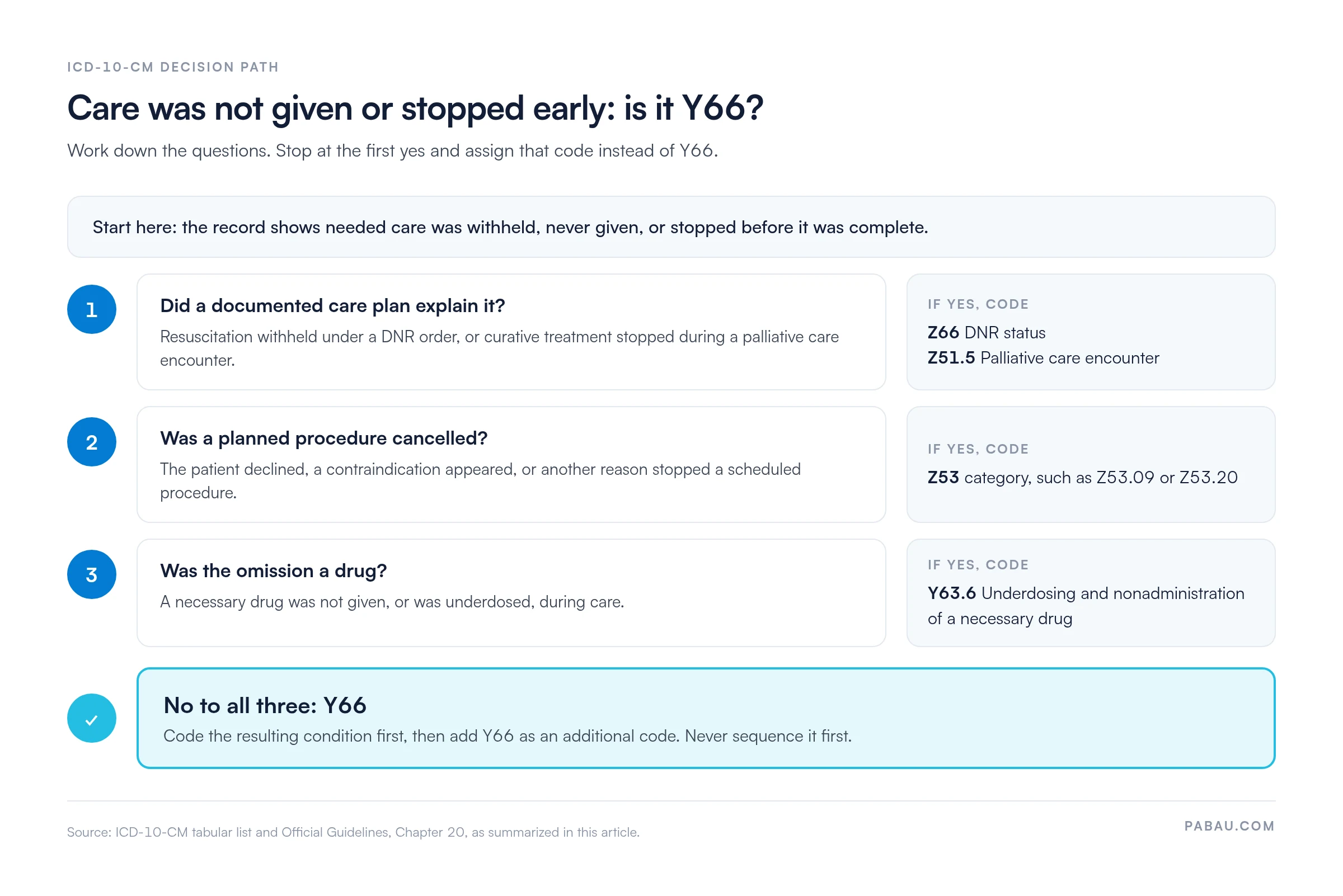
Its one inclusion term is premature cessation of surgical and medical care. Y66 is never the principal diagnosis, so it always follows the condition or complication that resulted. Care withheld under a DNR order (Z66) or during a palliative care encounter (Z51.5) is excluded.
Y66 also does not cover a planned procedure that was cancelled. A cancellation for a patient decision or a contraindication belongs in category Z53.

Y66 means nonadministration of surgical and medical care: necessary care that was withheld or stopped early. Its only inclusion term is premature cessation of care.
It is a billable Chapter 20 external cause code in block Y62-Y69, and it is never the principal or first-listed diagnosis.
Excludes1 notes keep Y66 off claims that report Z66 (DNR status) or Z51.5 (palliative care encounter), because care withheld under those plans is intentional.
A planned procedure cancelled for a patient decision, a contraindication, or another reason takes a Z53 code, not Y66.
Pabau’s practice management software keeps the treatment note behind each claim in the patient record. Its claims tools submit claims and track their status.
Use the table below to confirm the code’s core attributes before you assign it. Verify each annual release against the CDC/NCHS ICD-10-CM web tool before applying it to claims.
ICD-10 code Y66 classifies care a patient needed that was not given, or that was stopped before it was complete. The official descriptor is “Nonadministration of surgical and medical care.” WHO ICD-10 uses the same wording, so the code carries the same meaning outside the US.
Y66 sits in the misadventure block beside failed sterile precautions and dosing errors. Those codes describe an error made while care was delivered. Y66 describes care that was omitted or cut short. Any condition the omission caused is coded separately, from its own body-system chapter.
The ICD-10-CM tabular list carries one inclusion term and two Excludes1 notes under Y66. Check them against the CMS ICD-10-CM code files each year, because annual updates can change them.
An Excludes1 note means the codes are not reported together for the same circumstance. If a DNR order or a palliative care plan explains why care was withheld, code that situation and leave Y66 off the claim.
Y66 belongs to the external cause chapter, not a body-system chapter. That position decides how the code is sequenced on a claim.
Chapter 20 codes describe the circumstances around a health event rather than the event itself. The ICD-10-CM Official Guidelines for Coding and Reporting never allow an external cause code as the principal or first-listed diagnosis. A code from the relevant body-system chapter comes first.
The block runs from Y62 to Y69, but Y67 and Y68 do not exist. WHO ICD-10 uses the same Y66 descriptor, though its block is Y60-Y69 (ICD-10-CM starts at Y62).
Yes. ICD-10 code Y66 is a billable code with no subcodes, and it is valid on a claim as an additional code. Listing it as the principal or first-listed diagnosis breaks the Chapter 20 guidelines, and payer edits commonly reject it.
The guidelines set no national requirement to report external cause codes. Report Y66 when a state mandate or a payer requires it, or when your facility policy calls for it. For medical billing workflows that do report it, sequence the codes in this order:
Medicare and Medicaid follow the ICD-10-CM Official Guidelines on Chapter 20 sequencing. Commercial payers can add their own edits, so confirm payer-specific rules before the claim goes out.
Y66 rests on the provider’s documentation. A coder should not infer from the chart that care was withheld or stopped early. The note has to say so, and it should link the omission to its effect on the patient.
A supporting note should include five elements:
When any of these elements is missing, query the provider before you assign the code. Capturing them at the point of care also helps you submit a clean claim the first time, without a retrospective chart review.
Y66 fits a narrow set of situations. The table sets them beside the look-alike scenarios that need a different code.
The test that separates these rows is whether the omission was planned. Y66 records necessary care the patient did not receive. A cancellation, a refusal, or a documented care plan is a decision, and each one has its own code. The decision path below runs those checks in order.
The Y62-Y69 block holds six codes, and coders sometimes confuse Y66 with its neighbors. Y66 records care that was withheld or stopped early. The other specific codes record something that went wrong while care was delivered.
Y69 is reserved for a documented misadventure whose type cannot be named. When the record confirms that care was withheld or stopped early, Y66 is the specific code, and Y69 does not belong beside it. If the record is ambiguous, query the provider before assigning either code.
Our guide to Y69 covers when the unspecified code fits. The AAPC Codify ICD-10-CM reference lists current descriptors and exclusions for the whole block.
Run a quarterly audit of claims that carry Y66. Check each one for Z66 or Z51.5 on the same claim, and for a cancelled procedure that belongs in Z53. Either finding points to a coding error worth correcting before a payer or auditor finds it.
Most Y66 problems come from sequencing or scope rather than from the code itself. The table lists the patterns that surface most often, with a fix for each.
A denial management workflow that tags sequencing and scope errors separately lets the coding team fix them without clinical review. Our guide to medical billing denial codes explains the claim adjustment reason codes (CARCs) and remittance advice remark codes (RARCs) on a rejected claim.
In many practices, the evidence behind a Y66 code is scattered. The order sits in one system, the treatment note in another, and the claim in a billing tool. A coder then rebuilds the story weeks later.
In Pabau, treatment notes and consent forms live in the patient record. The note that explains why care stopped sits in the same system as the claim that reports it. Your coders read it there, then choose the codes.
For US practices, Pabau’s claims management software submits claims through Claim.MD and tracks their status. When a denial lands, your billing team opens the note behind the claim without chasing paper. The corrected claim goes back out sooner.
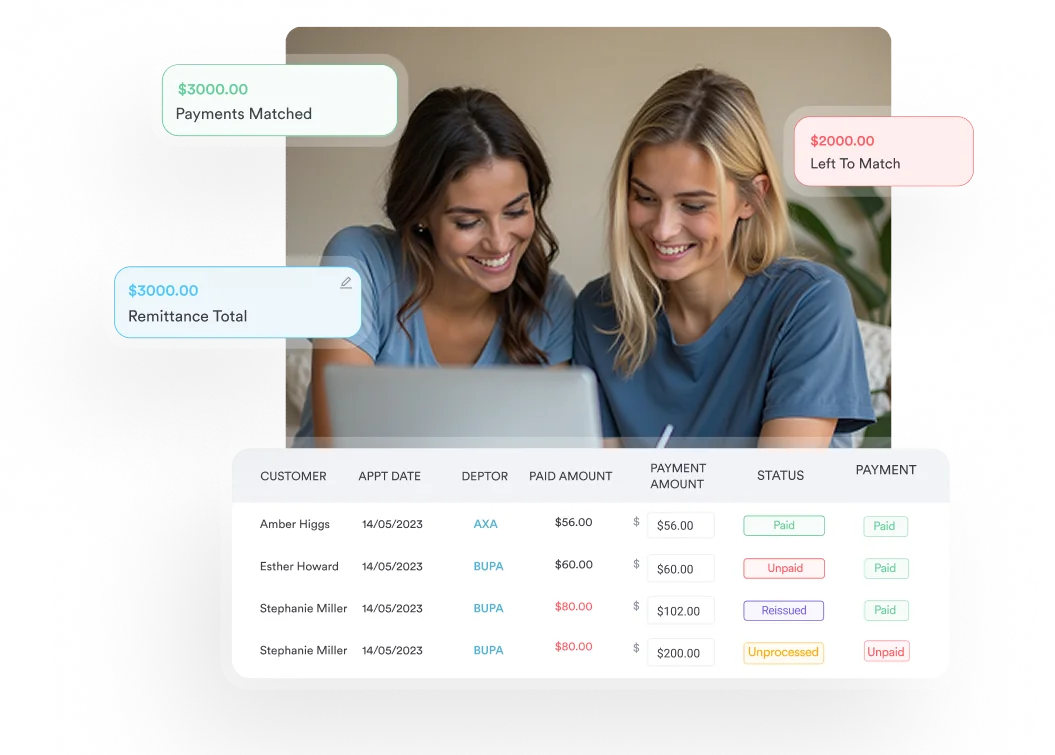

Pabau keeps treatment notes, claims, and claim status in one system, so your coders work from the record instead of chasing it. See how practices connect documentation and billing.

Before you add Y66, ask whether the record shows a decision to withhold care or a patient who missed care they needed. A documented decision points to Z66, Z51.5, or Z53, and Y66 stays off the claim.
The most useful habit starts with the provider. Ask for notes that say what care was withheld, why, and what followed, so coders can assign Y66 without a query. Book a demo to see how Pabau keeps clinical notes and claims in one place.

Coding an unspecified misadventure? ICD-10 code Y69 explains when the unspecified code fits and when a specific code applies.
Choosing how to submit claims? How Claim.MD works with Pabau explains how claims are submitted and their status tracked.
Want to see how denial tracking works across a practice? Revenue cycle management fundamentals covers how denial patterns feed back into coding and documentation.
Building encounter documentation for billing? Superbill documentation guide covers what an encounter record needs before a claim goes out.
ICD-10 code Y66 is the billable external cause code for nonadministration of surgical and medical care. It records necessary care that was withheld or stopped early. It sits in block Y62-Y69 of Chapter 20 and is never the principal diagnosis.
Use Y66 when the record confirms that necessary care was withheld or stopped early. Use Y69 only when a misadventure is documented but its type cannot be specified. If the record is unclear, query the provider before assigning either code.
Yes. Y66 has no subcodes and is valid on a claim. It is reported only as an additional code, after the condition or complication that the withheld care led to.
No. The ICD-10-CM Official Guidelines never allow a Chapter 20 external cause code as the principal or first-listed diagnosis. Code the resulting condition first, then add Y66.
No. A planned procedure not carried out because of a contraindication, a patient decision, or another reason takes a code from category Z53. Y66 covers necessary care that was withheld or stopped early.
Y66 carries two Excludes1 notes: do not resuscitate status (Z66) and encounter for palliative care (Z51.5). Care withheld under either one follows a documented plan, so Y66 is not reported with them.
The most common error is sequencing, with Y66 listed first. Others are a missing body-system diagnosis, Y66 used for a cancelled procedure, and Y66 reported alongside Z66 or Z51.5.