ICD-10 code I50.20: Unspecified systolic heart failure
ICD-10 code I50.20 covers systolic heart failure with no stated acuity ICD-10 co...

Last Updated: Nov 12, 2026
Billable Code Specific Code
T83.22XD is the billable ICD-10-CM code for displacement of graft of urinary organ, subsequent encounter. It applies when a graft used to repair or reconstruct part of the urinary tract has moved out of position.
Use 7th character D once active treatment is complete and the patient is receiving routine care during healing or recovery. Use T83.22XA for each encounter during active treatment. A displaced nephrostomy catheter is coded T83.022D, and a displaced ureteral stent is T83.122D, not T83.22XD.
Let Pabau's smart automation suggest the right codes, reduce claim denials, and keep your practice compliant—effortlessly.
Automate repetitive tasks and focus on what matters most—your patients.
Reduce coding errors and ensure compliance with the latest regulations.
Clean claims, fewer denials, and faster reimbursements.
Powerful insights and reporting to help your practice thrive.
HIPAA compliant SOC 2 certified GDPR-compliant Trusted by 4,000+ clinics worldwide

T83.22XD is the billable ICD-10-CM code for displacement of graft of urinary organ at a subsequent encounter.
The code describes a malpositioned graft used to repair or reconstruct part of the urinary tract. It does not describe a displaced catheter or stent.
A displaced nephrostomy catheter is coded T83.022D, and a displaced indwelling ureteral stent is T83.122D.
Use 7th character D once active treatment is complete and the patient is in the healing or recovery phase. Use A while active treatment continues.
Pabau’s practice software sends US claims through Claim.MD, with eligibility checks and electronic remittances in the same workflow.
ICD-10 code T83.22XD is a valid, billable ICD-10-CM code with the official descriptor “Displacement of graft of urinary organ, subsequent encounter.” It sits in Chapter 19 (S00-T88), under category T83 for complications of genitourinary prosthetic devices, implants and grafts.
The CDC/NCHS ICD-10-CM web tool lists the code as active and reportable. Use it only when three facts line up. The device is a graft of a urinary organ, the complication is displacement or malposition, and active treatment is already complete.
A graft of a urinary organ is tissue or graft material placed to repair or reconstruct part of the urinary tract. Reconstructive procedures on the ureter, bladder, or urethra can all involve a graft. Displacement means the graft has moved out of the position the surgeon placed it in.
The T83.2 subcategory separates the ways a graft can fail mechanically. Breakdown, displacement, leakage, erosion, and exposure each have their own code. T83.22XD applies only when the record describes the graft as displaced or malpositioned.
The subsequent encounter character is what makes this T83.22XD rather than T83.22XA. It fits visits after active treatment of the displacement is complete, while the patient is healing or recovering. Follow-up imaging, a postoperative check, or routine monitoring of a repaired graft are typical examples.
The 7th character for T83.22X follows the Chapter 19 rules in the Official Guidelines for Coding and Reporting, Section I.C.19.a. All three characters describe the same displaced graft. They differ only in where the patient is in the course of care.
The CMS ICD-10 codes page hosts the annual Official Guidelines as a free download. Section I.C.19.a is the reference to cite when an auditor questions encounter character selection.
Active treatment decides the 7th character, whatever the visit’s place in the sequence. Use A for every encounter where the patient is receiving active treatment for the displaced graft. A third or fourth visit still takes A while active treatment is under way.
Use D once active treatment is complete and the visit is routine care during healing or recovery. For complication codes, the guidelines tie active treatment to the complication itself. A related earlier procedure does not decide the character.
T83.22XD sits inside a clear hierarchy. Knowing each level helps you avoid a non-billable parent code and avoid a sibling built for a different failure. The CDC/NCHS tool shows the full T83 tree.
The other T83.2 codes describe different mechanical failures of the same graft. Each one carries the same A, D, and S characters:
Most T83.22XD errors start with the wrong device. Displacement codes exist for catheters, stents, and other urinary devices, and each sits in its own subcategory. The AAPC ICD-10-CM lookup lets you compare descriptors side by side before you code.
The three checks below put the device, the complication, and the encounter phase in order. A wrong answer at any step names the code to use instead.
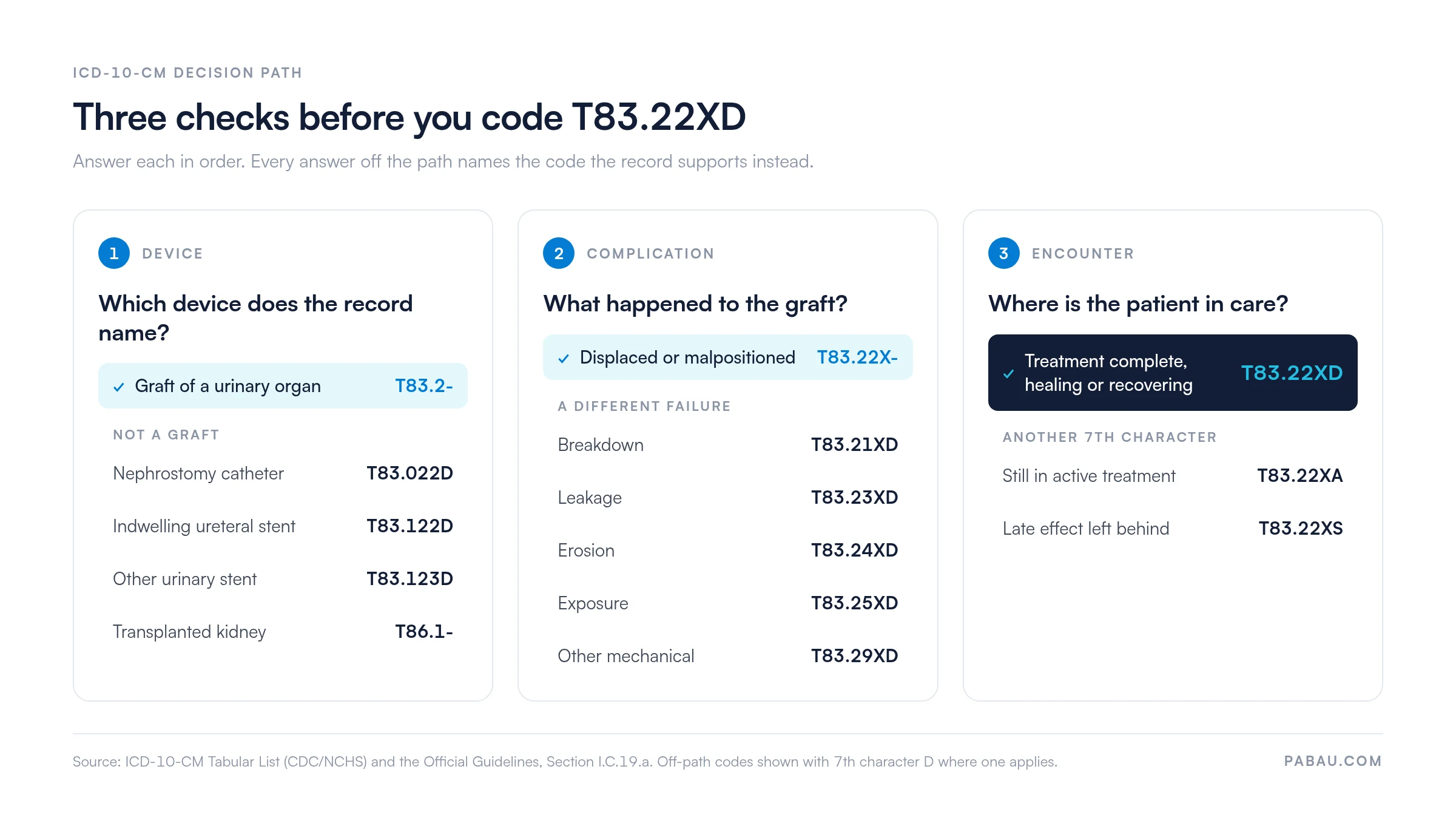
Before you assign T83.22XD, run a three-point check. Confirm the record names a graft of a urinary organ, not a catheter or stent. Confirm the complication is displacement or malposition. Then confirm active treatment is complete and the visit is part of healing or recovery.
Payers reviewing T83.22XD claims look for a documentation chain that runs from the graft to the visit being billed. Medical billing compliance for this code means the record establishes each element below before the claim leaves the practice.
An external cause code is not required to report T83.22XD. The T83 code already identifies the condition as a complication of a graft. Many coders still add a Y83 code to show which procedure led to the complication.
For a displaced graft, Y83.2 fits most often. It covers a surgical operation with anastomosis, bypass or graft as the cause of a later complication. Payers handle Y codes inconsistently, so confirm their guidance before you add one.
Medicare and commercial payers set their own expectations for T83.22XD claims. Missing one of them is a more reliable denial trigger than the encounter character. Outpatient follow-up is paid under the Medicare Physician Fee Schedule, while inpatient stays fall under MS-DRG assignment.
Pabau submits US claims through the Claim.MD clearinghouse as CMS-1500 and 837P claims. Eligibility checks run before the visit, and electronic remittances come back after payment. If the clearinghouse step is new to your team, medical billing fundamentals shows where it sits between coding and payment.
T83.22XD denials cluster around a few avoidable errors. The table maps each one to its root cause and a prevention step. Denial management workflows and the wider list of denial codes in medical billing show where these edits sit in the revenue cycle.
Audit every T83.22XD claim before submission. Confirm the note names a graft, not a catheter or stent. Check that the record uses the word displacement or malposition. Then confirm the 7th character against whether active treatment was still under way at that visit.
In many practices the graft details live in an operative note, while the claim is built later at the billing desk. A coder reads the note days after the visit and picks the code. If the note names the device loosely, a displaced graft can go out as a displaced catheter.
Pabau keeps clinical notes, appointments, and billing in one record. The coder works from the same chart the surgeon wrote. Claims go to US payers through Claim.MD as CMS-1500 and 837P submissions, with eligibility checks before the visit.
Remittances come back into the same system, so your team can see which claims paid and which were denied. Every Pabau subscription includes the full feature set, with structured onboarding to get your billing team started.

Pabau keeps clinical documentation and US claims in one system. Claims go through Claim.MD as CMS-1500 and 837P submissions, with eligibility checks and electronic remittances built in.

T83.22XD describes one situation: A displaced graft of a urinary organ at a subsequent encounter. The most costly mistake is treating it as a catheter or stent code. A displaced nephrostomy catheter belongs under T83.022D, and a displaced ureteral stent under T83.122D.
Once the device is right, the 7th character follows the patient’s course of care. Report A while active treatment continues and D once the patient is healing or recovering. Pabau’s claims management software keeps the note behind that choice in the same record as the claim. To see it in your urology or surgical practice, book a demo.

Need to understand how clearinghouse submission works for ICD-10 claims? Understanding the Claim.MD clearinghouse explains how electronic claims are validated and routed to over 4,000 US payers.
Looking for guidance on the electronic remittance process after submission? Electronic remittance advice explained covers how to read ERA files and reconcile denial reason codes.
Want a framework for reducing claim rejections across your whole billing workflow? What is revenue cycle management maps the end-to-end process from patient registration through final payment posting.
ICD-10 code T83.22XD means displacement of graft of urinary organ, subsequent encounter. It applies when a graft placed to repair or reconstruct part of the urinary tract has moved out of position. The D character applies once active treatment is complete and the patient is healing or recovering.
No. T83.22XD covers a displaced graft of a urinary organ, not a catheter. A displaced nephrostomy catheter at a subsequent encounter is T83.022D. A displaced indwelling ureteral stent is T83.122D.
Use T83.22XA for each encounter where the patient receives active treatment for the displaced graft. That can include more than one visit. Use T83.22XD once active treatment is complete and the visit is routine care during healing or recovery.
Yes. T83.22XD is a billable, specific ICD-10-CM code with all seven characters. Its parent codes, T83.22 and T83.2, are not billable on their own.
All three describe a displaced graft of a urinary organ. T83.22XA covers encounters during active treatment, and T83.22XD covers routine care during healing or recovery. T83.22XS covers a late effect that remains after the displacement was treated.
No. An external cause code is not required with T83.22XD. Many coders add Y83.2 to show that a surgical operation with a graft caused the later complication. Confirm payer guidance before adding it.
The most common causes are a wrong device subcategory, such as coding a nephrostomy catheter as a graft. Others are a wrong 7th character, missing displacement documentation, and the wrong mechanical complication. Weak medical necessity notes and bundling edits also cause denials.