ICD-10 code Z64.1: Problems related to multiparity
ICD-10 code Z64.1 covers problems related to multiparity ICD-10 code Z64.1 carri...

Last Updated: Nov 19, 2026
Billable Code Specific Code
Y83.0 is the billable ICD-10-CM code for a whole organ transplant that caused an abnormal reaction or later complication, without misadventure.
It's an external cause code, so it explains why the complication happened rather than what it is. The complication code, such as T86.11 for kidney transplant rejection, goes first and Y83.0 follows. External cause codes are never the principal diagnosis, and a claim that lists Y83.0 first may be rejected or denied under payer edits.
Let Pabau's smart automation suggest the right codes, reduce claim denials, and keep your practice compliant—effortlessly.
Automate repetitive tasks and focus on what matters most—your patients.
Reduce coding errors and ensure compliance with the latest regulations.
Clean claims, fewer denials, and faster reimbursements.
Powerful insights and reporting to help your practice thrive.
HIPAA compliant SOC 2 certified GDPR-compliant Trusted by 4,000+ clinics worldwide

Y83.0 is a billable external cause code that names a whole organ transplant, done without error, as the cause of a later complication.
It never goes first on a claim. The complication code, such as T86.11 for kidney transplant rejection, leads and Y83.0 follows.
A documented error during surgery moves the case to the Y60-Y69 misadventure block, and a non-surgical procedure moves it to Y84.
There’s no national mandate to report external cause codes, so check which payers and state programs ask for them.
Pabau sends US claims through Claim.MD, with eligibility checks and remittances kept on the same patient record.
ICD-10 code Y83.0 is a billable external cause code for a complication caused by a whole organ transplant performed without error. The FY 2026 ICD-10-CM Official Guidelines place it in Chapter 20, whose codes are never sequenced as the first-listed or principal diagnosis. So it always rides behind the code for the complication itself.
The official descriptor spells out that scope in full.
Surgical operation with transplant of whole organ as the cause of abnormal reaction of the patient, or of later complication, without mention of misadventure at the time of the procedure.
The phrase “without mention of misadventure” carries the weight. Y83.0 fits when the transplant went as planned and the patient still had a bad outcome. If the record documents an error, you’re in the Y60-Y69 misadventure block instead.
Think of an instrument left in the body or surgery on the wrong site. A retained instrument takes Y61, and a wrong procedure or site takes a Y65.5- code.
Y83.0 applies when a whole organ transplant, performed without error, is documented as the cause of the patient’s later problem. “Whole organ” is the test, and these transplants pass it.
The complication itself, such as acute rejection or graft failure, is coded first. The guidelines ask for two codes to describe a transplant complication: a T86 code and a second code that names the complication. A rejected kidney, for example, takes T86.11. Y83.0 then follows as the external cause.
Most wrong Y83.0 assignments come from one of these boundaries. Check each before you settle on the code.
Y83.0 is one of nine Y83 subcodes, running from Y83.0 to Y83.6 plus Y83.8 and Y83.9. There’s no Y83.7. Each one maps to a different type of surgery, and the table compares Y83.0 with the ones it’s most often confused with.
Two fallback codes sit at the edges. When the operative note doesn’t say what kind of surgery was done, Y83.9 is the unspecified option. When the procedure wasn’t surgical and the record doesn’t name it, Y84.9 plays the same role. The decision flow below puts the whole choice on one page.
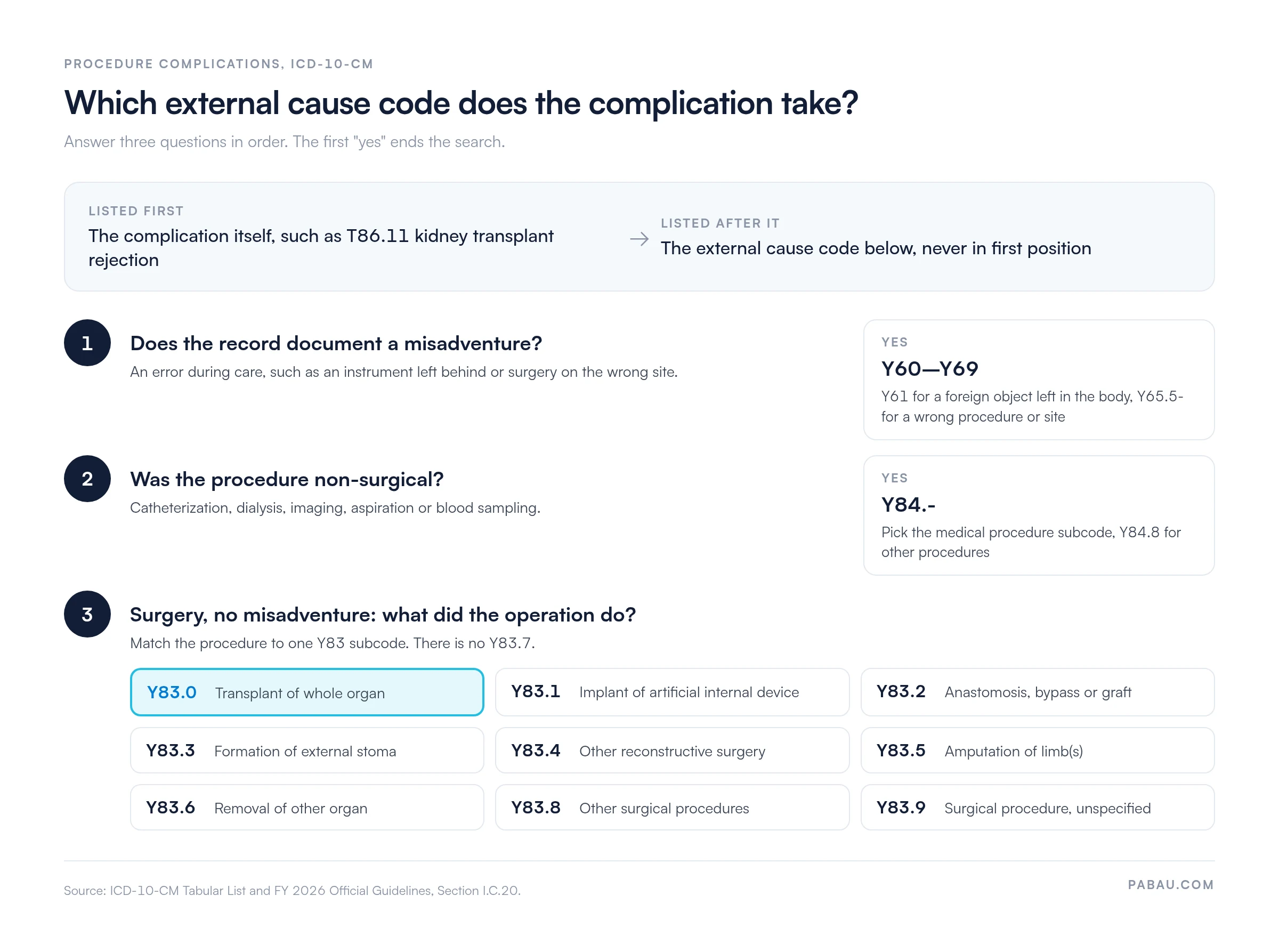
The split between Y83.0 and Y83.1 catches coders most often. A kidney transplant uses Y83.0. A ureteral stent placed in the same operation uses Y83.1 for any stent-related complication, because a stent is an artificial internal device. When one episode involves both, each complication gets its own external cause code.
External cause codes never explain why the patient came in. They explain why the complication exists. Work through the record in this order.
Run a two-point check on every claim that carries Y83.0. Is there a condition code in first position that names the complication? Does the operative note name the transplanted organ? Those two answers settle most Y83.0 questions before the claim leaves the practice.
Here’s how an illustrative encounter codes out. A patient who received a deceased-donor kidney in the spring is admitted with rising creatinine. A biopsy confirms acute rejection, and the nephrologist writes that the rejection is a complication of the transplant.
T86.11 goes in first position, because rejection is the reason for the stay. Y83.0 follows, since the operation itself caused the reaction and nobody documented an error. If the same note had mentioned a sponge left in the abdomen, Y61 would replace Y83.0 for that complication.
Now change one detail. The patient’s ureteral stent is blocked, and that’s what brings them in. The transplant is still the background, but the stent is a device, so the external cause becomes Y83.1.
Supporting Y83.0 takes documentation in two places: the operative note and the encounter or discharge record. The guidelines base code assignment on the provider’s documented link between the condition and the care, so the record has to make that link.
ICD-10-CM guidelines bar external cause codes from the principal or first-listed position, and payers build edits around that rule. A claim with Y83.0 listed first may be rejected or denied under payer edits. How strict those edits are varies by payer and clearinghouse.
There’s also no national requirement to report external cause codes at all. You report them when a state mandate or a payer calls for them, and voluntarily otherwise. Knowing which of your payers expects Y codes tells you where a missing or misplaced Y83.0 can cost you.
Most of these problems trace back to the same two habits: sequencing and documentation. If rejections keep coming back on transplant claims, a structured denial management process shows you which of the five rows is costing you most.
Ask your clearinghouse which edits it runs on external cause codes. Some clearinghouses may flag a Y code in first position before the claim reaches the payer. Fixing sequencing at that stage takes minutes, while fixing it after a denial takes days.
A clean claim for a transplant complication needs the right codes in the right order, backed by the right note. Run through these five points before it goes out.
For the descriptor and any Excludes notes, the AAPC Codify ICD-10-CM lookup is a quick check. The ICD List reference tool shows the neighboring Y83 codes side by side. Our ICD-10-CM code library covers the complication codes you’ll pair with it.
Transplant follow-up care means a lot of visits. Each rejection workup, biopsy review or infection visit produces a claim, and each one needs the complication code first. When billing lives in a separate portal, staff retype codes from the visit note, and sequencing slips there.
Pabau, a practice management platform, keeps the visit, the invoice and the claim on one patient record through its claims management for practices. In the US, claims go out as CMS-1500 or 837P files through Claim.MD. Eligibility checks run before the visit, and electronic remittances come back against the invoice.
When a payer rejects a claim, the remittance shows it on the record your coder already works from. Secondary claims go out from the same place, so follow-up doesn’t start from a blank form.

Pabau’s claims management sends US claims through Claim.MD, runs eligibility checks and brings remittances back to the invoice. See how it fits your transplant follow-up billing.

Y83.0 rarely causes trouble on its own. Problems come from where it sits on the claim and what the operative note says about the organ. Put the complication code first, get the causal link into the record, and the Y code does its quiet job.
Before you build a workflow around it, find out which payers and state programs ask for external cause codes. Where nobody requires them, Y83.0 is still worth reporting for clean data, but it shouldn’t hold up a claim.
Book a demo to see how Pabau keeps transplant follow-up claims, eligibility checks and remittances on one patient record.

Need a full framework for managing claim denials? Denial management in healthcare covers how to spot, appeal and prevent recurring claim rejections.
Want to know what makes a claim clean before it leaves the practice? Clean claim submission breaks down what payers check before adjudication.
Coding the rejection itself? ICD-10 code T86.11 covers kidney transplant rejection, the code that goes in front of Y83.0.
Looking for the bigger picture on ICD-10-CM coding and revenue? What is revenue cycle management explains where diagnosis coding sits in the payment workflow.
No. Y83.0 is a complete, billable code at four characters. Many Chapter 20 categories take an A, D or S seventh character, but Y83 doesn’t, so you report Y83.0 as it stands.
No. The guidelines say a status code isn’t used when the complication code already carries that information. Their own example is Z94.1, heart transplant status, which isn’t reported with a T86.2 heart transplant complication code.
Not nationally. ICD-10-CM has no national requirement to report external cause codes. You report them when a state mandate or a payer requires them, and the guidelines encourage voluntary reporting otherwise.
Yes. The descriptor covers a “later complication” and sets no time limit. What matters is that the provider links the complication to the transplant, whether it shows up in week one or year ten.
No. A T86 code describes the complication, such as rejection or failure. Y83.0 only records that the transplant surgery caused it, so it supports the T86 code rather than replacing it.