ICD-10 code Y83.0: Surgical operation with whole organ transplant
ICD-10 code Y83.0 names the transplant as the cause, not the problem ICD-10 code...

Last Updated: Nov 19, 2026
Billable Code Specific Code
Z64.1 is the billable ICD-10-CM code for problems related to multiparity. It records that a patient's number of previous births, including grand multiparity, is creating a problem the clinician has documented.
The Alphabetic Index sends grand multipara status in a patient who is not pregnant to Z64.1. During prenatal supervision, grand multiparity is coded to O09.4- instead, so pregnancy status decides the code.
Let Pabau's smart automation suggest the right codes, reduce claim denials, and keep your practice compliant—effortlessly.
Automate repetitive tasks and focus on what matters most—your patients.
Reduce coding errors and ensure compliance with the latest regulations.
Clean claims, fewer denials, and faster reimbursements.
Powerful insights and reporting to help your practice thrive.
HIPAA compliant SOC 2 certified GDPR-compliant Trusted by 4,000+ clinics worldwide

Z64.1 is the billable ICD-10-CM code for problems related to multiparity, a psychosocial circumstance code in category Z64.
The Alphabetic Index sends grand multipara status in a patient who is not pregnant to Z64.1, and prenatal supervision for grand multiparity to O09.4-.
Chapter 15 codes take sequencing priority in pregnancy, so Z64.1 mostly appears on contraception, postpartum, gynecology and social care encounters.
A birth count alone doesn’t support the code, so the record has to name the problem that the number of births is causing.
Pabau, a practice management platform, keeps the clinician’s notes on the patient record and submits US claims through Claim.MD on 837P.
ICD-10 code Z64.1 carries the official descriptor “Problems related to multiparity.” You report it when a patient’s number of previous births is causing a problem that a clinician has written down. It is a valid, billable code in the FY 2027 ICD-10-CM tabular, which took effect on October 1, 2026.
The code sits in Chapter 21, “Factors influencing health status and contact with health services” (Z00-Z99). Within it, Z64.1 belongs to the block for persons with potential health hazards related to socioeconomic and psychosocial circumstances (Z55-Z65).
That placement tells you what kind of code it is. Z64.1 describes a circumstance in the patient’s life, not a complication of a pregnancy.
Multiparity means a patient has given birth more than once. Many obstetric texts define grand multiparity as five or more previous births, though definitions vary. ICD-10-CM sets no number, so code from the clinician’s wording rather than from a threshold of your own.
The descriptor says “problems related to,” and that word carries the weight. A parity count in the history doesn’t support Z64.1 on its own. The official guidelines make the same point about other social codes, using living alone as the example. Living alone supports Z60.2 only when a documented risk or unmet need goes with it.
In practice, Z64.1 tends to show up in encounters like these:
The Alphabetic Index splits multiparity by whether the patient is pregnant. “Grand multipara status only (not pregnant)” goes to Z64.1. “Multiparity, affecting management of pregnancy, labor and delivery (supervision only)” goes to O09.4-, Supervision of pregnancy with grand multiparity.
The decision path below shows where each branch lands.
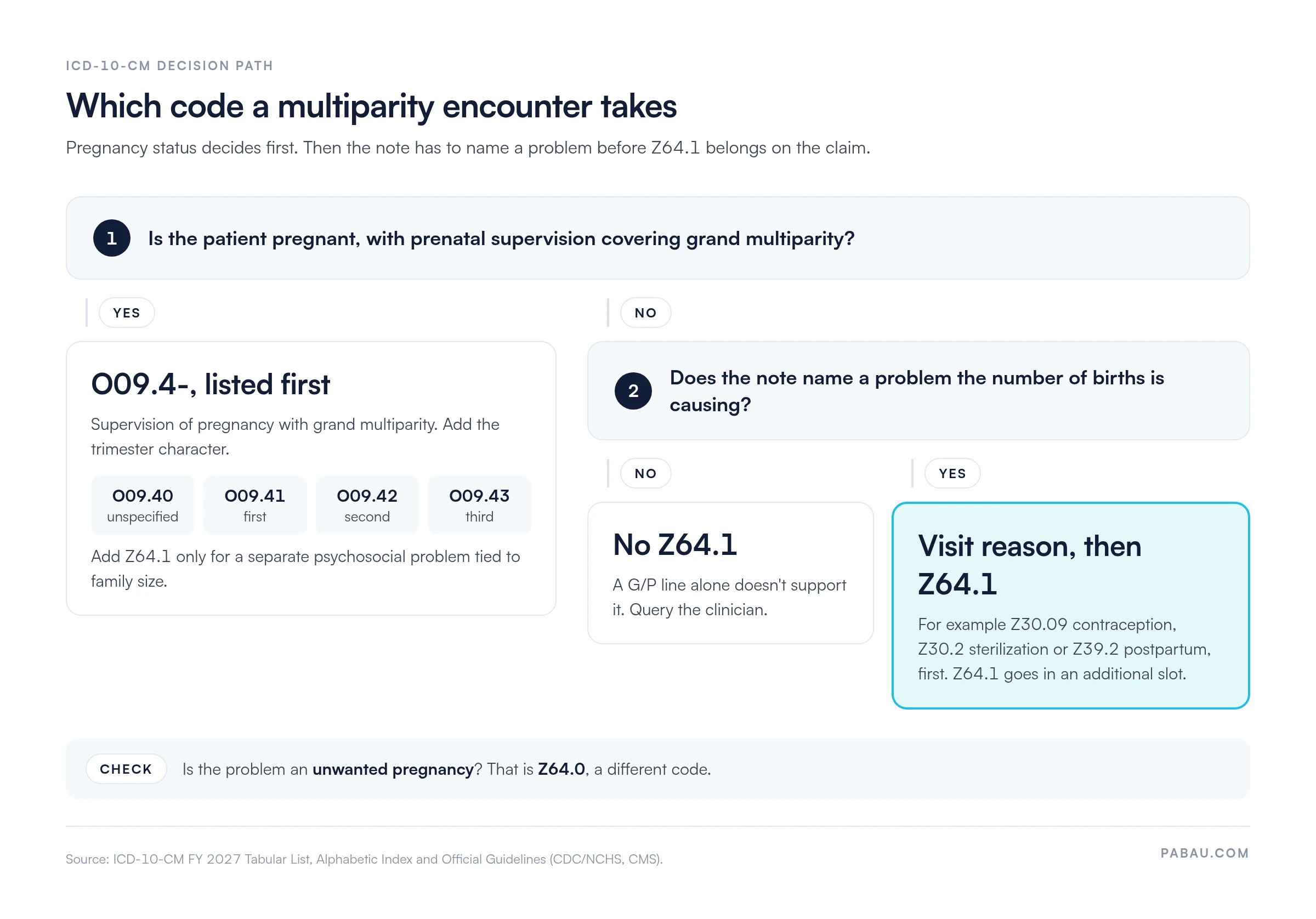
The guidelines back that split up. Chapter 15 codes have sequencing priority over codes from other chapters. For routine prenatal visits in a high-risk pregnancy, a code from category O09 is listed first. O09.4- then needs its trimester character: O09.40 unspecified, O09.41 first, O09.42 second and O09.43 third.
Can Z64.1 sit next to O09.4- on the same claim? The tabular doesn’t forbid it, because Z64.1 has no Excludes1 note. But the two codes would report the same fact twice. Add Z64.1 there only when the record names a separate psychosocial problem tied to family size.
With the code choice settled, here’s the route a typical outpatient claim takes. Each step is a place where the code can drop off or land in the wrong slot.
Z64.1 rarely drives payment by itself. Its job is to explain the circumstances around the visit, so the first-listed code still carries medical necessity.
Z64.1 is a social code, and the guidelines treat social codes differently from medical diagnoses. For categories Z55-Z65, coders may use documentation from clinicians who aren’t the patient’s provider. That includes social workers, community health workers, case managers and nurses, if their notes are part of the official record.
Patient self-reported information counts too, as long as a clinician or provider signs it off and incorporates it into the record. So a signed intake questionnaire can support the code. A form nobody has reviewed can’t.
Whoever writes it, the record should show:
Write the note at the point of care. Adding the problem after the claim is built is an audit risk, and it rarely reads convincingly. Good claims management software keeps the note and the claim on the same record, so the coder isn’t working from memory.
The official guidelines list category Z64 among the Z codes for social determinants of health (SDOH), alongside Z55 to Z63 and Z65. Neighbors in that range include Z55.5, less than a high school diploma, and Z60.8, other problems related to social environment. The guidelines tell coders to assign as many SDOH codes as needed to describe the social problems documented in the current episode of care.
For a practice, that means Z64.1 belongs on the claim whenever the record supports it, even when it doesn’t change the payment. CMS publishes a Z codes infographic that walks through collecting, documenting and coding this kind of information. It’s a useful handout for front-desk and clinical teams who gather the details.
Most problems with this code come from mixing it up with its neighbors, or from older reference material. Here are the ones coders run into most, with the fix for each.
Category Z64 is small in the US version, with just three codes. Z64.0 is problems related to unwanted pregnancy. Z64.1 is problems related to multiparity. Z64.4 is discord with counselors, which includes discord with a probation officer or social worker.
The WHO ICD-10 browser shows more Z64 subcodes, but those don’t apply to US claims. For US work, check the code in the CDC/NCHS ICD-10-CM browser tool and the files on the CMS ICD-10 page. Our diagnostic codes guide collects the other ICD-10-CM code pages, Chapter 21’s Z codes included.
The hardest part of coding Z64.1 is having the right note in front of the coder. When the parity problem lives in one system and the claim in another, the code either gets missed or gets added without support.
Pabau keeps the clinician’s notes and the patient’s claims on the same record. For US practices, it submits claims through its Claim.MD integration as CMS-1500/837P claims. It also runs eligibility checks and brings ERA remittances back against the claim, so the coder sees whether Z64.1 rode along without trouble.
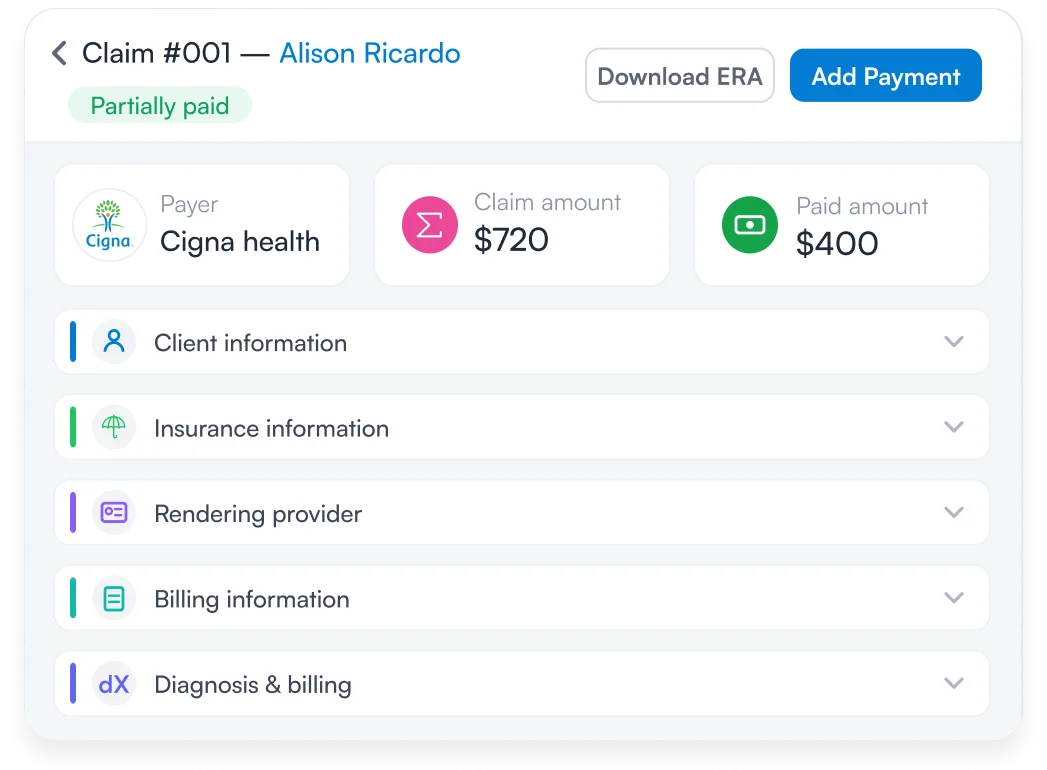

Pabau keeps clinical notes and claims on the same patient record. US claims go out through Claim.MD on 837P, and ERA remittances come back against them. See how it works for your team.

Z64.1 is a narrow code, and that’s its strength. It tells a payer that a patient’s number of births is shaping their care, when no obstetric code is in play to say so.
Get two questions right and the rest follows. Is the patient pregnant, and does the note name a problem? If you’re coding these encounters often, book a demo to see how Pabau keeps the note and the claim together.

Want the whole billing workflow behind obstetric claims? Revenue cycle management basics covers the end-to-end process from encounter to payment posting.
Seeing repeated denials on Z-code claims? Denial codes in medical billing explains the most common CARC reasons and how to respond to each.
Want to understand how the clearinghouse validates your claims? 837 file format and submission breaks down how electronic claim files are structured and validated before reaching payers.
Use Z64.1 when the patient isn’t pregnant and the record documents a problem related to multiparity. During prenatal supervision, grand multiparity is coded to O09.4-, with the fifth character showing the trimester.
Unwanted pregnancy is Z64.0, Problems related to unwanted pregnancy. It sits next to Z64.1 in category Z64, and the two are easy to swap by mistake.
It’s gravida/para notation. G5 means five pregnancies, and P5 means five pregnancies carried to 20 weeks or beyond. The notation records parity, but it doesn’t support Z64.1 unless the note also names a problem.
Yes. For Z55-Z65 codes, the official guidelines allow documentation from nurses, social workers, case managers and community health workers in the official record. Signed-off patient self-report also qualifies.
A multigravida has been pregnant more than once, whatever the outcome. A multipara has carried more than one pregnancy to 20 weeks or beyond. Z64.1 follows the birth history, so a multigravida with one birth doesn’t fit it.