ICD-10 Code Y78.0: Radiological device malfunction
ICD-10 Code Y78.0: Definition and official descriptor ICD-10 Code Y78.0 is the b...

Last Updated: Nov 3, 2026
Billable Code Specific Code
Y72.2 is the billable ICD-10-CM code for prosthetic and other implants, materials and accessory otorhinolaryngological devices associated with adverse incidents. It is a supplementary external cause code that reports a cochlear implant, voice prosthesis or other ENT implant as the source of harm.
Denials tied to this code usually trace to two mistakes. Coders sequence it as the primary diagnosis (it cannot be), or they omit a documented primary condition code.
Let Pabau's smart automation suggest the right codes, reduce claim denials, and keep your practice compliant—effortlessly.
Automate repetitive tasks and focus on what matters most—your patients.
Reduce coding errors and ensure compliance with the latest regulations.
Clean claims, fewer denials, and faster reimbursements.
Powerful insights and reporting to help your practice thrive.
HIPAA compliant SOC 2 certified GDPR-compliant Trusted by 4,000+ clinics worldwide

Y72.2 is a supplementary external cause code, so it always follows a primary diagnosis code and never stands alone on a claim.
The code covers prosthetic and implanted ENT devices such as cochlear implants, voice prostheses and nasal implants. Diagnostic and therapeutic ENT devices have their own codes.
A record that never names the device or describes the adverse incident leaves the payer no basis to accept Y72.2.
A displaced cochlear implant electrode codes to T85.628A first, with Y72.2 added as the external cause.
ICD-10 Code Y72.2 is a supplementary external cause code that reports a prosthetic or implanted ENT device as the source of an adverse incident. It always follows the code for the complication it caused, and the table holds its reference details.
ICD-10 Code Y72.2 identifies the external cause when a prosthetic or implant-type otorhinolaryngological device is associated with an adverse incident. In practice, an adverse incident means the device malfunctioned, broke down, was used outside its intended purpose, or otherwise harmed the patient.
The code does not describe the patient’s resulting injury or condition. It tells payers and epidemiological registries that the event was device-related and which ENT device category was involved. The primary diagnosis code carries the clinical description of what happened to the patient. That is typically a T-code from Chapter XIX, or a complication code from another category.
Three distinctions matter for correct assignment:
The hierarchy shows where Y72.2 sits beside its siblings, so you can rule out Y72.0, Y72.1 and Y72.3 before you assign it.
The subcategory turns on what the device was doing when the incident happened. If the ENT device was used for surgical access (instruments, drills, retractors), Y72.3 applies. If it was used to monitor or measure (audiometers, tympanometers), Y72.0 is the correct choice.
Y72.2 applies only when the device is implanted, prosthetic, or serves as a materials-based replacement. The chart below maps each device role to its code and shows where the code lands on the claim.
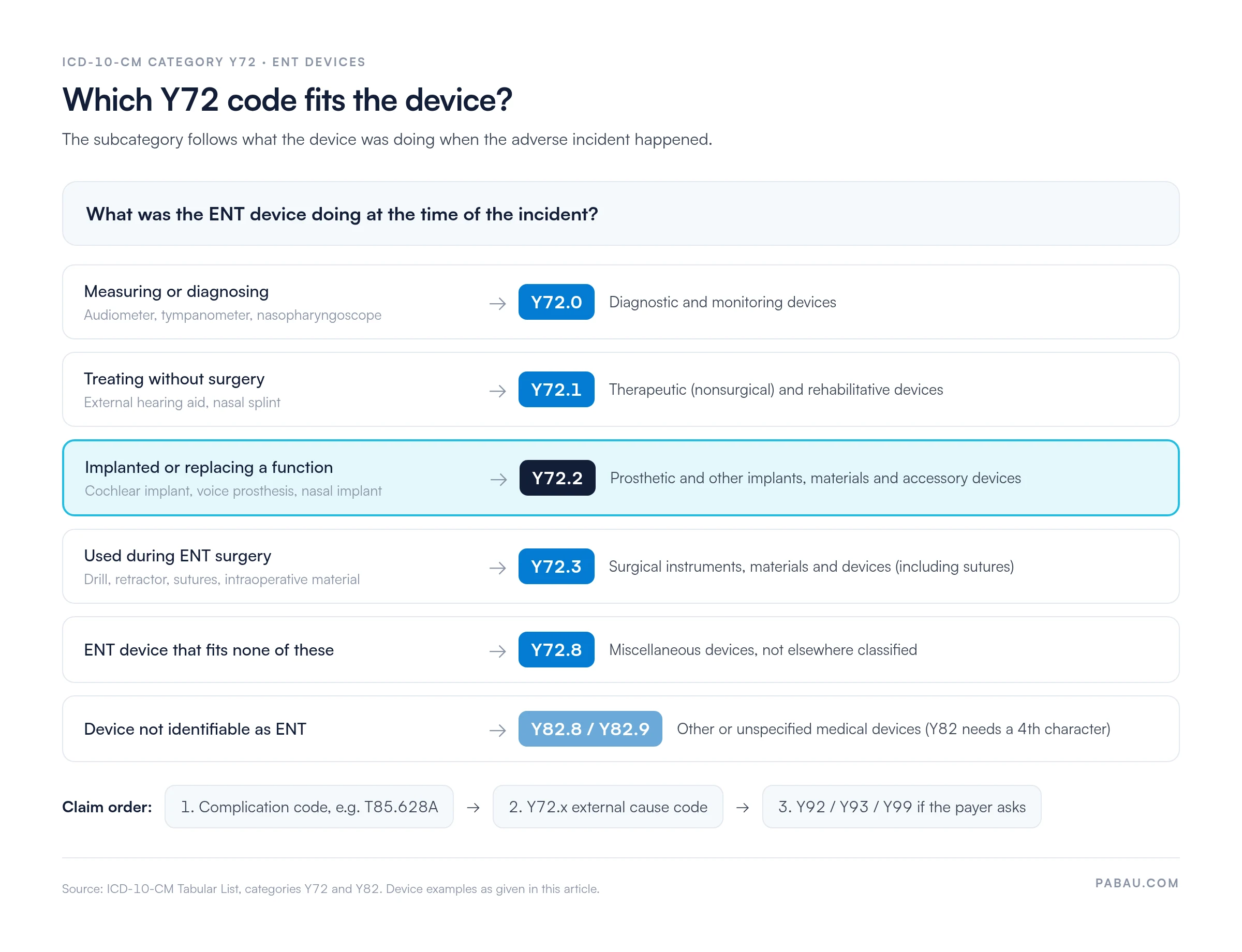
Y72.2 covers prosthetic and implant-type ENT devices associated with adverse incidents. The following device types fall within its scope when they are linked to an adverse event:
As a practical working description, a reportable adverse incident includes malfunction, unexpected breakage, device failure leading to patient harm, device-tissue incompatibility, and documented misuse. Routine device maintenance visits, scheduled device checks without a documented adverse event, and prophylactic follow-up do not warrant Y72.2.
The decision table below covers the codes most commonly confused with Y72.2. Choosing between them hinges on two questions. What type of device was involved, and what was its intended function at the time of the adverse incident?
Y82.8 and Y82.9 are the fallback of last resort. Y82 itself is a non-billable category header that requires a 4th character. Y82.8 covers other medical devices, and Y82.9 covers unspecified ones. According to the CMS ICD-10 coding guidance, coders should assign the most specific code available. If the device can be identified as otorhinolaryngological, Y72.x always takes precedence over Y82.8 or Y82.9.
Before assigning Y72.2, review the operative note or device incident report to confirm the device is explicitly described as implanted, prosthetic, or materials-based. A device listed as external or non-implanted routes to Y72.1 or Y72.0. Confirm device type in writing before submitting.
Per the ICD-10-CM Official Guidelines for Coding and Reporting, Chapter XX external cause codes are supplementary. They are never assigned as the principal diagnosis in inpatient coding or as the first-listed diagnosis in outpatient coding.
Build the code set in this order:
Medical billing compliance starts with documentation. For Y72.2, the medical record must support every element of the code’s descriptor. It must show that a prosthetic otorhinolaryngological device was involved and that an adverse incident occurred.
Sound medical billing fundamentals mean the record tells the same story the code tells. A reviewer who reads Y72.2 and then opens the note should find a prosthetic ENT device named as the source of the adverse event.
Y72.2 payer requirements vary by payer type and MAC region. No universal prior authorization obligation applies specifically to this code, but its presence on a claim can trigger secondary review in several scenarios.
For Medicare claims, the code falls under the CMS external cause framework. Medicare does not reimburse for Y72.2 alone, since it cannot serve as a primary diagnosis. When Y72.2 accompanies a valid primary T-code or complication code, reimbursement follows the primary code’s Local Coverage Determination (LCD).
Device-related coverage determinations can vary by MAC region, so verify applicable LCDs with your Medicare Administrative Contractor. Thorough insurance eligibility verification before the encounter confirms whether prosthetic ENT device services need prior authorization.
Many commercial payers require explicit medical necessity language in the clinical notes for the primary diagnosis before they process a claim that includes Y72.2. When a prosthetic device failure is the basis for the claim, some plans also ask for a device incident report or a manufacturer malfunction report.
Y72.2 denials tend to fall into five categories. Effective denial management workflows start by sorting each rejection into one of them, so the fix targets the right failure point.
Checking Y72.2 rejections against the standard denial codes helps billing teams match each one to its CARC and route the appeal correctly. Sequencing denials commonly carry CARC 11 (diagnosis inconsistent with procedure) or CARC 16 (missing information).
A sequencing appeal should include the primary diagnosis code, the supporting documentation, and a brief note on why Y72.2 is secondary. For a documentation denial, send a corrected claim with the amended note attached. Holding every Y72.2 claim to the standard of a clean claim heads off both before the payer sees them.
Run a monthly audit of every claim containing Y72.2. Check that a primary diagnosis code is present, Y72.2 sits second or later, and the clinical note names the device. A pre-submission scrub of those three fields catches three of the denial triggers above before the payer does.
These vignettes show complete code sets for typical Y72.2 situations in ENT and audiology practice. Each one pairs the complication code with Y72.2, because the external cause code carries no clinical meaning on its own.
Patient presents with sudden post-implant hearing loss. Imaging confirms electrode array migration from its original cochlear position. The device is a surgically implanted cochlear prosthesis. Recommended code set:
Post-laryngectomy patient returns with aspiration caused by a failed tracheoesophageal voice prosthesis. The device seal has degraded, allowing leakage. Recommended code set:
Rhinoplasty patient presents with implant extrusion at the nasal tip. The prosthetic material has partially extruded through the skin. Recommended code set:
In each scenario, verify the specific T85 subcategory against the ICD-10-CM Tabular List. Use the AAPC ICD-10-CM code lookup or the CDC/NCHS ICD-10-CM tool to confirm the 7th character (encounter type) for the presenting visit.
Without a billing system, an ENT practice keys each code set into a payer portal and tracks rejections in a spreadsheet. A Y72.2 claim returned for sequencing then sits until someone spots it.
Pabau, the practice management and billing platform we build, keeps each claim beside the patient record. Pabau’s claims management software submits and tracks claims, including their external cause codes, through Claim.MD.
Your coders still choose and order the codes. Pabau shows each claim’s status and denial reason in one place. A rejected Y72.2 claim gets corrected and resubmitted while the note is still fresh.

Pabau helps audiology and ENT practices submit claims through Claim.MD, track each one, and work denials before they age into write-offs.

Y72.2 rarely fails on its own merits. It fails when the claim order or the record lets it down. Before you submit, check that the device is prosthetic or implanted and that the note ties its failure to the patient’s condition. Then confirm a T85 complication code sits ahead of Y72.2.
That review costs a few minutes per claim, against a rejection and a resubmission cycle. For a practice that fits or maintains cochlear implants and voice prostheses, it belongs in the standard pre-submission check.
Book a demo to see how Pabau submits and tracks external cause code claims for ENT and audiology practices.

Need to understand the broader denial landscape? Denial management in healthcare covers how to categorize, track, and resolve claim rejections across code types.
Submitting ENT claims electronically? 837 file structure and submission explains how electronic claim files are formatted and what external cause codes require for a valid 837P transmission.
Tracing a Y72.2 denial back to its claim line? Electronic remittance advice (ERA) explains how 835 remittance data maps denial reason codes back to specific claim lines, making Y72.2 denial root-cause analysis faster.
ICD-10 Code Y72.2 is the external cause code for prosthetic and other implants, materials and accessory otorhinolaryngological devices associated with adverse incidents. It shows that a prosthetic ENT device, such as a cochlear implant or voice prosthesis, malfunctioned, failed or was misused. The patient’s resulting condition is reported by the primary diagnosis code it accompanies.
Yes, Y72.2 is a valid, billable ICD-10-CM code, but it can never be the primary diagnosis. It is a supplementary external cause code, so it always follows a primary code such as a T85 complication code. A claim listing only Y72.2 will be rejected.
Claims with Y72.2 get denied when the code is sequenced as the primary diagnosis, sent without a primary code, or unsupported by device documentation. Choosing Y72.2 for a diagnostic or surgical device also triggers denials. A pre-submission review of the code set against the clinical note catches each of these.
No. Medicare does not pay for Y72.2 alone, because it cannot serve as a primary diagnosis. When it accompanies a valid primary code such as a T85 complication code, the claim is processed under that primary code’s coverage rules. Coverage and prior authorization vary by Medicare Administrative Contractor, so check your MAC’s LCDs before submission.