ICD-10 code Y83.0: Surgical operation with whole organ transplant
ICD-10 code Y83.0 names the transplant as the cause, not the problem ICD-10 code...

Last Updated: Nov 19, 2026
Billable Code Specific Code
Y82.9 is the billable ICD-10-CM code for unspecified medical devices associated with adverse incidents. It records that a medical device broke down or malfunctioned and played a part in the patient's condition. The record doesn't say what kind of device it was.
As an external cause code, Y82.9 is never listed first. It follows the code for the injury or complication it explains. It closes the Y70 to Y82 block, so it applies only after the 12 device-specialty categories and Y82.8 are ruled out.
Let Pabau's smart automation suggest the right codes, reduce claim denials, and keep your practice compliant—effortlessly.
Automate repetitive tasks and focus on what matters most—your patients.
Reduce coding errors and ensure compliance with the latest regulations.
Clean claims, fewer denials, and faster reimbursements.
Powerful insights and reporting to help your practice thrive.
HIPAA compliant SOC 2 certified GDPR-compliant Trusted by 4,000+ clinics worldwide

Y82.9 is the external cause code for an adverse incident involving a medical device whose type the record doesn’t name.
The Y70 to Y82 block applies only when a device broke down or malfunctioned. A device that worked as intended points to Y83 or Y84.
Use Y82.8 when the device is named but fits none of the 12 specialty categories in Y70 to Y81.
If the record names only the specialty, the External Cause Index sends you to that category’s .8 code, such as Y71.8 for cardiovascular devices.
Y82.9 is never listed first, and no national rule requires external cause codes, so check your payer’s and state’s reporting requirements.
ICD-10 code Y82.9 is the external cause code for an adverse incident involving a medical device whose type isn’t documented.
Its official title in CMS’s 2027 ICD-10-CM files is “Unspecified medical devices associated with adverse incidents.” It doesn’t describe the injury. It tells the payer a device was involved, and it follows the code for the condition it explains.
Most of the time, you won’t need it. The block it closes, Y70 to Y82, offers 12 device-specialty categories and Y82.8 before you get here. The quick reference below covers the facts you’ll check most often.
The Y70 to Y82 block opens with an includes note that sets its scope. It covers breakdown or malfunction of medical devices during use, after implantation or in ongoing use.
That one condition does most of the sorting. A catheter that snaps during insertion fits. A reaction after a procedure that went as planned doesn’t, and neither does a dosing error.
The quickest check is the External Cause Index itself. Look up Incident, adverse, device, and the subterms do the sorting for you. Here’s the order to follow.
Laid out as a decision path, the same order looks like this.
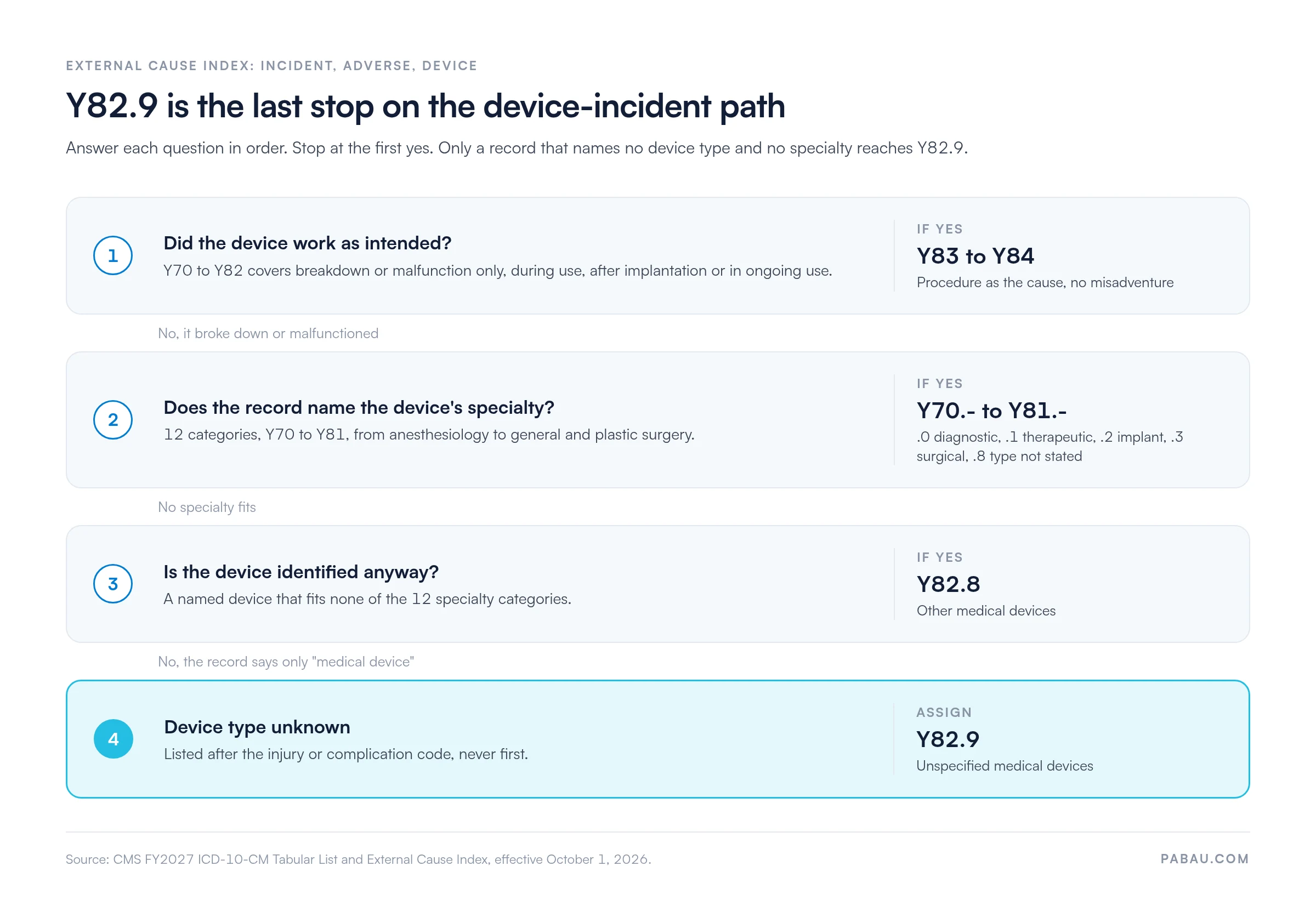
Y82 has only two codes, and they split on one question. Does the record name the device? If it does but no specialty fits, use Y82.8. If it doesn’t, use Y82.9.
Read the whole record before choosing. A device the progress note calls “the device” may be named in the operative report or the nursing notes. If any note identifies it, even loosely, map it to Y70 to Y81 or Y82.8 first.
Sequencing trips up more device claims than code choice does. Three questions settle it, and the FY2027 ICD-10-CM Official Guidelines answer all three.
Because reporting is voluntary in many settings, some practices skip Y-codes altogether. That’s allowed where no mandate applies. Check your payer contracts and state rules once, then write the answer into your coding policy so every coder handles it the same way.
An unspecified code is legitimate when the record holds no more detail. Guideline I.B.18 says to report the unspecified code when it most accurately reflects what’s known at that encounter. The record still has to show the device failed and how that links to the condition.
If one note says a device failed and another names it, query the provider rather than defaulting to Y82.9. Keeping that query trail is part of medical billing compliance, and it answers an auditor’s first question.
Track Y82.9 use by provider over a quarter. If one provider accounts for most of it, the fix usually sits in how their notes describe devices. A short session on naming the device in the note clears it faster than correcting claims one by one.
Each of these is a coding rule, so the fix belongs in your process rather than in a resubmission. Steady denial management workflows separate a one-off error from a pattern. When a payer does deny, our guide to medical billing denial codes explains the reason codes.
If you’re reconciling legacy records, you won’t find an ICD-9-CM predecessor. In CMS’s 2018 GEMs files, Y82.9 carries a no-map flag.
The old device and procedure E-codes went elsewhere. The same files map E878.9 to Y83.9 and Y84.9, and E879.8 to Y84.8. A legacy record coded E878 or E879 lands in Y83 to Y84, so don’t back-fill it with Y82.9.
Each family below answers a different question about the same event. Most confusion comes from mixing up the condition and its cause.
The T82 to T85 pairing deserves a closer look. The T80-T88 block tells coders to add a code from Y62-Y82 to identify the device and the circumstances. So the T-code goes first, and Y82.9 follows only when the device type is unknown.
Device incidents rarely arrive tidy. The device name sits in one note, the complication in another, and the claim waits while someone matches them up.
Pabau, a practice management platform with built-in billing, builds the claim from the patient record. Its ICD-10-CM lookup sits inside the claim form, so coders can search Y82.8 and Y82.9 without leaving it. The claim won’t send until required fields, such as membership numbers and authorization codes, are complete.
In the US, claims go through Claim.MD with real-time eligibility checks, claim-status tracking and ERA posting. Pabau’s cleaner claims management keeps the coding, the submission and the remittance on the same patient record.

Pabau fills each claim from the patient record, puts an ICD-10-CM lookup inside the claim form and holds the claim until required fields are complete.

Every Y82.9 on a claim says the record never named the device. One now and then is normal. A steady stream means device details are getting lost before the coder sees them, and that’s a documentation fix.
So keep the order tight. Confirm the failure, check the specialty, try Y82.8, and only then assign Y82.9 behind the condition code. Book a demo to see how Pabau keeps device codes, claims and remittances on one patient record.

Need a full reference on claim rejection codes? Medical billing denial codes provides a complete guide to CARC and RARC reason codes used by payers.
Want to understand the clearinghouse submission process? Medical claims clearinghouse guide explains how claims travel from EHR to payer and where Y-code errors are most likely caught.
Looking for clean-claim best practices? Submitting a clean claim outlines the documentation and coding requirements that prevent first-pass rejections.
Yes. Y82.9 is a valid, billable ICD-10-CM code for HIPAA-covered transactions. It can only be reported as an additional code, after the condition it explains.
Y82.8 covers other specified medical devices, and Y82.9 covers unspecified devices. Use Y82.8 when the device is known but fits no Y70 to Y81 category. Use Y82.9 when the record doesn’t identify it.
Check Y74 first. The External Cause Index sends personal-use devices to Y74, general hospital and personal-use devices, with Y74.8 as the default. Y82.9 applies only when the device type is unknown.
Yes, where the rules apply, because coding and safety reporting are separate. ICD-10-CM codes go on the claim and record. Device problems go to the FDA through MedWatch, and hospitals and other user facilities have mandatory reporting duties.
None. CMS’s 2018 General Equivalence Mappings give Y82.9 no ICD-9-CM equivalent. Legacy E878 and E879 codes map to Y83 and Y84 instead.