ICD-10 Code Y74.2: General hospital and personal-use implant failure
ICD-10 code Y74.2: Definition, descriptor, and billable status ICD-10 code Y74.2...

Last Updated: Oct 29, 2026
Billable Code Specific Code
X95.02XS is the billable ICD-10-CM code for assault by paintball gun discharge, sequela. It applies when a visit treats a late effect, such as a scar or chronic pain, after the original paintball injury has healed.
The 7th character records the encounter. X95.02XA covers the initial encounter, X95.02XD covers follow-up during healing, and X95.02XS covers late effects only. A mismatched 7th character can trigger a claim denial.
Let Pabau's smart automation suggest the right codes, reduce claim denials, and keep your practice compliant—effortlessly.
Automate repetitive tasks and focus on what matters most—your patients.
Reduce coding errors and ensure compliance with the latest regulations.
Clean claims, fewer denials, and faster reimbursements.
Powerful insights and reporting to help your practice thrive.
HIPAA compliant SOC 2 certified GDPR-compliant Trusted by 4,000+ clinics worldwide

X95.02XS is a billable ICD-10-CM code for the sequela of a paintball gun assault.
The 7th character S applies only when the encounter treats a residual late effect, not an active or healing injury.
X95.02XS is an external cause code and is never sequenced as the principal diagnosis on a claim.
Pabau, the practice management platform we build, checks every claim for missing or invalid details before it reaches the payer.
ICD-10 code X95.02XS is the billable ICD-10-CM code for assault by paintball gun discharge, sequela.
You report it as a secondary code when a visit treats a late effect of a healed paintball assault injury. Typical late effects are a scar or chronic pain. The current CMS tabular list confirms it is valid on professional and facility claims.
Pabau’s claims management software checks each claim for missing or invalid details before submission. That catches a dropped placeholder X or a missing principal diagnosis before the payer sees it.
X95.02XS covers encounters where the provider treats a residual condition left by a prior assault with a paintball gun, a gas-operated nonpowder gun. The code applies after the original injury has left active treatment. The patient returns with a late effect, such as chronic pain, scarring, or nerve damage, caused by the original assault.
Two conditions must both be met for this code to apply. The injury mechanism must be a paintball gun, classified under X95.0 as a gas, air, or spring-operated gun rather than a powder firearm. The intent must be assault, meaning another person deliberately fired the gun at the patient.
The 7th character S marks a sequela encounter, defined in OGCR Section I.C.19.a. It is a visit for a residual condition caused by a previous injury, once the acute treatment phase has ended. The character has to match what the provider documented about the original injury.
The three 7th characters for the X95.02X family each describe a distinct point in the patient’s care. According to the CMS ICD-10-CM guidelines, A applies to the initial encounter and D to subsequent encounters during healing. S applies only once the original condition has resolved and the patient is treated for a lingering effect of it.
A practical decision rule is to ask whether the provider’s note says the original paintball injury has healed. If it has, and the visit addresses something it left behind, use S. Scar revision, chronic pain management, and nerve hypersensitivity all qualify. If the original injury is still being managed, use A for active care or D for routine care.
X95.02XA, X95.02XD, and X95.02XS describe the same assault at three different points in care. A mismatched 7th character can trigger a denial, so confirm the encounter type in the note before you pick one.
X95.02XS sits at the most specific level of a six-tier hierarchy within ICD-10-CM Chapter 20. Knowing the hierarchy helps coders navigate to the correct code and read the exclusion notes that apply at each level.
The placeholder X at position 6 is mandatory. Submitting “X95.02S” without it makes the code invalid, and the claim fails front-end edits at the clearinghouse. Verify the full seven-character string against the CDC/NCHS ICD-10-CM web tool before submitting any claim in this code family.
Sibling codes such as X95.01XS and X95.09XS sit in the same subcategory. You can compare them side by side in our diagnostic codes library.
X95.02XS is an external cause code, so it is always paired with the code for the sequela condition itself. That condition is sequenced first as the principal diagnosis. Under OGCR Section I.C.20.a, external cause codes are supplementary and never lead a claim.
Additional codes complete the external cause picture: place of occurrence (Y92), activity (Y93), and external cause status (Y99). Report them when the information is documented and when the payer or state requires them. OGCR sets no national requirement for external cause reporting, so check each payer’s rules.
Several neighboring codes share enough with X95.02XS that coders pick the wrong one without realizing it. The table below lists the most frequent substitutions and what separates each from X95.02XS.
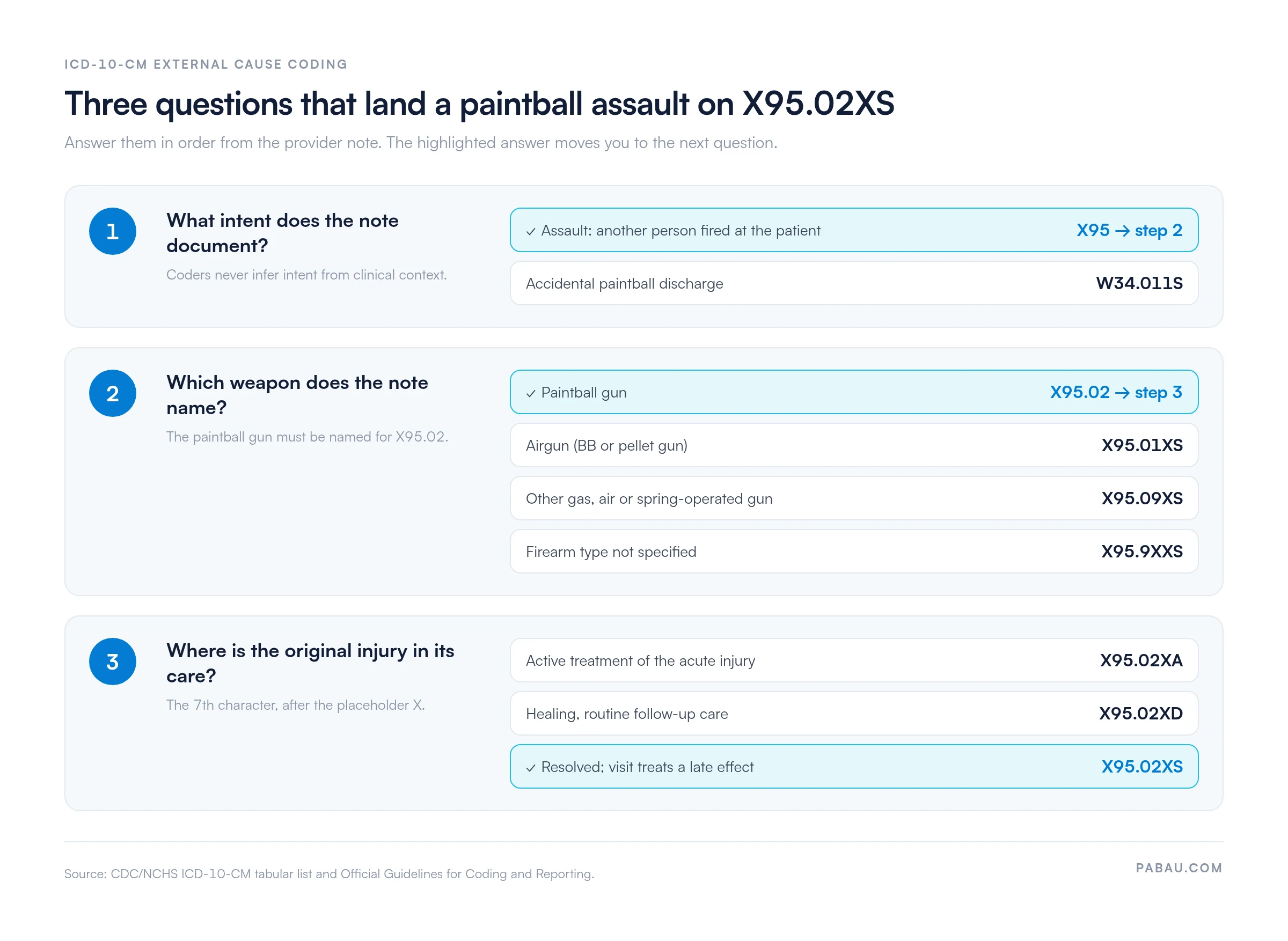
X95.02XS carries three documentation requirements, and all three must be met before a coder assigns it. Missing any one can lead to a denial or an audit flag. A solid medical billing workflow builds these checks into pre-submission review rather than catching them at the denial stage.
The flow below runs those three checks in order and shows where each other answer sends the code.
Assault codes carry third-party liability implications. Some payers therefore ask for a more detailed documentation trail than they would for accidental injuries. Keeping up with medical billing compliance requirements helps keep that trail audit-ready.
Assault codes activate coordination of benefits (COB) rules at many commercial payers, because the payer may seek reimbursement from a liable third party. When X95.02XS appears on a claim, expect requests for accident questionnaires and records establishing the assault circumstances. Pabau’s Claim.MD clearinghouse integration checks patient eligibility in real time, so coverage is confirmed before the visit.
Medicare and Medicaid follow OGCR sequencing rules strictly. External cause codes, X95.02XS included, are supplementary and never appear in the principal diagnosis field. Medicare’s coverage policies, contractor LCDs and national NCDs, reference the underlying sequela condition rather than the external cause code. Cross-reference the sequela diagnosis with any applicable LCD before submitting.
Review electronic remittance advice from earlier claims in this code family to spot payer-specific edit patterns before you submit new ones.
Flag every assault code claim for a pre-submission COB review. Ask the patient at intake whether any third-party liability insurance applies to the injury. Record the answer in the chart before the claim goes out. An unanticipated COB request can hold up payment on an assault claim while the payer looks into liability.
Denials for ICD-10 code X95.02XS trace back to a consistent set of root causes. Strong denial management in healthcare means spotting these triggers before the claim is submitted rather than after the denial arrives.
Feed denial data into the practice’s broader revenue cycle management review at least monthly. That shows whether a denial type keeps recurring, so the team can fix it at the workflow level rather than case by case. The Check ICD-10 database helps confirm code validity and flags OGCR updates that affect the X95 family.
Many billing teams only spot a wrong 7th character or a missing placeholder X when a claim bounces back. Someone then pulls the chart, corrects the code, and resubmits while the payment waits.
Pabau moves those checks ahead of submission. Its claim validation scrubs every claim for missing or invalid details before it leaves Pabau, so each fix takes seconds. Claims go out as electronic CMS-1500s through Claim.MD, and electronic remittance advice comes back into the same billing workflow.
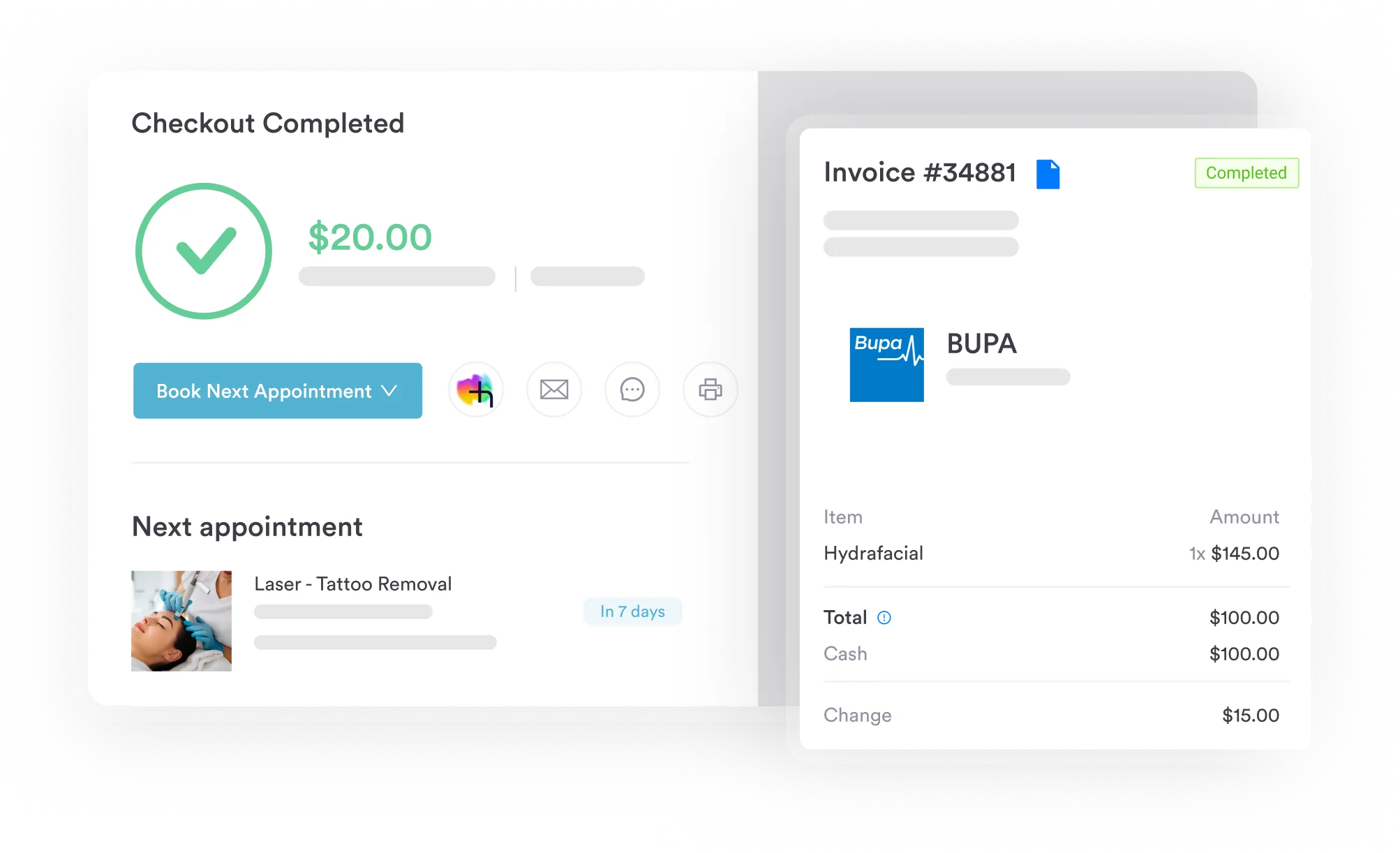
For an assault sequela claim, the client card holds each patient’s insurer and policy details, and eligibility is checked before the visit. The COB question gets answered at intake, and coding errors get fixed before a payer ever sees them.

Pabau’s claim validation checks every claim for missing or invalid details before it leaves, and Claim.MD checks patient eligibility in real time. Your billing team spends less time reworking bounced claims.

Code X95.02XS only when the note settles three facts: assault intent, a named paintball gun, and a healed injury that left a lasting effect. If one of them is missing, query the provider before you pick a code. A short query costs far less than reworking a denied claim.
Remember that the external cause code never carries the claim on its own. Coverage policies look at the sequela condition, so code that condition first and code it precisely.
If first-pass acceptance is the goal, start with what a clean claim needs. Then book a demo to see how Pabau checks external cause claims before they reach the payer.

Need to understand how claim denials are managed systematically? Denial management in healthcare covers root cause analysis, appeal workflows, and denial prevention frameworks for practice billing teams.
Want guidance on clean claim submission for external cause codes? Medical claims clearinghouse overview explains how clearinghouse edits catch coding errors before claims reach the payer.
Looking for ICD-10 coding compliance resources? Medical billing compliance outlines the documentation and audit trail requirements that support external cause code assignment.
ICD-10 Code X95.02XS is the billable ICD-10-CM code for assault by paintball gun discharge, sequela. It identifies encounters that treat a residual late effect of a prior paintball gun assault after the original injury has resolved. It belongs to Chapter 20 (External causes of morbidity). It is always reported as a secondary code, after the sequela condition that is the principal diagnosis.
Yes, X95.02XS is a billable ICD-10-CM code valid for claim submission, confirmed in the current CMS tabular list. It must be reported as a secondary code, never as the principal diagnosis, because external cause codes are supplementary under OGCR Section I.C.20.a.
X95.02XA applies to the initial encounter, when active treatment is being rendered for the acute assault injury. X95.02XD applies to subsequent encounters during the healing phase. X95.02XS applies only once the original injury has resolved. The visit then addresses a residual late effect of the assault, such as chronic pain or scarring.
A subsequent encounter (7th character D) is a visit during the healing phase, when the patient is recovering but not yet fully healed. A sequela (7th character S) is a visit for a residual condition that persists after the original injury has completely resolved. The key distinction is whether the original injury is still healing or has closed out.
Three elements must appear in the provider note. The first is explicit documentation of assault intent, not accidental discharge. The second is a paintball gun named as the weapon. The third is a statement that the original injury has resolved and this encounter treats a sequela. Missing any of the three can lead to a denial or an audit flag.
Common denial causes include a wrong 7th character, such as XA or XD submitted when XS applies, or X95.02XS placed in the principal diagnosis field. Others are missing Y92, Y93 or Y99 codes where the payer requires them, and assault intent the provider never documented. Omitting the placeholder X, or an unanticipated coordination of benefits request, can also stop the claim.
Report the sequela condition code first as the principal diagnosis, such as a scar, chronic pain, or musculoskeletal condition caused by the assault. X95.02XS follows as the external cause code, per OGCR Section I.C.20.a. Y92 (place of occurrence), Y93 (activity), and Y99 (external cause status) are reported when documented and when the payer or state requires them.