ICD-10 Code S53.013D: Anterior subluxation of unspecified radial head
ICD-10 Code S53.013D: Quick reference summary Use the table below as your first ...

Last Updated: Nov 6, 2026
Billable Code Specific Code
X74.09XA is the billable ICD-10-CM code for intentional self-harm by other gas, air or spring-operated gun, initial encounter. It covers a self-inflicted injury from a gas-, air- or spring-powered gun that is neither an airgun (X74.01) nor a paintball gun (X74.02).
The weapon named in the clinical record decides the code. X74.09XA is an external cause code, so it is always reported after the injury code and never as the principal diagnosis.
Let Pabau's smart automation suggest the right codes, reduce claim denials, and keep your practice compliant—effortlessly.
Automate repetitive tasks and focus on what matters most—your patients.
Reduce coding errors and ensure compliance with the latest regulations.
Clean claims, fewer denials, and faster reimbursements.
Powerful insights and reporting to help your practice thrive.
HIPAA compliant SOC 2 certified GDPR-compliant Trusted by 4,000+ clinics worldwide

X74.09XA is billable for FY 2025 and FY 2026 as an external cause code, never as a principal diagnosis.
The ‘other’ qualifier separates X74.09 from X74.01 (airgun) and X74.02 (paintball gun), so the record must name the weapon type.
All three seventh characters are valid: A (initial encounter), D (subsequent encounter) and S (sequela).
Always sequence the injury code first, with X74.09XA following as the external cause of morbidity code.
ICD-10 Code X74.09XA is the billable external cause code for intentional self-harm by a gas, air or spring-operated gun, initial encounter.
It covers any such gun except an airgun (X74.01) or a paintball gun (X74.02), and it always follows the injury code.
Use this table to verify the code’s essential attributes before claim submission. All data reflects the CMS ICD-10-CM tabular list for FY 2025 and FY 2026.
X74.09XA captures intentional self-harm injuries caused by gas-, air-, or spring-powered guns that fall outside the two specifically named subcategories in the X74. group. The code applies when a patient presents with a self-inflicted wound from a device in this family. The record must show that the weapon is not an airgun (X74.01) or a paintball gun (X74.02). Practices that treat these injuries assign it while the patient is receiving active treatment.
The code is an external cause of morbidity code. Its role in a claim is to describe the mechanism and intent behind an injury, not to classify the injury itself. A coder never assigns X74.09XA as the first-listed or principal diagnosis. The injury (for example, a puncture wound of the forearm or thorax) is coded with the appropriate S-code first.
Clinical scenarios that trigger this code include self-inflicted wounds from CO2-powered devices, spring-loaded airsoft guns and gas-operated airsoft rifles. Similar devices qualify when they are neither standard airguns nor paintball guns. If the weapon type is unclear from the record, coders should query the provider before assigning X74.09XA.
X74.09XA sits at the bottom of the CMS ICD-10-CM tabular hierarchy, below five non-billable levels. Submitting any of those parent codes gets the claim rejected. Our ICD-10-CM code library lists the neighboring codes at each level.
The “X” at position six is a placeholder character. ICD-10-CM requires it so the seventh character lands in the seventh position. It carries no clinical meaning.
X74.09 requires a seventh character at every encounter. The character identifies the phase of treatment, not the nature of the injury. The ICD-10-CM Official Guidelines for Coding and Reporting cover this in Section I.C.20. The external cause code takes the same seventh character as the principal injury code for that encounter. That rule runs through the whole self-harm block. At a sequela visit after a patient deliberately drove into a tree, the external cause code is ICD-10-CM code X82.2XXS.
A common error is using X74.09XA at a follow-up wound check. Once active treatment is complete, the encounter shifts to “D”. Mismatching the seventh character between the injury code and the external cause code triggers an edit that rejects the claim.
All three codes live under subcategory X74.0. The weapon type documented in the clinical record decides between them, never clinical inference. Each sibling takes the same seventh characters, so a late effect of a BB gun injury is coded X74.01XS.
When the record describes only “an air-powered gun” without naming the specific type, X74.09XA is the appropriate fallback within this subcategory. Query the provider where you can, because X74.01XA or X74.02XA may be more precise once clarified. The decision path below runs in the order a coder checks: intent, then the gun, then the encounter.
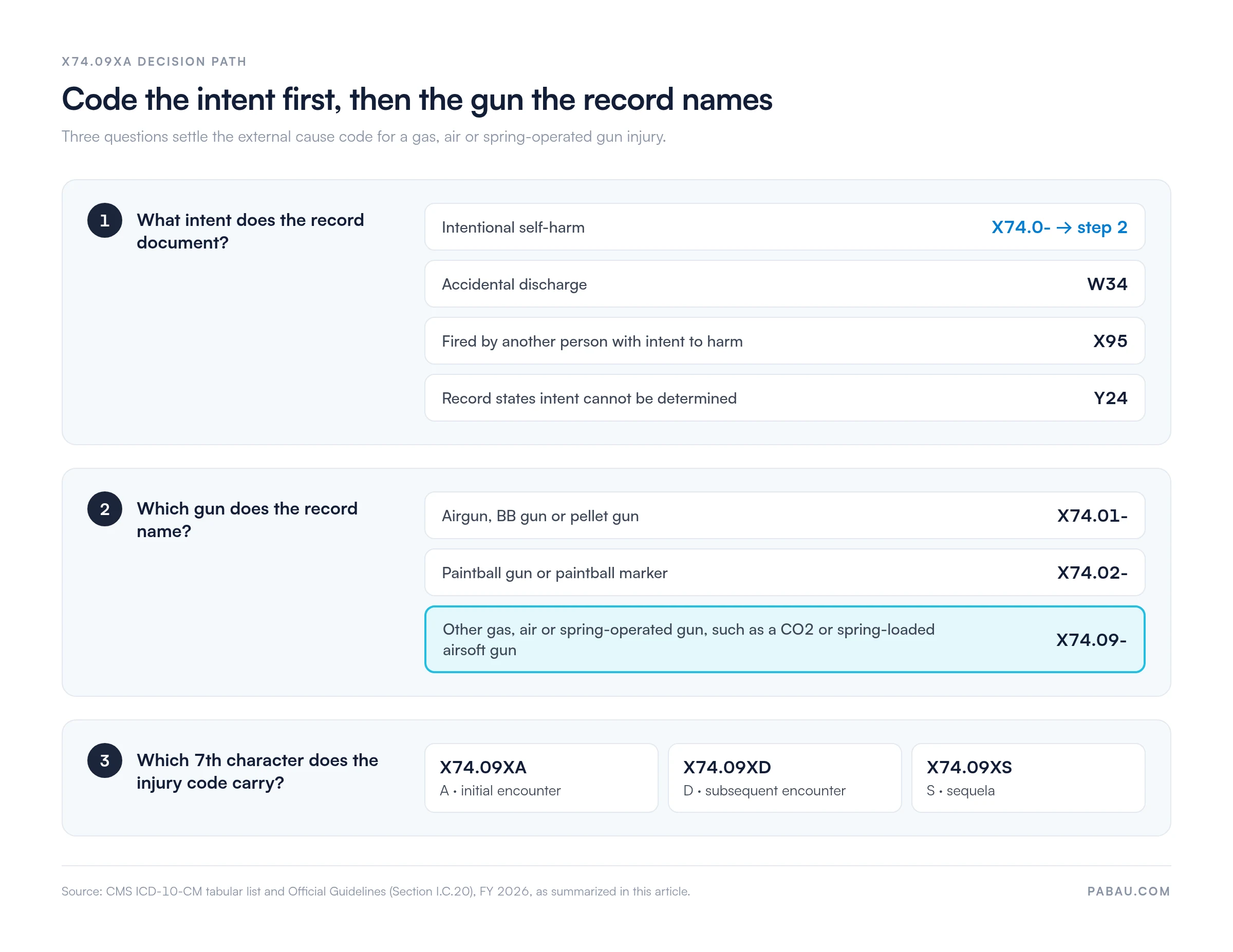
The X74 category does not carry its own Excludes1 or Excludes2 notes in the FY 2025/2026 tabular. Four Chapter 20 rules still govern how ICD-10 Code X74.09XA is reported.
Flag cases where clinical documentation states ‘self-inflicted’ but does not confirm intent. Under ICD-10-CM guidelines, unknown intent is coded as accidental. Y24 (other and unspecified firearm discharge, undetermined intent) applies only when the record states that intent cannot be determined. Examples are Y24.0 for an airgun and Y24.8 for other firearms such as a paintball gun. Defaulting to X74.09XA when intent is undocumented creates a compliance risk.
Correct sequencing is a clean-claim prerequisite. In Pabau, the practice management and billing platform we build, claim validation scrubs claims for missing or invalid details before they leave Pabau. Follow this four-step workflow for every encounter.
Some state Medicaid programs and commercial payers require external cause codes for injury encounters as a condition of payment. Medicare does not mandate them but strongly encourages their use for injury diagnosis reporting.
The denials that cluster around this code family are preventable. Most stem from sequencing errors, seventh character mismatches, or submitting a non-billable parent code. A structured denial management workflow catches these before they become write-offs.
The clinical record must support every element of the code before it is assigned. Claim validation in Pabau’s medical billing software flags missing or invalid claim details, but no software can add a weapon type the note never recorded. Thorough records also support medical billing compliance during an external cause coding audit.
Four documentation elements are required to support X74.09XA:
When documentation supports a self-harm injury but the weapon type is vague, do not default to X74.09XA without a provider query. A brief clarification note asking ‘Was the device an airgun, paintball gun, or another type of gas or air-powered device?’ takes under a minute and prevents a claim denial or an audit flag.
Without a check before submission, a missing detail on an injury claim surfaces only when the payer rejects it. The coder then corrects the claim and resubmits it, and payment waits another cycle.
In Pabau, each claim is raised from the patient’s invoice, so patient and insurer details carry over without re-keying. Claim validation scrubs the claim for missing or invalid details before it leaves Pabau. US practices then submit CMS-1500 claims through Claim.MD.
If a claim still comes back rejected, Pabau flags it Needs action and shows the reason. Your team fixes it from the claims dashboard, which tracks each claim from Pending to Paid.

Pabau’s claim validation scrubs claims for missing or invalid details before they leave Pabau. A rejected claim is flagged with its reason, so your team can fix it fast.

X74.09XA is only as defensible as the note behind it. When the record states the intent, names the gun and supports the encounter type, the code choice takes seconds and holds up in an audit.
The trade-off sits at the front end. A one-line provider query about the weapon or the intent costs a minute, while a rejected claim costs a full resubmission cycle. Ask the question before you code.
Pabau’s claim validation scrubs claims for missing or invalid details before they leave Pabau. To see how that works on injury claims that carry external cause codes, book a demo with the team.

Need the full picture on medical billing for injury claims? What is medical billing covers the end-to-end revenue cycle workflow from coding through payment posting.
Handling a high volume of denied claims? Denial management in healthcare explains how to build a structured appeals and prevention process that reduces write-offs.
Decoding a rejection on an injury claim? Denial codes in medical billing walks through the top 20 CARC codes and how to fix each one.
Want to catch claim errors before payer submission? Claim.MD clearinghouse review explains what the clearinghouse does and how claims move through it to the payer.
ICD-10 Code X74.09XA is the billable external cause code for intentional self-harm by other gas, air or spring-operated gun at an initial encounter. It belongs to Chapter 20 of ICD-10-CM and must always be sequenced as a secondary code alongside a principal injury S-code from Chapter 19. It covers gas-, air-, and spring-powered devices that are not classified as airguns (X74.01) or paintball guns (X74.02).
Yes, X74.09XA is a billable ICD-10-CM code, valid from FY 2016 through FY 2026. Its parent codes (X74, X74.0, and X74.09) are non-billable header codes and must never be submitted on a claim without the seventh character.
The seventh character “A” designates an initial encounter, meaning the patient is receiving active treatment for the injury. The three valid seventh characters for X74.09 are A (initial encounter), D (subsequent encounter), and S (sequela). The character on the external cause code must match the character on the paired injury code at every encounter.
X74.01 covers intentional self-harm by airgun (BB gun, pellet rifle), and X74.02 covers intentional self-harm by paintball gun. X74.09 covers every other gas-, air-, or spring-operated gun. The weapon type documented in the clinical record determines which code applies.
Yes. X74.09XA is an external cause code and can never be listed as the principal (first-listed) diagnosis. The claim must include a principal injury code from Chapter 19 (S00-T88) describing the physical injury. X74.09XA is sequenced immediately after the injury code to explain its mechanism and intent.
Use X74.09XD for a subsequent encounter, not X74.09XA. Subsequent encounters cover routine follow-up care after active treatment has ended, such as wound checks, suture removal, or physical therapy visits. Confirm that the paired injury S-code also uses the “D” seventh character to avoid a sequencing edit.