ICD-10 Code S42.444P: Medial epicondyle fracture, right humerus
ICD-10 Code S42.444P: full descriptor and code validity ICD-10 Code S42.444P car...

Last Updated: Oct 13, 2026
Billable Code Specific Code
X78.1XXD is the billable ICD-10-CM code for intentional self-harm by knife, subsequent encounter. It tells the payer how a wound happened when the patient returns after active treatment ends, for a wound check, suture removal or dressing change. It never stands alone or first on a claim.
The injury code leads, also ending in D, and X78.1XXD follows it. Getting that order and the 7th character right keeps a sensitive claim from coming back for rework. Below, you'll find the sequencing rules, a worked example, the documentation coders need and a checklist to run before you submit.
Let Pabau's smart automation suggest the right codes, reduce claim denials, and keep your practice compliant—effortlessly.
Automate repetitive tasks and focus on what matters most—your patients.
Reduce coding errors and ensure compliance with the latest regulations.
Clean claims, fewer denials, and faster reimbursements.
Powerful insights and reporting to help your practice thrive.
HIPAA compliant SOC 2 certified GDPR-compliant Trusted by 4,000+ clinics worldwide

X78.1XXD codes intentional self-harm by knife at a subsequent encounter, after active treatment ends and while the wound heals.
It’s an external cause code, so it never goes first. The injury code ending in D leads the claim.
Using A instead of D on a follow-up visit is a common denial trigger, so check the note for treatment status.
Y92, Y93 and Y99 codes are reported once, at the initial encounter, and left off follow-up claims.
Claims software such as Pabau pre-fills the claim from the patient record and checks required fields before sending.
ICD-10 code X78.1XXD is a valid, billable ICD-10-CM external cause code. It reports intentional self-harm by knife at a subsequent encounter. In plain terms, the patient is back for routine care while the wound heals, after active treatment has ended.
The code sits in Chapter 20, under category X78 for self-harm by a sharp object. It’s current for FY 2027, which runs from October 1, 2026 to September 30, 2027. You can check the descriptor in the CDC/NCHS ICD-10-CM coding tool.
The 7th character tells the payer where the patient is in their care for the injury. Under the ICD-10-CM Official Guidelines, A covers active treatment. That includes surgical treatment, emergency department care, evaluation and continuing treatment.
D covers care during the healing or recovery phase, once active treatment is complete. Typical D visits are wound checks, suture or staple removal and dressing changes. S is for sequelae, meaning late effects such as a scar that needs treatment.
So the cut-off isn’t the first wound closure or the discharge date. It’s the point where the provider stops treating the injury and starts monitoring how it heals. A follow-up visit can still take A if the provider is still actively treating the injury.
All three codes share the same mechanism. Only the 7th character changes, and payers compare it with the dates and notes on file.
The diagram below turns the choice into two questions you can answer from the provider’s note.
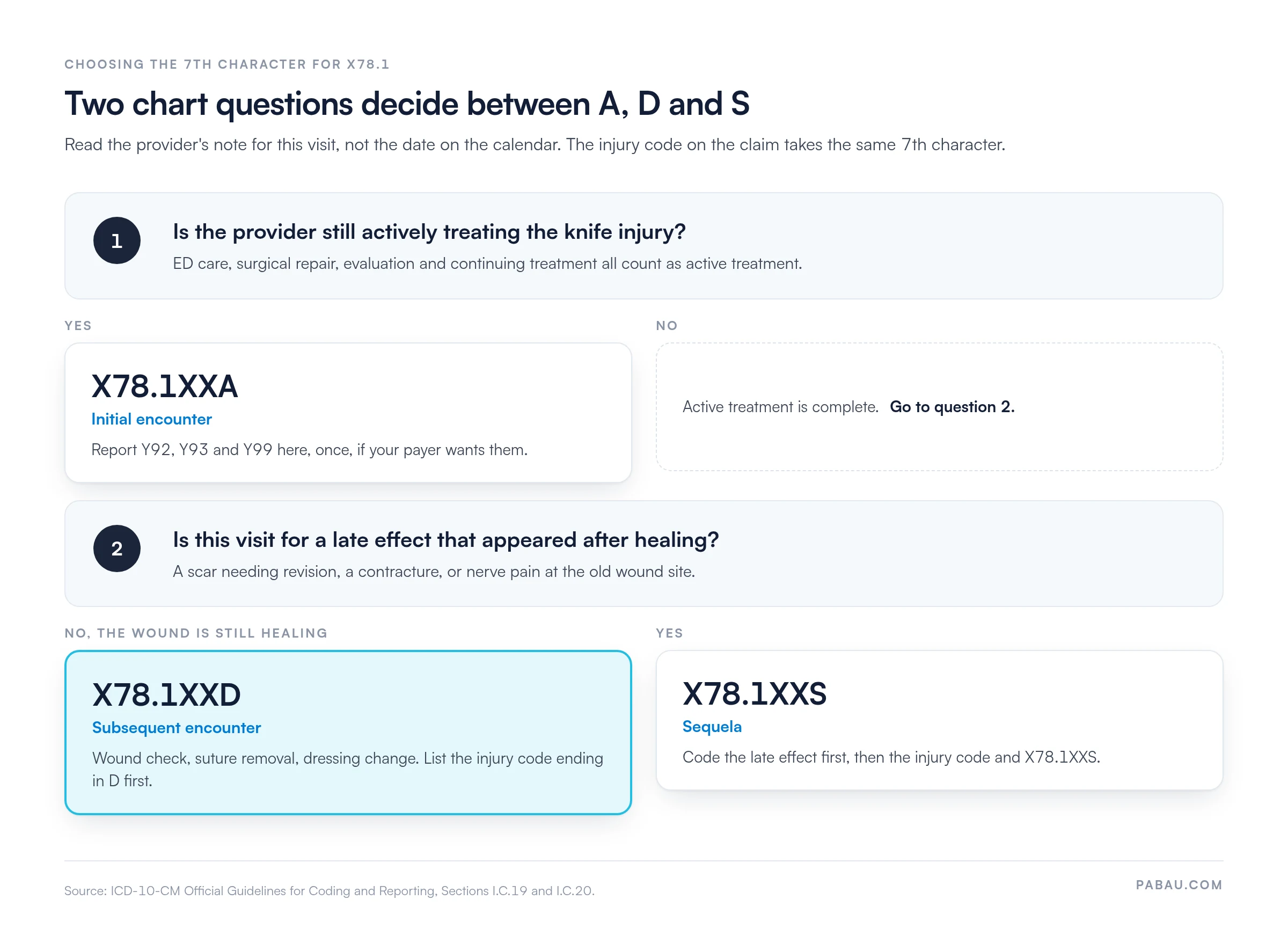
A quick test helps. If the note describes healing in progress, D applies. If healing is finished and a new problem from the injury is being treated, S applies.
Note in the chart when active treatment for the self-harm injury ended. At each follow-up, read today’s note against it. If the provider is checking healing rather than treating, the 7th character is D. Build this into intake, so coders don’t work from memory.
Subcategory X78.1 isolates a knife within the wider X78 sharp-object family. A note that only says “sharp object” can’t support it, so the coder needs the instrument named.
X78.1XXD doesn’t separate non-suicidal self-injury from a suicide attempt. That distinction rests on the provider’s documented assessment of intent. The code itself captures only the mechanism and the encounter type. If the note is unclear, code what the provider states and nothing more.
External cause codes from Chapter 20 are never the first-listed diagnosis. Section I.C.20 of the Official Guidelines uses them to explain how an injury happened. So X78.1XXD always follows the injury code it describes.
In most medical billing workflows, a follow-up claim lines up like this:
Y92, Y93 and Y99 are reported only at the initial encounter, so omit them at follow-up visits.
A patient returns 10 days after a self-inflicted knife cut to the right index finger. The ED repaired it, and today’s visit is a wound check and suture removal. The provider notes that the wound is healing well and records the injury as intentional self-harm.
The coder lists S61.210D first, since the wound is on the right index finger. X78.1XXD follows it. No Y92, Y93 or Y99 code goes on this claim, because those belonged to the initial encounter.
Now suppose the patient returns months later for a painful scar on the healed finger. The scar code goes first, followed by S61.210S and X78.1XXS. A healed wound with a late effect takes the S character instead.
A visit only for depression, with the wound already healed, works differently. No injury is being treated, so X78.1XXD has nothing to explain. Code the mental health diagnosis, and add Z91.51 or Z91.52 if the provider documents the history.
The clinical record has to support every part of the code. Thin documentation can cause denials just as easily as a wrong 7th character. For medical billing compliance, check that the note covers these points before the code goes out.
X78.1XXD can’t stand alone, so it always appears with other codes. The table shows the ones that commonly sit beside it on a follow-up claim.
Z91.51 and Z91.52 need explicit documentation. Pick the one that matches how the provider describes the episode. Never infer intent from the mechanism alone.
Several nearby codes cause audit trouble. The AAPC Codify ICD-10-CM lookup helps coders confirm exact descriptors before assigning one.
External cause codes aren’t mandated by every payer. Requirements depend on your state and on who pays the claim, so check before you bill.
Practices that submit through Claim.MD can send claims electronically, check eligibility and track claim status, so errors surface sooner. When submitting a clean claim, confirm whether your payer requires this external cause code for each self-harm encounter.
A follow-up claim passes through five steps before it’s paid. Each step has its own way of going wrong.
Self-harm external cause codes can cause denials when nobody checks the 7th character against the chart. Good denial management workflows for these claims start with the edits that trigger on X78.1XXD.
For a wider view, a guide to medical billing denial codes maps each payer reason to a fix. Your denial reports then show which patterns recur for your payer mix and specialty.
Each quarter, pull X78.1XXA claims billed well after the original encounter. Check each chart for whether active treatment had ended by that visit. Where it had, rebill with D and a note citing the date treatment ended.
In many practices, a follow-up claim is still put together by hand. Someone re-keys the patient’s details, looks up the codes and hopes no required field is blank. A missing authorization number sends the claim back, however well the 7th character was chosen.
Pabau, the practice management platform we build, starts the claim from the patient record instead. Its cleaner claims management pre-fills the claim and offers ICD-10-CM code lookup libraries. It also checks that claim-required fields are complete before the claim can be sent.
US practices submit through Claim.MD, with eligibility checks and claim tracking built in. Your coder still chooses the 7th character. Pabau makes sure the claim around that decision is complete, so fewer claims come back for rework.
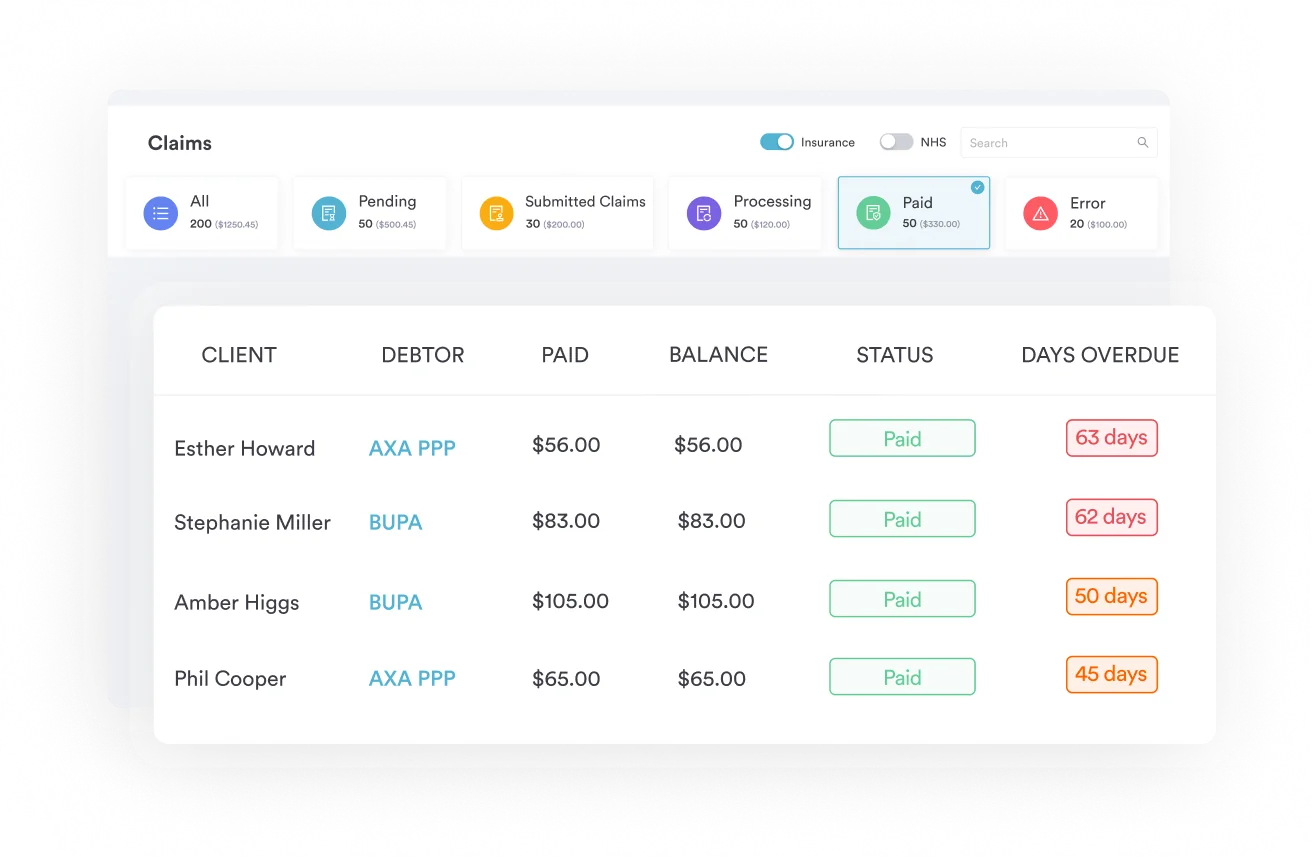

Pabau pre-fills each claim from the patient record and checks required fields before it’s sent. US practices submit through Claim.MD, with eligibility checks and claim tracking.

X78.1XXD rewards coders who read the note before the calendar. When the provider is checking a healing knife wound, D applies and the injury code leads. When they’re treating what the wound left behind, both codes switch to S.
The cost is a few minutes of chart review per claim, which is less than a rebill takes. If the note doesn’t say whether active treatment has ended, query the provider before the claim goes out.
Book a demo to see how Pabau pre-fills follow-up claims from the patient record, so your team spends less time on rework.

Need a reference for denial code meanings? Denial codes in medical billing explains the most common CARC and RARC codes and how to respond to each.
Want to understand the clearinghouse process for behavioral health claims? Medical claims clearinghouse guide covers how electronic claim routing works between practice and payer.
Looking for a guide to the broader billing compliance framework? What is revenue cycle management explains the end-to-end billing workflow from encounter to payment posting.
Yes. X78.1XXD is a valid, billable ICD-10-CM code for FY 2027, which runs from October 1, 2026 to September 30, 2027. It’s reported as a secondary code, never first-listed.
In ICD-9-CM, self-inflicted injury by a cutting or piercing instrument was E956. ICD-10-CM splits that into X78.0 to X78.9 by instrument, with a 7th character for the encounter.
No. It captures the mechanism and the encounter type, not intent. The provider’s documentation decides whether the episode was a suicide attempt or non-suicidal self-injury. If the injury is known, code the injury plus X78.1XXD. T14.91XD applies only when the injury type is unspecified.
There is no national CMS requirement to report external cause codes. Reporting is mandatory only where a state or a payer requires it, so check your payer’s rules. Some commercial payers and behavioral health carve-outs do require them.
No. External cause codes such as X78.1XXD don’t map to CMS-HCC categories. Any risk adjustment comes from the other diagnoses on the claim.